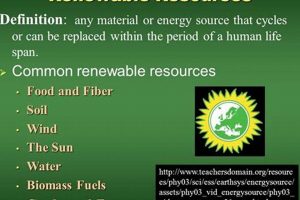
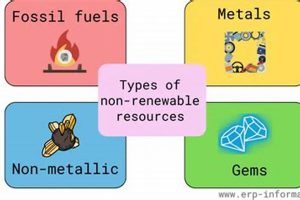
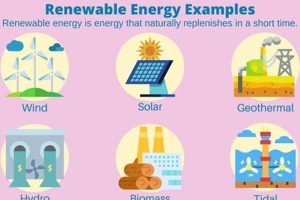
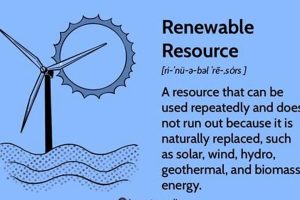
Earth’s resources are broadly categorized by their ability to be replenished within a human timescale. One category encompasses sources that regenerate naturally and continuously. These include solar energy, harnessed via photovoltaic cells or concentrated solar power; wind power, converted to electricity using turbines; hydroelectric power, derived from flowing water; geothermal energy, sourced from the Earth’s internal heat; and biomass, organic matter used for fuel. Contrastingly, the other category includes sources existing in finite quantities, formed over millions of years. Fossil fuels, such as coal, petroleum (crude oil), and natural gas, fall into this classification. Nuclear fuels, like uranium, utilized in nuclear power plants, are also considered non-renewable.
The utilization of resources has a profound impact on environmental sustainability and long-term energy security. Reliance on regenerative sources promotes cleaner energy production, reduces greenhouse gas emissions, and mitigates climate change. Furthermore, these sources are inherently domestic, reducing dependence on foreign energy markets. The consumption of finite sources, while historically crucial for industrial development, contributes to air and water pollution, habitat destruction, and geopolitical instability due to uneven distribution and resource scarcity.
Understanding the distinctions between these types of resources is critical for informed decision-making regarding energy policy, technological innovation, and responsible environmental stewardship. Examining the practical applications, economic viability, and environmental consequences of each type can assist in charting a course toward a more sustainable future.
Resource Management Tips
Effective resource management requires careful consideration of the available options and their long-term impacts. Prudent strategies can ensure both economic prosperity and environmental responsibility.
Tip 1: Prioritize Renewable Energy Investments: Governments and private sectors should direct funding towards research, development, and deployment of technologies that harness solar, wind, geothermal, and hydro power. This reduces reliance on fossil fuels and supports a transition to cleaner energy systems.
Tip 2: Enhance Energy Efficiency: Implement measures to reduce energy consumption in buildings, transportation, and industrial processes. Examples include improved insulation, efficient lighting, hybrid and electric vehicles, and optimized manufacturing techniques.
Tip 3: Promote Sustainable Consumption Patterns: Encourage consumers to make informed choices about their energy usage, transportation methods, and product purchases. This includes supporting products with lower environmental footprints and adopting more sustainable lifestyles.
Tip 4: Diversify Energy Sources: Avoid over-reliance on any single type of energy source. Diversification improves energy security and reduces vulnerability to price fluctuations and supply disruptions. A balanced portfolio that includes both regenerative and finite resources, managed responsibly, is crucial.
Tip 5: Implement Carbon Capture and Storage Technologies: For industries that continue to rely on fossil fuels, invest in carbon capture and storage (CCS) technologies. This process captures carbon dioxide emissions and stores them underground, preventing them from entering the atmosphere.
Tip 6: Develop Smart Grid Infrastructure: Modernize electrical grids with smart technologies that improve efficiency, reliability, and flexibility. Smart grids enable better integration of renewable energy sources and allow for real-time monitoring and control of energy flows.
Resource management hinges on making responsible choices today to ensure resource availability for future generations. A strategic approach encompassing technological innovation, policy changes, and individual responsibility is essential for sustainable development.
Implementing these suggestions can foster a balanced and sustainable approach to resource utilization.
1. Solar energy utilization

Solar energy utilization stands as a prime example of a renewable resource application, contrasting sharply with the depletion-based nature of finite reserves. Solar energy, derived from the sun’s radiant light and heat, is inexhaustible on a human timescale. Photovoltaic cells convert sunlight directly into electricity, while concentrated solar power plants use mirrors to focus sunlight and generate heat, subsequently driving turbines to produce electricity. This directly displaces reliance on non-renewable resources such as coal, natural gas, and oil, which are finite and contribute significantly to greenhouse gas emissions. Furthermore, the implementation of solar technologies, from residential rooftop panels to large-scale solar farms, reduces the environmental impact associated with resource extraction, transportation, and combustion inherent in fossil fuel-based energy systems. Real-world examples include the increasing adoption of solar power in sunny regions, such as California and the Middle East, where substantial investments are being made in solar infrastructure to reduce dependence on petroleum and other non-renewable resources.
The importance of solar energy extends beyond its renewable nature. Distributed generation through solar panels can enhance energy security by reducing reliance on centralized power grids and imported fuels. Solar energy also creates new economic opportunities in manufacturing, installation, and maintenance, contributing to job creation and economic growth. Governmental incentives, such as tax credits and feed-in tariffs, play a crucial role in promoting solar energy adoption by making it economically competitive with non-renewable alternatives. The development of advanced solar technologies, such as perovskite solar cells and improved energy storage solutions, promises to further enhance the efficiency and affordability of solar energy, accelerating its integration into the global energy mix. In regions like Germany, solar energy has become a significant contributor to the electricity supply, demonstrating the potential for wide-scale solar integration.
In summary, solar energy utilization exemplifies the principles of renewable resource management, offering a sustainable alternative to depleting non-renewable sources. While challenges remain in terms of energy storage and grid integration, the ongoing technological advancements and policy support are driving its continued growth. Understanding the practical significance of solar energy is crucial for transitioning towards a cleaner, more sustainable energy future and mitigating the environmental impacts associated with fossil fuel dependence. Therefore, continued innovation and strategic deployment of solar technologies are essential components of comprehensive energy strategies.
2. Fossil Fuel Dependence
Fossil fuel dependence represents a critical nexus in the discussion of resource management, intrinsically linking the consumption of non-renewable energy sources to the potential and necessity of renewable alternatives. The pervasive use of coal, oil, and natural gas as primary energy sources highlights both the historical reliance on finite resources and the urgent need for transition to more sustainable options.
- Historical Energy Infrastructure and Economic Development
The development of global energy infrastructure has historically been intertwined with the availability and affordability of fossil fuels. Industrialized nations built their economies upon the accessibility of these resources, creating deeply entrenched systems for extraction, processing, and distribution. The economic advantages derived from fossil fuels, particularly during the 20th century, established a path-dependent trajectory that continues to shape energy policies and investments today. For example, the expansion of coal-fired power plants in developing countries underscores the ongoing influence of historical infrastructure and economic factors in perpetuating fossil fuel dependence.
- Environmental Degradation and Climate Change
The combustion of fossil fuels releases significant quantities of greenhouse gases, primarily carbon dioxide, into the atmosphere, contributing to climate change and its associated environmental consequences. Air and water pollution resulting from fossil fuel extraction and processing further exacerbate environmental degradation. For instance, oil spills from offshore drilling and coal ash contamination of waterways illustrate the detrimental environmental impacts of fossil fuel dependence. These environmental costs necessitate a critical evaluation of the long-term sustainability of relying on these non-renewable sources.
- Geopolitical Implications and Resource Security
Uneven distribution of fossil fuel reserves creates geopolitical dependencies, where nations reliant on imports are vulnerable to supply disruptions and price volatility. Resource-rich countries exert considerable influence in global affairs, often leading to political tensions and conflicts. The dependence on imported oil in many industrialized nations highlights the geopolitical risks associated with finite energy sources. Diversifying energy sources and fostering domestic renewable energy production can enhance energy security and reduce vulnerability to external pressures.
- Technological Transition and Renewable Energy Adoption
Overcoming fossil fuel dependence requires a comprehensive transition towards renewable energy sources and the development of innovative technologies. Solar, wind, geothermal, and hydro power offer viable alternatives, but their widespread adoption necessitates significant investments in infrastructure, research, and policy support. The growth of electric vehicle markets and the increasing efficiency of renewable energy systems demonstrate the potential for technological advancements to drive the energy transition. Strategic policies that incentivize renewable energy adoption and discourage fossil fuel consumption are essential for accelerating this transition.
The multifaceted consequences of fossil fuel dependence encompassing economic, environmental, and geopolitical dimensions underscore the imperative for a transition towards sustainable energy systems. Examining alternative energy sources, and how reliance on fossil fuels has shaped societies is crucial to a more sustainable future.
3. Sustainable biomass sourcing

Sustainable biomass sourcing is intrinsically linked to the dichotomy of replenishable and finite sources, impacting resource management. Biomass, organic matter derived from plants and animals, can serve as a replenishable energy source. However, the sustainability of its sourcing dictates whether it truly embodies renewable characteristics. Unsustainable biomass practices, such as deforestation for fuel wood, deplete carbon sinks, leading to habitat destruction and carbon emissions exceeding those offset by the replacement biomass. In contrast, sustainable sourcing prioritizes responsible land use, waste utilization, and reforestation efforts, minimizing environmental impact.
The integration of sustainable biomass sourcing within renewable resource frameworks necessitates careful consideration of feedstock selection, harvesting methods, and land management practices. For example, utilizing agricultural residues like corn stover or rice husks avoids direct land conversion, minimizing disruption to existing ecosystems. Similarly, the cultivation of dedicated energy crops on marginal lands unsuitable for food production can provide a sustainable feedstock without competing with food crops. The key lies in ensuring that biomass harvesting rates do not exceed the rate of natural regeneration, thus maintaining the resource’s replenishable nature. Certification schemes, such as the Forest Stewardship Council (FSC) for wood products, offer a mechanism for verifying sustainable sourcing practices and ensuring compliance with environmental standards.
The practical significance of understanding sustainable biomass sourcing lies in its potential to mitigate climate change and enhance energy security. When biomass is sourced responsibly and converted into energy through efficient combustion or conversion technologies, it can provide a lower-carbon alternative to fossil fuels. Furthermore, the development of bioenergy industries can create economic opportunities in rural areas, supporting sustainable rural development and reducing dependence on finite energy resources. However, challenges remain in scaling up sustainable biomass production while avoiding unintended environmental consequences. Continued research and policy support are crucial for ensuring that biomass contributes to a truly sustainable energy future.
4. Nuclear waste management

Nuclear waste management is inextricably linked to the discourse surrounding replenishable and finite resources due to the nature of nuclear power itself. Nuclear power, while not reliant on depleting fossil fuels in its operation, utilizes uranium, a finite resource. The byproduct of nuclear fission is radioactive waste, which presents a significant long-term environmental challenge. The management of this waste underscores the distinction between the purported benefits of a non-fossil fuel energy source and the enduring consequences of its waste stream. Specifically, the absence of a universally accepted, permanent disposal solution for high-level nuclear waste necessitates interim storage, often in the form of on-site facilities, for potentially thousands of years. The costs associated with this storage, both financial and environmental, must be considered in any comprehensive assessment of nuclear energy’s viability as a component of energy portfolios, particularly when juxtaposed with the long-term sustainability of genuinely replenishable sources.
The challenge of nuclear waste management is magnified by the diverse range of waste products, varying in radioactivity and half-life. High-level waste, primarily spent nuclear fuel, contains highly radioactive isotopes requiring deep geological repositories for safe disposal. Low-level waste, consisting of contaminated tools and clothing, poses a lesser but still significant risk, requiring specialized handling and storage procedures. The ongoing search for suitable geological repository sites has faced considerable political and public opposition, highlighting the complexities of balancing energy needs with environmental and social concerns. The Yucca Mountain project in the United States serves as a prominent example of the challenges in securing a permanent disposal site, illustrating the difficulties in overcoming public resistance and addressing technical uncertainties. Furthermore, the potential for nuclear waste to contaminate groundwater or surface water sources necessitates stringent safety protocols and ongoing monitoring to prevent environmental harm.
In conclusion, nuclear waste management is a critical consideration when evaluating the role of nuclear power within the framework of examples of replenishable and finite energy sources. While nuclear power may reduce dependence on fossil fuels, the long-term implications of nuclear waste necessitate comprehensive and responsible management strategies. The ongoing challenges associated with waste disposal, environmental risks, and public acceptance underscore the importance of balancing energy needs with environmental sustainability and ethical considerations. Future energy policies must account for the full lifecycle costs of nuclear power, including the management of its waste stream, to ensure that energy choices contribute to a truly sustainable future.
5. Geothermal energy potential

Geothermal energy potential occupies a unique position within the spectrum of examples of renewable resources. Unlike solar or wind energy, which are intermittent and dependent on external conditions, geothermal energy harnesses the Earths internal heat, providing a consistent and reliable energy source. This constant availability distinguishes it from other intermittent renewables and positions it as a stable baseload power option, similar to some non-renewable resources like nuclear power but without the associated waste concerns. The origin of this heat is primarily from the Earth’s formation and radioactive decay in the mantle and crust, making it a naturally replenishing resource on a human timescale. Practical application is seen in countries like Iceland, where a significant portion of electricity and heating is derived from geothermal sources, demonstrating the potential for widespread adoption in geologically suitable regions.
The extraction of geothermal energy involves tapping into reservoirs of hot water or steam found beneath the Earth’s surface. This is achieved through drilling wells and using the steam or hot water to drive turbines, generating electricity. In some cases, Enhanced Geothermal Systems (EGS) are employed to create artificial reservoirs in areas with hot but dry rock formations, expanding the geographical applicability of geothermal energy. Direct-use applications of geothermal energy, such as district heating, greenhouse heating, and aquaculture, further underscore its versatility. The environmental impact of geothermal energy is generally lower than that of fossil fuels, with minimal greenhouse gas emissions and a relatively small land footprint. However, careful management is required to prevent ground subsidence, induced seismicity, and the release of non-condensable gases.
In summary, geothermal energy potential represents a significant, yet often overlooked, component within the suite of replenishable energy resources. Its consistent availability, versatility in application, and relatively low environmental impact underscore its importance in transitioning away from finite energy sources. While geographical constraints and technological challenges exist, continued research and development efforts can unlock its full potential, contributing to a more sustainable and resilient energy future. Realizing this requires careful consideration of geological factors, environmental safeguards, and strategic integration with other renewable and non-renewable energy sources to achieve balanced and efficient resource utilization.
Frequently Asked Questions
The following addresses prevalent queries regarding examples of replenishable and finite energy sources and their implications for sustainability.
Question 1: What differentiates renewable energy sources from non-renewable ones?
Renewable resources naturally replenish within a human timescale, such as solar, wind, and geothermal. Non-renewable resources, like fossil fuels and uranium, exist in finite quantities and cannot be replenished at a rate comparable to consumption.
Question 2: Is biomass always a renewable energy source?
Biomass can be a renewable resource if sourced sustainably. Unsustainable practices, like deforestation, render it non-renewable and environmentally damaging. Sustainable biomass sourcing prioritizes responsible land use and waste utilization.
Question 3: Why is continued dependence on fossil fuels a concern?
Reliance on fossil fuels contributes significantly to greenhouse gas emissions, climate change, and air pollution. Uneven distribution of these resources also leads to geopolitical instability and resource scarcity.
Question 4: What are the primary challenges associated with nuclear waste management?
Nuclear waste poses long-term environmental risks due to its radioactivity. The absence of a permanent disposal solution necessitates interim storage for thousands of years, raising safety and environmental concerns.
Question 5: How does geothermal energy differ from other renewable sources like solar and wind?
Geothermal energy provides a consistent and reliable energy source by harnessing Earth’s internal heat, unlike intermittent solar and wind power. It can serve as a stable baseload power option.
Question 6: What is the significance of energy diversification in resource management?
Diversifying energy sources enhances energy security and reduces vulnerability to price fluctuations and supply disruptions. A balanced portfolio including both renewable and non-renewable resources is crucial.
Understanding these key distinctions is essential for making informed decisions about energy policy and responsible resource utilization.
A comprehensive grasp of examples of replenishable and finite resources enables a more effective transition to more environmentally sound options.
Conclusion
The examination of examples of renewable resources and non-renewable resources underscores a critical juncture in global energy management. The inherent differences between these resource types dictate varying environmental, economic, and geopolitical consequences. Reliance on finite sources necessitates careful consideration of depletion rates and long-term sustainability, while the promotion of replenishable alternatives offers a pathway toward reduced environmental impact and enhanced energy security. Comprehensive assessments must account for the full lifecycle costs, environmental footprints, and resource availability associated with each energy option.
Strategic implementation of sustainable energy policies, technological innovation, and responsible consumption patterns are essential for navigating the complexities of resource utilization. Continued research, development, and deployment of replenishable technologies, coupled with responsible management of finite resources, will shape the trajectory of future energy systems. A commitment to informed decision-making and responsible stewardship is paramount to ensuring a stable and sustainable energy future for generations to come.
![Guide to What Energy Resources Are Renewable [+Future] | Renewable Energy Solutions for a Sustainable Future | Clean & Green Power](https://pplrenewableenergy.com/wp-content/uploads/2026/03/th-516-300x200.jpg "Guide to What Energy Resources Are Renewable [+Future] Renewable Energy Solutions for a Sustainable Future | Clean & Green Power")