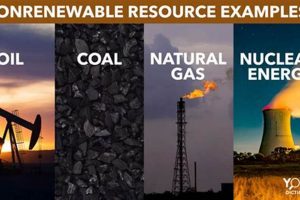
Petroleum, in its unrefined state, is a naturally occurring, yellowish-black liquid found in geological formations beneath the Earth’s surface. Formed from the remains of ancient marine organisms over millions of years, this complex mixture of hydrocarbons requires extensive geological processes and timescales far exceeding human lifespans for its creation. This characteristic makes it a finite resource, meaning its reserves are depleted faster than they can be replenished naturally.
The finite nature of this vital energy source has significant implications for global economies and energy security. Historically, it has fueled industrialization and transportation, underpinning modern civilization. Understanding its limitations is crucial for developing sustainable energy strategies and transitioning to renewable alternatives. This knowledge promotes responsible resource management, encourages innovation in energy technologies, and mitigates the environmental impact associated with its extraction and use.
Further exploration of this topic will delve into the geological processes behind its formation, the challenges associated with its extraction and refining, the environmental consequences of its consumption, and the ongoing search for sustainable energy solutions.
Practical Steps Towards Sustainable Energy Consumption
Given the finite nature of conventional petroleum resources, adopting mindful practices is essential for both present and future generations. The following recommendations offer practical strategies for minimizing reliance on this non-renewable resource and fostering a more sustainable energy future.
Tip 1: Improve Energy Efficiency at Home: Implementing simple measures like proper insulation, energy-efficient appliances, and mindful energy usage can significantly reduce reliance on fossil fuels for heating, cooling, and powering homes.
Tip 2: Embrace Alternative Transportation: Opting for public transport, cycling, walking, or electric vehicles reduces demand for petroleum-based fuels. Carpooling and trip consolidation also contribute to decreased fuel consumption.
Tip 3: Support Renewable Energy Sources: Advocating for and investing in renewable energy technologies like solar, wind, and geothermal power accelerates the transition away from fossil fuel dependence.
Tip 4: Reduce, Reuse, and Recycle: Manufacturing processes often rely heavily on fossil fuels. By reducing consumption, reusing items, and recycling materials, demand for these energy-intensive processes is lessened.
Tip 5: Advocate for Sustainable Policies: Supporting policies that promote energy efficiency, renewable energy development, and responsible resource management encourages systemic change towards a sustainable energy future.
Tip 6: Invest in Energy-Efficient Technologies: Prioritizing energy-efficient products and technologies in purchasing decisions, from household appliances to industrial equipment, contributes to overall reduction in energy consumption.
Tip 7: Educate and Raise Awareness: Sharing knowledge about the finite nature of fossil fuels and the importance of sustainable practices empowers individuals and communities to make informed choices.
Adopting these measures not only lessens the strain on dwindling petroleum reserves but also contributes to a cleaner, more sustainable environment for future generations. The cumulative effect of individual actions can drive significant collective progress towards a more sustainable energy future.
By understanding the limitations of non-renewable resources and embracing conscious consumption practices, a smoother transition to a more sustainable energy landscape can be achieved.
1. Finite Resource

The concept of a “finite resource” is central to understanding the nature of crude oil and its implications for global energy systems. A finite resource is one with a limited supply, incapable of being replenished at a rate comparable to its consumption. This characteristic distinguishes it from renewable resources like solar or wind energy, which are naturally replenished over relatively short periods.
- Geological Timescale of Formation
Crude oil forms over millions of years through complex geological processes involving the decomposition of organic matter under immense pressure and heat. This timescale far exceeds human lifespans, making the natural replenishment of extracted oil effectively impossible. This geological reality underscores the finite nature of this resource.
- Global Reserves and Consumption Rates
While substantial reserves of crude oil exist, they are not infinite. Current global consumption rates significantly outpace the negligible rate of natural replenishment. This imbalance highlights the finite nature of the resource and the inevitable decline of readily accessible reserves.
- Economic and Geopolitical Implications
The finite nature of crude oil has significant economic and geopolitical implications. Competition for dwindling resources can influence international relations and market stability. Price volatility and supply disruptions are potential consequences of this resource’s finite nature.
- The Need for Sustainable Alternatives
The finite nature of crude oil necessitates the development and adoption of sustainable energy alternatives. Transitioning to renewable energy sources like solar, wind, and geothermal reduces reliance on this dwindling resource and mitigates the risks associated with its eventual depletion.
The finite nature of crude oil underscores the urgency of transitioning to a more sustainable energy future. Recognizing the limitations of this resource and investing in renewable alternatives are essential steps toward ensuring long-term energy security and mitigating the environmental impacts associated with fossil fuel dependence.
2. Geological Formation

The geological formation of crude oil is intrinsically linked to its non-renewable nature. The process requires specific conditions and vast timescales that render natural replenishment at a pace matching human consumption impossible. Organic matter, primarily from ancient marine organisms, accumulates on the seabed and undergoes burial under successive layers of sediment. Over millions of years, the combination of heat and pressure transforms this organic material into kerogen, a waxy substance. Further burial and increased temperatures convert kerogen into hydrocarbons, the building blocks of crude oil and natural gas. These hydrocarbons then migrate through porous rock formations until trapped by impermeable layers, forming reservoirs from which extraction occurs. Examples of such geological formations include anticline traps and fault traps, where the geological structure creates pockets where hydrocarbons accumulate.
The immense timescale required for these geological processes, spanning millions of years, is the key factor in classifying crude oil as non-renewable. While some organic matter continues to accumulate in sedimentary basins, the rate of formation is infinitesimally small compared to the rate at which existing reserves are extracted and consumed. This disparity between formation and consumption rates emphasizes the finite nature of this resource. Practical implications of this understanding include the need for responsible resource management, exploration of alternative energy sources, and development of technologies to enhance extraction efficiency from existing reservoirs.
In summary, the geological formation of crude oil is a protracted process requiring specific conditions over vast geological timescales. This inherent characteristic dictates its classification as a non-renewable resource. Recognizing this connection underscores the need for sustainable energy practices and the development of alternative energy sources to meet future energy demands. The inherent limitations of natural replenishment necessitate a shift toward resources that offer long-term viability.
3. Millions of Years

The non-renewable nature of crude oil is inextricably linked to the vast timescale required for its formation, a process spanning millions of years. This extended timeframe distinguishes it from renewable resources that replenish naturally within human timescales. Understanding this temporal dimension is crucial for grasping the implications of resource depletion and the need for sustainable alternatives.
- Geological Processes and Timescales
The formation of crude oil involves a complex sequence of geological processes, including the deposition, burial, and transformation of organic matter under specific pressure and temperature conditions. These processes unfold over geological timescales, typically measured in millions of years, far exceeding human lifespans. This protracted timeframe makes natural replenishment of extracted oil at a pace matching human consumption effectively impossible.
- Comparison with Renewable Resources
Unlike renewable resources like solar and wind energy, which are replenished continuously through natural processes, crude oil formation is a finite event tied to specific geological conditions in the distant past. The contrast between the continuous replenishment of renewable resources and the finite, geologically constrained formation of crude oil underscores the fundamental difference in their renewability.
- Resource Depletion and Future Projections
The millions of years required for crude oil formation, coupled with current consumption rates, highlight the inevitable depletion of readily accessible reserves. Projections of future energy demands, considering the finite nature of this resource, underscore the urgency of developing and implementing sustainable energy solutions.
- Implications for Energy Security and Sustainability
The extended timescale for crude oil formation has profound implications for energy security and sustainability. Reliance on a resource that cannot be replenished within human timescales necessitates proactive strategies for resource management, diversification of energy sources, and transition to renewable alternatives.
The “millions of years” timeframe inherent in crude oil formation underscores its non-renewable nature and the finite supply of this crucial energy resource. Recognizing this temporal dimension is paramount for developing sustainable energy policies, promoting responsible consumption, and ensuring long-term energy security. The contrast with renewable resources, which replenish within human timescales, further emphasizes the critical need for a transition to a more sustainable energy future.
4. Extraction Limitations

Extraction limitations are intrinsically linked to the non-renewable nature of crude oil, impacting accessibility, economic viability, and environmental consequences. The finite nature of this resource implies that not all existing reserves are technically or economically recoverable. Several factors contribute to these limitations:
- Geological Constraints: Crude oil reservoirs vary significantly in their geological characteristics, including depth, porosity, permeability, and pressure. These factors influence the ease and cost of extraction. Deepwater drilling, for instance, presents significant technical challenges and higher costs compared to onshore extraction. Unconventional resources like shale oil require specialized techniques like hydraulic fracturing, which pose environmental concerns.
- Technological Limits: Current extraction technologies cannot recover 100% of the oil in place within a reservoir. Enhanced oil recovery (EOR) techniques aim to improve recovery rates, but these methods often involve complex processes and significant investments, further constrained by geological factors.
- Economic Viability: Extraction becomes economically unviable when the cost of recovery exceeds the market value of the oil. Factors influencing economic viability include the global oil price, extraction technology costs, and the specific geological challenges of the reservoir.
- Environmental Considerations: Extraction activities can have significant environmental impacts, including habitat disruption, water contamination, and greenhouse gas emissions. Regulations and environmental concerns can impose limitations on extraction practices, further impacting accessibility and economic feasibility.
The interplay of these factors creates a complex landscape for crude oil extraction. As readily accessible reserves are depleted, the industry faces increasing challenges in accessing remaining resources. This reality necessitates continuous technological advancements and careful consideration of environmental and economic trade-offs.
In summary, extraction limitations are a crucial component of understanding the implications of “crude oil is non-renewable.” These limitations, arising from geological constraints, technological limits, economic viability, and environmental considerations, underscore the challenges of accessing remaining reserves. This understanding reinforces the need for responsible resource management, exploration of alternative energy sources, and continuous innovation in extraction technologies. The finite nature of this resource, coupled with extraction limitations, emphasizes the urgency of transitioning towards a more sustainable energy future.
5. Environmental Impact
The environmental impact of crude oil extraction, processing, and consumption is substantial and intrinsically linked to its non-renewable nature. This connection arises because reliance on a finite resource necessitates continuous exploration and extraction, often in increasingly sensitive environments. Furthermore, the combustion of crude oil-derived fuels releases greenhouse gases, contributing to climate change. Several key aspects highlight this environmental impact:
- Habitat Disruption: Exploration and extraction activities, whether on land or offshore, can disrupt ecosystems and fragment habitats. Construction of pipelines, well pads, and access roads can lead to deforestation, soil erosion, and habitat loss for various species. Offshore drilling can impact marine life through noise pollution, chemical discharge, and the risk of oil spills.
- Greenhouse Gas Emissions: The combustion of crude oil-derived fuels, primarily for transportation and energy generation, releases significant quantities of greenhouse gases, particularly carbon dioxide. These emissions contribute to global warming and climate change, with far-reaching consequences for ecosystems, weather patterns, and human societies.
- Water Contamination: Extraction and transportation processes pose risks of water contamination. Oil spills, leaks from pipelines, and wastewater discharge from refining operations can contaminate surface and groundwater resources, impacting both human health and aquatic ecosystems.
- Air Pollution: Refining operations and the combustion of fossil fuels release air pollutants, including particulate matter, sulfur oxides, and nitrogen oxides. These pollutants contribute to respiratory problems and other health issues, and can also impact air quality and visibility.
Examples of these impacts include the Deepwater Horizon oil spill in the Gulf of Mexico, which caused widespread damage to marine and coastal ecosystems, and the air pollution associated with oil refineries, which disproportionately affects communities located near these facilities. The Alberta oil sands development, while providing significant energy resources, has also raised concerns about deforestation, water usage, and greenhouse gas emissions.
Understanding the environmental impacts associated with crude oil, from extraction to consumption, is crucial for informed decision-making regarding energy policy and resource management. The finite nature of this resource, coupled with its significant environmental footprint, reinforces the urgency of transitioning to more sustainable energy sources and implementing practices that minimize environmental harm.
6. Energy Dependence
Energy dependence, particularly on crude oil, presents significant challenges stemming directly from its non-renewable nature. This dependence creates vulnerabilities related to price volatility, supply disruptions, and geopolitical instability. Because crude oil reserves are finite and unevenly distributed globally, nations heavily reliant on imports face potential economic and security risks. Price fluctuations, driven by market forces and geopolitical events, can significantly impact national economies dependent on this resource. Supply disruptions, whether due to natural disasters, political instability, or technical issues, can create energy shortages and economic hardship. Furthermore, reliance on crude oil can create geopolitical dependencies, potentially influencing foreign policy decisions and creating vulnerabilities to external pressures.
The historical context of oil crises, such as the 1973 oil embargo and the 1990 Gulf War, provides concrete examples of the disruptive impacts of energy dependence. These events demonstrated the vulnerability of nations heavily reliant on crude oil imports, highlighting the economic and social consequences of supply disruptions. More recent geopolitical events further underscore the risks associated with energy dependence, particularly as competition for dwindling resources intensifies. The ongoing transition to renewable energy sources presents a pathway toward mitigating these risks, although challenges remain in terms of infrastructure development, technological advancements, and economic adjustments.
In summary, energy dependence on crude oil creates significant vulnerabilities stemming from the resource’s finite nature. Price volatility, supply disruptions, and geopolitical risks are inherent challenges. Historical examples and current geopolitical events underscore the practical significance of this understanding. The transition to renewable energy sources offers a crucial strategy for reducing energy dependence and enhancing energy security, albeit with its own set of challenges to overcome. Addressing energy dependence requires a multi-faceted approach involving diversification of energy sources, technological innovation, and responsible resource management.
7. Sustainable Alternatives

The finite nature of crude oil necessitates exploration and adoption of sustainable alternatives. These alternatives offer a pathway toward mitigating the risks associated with resource depletion, price volatility, and environmental degradation inherent in continued reliance on fossil fuels. Transitioning to sustainable energy sources requires a multifaceted approach encompassing technological innovation, policy adjustments, and shifts in consumption patterns.
- Renewable Energy Sources
Renewable energy sources, such as solar, wind, hydro, geothermal, and biomass, derive energy from naturally replenishing resources. Solar photovoltaic panels convert sunlight directly into electricity, while wind turbines harness wind energy to generate power. Hydropower utilizes the energy of flowing water, while geothermal taps into the Earth’s internal heat. Biomass energy derives from organic matter. These sources offer a sustainable alternative to fossil fuels, reducing reliance on finite resources and mitigating greenhouse gas emissions. For example, Denmark has significantly increased its reliance on wind power, while Iceland utilizes geothermal energy extensively.
- Energy Efficiency and Conservation
Improving energy efficiency and implementing conservation measures play a critical role in reducing reliance on crude oil. Energy-efficient appliances, building insulation, and sustainable transportation systems contribute to lower energy consumption. Examples include the adoption of LED lighting, improved building codes for energy efficiency, and the development of public transportation networks. These measures reduce demand for fossil fuels, mitigating the impacts of their finite nature.
- Energy Storage Technologies
Energy storage technologies are crucial for integrating intermittent renewable energy sources into the grid. Batteries, pumped hydro storage, and other technologies store excess energy generated during periods of high renewable energy production and release it during periods of low production or high demand. This capability addresses the intermittency challenge associated with solar and wind power, enhancing their reliability and viability as sustainable alternatives.
- Circular Economy and Material Science
Transitioning to a circular economy, emphasizing reuse and recycling, reduces demand for virgin materials, including those derived from crude oil. Advances in material science contribute to the development of sustainable materials derived from renewable resources. Bioplastics, for instance, offer an alternative to conventional plastics derived from fossil fuels. These approaches reduce reliance on finite resources and minimize waste generation.
The exploration and adoption of these sustainable alternatives are essential for mitigating the challenges associated with the finite nature of crude oil. Transitioning to a more sustainable energy future requires a concerted effort across sectors, involving technological innovation, policy support, and changes in individual and collective behavior. The long-term viability of human societies hinges on successfully navigating this transition, reducing dependence on finite resources, and mitigating the environmental consequences of fossil fuel consumption.
Frequently Asked Questions
This section addresses common inquiries regarding the non-renewable nature of crude oil, aiming to provide clear and concise information.
Question 1: What precisely defines crude oil as “non-renewable”?
Crude oil is categorized as non-renewable due to the immense timescale required for its formation. The geological processes involved span millions of years, far exceeding human timescales. This timeframe renders natural replenishment at a pace matching human consumption effectively impossible.
Question 2: How does the finite nature of crude oil impact global energy security?
The finite nature of crude oil creates vulnerabilities related to price volatility, supply disruptions, and geopolitical instability. Reliance on a dwindling resource with uneven global distribution poses significant risks to energy security, potentially leading to economic and social disruption.
Question 3: What are the primary environmental consequences of relying on crude oil?
Environmental consequences associated with crude oil include habitat disruption from extraction activities, greenhouse gas emissions contributing to climate change, water contamination from spills and wastewater, and air pollution from refining and combustion processes.
Question 4: Are there viable alternatives to crude oil for meeting global energy demands?
Sustainable alternatives to crude oil include renewable energy sources like solar, wind, hydro, and geothermal power, coupled with energy efficiency measures, energy storage technologies, and advancements in material science promoting a circular economy.
Question 5: What steps can individuals take to reduce reliance on crude oil?
Individuals can reduce reliance on crude oil by adopting energy-efficient practices at home, utilizing sustainable transportation options, supporting renewable energy initiatives, and advocating for policies that promote sustainable energy development.
Question 6: What are the key challenges in transitioning away from crude oil dependence?
Challenges in transitioning away from crude oil dependence include infrastructure development for renewable energy, advancements in energy storage technologies, economic adjustments in transitioning industries, and fostering public awareness and support for sustainable practices.
Understanding the non-renewable nature of crude oil and its implications is crucial for informed decision-making regarding energy consumption and the pursuit of sustainable alternatives. Transitioning to a more sustainable energy future requires collective action and individual responsibility.
Further sections will explore specific sustainable energy technologies, policy frameworks, and economic considerations related to transitioning away from crude oil dependence.
Conclusion
This exploration of the non-renewable nature of crude oil has highlighted its finite reserves, geological formation timescales, extraction limitations, environmental consequences, and the implications of energy dependence. The analysis underscores that continued reliance on this finite resource presents significant challenges for global energy security, economic stability, and environmental sustainability. The inherent limitations of a resource formed over millions of years, coupled with the environmental impact of its extraction and use, necessitate a fundamental shift in energy production and consumption patterns.
The transition away from non-renewable crude oil presents a defining challenge for the 21st century. Embracing sustainable alternatives, including renewable energy sources, energy efficiency measures, and innovative technologies, is not merely an option but a necessity. The future of global well-being hinges on the collective commitment to responsible resource management, sustainable practices, and a decisive shift toward a diversified and renewable energy portfolio.