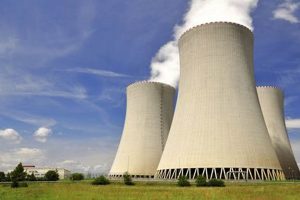
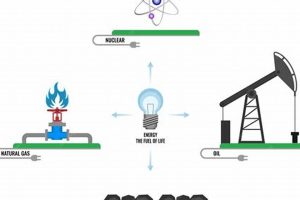
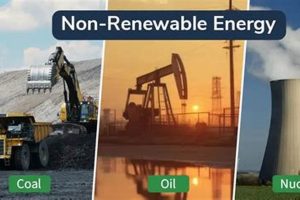
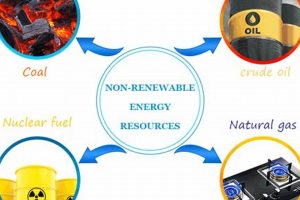
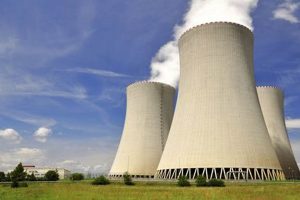
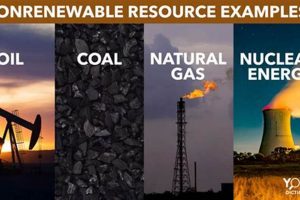
Resources categorized as finite are those that exist in limited quantities and are depleted faster than natural processes can replenish them. Fossil fuels, such as coal, oil, and natural gas, are prime examples. These resources formed over millions of years from decayed organic matter under specific geological conditions. Uranium, a key element in nuclear power generation, is another finite resource extracted from the Earth’s crust.
Understanding the finite nature of these resources is crucial for sustainable development. Their continued use at current rates poses significant environmental challenges, including climate change due to greenhouse gas emissions and habitat destruction from extraction processes. Historically, the industrial revolution and subsequent technological advancements were fueled by readily available and inexpensive fossil fuels, leading to the current dependence on these finite resources. Transitioning to renewable energy sources and improving resource efficiency are critical steps towards a sustainable future.
This understanding informs discussions regarding energy security, resource management, and the development of alternative energy technologies. The following sections delve deeper into the specific challenges and opportunities associated with different types of finite resources and the pathways towards a more sustainable energy landscape.
Practical Steps for Addressing Finite Resource Depletion
Transitioning away from dependence on finite resources requires a multifaceted approach involving individual actions, policy changes, and technological innovation. The following tips offer practical strategies to contribute to this crucial shift.
Tip 1: Improve Energy Efficiency: Reducing energy consumption through measures like home insulation, energy-efficient appliances, and sustainable transportation significantly decreases demand for finite resources used in power generation.
Tip 2: Support Renewable Energy: Advocating for and investing in renewable energy sources like solar, wind, and hydropower accelerates the transition towards a sustainable energy future.
Tip 3: Reduce, Reuse, Recycle: Embracing the principles of a circular economy by minimizing waste generation, reusing products, and recycling materials reduces the need to extract virgin resources.
Tip 4: Advocate for Sustainable Policies: Supporting policies that incentivize renewable energy development, promote resource efficiency, and regulate the extraction of finite resources is crucial for systemic change.
Tip 5: Invest in Research and Development: Continued investment in research and development of alternative energy technologies and resource management strategies is essential for long-term solutions.
Tip 6: Educate and Raise Awareness: Promoting awareness about the finite nature of resources and the importance of sustainable practices within communities and networks fosters collective action.
Tip 7: Choose Sustainable Products: Opting for products made from recycled materials or from companies committed to sustainable practices reduces demand for finite resources.
By adopting these practices, individuals and communities can contribute to a more sustainable future by reducing reliance on finite resources and minimizing the environmental impact associated with their extraction and use.
These individual and collective efforts are vital steps in forging a sustainable future, decoupling economic growth from resource depletion, and mitigating the environmental consequences of finite resource dependence. The concluding section offers a perspective on the long-term implications of these actions.
1. Finite Supply

The concept of “finite supply” is central to the definition of non-renewable resources in scientific discourse. A finite resource exists in a limited quantity within the Earth’s crust. This inherent limitation distinguishes non-renewable resources from renewable resources like solar or wind energy, which are effectively inexhaustible on a human timescale. The finite nature of these resources necessitates careful management and exploration of alternative sources. Fossil fuels, formed over millions of years from decayed organic matter, exemplify this finite characteristic. Their extraction and consumption occur at rates far exceeding their natural replenishment, leading to depletion.
This finite characteristic has profound implications. Depletion of fossil fuels raises concerns about energy security and price volatility. Furthermore, the extraction and use of these resources contribute significantly to environmental challenges, including climate change and habitat destruction. Recognizing the finite nature of these resources underscores the urgency of transitioning towards renewable energy sources and implementing sustainable resource management practices. For example, known reserves of certain rare earth elements crucial for advanced technologies are projected to be depleted within decades at current consumption rates, highlighting the need for material substitution and recycling initiatives.
Understanding “finite supply” as a defining characteristic of non-renewable resources is crucial for informed decision-making regarding energy policy, resource management, and technological development. The finite nature of these resources poses significant challenges but also drives innovation in the pursuit of sustainable alternatives. Moving forward, balancing the demands of a growing global population with the limitations of finite resources requires a concerted effort towards resource efficiency, circular economy principles, and the development of sustainable technologies.
2. Geological Formation

Geological formation plays a crucial role in defining non-renewable resources. The processes by which these resources form dictate their distribution, concentration, and accessibility within the Earth’s crust. Understanding these geological processes is essential for effective exploration, extraction, and management of these finite resources.
- Fossil Fuel Formation
Fossil fuels, including coal, oil, and natural gas, originate from organic matter accumulated over millions of years. Specific geological conditions, such as high pressure and temperature in anaerobic environments, transform this organic material into hydrocarbons. The location and type of these ancient deposits dictate the geographical distribution of fossil fuel reserves, influencing global energy dynamics and geopolitics.
- Uranium Ore Formation
Uranium, a key element in nuclear power generation, occurs naturally in various geological formations. Uranium ore deposits are found in igneous, sedimentary, and metamorphic rocks, formed through processes like hydrothermal activity and weathering. The concentration and accessibility of these deposits vary significantly depending on their geological origin, influencing the feasibility and cost of uranium extraction.
- Mineral Formation Processes
Many non-renewable mineral resources, such as metallic ores and rare earth elements, are formed through specific geological processes. These include magmatic differentiation, hydrothermal circulation, and sedimentary deposition. The specific geological conditions during formation dictate the chemical composition and concentration of these mineral deposits, influencing their economic viability and potential uses.
- Timescales of Formation
The vast timescales involved in the geological formation of non-renewable resources are a defining characteristic. Millions of years are required for the processes that create fossil fuels, uranium deposits, and other mineral resources to occur. This slow formation rate contrasts sharply with the rate at which these resources are currently being consumed, highlighting their finite nature and the need for sustainable resource management.
The geological formation of non-renewable resources is inextricably linked to their classification as finite and their subsequent implications for resource management. The diverse geological processes involved influence resource distribution, extraction feasibility, and ultimately, the sustainability of their use. This understanding underscores the need for responsible resource management, exploration of alternative resources, and development of sustainable technologies.
3. Slow Replenishment

The defining characteristic of non-renewable resources hinges on the concept of slow replenishment. These resources, formed over geological timescales, are replenished at rates far slower than their consumption. This imbalance between formation and consumption renders them effectively finite within human timescales. Fossil fuels, for instance, require millions of years to form from decayed organic matter under specific geological conditions. The current rate of fossil fuel consumption drastically outpaces their natural replenishment, leading to depletion and necessitating the exploration of alternative energy sources.
The slow replenishment rate has significant practical implications. For example, the depletion of readily accessible oil reserves necessitates exploration in increasingly challenging and environmentally sensitive areas, such as deep-sea drilling or arctic exploration. Similarly, the limited availability of certain mineral resources essential for modern technologies necessitates strategies for resource conservation, recycling, and material substitution. The slow replenishment of these resources underscores the urgency of transitioning towards a circular economy model that minimizes waste and maximizes resource utilization.
Understanding the link between slow replenishment and the non-renewable nature of resources is crucial for sustainable resource management. This understanding informs policies aimed at promoting resource efficiency, developing alternative technologies, and mitigating the environmental impact of resource extraction. The slow replenishment rate highlights the finite nature of these resources and the need for a long-term perspective on resource utilization, emphasizing the importance of intergenerational equity and environmental stewardship.
4. Fossil Fuels (Coal, Oil, Gas)

Fossil fuelscoal, oil, and natural gasrepresent a cornerstone of the “non-renewable definition science” concept. Their classification as non-renewable stems from the geological timescales required for their formation, rendering their replenishment rates insignificant compared to current consumption rates. Formed from decayed organic matter subjected to immense pressure and heat over millions of years, these resources exist in finite quantities. The processes involved, from organic matter accumulation to geological transformation, necessitate specific conditions rarely replicated at scales relevant to human timescales. This inherent limitation in natural replenishment distinguishes fossil fuels as finite and non-renewable.
The burning of fossil fuels, the primary means of energy generation for centuries, releases greenhouse gases, notably carbon dioxide, contributing significantly to climate change. Coal combustion, for example, releases substantial amounts of particulate matter and sulfur dioxide, leading to air pollution and respiratory problems. Oil spills devastate marine ecosystems, while natural gas extraction through hydraulic fracturing (fracking) raises concerns about groundwater contamination. These environmental consequences underscore the need for transition to sustainable, renewable energy sources.
Understanding the non-renewable nature of fossil fuels is crucial for informed decision-making regarding energy policy and environmental stewardship. The finite nature of these resources necessitates strategies for resource conservation, development of alternative energy technologies, and mitigation of environmental impacts. Recognizing the link between fossil fuel consumption and climate change emphasizes the urgency of transitioning towards a sustainable energy future, balancing energy needs with environmental responsibility.
5. Uranium

Uranium, a radioactive element found in the Earth’s crust, plays a significant role within the framework of “non-renewable definition science.” Its classification as a non-renewable resource stems from the geological timescales involved in its formation and concentration into usable deposits. While uranium undergoes natural radioactive decay, this process does not replenish economically viable uranium ore at a rate comparable to human consumption. This inherent limitation positions uranium as a finite resource demanding careful management and consideration of long-term sustainability.
- Geological Occurrence and Formation
Uranium occurs naturally in various geological formations, including igneous, sedimentary, and metamorphic rocks. Its concentration into usable ore deposits requires specific geological processes operating over millions of years. These processes include hydrothermal activity, weathering, and sedimentation, all contributing to the uneven distribution of uranium ore globally. The geological constraints on uranium formation highlight the finite nature of this resource and the challenges associated with its exploration and extraction.
- Nuclear Fuel and Energy Generation
Uranium’s primary application lies in nuclear power generation. The isotope Uranium-235, capable of sustaining a nuclear chain reaction, serves as the crucial fuel for nuclear reactors. This process, while generating significant amounts of energy, also produces radioactive waste, posing long-term storage and disposal challenges. The dependence on uranium for nuclear power necessitates careful consideration of waste management and the environmental impact of the nuclear fuel cycle.
- Finite Reserves and Resource Management
Like fossil fuels, uranium exists in finite quantities. Although estimates of global uranium reserves vary, the finite nature of this resource necessitates strategies for efficient utilization and exploration of alternative energy sources. The geographic distribution of uranium deposits also influences geopolitics and energy security concerns, highlighting the importance of international cooperation and responsible resource management.
- Environmental Considerations and Sustainability
While nuclear power generation does not directly contribute to greenhouse gas emissions, the uranium fuel cycle presents other environmental challenges. Uranium mining can impact local ecosystems, while the long-term storage and disposal of radioactive waste remain complex issues demanding careful consideration. The sustainability of nuclear power depends on addressing these environmental concerns and developing safe and effective waste management strategies.
The exploration of uranium within the context of “non-renewable definition science” emphasizes the interconnectedness of geological processes, resource availability, and environmental sustainability. Uranium, as a finite and non-renewable resource, exemplifies the challenges and opportunities associated with utilizing Earth’s resources responsibly. The finite nature of uranium necessitates a balanced approach that considers both the benefits of nuclear power and the long-term environmental implications of the nuclear fuel cycle. This understanding underscores the ongoing need for research into alternative energy sources and sustainable resource management practices to ensure a secure and environmentally responsible energy future.
6. Environmental Impact

The environmental impact of non-renewable resource extraction and utilization represents a critical dimension of their scientific definition. The inherent finite nature of these resources necessitates extraction processes that often disrupt ecosystems and generate pollution. Furthermore, the combustion of fossil fuels, the dominant energy source derived from non-renewable resources, releases greenhouse gases, driving climate change. This cause-and-effect relationship between non-renewable resource use and environmental degradation underscores the importance of “environmental impact” as an integral component of understanding these resources.
Consider coal mining, a prime example. Mountaintop removal mining drastically alters landscapes, destroys habitats, and contaminates water sources. Oil extraction, whether onshore or offshore, carries risks of spills that devastate marine ecosystems and coastal communities. The extraction and processing of uranium, while crucial for nuclear power, generate radioactive waste requiring long-term storage solutions. These real-world examples demonstrate the direct link between non-renewable resource extraction and environmental degradation, emphasizing the importance of sustainable resource management and the development of alternative energy sources.
The practical significance of understanding this connection lies in informing responsible resource management practices and policy decisions. Recognizing the environmental consequences of non-renewable resource dependence necessitates a shift towards sustainable practices. This includes investing in renewable energy technologies, improving energy efficiency, and implementing policies that incentivize resource conservation and minimize environmental damage. Failure to address the environmental impact of non-renewable resource use threatens ecological stability and jeopardizes long-term sustainability. Transitioning towards a future powered by renewable resources and guided by circular economy principles represents a crucial step in mitigating these environmental risks and ensuring a healthy planet for future generations.
Frequently Asked Questions
This section addresses common inquiries regarding non-renewable resources, providing concise and informative responses based on established scientific understanding.
Question 1: What distinguishes a resource as “non-renewable”?
A non-renewable resource exists in a finite quantity and is replenished at a rate far slower than its consumption. This slow replenishment, often taking millions of years, renders these resources effectively finite within human timescales.
Question 2: What are the primary types of non-renewable resources?
The primary types include fossil fuels (coal, oil, and natural gas), uranium, and certain minerals extracted from the Earth’s crust.
Question 3: Why is the use of non-renewable resources considered unsustainable?
Unsustainable use stems from the finite nature of these resources. Current consumption rates exceed natural replenishment, leading to depletion. Furthermore, extraction and utilization often generate significant environmental impacts, including habitat destruction, pollution, and climate change.
Question 4: What are the environmental consequences of relying on non-renewable resources?
Environmental consequences include greenhouse gas emissions from fossil fuel combustion, contributing to climate change; habitat destruction from resource extraction; and pollution of air, water, and soil.
Question 5: What are the alternatives to non-renewable resources?
Key alternatives include renewable energy sources such as solar, wind, hydro, geothermal, and biomass. These resources replenish naturally and offer a sustainable pathway for energy generation.
Question 6: How can individuals contribute to reducing reliance on non-renewable resources?
Individuals can contribute by reducing energy consumption, improving energy efficiency, supporting renewable energy initiatives, embracing recycling and reuse practices, and advocating for sustainable policies.
Understanding the characteristics and implications of non-renewable resources is crucial for informed decision-making regarding energy consumption, resource management, and environmental stewardship. Transitioning towards sustainable practices and embracing alternative energy sources represents a critical step in ensuring a secure and environmentally responsible future.
The following section explores the specific challenges and opportunities associated with transitioning towards a more sustainable energy landscape.
Conclusion
Examination of the “non-renewable definition science” concept reveals the inherent limitations and environmental consequences associated with resource utilization. Finite resources, characterized by slow replenishment rates relative to consumption, necessitate careful management and a transition towards sustainable alternatives. Fossil fuels and uranium, cornerstones of current energy systems, exemplify the challenges posed by non-renewable resource dependence. Their extraction and utilization contribute to habitat destruction, pollution, and climate change, underscoring the urgency of transitioning towards renewable energy sources and sustainable resource management practices.
The finite nature of these resources presents a fundamental challenge to long-term sustainability. Continued reliance on non-renewable resources necessitates a paradigm shift towards resource efficiency, circular economy principles, and the development and adoption of renewable energy technologies. The future of human civilization hinges on embracing sustainable practices and fostering a global commitment to responsible resource management. Transitioning away from non-renewable resource dependence represents not merely a technological challenge but a societal imperative, demanding collective action and a fundamental shift in human-environment interaction. This transition represents a crucial step towards ensuring a secure, equitable, and environmentally sustainable future for generations to come.