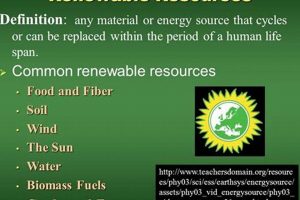
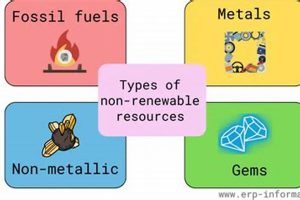
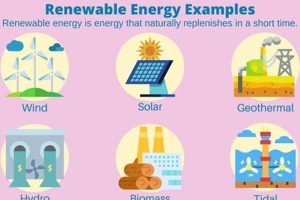
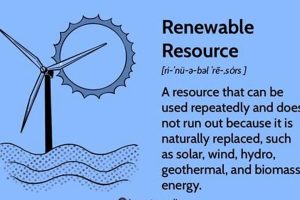
A naturally replenished resource is one that is restored by natural processes at a rate comparable to its rate of consumption by humans or other users. These resources stand in contrast to finite resources, which exist in fixed amounts or are consumed at a rate faster than their regeneration. Sunlight, wind, and geothermal heat are prime instances, offering continuous energy supplies. Biomass, such as forests and crops, and water are other significant instances, though their renewability depends on responsible management and sustainable usage practices.
The utilization of naturally replenished resources is crucial for mitigating environmental impact and ensuring long-term sustainability. Reliance on these resources reduces dependence on finite fossil fuels, thereby minimizing greenhouse gas emissions and combating climate change. Furthermore, harnessing these resources can foster energy independence, create new economic opportunities, and promote resilient infrastructure. Historically, societies have relied on these resources for basic needs, but modern technologies are expanding the possibilities for efficient and widespread utilization.
Understanding the diversity and potential of naturally replenished resources is essential for shaping a sustainable future. The following sections will delve into specific categories of these resources, examining their characteristics, applications, and the challenges associated with their effective management and integration into global energy systems.
Harnessing Naturally Replenished Resources
The efficient and sustainable utilization of naturally replenished sources requires careful planning and execution. The following guidance points offer practical strategies for maximizing the benefits of these sources while minimizing potential drawbacks.
Tip 1: Prioritize Resource Conservation: Before investing in naturally replenished energy systems, reduce overall energy consumption through efficiency improvements in buildings, transportation, and industrial processes. Lower demand reduces the required scale and cost of naturally replenished infrastructure.
Tip 2: Implement Integrated Resource Management: For resources like water and biomass, adopt comprehensive management plans that consider environmental impacts, competing uses, and long-term availability. Sustainable forestry practices, for example, ensure continuous biomass production without depleting forest ecosystems.
Tip 3: Diversify Energy Portfolio: Do not rely solely on a single naturally replenished source. A diversified portfolio, incorporating solar, wind, geothermal, and biomass, enhances system resilience and mitigates the variability inherent in some resources.
Tip 4: Invest in Energy Storage: Many naturally replenished sources, such as solar and wind, are intermittent. Integrating energy storage solutions, such as batteries or pumped hydro storage, is critical for ensuring a reliable and continuous energy supply.
Tip 5: Support Research and Development: Continued investment in research and development is essential for improving the efficiency and affordability of naturally replenished technologies. This includes advancements in solar cell technology, wind turbine design, and energy storage systems.
Tip 6: Promote Public Awareness and Education: Educate the public about the benefits and limitations of naturally replenished resources to foster acceptance and encourage adoption. Clear communication can address misconceptions and promote informed decision-making.
Tip 7: Establish Supportive Policy Frameworks: Governments play a vital role in promoting the adoption of naturally replenished sources through policies such as tax incentives, feed-in tariffs, and renewable energy standards. A stable and predictable policy environment encourages investment and innovation.
Effective application of these guidelines can facilitate a smooth transition towards a sustainable energy future. By prioritizing conservation, diversification, and technological advancement, societies can harness the full potential of naturally replenished resources while safeguarding the environment for future generations.
The subsequent sections will elaborate on the economic and environmental implications of adopting various resource strategies.
1. Solar Radiation Abundance
Solar radiation abundance forms a cornerstone of naturally replenished resources. The virtually inexhaustible supply of energy from the sun makes it a key candidate among others. Sunlight drives various processes. Its continuous influx is the fundamental energy source for photosynthesis, underpinning the growth of biomass, another naturally replenished resource. Moreover, it provides direct heat and can be converted into electricity via photovoltaic technology. Solar radiation abundance enables the operation of solar water heaters, solar thermal power plants, and distributed solar photovoltaic systems, all contributing to reduced reliance on fossil fuels. The availability of solar radiation varies geographically and seasonally, but its overall magnitude is far greater than current human energy consumption, highlighting its significant potential.
The deployment of technologies to harness the sun’s energy offers a way to produce electricity and heat with minimal environmental impact. Solar power is a good way to meet energy needs and can mitigate greenhouse gas emissions associated with conventional power generation. The integration of solar energy into the grid often requires energy storage solutions to address intermittency, but technological advancements in battery storage are rapidly improving the reliability of solar power. Moreover, distributed solar generation, such as rooftop solar panels, can enhance grid resilience and reduce transmission losses.
In summation, solar radiation’s vast abundance and diverse applications position it as a critical component. Maximizing its utilization requires ongoing advancements in technology, supportive policies, and strategic integration into the energy infrastructure. The inherent challenges, such as intermittency and spatial variability, can be addressed through energy storage, grid modernization, and informed resource management, ensuring that sunlight plays a central role in a sustainable energy future.
2. Wind Kinetic Energy

Wind kinetic energy exemplifies a naturally replenished resource due to the continuous atmospheric circulation driven by solar heating and the Earth’s rotation. This ceaseless movement of air masses generates kinetic energy, which can be converted into electricity using wind turbines. The direct relationship between wind kinetic energy and electricity generation positions it as a vital component for achieving sustainable energy targets. Consider the numerous wind farms operating across the globe, converting the energy of moving air into electricity that powers homes, businesses, and industries. This directly reduces reliance on finite resources. Wind energy demonstrates the practical application of a naturally replenished resource to meet energy demands.
Further analysis of wind energy reveals its practical significance in diversifying energy portfolios and enhancing energy security. Unlike finite fuels concentrated in specific regions, wind resources are geographically dispersed. This widespread availability allows for localized energy production, reducing dependence on centralized power plants and long-distance transmission lines. The deployment of offshore wind farms, which capitalize on stronger and more consistent wind speeds, demonstrates ongoing technological advancements aimed at maximizing energy output. These advancements contribute to the economic viability and environmental sustainability of wind energy, solidifying its role in the global energy landscape.
In summary, wind kinetic energy is an essential component due to its continuous replenishment and its ability to generate electricity. Challenges associated with wind energy, such as intermittency and aesthetic concerns, are being addressed through technological innovations and strategic planning. The continued development and deployment of wind energy technologies will play a crucial role in transitioning towards a sustainable and resilient energy future, reducing dependence on finite resources, and mitigating the environmental impacts of conventional power generation. This exemplifies the application of what is a renewable resource examples.
3. Geothermal Earth's Heat

Geothermal Earth’s heat represents a significant intersection within the realm of naturally replenished resources, providing a stable and consistent energy source derived from the planet’s internal thermal energy. Unlike solar or wind, geothermal energy is not dependent on surface weather conditions, offering a baseload power generation capability with notable implications for energy security and sustainability.
- Harnessing Subsurface Thermal Reservoirs
Geothermal power plants tap into subsurface reservoirs of hot water or steam to generate electricity. These reservoirs are replenished by heat emanating from the Earth’s core and radioactive decay within the crust. Iceland, for instance, derives a substantial portion of its electricity and heating needs from geothermal resources, demonstrating the viability of this energy source on a national scale. The consistent heat flow from the Earth ensures continuous energy availability, contingent on responsible reservoir management.
- Geothermal Direct Use Applications
Beyond electricity generation, geothermal energy is directly utilized for heating, industrial processes, and aquaculture. Geothermal heating systems provide a sustainable alternative to fossil fuel-based heating, reducing carbon emissions. Greenhouses heated by geothermal energy can operate year-round, enhancing agricultural productivity. These direct use applications highlight the versatility of geothermal energy and its potential to contribute to multiple sectors of the economy.
- Enhanced Geothermal Systems (EGS)
Enhanced Geothermal Systems (EGS) expand the accessibility of geothermal energy by creating artificial reservoirs in hot, dry rock formations. This technology involves injecting water into fractured rock to extract heat, enabling geothermal energy production in areas lacking natural hydrothermal resources. EGS significantly increases the potential geographical range for geothermal energy development, although it also presents technical and environmental challenges that require careful management.
- Environmental Considerations and Sustainability
While geothermal energy is generally considered environmentally friendly, it is not without potential impacts. Geothermal power plants can release small amounts of greenhouse gases, and the extraction of geothermal fluids can sometimes cause seismic activity or land subsidence. Sustainable reservoir management practices, including reinjection of geothermal fluids, are crucial for minimizing environmental impacts and ensuring the long-term viability of geothermal resources. Proper planning and monitoring are essential to mitigate these risks and maximize the benefits of geothermal energy.
In conclusion, geothermal energy, derived from Earth’s internal heat, stands as a reliable and versatile resource that complements other naturally replenished energy sources. Its baseload power generation capabilities, coupled with diverse direct use applications, make it an important element of a sustainable energy future. Addressing the environmental considerations and continuing to develop enhanced geothermal systems will further unlock the full potential of this naturally replenished resource, contributing to global efforts to reduce carbon emissions and ensure energy security. This further exemplified by what is a renewable resource examples.
4. Biomass Sustainable Yield

Biomass sustainable yield represents the rate at which biological resources can be harvested without compromising their long-term availability or ecological integrity. It is a critical concept in evaluating biomass as a resource category within a broader “renewable resource examples” framework. The underlying principle is that the rate of biomass extraction must not exceed its rate of regeneration, ensuring a continuous supply and avoiding resource depletion. Without adherence to sustainable yield principles, biomass exploitation transitions from a renewable practice to a destructive one. Deforestation, driven by unsustainable logging practices, provides a stark example where exceeding sustainable yield leads to habitat loss, soil erosion, and carbon emissions, effectively negating the renewability of the resource.
The practical application of sustainable yield principles in biomass management involves careful consideration of ecological factors, harvesting techniques, and regeneration strategies. Sustainable forestry practices, for instance, incorporate selective logging, reforestation efforts, and forest management plans designed to maintain biodiversity and ecosystem health. Similarly, in agriculture, crop rotation, soil conservation, and efficient irrigation techniques enhance the sustainable yield of biomass crops used for biofuels or other purposes. Certification programs, such as the Forest Stewardship Council (FSC), provide independent verification of sustainable biomass production practices, ensuring that harvested biomass originates from well-managed sources. These initiatives are key to ensuring responsible production of biomass and the sustainable integration of that biomass into the production of renewable energy.
In conclusion, biomass sustainable yield is an indispensable aspect of biomass utilization within the context of resources, due to the impact sustainable practices has on them. Failing to adhere to sustainable yield limits transforms biomass from a renewable resource into a finite and environmentally damaging one. Effective implementation of sustainable management practices, supported by certification programs and robust monitoring systems, is essential for harnessing the potential of biomass while safeguarding ecological integrity and ensuring the long-term availability of this key resource. In other words, it ensures biomass remains a truly “renewable resource example”.
5. Hydropower Water Cycle

Hydropower relies directly on the continuous water cycle, a naturally replenished process powered by solar energy. Evaporation, precipitation, and runoff perpetually renew the water supply used to generate electricity. This inherent connection positions hydropower as a prominent component. Water accumulates in reservoirs behind dams; the controlled release of this water through turbines spins generators, producing electricity. Without the consistent replenishment provided by the water cycle, hydropower generation would be unsustainable. The Hoover Dam, for instance, depends on the Colorado River’s flow, sustained by snowmelt and rainfall across a vast drainage basin, to supply power to millions. This reliance underscores the vital role of the water cycle in maintaining hydropower’s functionality.
The effective utilization of hydropower requires careful management of water resources within the context of the water cycle. Dam construction and operation can significantly alter river ecosystems, impacting fish migration, sediment transport, and water quality. Integrated water resource management strategies are therefore essential to balance electricity generation with environmental protection. These strategies involve optimizing dam releases to mimic natural flow regimes, constructing fish passages to facilitate migration, and implementing watershed management practices to reduce erosion and sedimentation. Furthermore, climate change, which can alter precipitation patterns and increase the frequency of droughts and floods, poses a significant challenge to hydropower sustainability, necessitating adaptive management approaches.
Hydropower, intricately linked to the water cycle, exemplifies a renewable energy source, but its sustainability hinges on responsible water resource management and adaptation to changing climatic conditions. The continued viability of hydropower as a significant contributor to global energy supply depends on integrating ecological considerations into dam operations, implementing adaptive management strategies to address climate change impacts, and fostering collaboration among stakeholders to ensure equitable and sustainable water use. This holistic approach ensures that hydropower remains a truly “renewable resource example,” contributing to a cleaner and more sustainable energy future.
Frequently Asked Questions
The following section addresses common queries and misconceptions regarding the nature, scope, and practical application of naturally replenished resources.
Question 1: What fundamentally distinguishes a naturally replenished resource from a finite one?
Naturally replenished resources are characterized by their ability to regenerate through natural processes at a rate comparable to or exceeding their rate of consumption. Finite resources, conversely, exist in fixed quantities or are depleted at a rate that surpasses their natural regeneration capacity.
Question 2: What role does sustainable management play in ensuring the renewability of resources like water and biomass?
Sustainable management practices are paramount for maintaining the renewability of water and biomass. Overexploitation, pollution, or habitat destruction can disrupt natural regeneration processes, transforming these resources into finite ones. Responsible stewardship ensures their long-term availability.
Question 3: Is any naturally replenished resource truly inexhaustible?
While solar energy is often considered inexhaustible on human timescales, other resources, such as geothermal energy, have theoretical limits to their extraction rates. The sustainable yield principle dictates the maximum rate at which a resource can be used without depleting its supply.
Question 4: How does climate change impact the availability and reliability of naturally replenished resources?
Climate change can significantly alter the availability and reliability of resources. Changes in precipitation patterns, increased frequency of extreme weather events, and rising temperatures can disrupt water cycles, reduce biomass productivity, and affect the performance of renewable energy systems.
Question 5: What are the primary economic barriers to wider adoption of technologies that harness naturally replenished resources?
High initial capital costs, intermittency of supply, and competition from established finite fuel industries are significant economic barriers. Government policies, technological advancements, and economies of scale are critical for overcoming these challenges.
Question 6: Do naturally replenished resources always have a lower environmental impact compared to finite fuels?
While generally having a lower overall environmental impact, resources are not entirely without consequence. Hydropower dams can alter river ecosystems, biomass combustion can release air pollutants, and geothermal energy extraction can sometimes cause seismic activity. Life-cycle assessments are necessary to fully evaluate the environmental footprint of resources.
The responsible and sustainable utilization of resources is essential for mitigating environmental impact and ensuring long-term energy security. Understanding the complexities and limitations of resources is critical for making informed decisions about energy policy and resource management.
The following section will transition to case studies, where resource utilization has contributed to environmental changes or improvements.
Conclusion
This exploration has illuminated diverse renewable resource examples, emphasizing their potential to address global energy demands and mitigate environmental impact. Solar, wind, geothermal, biomass, and hydropower each offer distinct advantages and challenges, necessitating careful consideration of ecological impacts, technological advancements, and sustainable management practices. The efficient harnessing of these resources requires integrated approaches that prioritize conservation, diversification, and continuous innovation.
The transition towards a sustainable energy future hinges on widespread adoption and responsible stewardship of what is a renewable resource examples. Continued research, supportive policies, and informed public engagement are crucial for maximizing the benefits and minimizing the risks associated with these resources. By embracing these principles, societies can foster a resilient and environmentally responsible energy landscape for generations to come.
![Guide to What Energy Resources Are Renewable [+Future] | Renewable Energy Solutions for a Sustainable Future | Clean & Green Power](https://pplrenewableenergy.com/wp-content/uploads/2026/03/th-516-300x200.jpg "Guide to What Energy Resources Are Renewable [+Future] Renewable Energy Solutions for a Sustainable Future | Clean & Green Power")