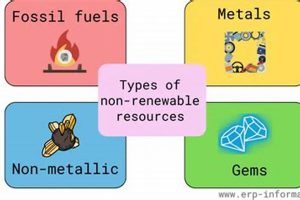
Certain sources of power are finite and cannot be replenished within a human lifespan. These are termed non-renewable and are extracted from the Earth. Examples include coal, a combustible black or brownish-black sedimentary rock; petroleum (crude oil), a naturally occurring, unrefined liquid; natural gas, primarily methane; and uranium, a radioactive metallic element used in nuclear power generation.
These energy forms have historically fueled industrial growth and societal advancement, offering high energy density and, in some cases, relative cost-effectiveness. However, their utilization is associated with environmental consequences, including greenhouse gas emissions contributing to climate change, air and water pollution, and habitat disruption. Understanding the limitations and impacts of these sources is crucial for informed energy policy and sustainable resource management.
The subsequent discussion will delve into each of these prominent sources individually, outlining their extraction methods, applications, and environmental considerations. This will provide a comprehensive overview of their role in the global energy landscape and the challenges associated with their continued use.
Considerations Regarding Depletable Energy Assets
Prudent evaluation of energy strategies necessitates understanding the inherent limitations and implications of relying on resources with finite reserves.
Tip 1: Diversify Energy Portfolio: Over-reliance on a single depletable resource exposes entities to price volatility and supply disruptions. A varied mix, incorporating renewable alternatives, mitigates risk.
Tip 2: Implement Energy Efficiency Measures: Reducing overall energy consumption diminishes dependence on these finite reserves and minimizes environmental impact.
Tip 3: Invest in Carbon Capture Technologies: Mitigating emissions associated with combustion through carbon capture and storage can lessen the environmental footprint during utilization.
Tip 4: Explore Advanced Extraction Techniques: While potentially increasing supply, advanced extraction methods for resources such as shale gas necessitate careful environmental impact assessments and stringent regulatory oversight.
Tip 5: Evaluate Lifecycle Costs: Comprehensive cost assessments must extend beyond initial acquisition to encompass environmental remediation, decommissioning, and long-term storage of waste products.
Tip 6: Support Research and Development: Prioritizing innovation in renewable technologies and energy storage systems is essential for transitioning towards a sustainable energy future.
Tip 7: Monitor Resource Depletion Rates: Continuously tracking the availability and depletion rates of reserves is essential for making informed energy policies and infrastructure planning.
Adopting these strategic considerations can foster responsible resource management and promote a more sustainable energy landscape.
The following conclusion will summarize the core arguments and provide a final perspective on the topic.
1. Coal's Formation

Coal, as a primary member of non-renewable energy sources, originates from the accumulation and transformation of plant matter over millions of years. Understanding the geological processes involved is crucial to appreciating both its significance and the limitations inherent in its exploitation.
- Peat Accumulation
The process begins with the accumulation of plant debris in swampy environments, forming peat. This initial stage requires anaerobic conditions that prevent complete decomposition. The rate of accumulation is dependent on climate and vegetation type, directly influencing the subsequent formation of coal deposits.
- Burial and Compaction
Over time, the peat is buried under layers of sediment, increasing pressure and temperature. This compaction forces out water and volatile compounds, concentrating the carbon content. The depth and duration of burial determine the rank of coal, from lignite (brown coal) to bituminous coal to anthracite (hard coal).
- Geochemical Alteration
During burial, biochemical and geochemical reactions further alter the composition of the plant matter. These processes involve the degradation of cellulose and lignin, followed by the formation of complex organic molecules. The type and extent of these reactions are influenced by the chemical environment and the presence of microorganisms.
- Timescale and Irreplaceability
The transformation of plant matter into coal requires geological timescales, typically millions of years. This protracted process renders coal a non-renewable resource, as its formation rate is negligible compared to the rate of human consumption. This underscores the importance of efficient utilization and exploration of alternative energy sources.
The protracted formation of coal, spanning geological epochs, highlights the finite nature of this non-renewable energy resource. Considering its role in energy production, coupled with the slow pace of natural creation, emphasizes the need for responsible consumption and the development of sustainable alternatives. Coal underscores the broader imperative of understanding the origin and limitations of other non-renewable fuels.
2. Petroleum Extraction

Petroleum extraction represents a critical process within the framework of non-renewable energy resources, dictating the accessibility and availability of this significant fuel source. The methods employed to extract petroleum directly influence its environmental impact and economic viability.
- Exploration and Seismic Surveys
The initial phase involves geological surveys and seismic imaging to identify potential underground reservoirs. Seismic surveys utilize sound waves to map subsurface structures. This process can impact marine life and ecosystems, necessitating careful planning and execution to minimize environmental damage. Successful exploration leads to the determination of drilling locations.
- Drilling and Well Construction
Drilling operations involve penetrating the Earth’s surface to access the petroleum deposit. Different techniques, such as conventional drilling and hydraulic fracturing (fracking), are employed depending on the geological formation. Well construction includes casing and cementing to prevent contamination of groundwater and ensure well integrity. Improper well construction can lead to leaks and environmental hazards.
- Extraction Techniques
Once a well is established, various extraction methods are used to bring petroleum to the surface. Primary recovery utilizes natural pressure to push oil to the wellbore. Secondary recovery methods, such as water or gas injection, enhance oil flow. Enhanced oil recovery (EOR) techniques, including chemical injection or thermal methods, are used to extract remaining oil from depleted reservoirs. Each technique has associated environmental and economic considerations.
- Transportation and Processing
Extracted petroleum is transported via pipelines, tankers, or trucks to refineries for processing. Transportation poses risks of spills and leaks, leading to environmental contamination. Refining processes separate crude oil into various products, such as gasoline, diesel, and jet fuel. These processes can release pollutants into the atmosphere and require careful management of waste streams.
The intricacies of petroleum extraction, from initial exploration to final processing, highlight the complex relationship between resource availability, technological advancement, and environmental stewardship. The ongoing demand for this non-renewable energy resource necessitates continuous improvements in extraction techniques to minimize environmental impact and maximize resource utilization.
3. Natural Gas Abundance

The perceived abundance of natural gas frequently positions it as a bridge fuel in the transition from more carbon-intensive non-renewable sources to renewable alternatives. However, its classification as a depletable resource necessitates careful examination of its long-term sustainability and environmental impact within the context of a list that includes coal, petroleum, and uranium.
- Proven Reserves and Resource Estimates
Estimates of global natural gas reserves vary, but significant quantities are considered recoverable with current technology. This apparent abundance often leads to increased investment in natural gas infrastructure. However, reserve estimates are subject to change based on economic factors and technological advancements. Moreover, estimates frequently do not account for fugitive methane emissions during extraction and transportation, a potent greenhouse gas which significantly diminishes the environmental benefits of natural gas relative to other fossil fuels like coal.
- Unconventional Gas Resources
Shale gas, tight gas, and coalbed methane represent unconventional sources that have contributed to increased natural gas production. Hydraulic fracturing, or fracking, is a key technology for accessing these resources, but its environmental impacts, including water contamination and induced seismicity, raise concerns. The environmental footprint of unconventional gas extraction needs careful consideration within the broader energy resource discussion.
- Regional Distribution and Geopolitical Implications
Natural gas reserves are unevenly distributed across the globe. This creates geopolitical dependencies and influences international energy markets. Regions with substantial reserves, such as Russia and the Middle East, wield significant influence over global energy supply and pricing. Access to and control of these resources are critical considerations in energy security and international relations. This uneven distribution highlights the importance of diversifying energy sources and reducing reliance on single suppliers.
- Infrastructure and Transportation Challenges
Transporting natural gas requires extensive pipeline networks or liquefaction and shipment via tankers. The construction and maintenance of this infrastructure are costly and can have environmental consequences, including habitat fragmentation and greenhouse gas emissions. Moreover, the risk of leaks and explosions during transportation poses safety hazards. Infrastructure limitations can restrict access to natural gas resources and influence its market price.
While natural gas may appear abundant in the short-to-medium term, its finite nature and the environmental impacts associated with its extraction, transportation, and combustion necessitate a long-term perspective. The reliance on natural gas, within the framework of non-renewable resources, should be carefully balanced against the development and deployment of sustainable energy solutions.
4. Uranium Radioactivity

The property of radioactivity exhibited by uranium is the foundational principle behind its use as a fuel source in nuclear power generation. This characteristic, while enabling substantial energy production, also introduces unique challenges and considerations within the realm of non-renewable energy management.
- Isotopic Composition and Decay
Uranium’s radioactivity stems from the unstable nature of certain isotopes, primarily Uranium-235 (235U) and Uranium-238 (238U). These isotopes undergo radioactive decay, emitting particles and energy. 235U is fissile, meaning it can sustain a nuclear chain reaction, making it suitable for use in nuclear reactors. 238U, while not fissile, can be converted into plutonium-239, another fissile material. The rate of decay is characterized by the half-life, which is extremely long for uranium isotopes, influencing long-term waste management strategies.
- Nuclear Fission and Energy Release
In a nuclear reactor, 235U atoms are bombarded with neutrons, causing them to split in a process called nuclear fission. This fission releases a large amount of energy in the form of heat, along with more neutrons, sustaining the chain reaction. The heat generated is used to produce steam, which drives turbines to generate electricity. The energy released per atom of uranium is significantly greater than that from burning fossil fuels, making nuclear power a high-energy-density option. A small mass of uranium can generate a very large amount of energy, highlighting both the benefits and the dangers involved.
- Radiation Hazards and Safety Protocols
The radioactive decay of uranium and the fission process produce ionizing radiation, which can be harmful to living organisms. Exposure to high levels of radiation can cause radiation sickness, genetic damage, and cancer. Nuclear facilities employ stringent safety protocols to prevent the release of radioactive materials into the environment. These protocols include multiple layers of containment, monitoring systems, and emergency response plans. The safe operation of nuclear facilities is paramount to minimize the risk of radiation exposure to workers and the public.
- Nuclear Waste Management
The fission process generates radioactive waste products, some of which have extremely long half-lives. The safe disposal of this nuclear waste is a major challenge. Current strategies include temporary storage in cooling pools and dry cask storage, followed by geological disposal in deep underground repositories. Finding suitable sites for long-term disposal is often controversial due to public concerns about potential contamination. The long-term management of nuclear waste represents a significant responsibility for current and future generations.
The unique characteristics of uranium radioactivity, including its capacity for generating substantial energy through nuclear fission, come with inherent challenges related to radiation hazards and long-term waste management. These considerations highlight the complexities associated with utilizing uranium as a non-renewable energy resource. The long-term environmental impact and safety concerns are essential components of any comprehensive evaluation of uranium’s role in the energy sector.
5. Environmental Impacts

The utilization of specific energy sources carries inherent consequences for the environment. These impacts, stemming from the extraction, processing, and combustion of resources such as coal, petroleum, natural gas, and uranium, warrant careful consideration in energy planning and policy decisions. The following points will address significant aspects of these environmental effects.
- Atmospheric Pollution
Combustion of coal, petroleum, and natural gas releases pollutants into the atmosphere, including sulfur dioxide, nitrogen oxides, particulate matter, and carbon dioxide. Sulfur dioxide and nitrogen oxides contribute to acid rain, damaging ecosystems and infrastructure. Particulate matter poses respiratory health risks. Carbon dioxide is a greenhouse gas, contributing to climate change. The release of these pollutants has demonstrable negative consequences for air quality and global climate stability.
- Habitat Disruption and Land Degradation
Extraction of non-renewable resources frequently involves habitat destruction and land degradation. Coal mining, whether surface or underground, can result in deforestation, soil erosion, and water pollution. Petroleum extraction, particularly offshore drilling and hydraulic fracturing, can disrupt marine ecosystems and contaminate groundwater. Uranium mining leaves behind radioactive tailings that require long-term management. The alteration and destruction of natural landscapes are unavoidable consequences of extracting these energy sources.
- Water Contamination
Various stages of resource extraction and processing can lead to water contamination. Coal mining can leach heavy metals and acids into waterways. Oil spills, whether during extraction, transportation, or refining, can devastate aquatic ecosystems. Hydraulic fracturing poses risks of groundwater contamination from fracking fluids. Nuclear power plants release thermal pollution into nearby water bodies. These sources of water contamination have detrimental effects on aquatic life and water quality.
- Radioactive Waste Disposal
Nuclear power generation produces radioactive waste that remains hazardous for thousands of years. The long-term storage and disposal of this waste present significant technical and social challenges. Potential leakage from waste repositories could contaminate groundwater and soil. The safe and secure management of nuclear waste is a critical consideration in assessing the environmental impact of uranium as an energy source.
The aforementioned environmental impacts, directly linked to the sourcing of these energy types, highlight the trade-offs inherent in their utilization. The long-term consequences for ecosystems, human health, and climate stability necessitate a comprehensive evaluation of the costs and benefits associated with the continued reliance on these resources, emphasizing the need for sustainable alternatives.
Frequently Asked Questions About Depletable Power Resources
This section addresses common inquiries regarding energy sources that are finite and cannot be replenished at a rate comparable to their consumption.
Question 1: What specifically defines an energy source as non-renewable?
An energy source is classified as non-renewable if its rate of formation is significantly slower than its rate of consumption by humans. These resources are finite and will eventually be depleted.
Question 2: Are there varying degrees of environmental impact among these energy types?
Yes. The environmental impact varies significantly depending on the specific resource and extraction methods. Coal combustion, for instance, generates substantial greenhouse gas emissions, while uranium necessitates careful long-term waste management.
Question 3: Can advanced extraction technologies indefinitely extend the lifespan of resources such as petroleum and natural gas?
Advanced extraction technologies can increase the amount of recoverable resources. However, they do not alter the fundamental fact that these sources are finite. Furthermore, these technologies often carry their own environmental risks.
Question 4: What role does energy efficiency play in mitigating the depletion of these resources?
Improvements in energy efficiency directly reduce the rate at which these resources are consumed, thereby extending their availability and reducing associated environmental impacts.
Question 5: How does the geographical distribution of these energy sources impact global politics and economics?
Uneven distribution creates geopolitical dependencies, with countries possessing large reserves wielding significant influence. This can lead to market volatility and concerns about energy security.
Question 6: What are the primary alternatives to reliance on this list of energy resource examples?
The primary alternatives are renewable energy sources, such as solar, wind, hydro, and geothermal. These sources are replenished naturally and offer a more sustainable long-term energy solution.
Understanding these facets is critical for informed decision-making concerning energy policy and infrastructure investments. A balanced approach, incorporating renewable alternatives, is essential for a sustainable energy future.
The following section will provide a concluding summary of the key points discussed.
List 4 Non Renewable Energy Resources
This exploration has underscored the critical attributes of coal, petroleum, natural gas, and uranium as finite energy resources. Their extraction and utilization present significant environmental and geopolitical challenges. Each resource possesses unique characteristics, ranging from the atmospheric pollutants emitted by coal combustion to the long-term radioactive waste generated by nuclear power. Prudent energy policy demands a comprehensive understanding of these factors.
Given the inherent limitations and environmental consequences associated with these energy sources, a sustained commitment to renewable energy development and improved energy efficiency is imperative. Responsible stewardship of Earth’s resources necessitates a transition toward a more sustainable energy future, mitigating the long-term risks associated with continued reliance on depletable options. Future generations will bear the consequences of choices made today regarding energy production and consumption.

![Guide to What Energy Resources Are Renewable [+Future] | Renewable Energy Solutions for a Sustainable Future | Clean & Green Power](https://pplrenewableenergy.com/wp-content/uploads/2026/03/th-516-300x200.jpg "Guide to What Energy Resources Are Renewable [+Future] Renewable Energy Solutions for a Sustainable Future | Clean & Green Power")