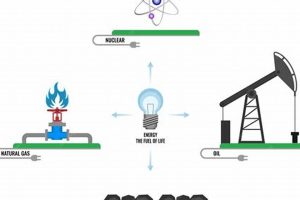
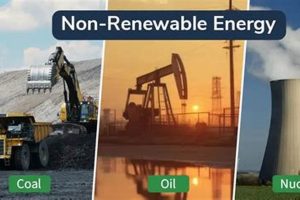
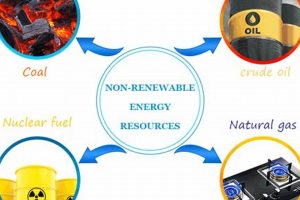
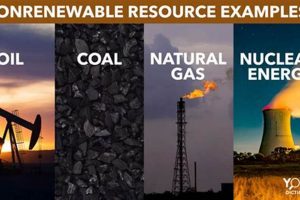
Crude oil, formed from the remains of ancient organisms over millions of years, is classified as a finite resource. Its formation is an extremely slow geological process, far outpacing the rate at which it is extracted and consumed. For example, the oil we use today originated from organic matter deposited during the Mesozoic Era, long before the emergence of humans. This stark contrast between formation timescale and consumption rate defines its non-renewable nature.
Understanding the finite nature of this crucial energy source is fundamental for shaping responsible energy policies and driving the development of alternative, sustainable energy sources. Historically, societies have heavily relied on it for transportation, industry, and power generation, leading to significant economic development. However, this reliance has also created environmental challenges, including greenhouse gas emissions and pollution. The realization of its limited supply has prompted research and investment in renewable energy technologies like solar, wind, and hydropower.
This discussion naturally leads to exploring several key related topics. These include the environmental impact of fossil fuel consumption, the geopolitical implications of oil dependency, and the technological advancements driving the transition towards a sustainable energy future.
Practical Steps Towards Sustainable Energy Consumption
Given the finite nature of fossil fuels, adopting practices that reduce reliance on these resources is crucial. The following tips offer practical guidance for transitioning towards more sustainable energy consumption patterns.
Tip 1: Improve Energy Efficiency at Home: Simple measures such as upgrading to energy-efficient appliances, using LED lighting, and improving insulation can significantly reduce energy consumption and lower household costs.
Tip 2: Embrace Sustainable Transportation: Opting for public transportation, cycling, walking, or carpooling reduces reliance on individual gasoline-powered vehicles. Consider investing in electric or hybrid vehicles where feasible.
Tip 3: Support Renewable Energy Sources: Explore opportunities to support and utilize renewable energy sources. This may include installing solar panels, participating in community solar projects, or choosing electricity providers that prioritize renewable energy.
Tip 4: Advocate for Policy Changes: Support policies that promote renewable energy development, energy efficiency standards, and sustainable transportation initiatives. Engaging in local and national advocacy efforts can drive systemic change.
Tip 5: Reduce, Reuse, and Recycle: Minimizing consumption and waste reduces the demand for products manufactured using fossil fuels. Prioritizing reusable items and actively participating in recycling programs contribute to resource conservation.
Tip 6: Educate and Engage Others: Sharing knowledge about sustainable energy practices with family, friends, and colleagues can amplify the impact of individual actions and foster a broader shift towards responsible energy consumption.
Adopting these practices not only reduces reliance on finite resources but also contributes to a cleaner, more sustainable future. These individual actions, when combined, create a significant collective impact.
These practical steps provide a foundation for building a more sustainable energy future. The transition away from dependence on non-renewable resources is a complex but necessary undertaking.
1. Formation
The formation of oil occurs over vast geological timescales, a critical factor in its classification as a non-renewable resource. Understanding these timescales is essential for grasping the implications of its consumption and the urgency of transitioning to sustainable alternatives.
- Organic Matter Accumulation:
Oil formation begins with the accumulation of vast quantities of organic matter, primarily from microscopic marine organisms, in sedimentary basins. This process occurs over millions of years, as organisms die and settle to the ocean floor, gradually building up thick layers of organic-rich sediment. The sheer timescale of this process highlights the non-renewable nature of the resulting resource.
- Diagenesis and Catagenesis:
As these organic-rich sediments are buried deeper, they are subjected to increasing pressure and temperature. This initiates a series of chemical and physical transformations, known as diagenesis and catagenesis. Over millions of years, these processes convert the organic matter into kerogen, a complex mixture of organic compounds. Continued heat and pressure then transform kerogen into hydrocarbons, the primary components of crude oil and natural gas. The extended duration of these processes further underscores the finite nature of these resources.
- Migration and Accumulation:
Once formed, hydrocarbons are less dense than surrounding rock and water, causing them to migrate upwards through porous and permeable rock formations. This migration can continue for millions of years until the hydrocarbons encounter a geological trap, such as an impermeable layer of rock. Trapped within these formations, the hydrocarbons accumulate, forming reservoirs of oil and natural gas. The protracted nature of migration and accumulation further reinforces the long timescales involved in resource formation.
- Timescale Comparison:
Comparing the geological timescales of oil formation, spanning millions of years, with the rate at which it is currently consumed, measured in decades, reveals a profound imbalance. This stark contrast emphasizes the finite nature of oil reserves and the unsustainable nature of current consumption patterns. The timescale discrepancy underscores the need for a shift towards renewable energy sources that can be replenished at a rate commensurate with human consumption.
The immense geological timescales involved in oil formation stand in stark contrast to the rate of its consumption. This fundamental disparity underscores the non-renewable nature of oil and the necessity of transitioning to sustainable energy practices and resources. The finite nature of this resource necessitates a shift towards renewable energy solutions and responsible resource management.
2. Replenishment rate

The exceedingly slow replenishment rate of oil is a defining characteristic of its non-renewable nature. Resources are considered renewable when their replenishment rate matches or exceeds the rate of consumption. Oil’s formation, requiring millions of years, occurs at a pace vastly slower than current consumption rates. This fundamental imbalance dictates its classification as a finite, non-renewable resource. Consider, for example, the extraction of a barrel of oil formed over millennia; its consumption within days or weeks highlights this disparity.
The practical implications of this slow replenishment rate are profound. Continued reliance on oil at current consumption levels inevitably leads to depletion. This underscores the critical need for strategies that mitigate this depletion trajectory. These strategies include developing alternative energy sources, enhancing energy efficiency, and fostering responsible consumption patterns. For instance, investments in solar and wind energy infrastructure directly address the limitations imposed by oil’s finite nature, contributing to a more sustainable energy landscape.
In summary, the geological timescales governing oil formation dictate its exceedingly slow replenishment rate. This inherent characteristic firmly establishes oil as a non-renewable resource. The practical consequences necessitate a global transition toward renewable energy sources and sustainable practices to ensure long-term energy security and mitigate the environmental impacts associated with fossil fuel dependence.
3. Consumption rate

The rapidly increasing consumption rate of oil significantly exacerbates the challenges posed by its non-renewable nature. While geological processes dictate the finite supply of this resource, the escalating demand accelerates its depletion, creating a critical juncture in the global energy landscape. Understanding the factors driving this escalating consumption is essential for formulating effective strategies for a sustainable energy future.
- Population Growth and Industrialization:
Global population growth and the industrialization of developing economies contribute significantly to rising oil demand. As populations expand and nations industrialize, the need for energy to power transportation, manufacturing, and other essential services intensifies. This surge in demand places increasing pressure on finite oil reserves, accelerating their depletion and highlighting the unsustainable nature of current consumption patterns.
- Rising Living Standards and Consumerism:
Increased living standards in many parts of the world correlate with higher energy consumption. Greater access to personal vehicles, air travel, and consumer goods contributes to a surge in oil demand. This escalating consumption, driven by rising affluence and consumerism, further strains limited oil resources and underscores the need for more sustainable consumption patterns.
- Technological Advancements and Energy Efficiency:
While technological advancements have led to improvements in energy efficiency in some sectors, these gains are often offset by increased demand. For instance, more fuel-efficient vehicles may encourage greater vehicle usage, ultimately leading to higher overall oil consumption. This dynamic illustrates the complex interplay between technology, efficiency, and demand, highlighting the need for comprehensive strategies to address the challenges of a finite resource.
- Lack of Widespread Adoption of Renewable Alternatives:
Despite significant advancements in renewable energy technologies, the global transition to these alternatives has not kept pace with the increasing demand for energy. Continued reliance on fossil fuels, particularly oil, to meet the growing energy needs of a rapidly developing world exacerbates the challenges associated with its finite nature. This underscores the urgency of accelerating the adoption of renewable energy solutions.
The rapidly increasing consumption rate of oil underscores the urgency of transitioning to a more sustainable energy future. This escalating demand, coupled with the finite nature of oil reserves, necessitates a multi-faceted approach that encompasses both supply-side and demand-side solutions. These solutions include investing in renewable energy technologies, improving energy efficiency, and promoting responsible consumption patterns. Failing to address this escalating consumption trajectory will inevitably lead to further depletion of this critical resource and exacerbate the associated economic and environmental challenges.
4. Resource classification

Resource classification as finite and non-renewable is central to understanding the nature of oil and its implications for long-term energy strategies. This classification directly addresses the question of whether oil is renewable or non-renewable, providing a framework for evaluating its sustainability and the need for alternative energy sources. A finite resource exists in a limited supply, while a non-renewable resource replenishes at a rate far slower than its consumption. Oil meets both criteria, necessitating careful consideration of its usage and the development of alternative energy solutions.
- Finite Supply:
The finite nature of oil reserves stems from the geological processes that formed them over millions of years. These processes are not readily repeatable on a human timescale, meaning the total amount of oil on Earth is essentially fixed. Extraction and consumption continuously diminish this finite supply, highlighting the unsustainable nature of complete reliance on this resource.
- Non-Renewable Nature:
The non-renewable classification of oil signifies its extremely slow replenishment rate. While small amounts of oil may continue to form through natural processes, the rate of formation is negligible compared to the rate of consumption. This disparity underscores the finite nature of this resource for practical purposes, as natural replenishment cannot keep pace with current or projected demand.
- Implications for Energy Security:
The finite, non-renewable nature of oil has profound implications for energy security. Dependence on a resource with a limited supply creates vulnerabilities to price volatility, geopolitical instability, and supply disruptions. Diversifying energy sources and transitioning to renewable alternatives mitigates these risks, enhancing long-term energy security.
- Environmental Consequences:
The extraction, processing, and combustion of oil contribute significantly to environmental challenges, including greenhouse gas emissions and pollution. The finite nature of this resource underscores the need for transitioning to cleaner energy sources to mitigate these environmental impacts and promote a sustainable future. Investing in renewable energy and adopting sustainable practices reduces reliance on this environmentally impactful resource.
Classifying oil as a finite, non-renewable resource directly answers the question of its renewability. This classification underscores the limitations of relying solely on oil for long-term energy needs and necessitates a shift toward renewable energy sources. The finite nature of this resource and its environmental impact necessitate a transition to sustainable alternatives for a secure and environmentally responsible energy future.
5. Sustainability implications

The non-renewable nature of oil carries significant sustainability implications, impacting diverse facets of environmental, economic, and social systems. Understanding these implications is crucial for navigating the transition towards a sustainable energy future and mitigating the risks associated with continued reliance on finite fossil fuels.
- Climate Change:
The combustion of oil releases greenhouse gases, primarily carbon dioxide, contributing significantly to climate change. This process intensifies the greenhouse effect, leading to rising global temperatures, altered weather patterns, and increased frequency of extreme weather events. The finite nature of oil necessitates a transition to renewable energy sources to mitigate these climatic impacts.
- Resource Depletion:
As a finite resource, oil is susceptible to depletion. Continuous extraction and consumption inevitably lead to diminishing reserves, potentially resulting in price volatility, supply disruptions, and economic instability. Sustainable practices, including resource conservation and the development of alternative energy sources, are crucial to address the challenges posed by resource depletion.
- Environmental Degradation:
Oil extraction and transportation pose significant environmental risks. Oil spills, habitat destruction, and air and water pollution are detrimental consequences associated with the oil industry. These environmental impacts underscore the need for responsible resource management and a shift towards less environmentally damaging energy sources.
- Geopolitical Instability:
Global reliance on oil contributes to geopolitical instability. Competition for dwindling resources can exacerbate international tensions and conflicts. Diversifying energy sources and reducing dependence on oil enhances energy security and mitigates the risks associated with geopolitical instability.
The significant sustainability implications of oil’s non-renewable nature underscore the urgency of transitioning towards a more sustainable energy future. This transition requires a multifaceted approach that includes investing in renewable energy technologies, improving energy efficiency, and fostering responsible consumption patterns. Addressing these sustainability challenges necessitates a global commitment to diversifying energy sources and mitigating the environmental and economic risks associated with continued reliance on finite fossil fuels.
Frequently Asked Questions
This section addresses common inquiries regarding the renewability of oil, providing clear and concise answers to clarify misconceptions and foster a deeper understanding of this critical energy resource.
Question 1: How long does it take for oil to form naturally?
Oil formation requires millions of years, involving complex geological processes transforming organic matter under immense pressure and heat. This timescale far exceeds human lifespans, rendering it effectively non-renewable.
Question 2: If oil comes from ancient organisms, why can’t it be considered renewable like other biological resources?
While derived from organic matter, oil’s formation timescale distinguishes it from renewable biological resources. Replenishment of biological resources like plants and animals occurs within timescales relevant to human use, unlike the geological epochs required for oil formation.
Question 3: What are the primary consequences of depleting oil reserves?
Oil depletion entails economic instability due to price volatility and potential supply disruptions. Furthermore, reliance on oil necessitates transitioning to alternative energy sources to maintain essential services.
Question 4: How does the classification of oil as non-renewable influence energy policy?
Recognizing oil’s non-renewable nature underscores the urgency for policies promoting energy conservation, efficiency improvements, and diversification of energy sources, emphasizing renewable alternatives. This recognition drives the development of sustainable energy strategies.
Question 5: Are there any ongoing processes that replenish oil reserves?
While some oil formation continues through natural processes, the rate is negligible compared to current consumption rates. This extremely slow replenishment renders oil effectively non-renewable for practical purposes, necessitating alternative energy solutions.
Question 6: What are the key differences between renewable and non-renewable energy sources?
Renewable energy sources replenish naturally within a human timescale, exemplified by solar, wind, and hydro power. Conversely, non-renewable resources like oil possess finite reserves formed over vast geological timescales, depleting with use.
Understanding the distinction between renewable and non-renewable resources, particularly concerning oil, is paramount for informing responsible energy consumption and supporting sustainable energy policies.
For further exploration of specific aspects related to oil and its impact, consult the subsequent sections detailing practical steps towards sustainable energy and exploring the future of energy resources.
Conclusion
The exploration of whether oil is renewable or non-renewable has unequivocally established its finite nature. Formed over vast geological timescales, its replenishment rate is inconsequential compared to the rapid pace of current consumption. This fundamental characteristic dictates its classification as a non-renewable resource, carrying significant implications for global energy security, economic stability, and environmental sustainability. The discussion encompassed the geological processes behind oil formation, the stark contrast between its formation and consumption rates, and the escalating global demand accelerating its depletion. The environmental consequences of continued reliance on this finite resource, including climate change and pollution, underscore the urgency of transitioning to more sustainable energy practices.
The finite nature of oil necessitates a paradigm shift in energy production and consumption. A global commitment to developing and implementing sustainable energy solutions is paramount. Diversification of energy portfolios, investment in renewable energy technologies, improvements in energy efficiency, and fostering responsible consumption patterns are critical steps towards mitigating the risks associated with oil depletion and ensuring a sustainable energy future for generations to come. The transition away from dependence on non-renewable resources represents a complex but essential undertaking, requiring collaborative efforts and innovative solutions to navigate the challenges and opportunities that lie ahead.