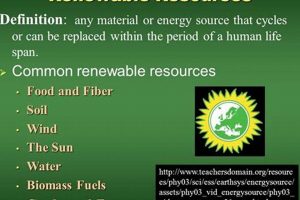
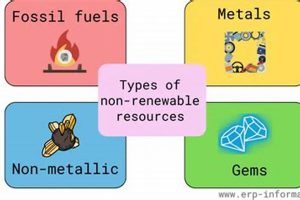
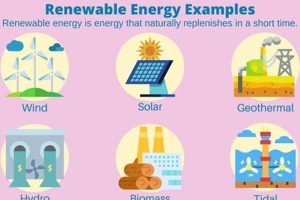
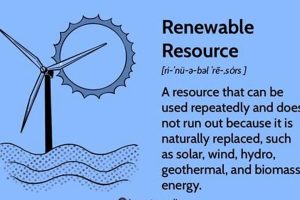
Energy resources, the foundation of modern society, are broadly categorized by their replenishment rates. One class, continuously replenished by natural processes, stands in contrast to those available in finite quantities, formed over geological timescales. The first category includes solar, wind, hydro, geothermal, and biomass. The other encompasses fossil fuels like coal, oil, and natural gas, as well as nuclear fuels such as uranium.
The distinction between these resource types carries significant implications for environmental sustainability, economic stability, and long-term energy security. Reliance on the exhaustible group presents challenges regarding resource depletion, geopolitical instability, and environmental degradation through pollution and greenhouse gas emissions. Conversely, a shift towards the constantly renewed resources fosters cleaner energy production, mitigates climate change, and promotes a more sustainable energy future.
The following sections will delve deeper into the characteristics, environmental impacts, economic considerations, and technological advancements associated with each type of energy resource, ultimately providing a detailed understanding of their respective roles in the global energy landscape.
Understanding the nuances between energy sources is crucial for informed decision-making across various sectors. The following points provide critical insights for evaluating energy options.
Tip 1: Assess Long-Term Availability: Examine the resource base for each energy type. Fossil fuels and uranium are finite and subject to depletion. Solar, wind, and other sources are constantly replenished.
Tip 2: Evaluate Environmental Impact: Quantify the pollution and greenhouse gas emissions associated with each energy production method. Renewable options generally have lower carbon footprints compared to combustion-based methods.
Tip 3: Analyze Economic Viability: Consider the levelized cost of energy (LCOE) for each resource, factoring in capital costs, operating expenses, and fuel prices. Renewable energy LCOE is steadily decreasing.
Tip 4: Understand Infrastructure Requirements: Recognize the existing infrastructure and potential grid upgrades required for integrating different energy sources. Renewable energy often necessitates distributed generation and grid modernization.
Tip 5: Account for Energy Storage Needs: Acknowledge the intermittency challenges associated with certain renewable energy sources. Investigate energy storage solutions like batteries or pumped hydro to ensure reliable power supply.
Tip 6: Consider Geopolitical Implications: Assess the geopolitical risks associated with reliance on specific energy sources, particularly those concentrated in certain regions. Diversifying energy sources can enhance energy security.
Tip 7: Investigate Technological Advancements: Stay informed on the latest technological developments in both renewable and non-renewable energy sectors. Efficiency improvements and cost reductions are constantly occurring.
These considerations are fundamental to creating sustainable energy policies and making informed investment decisions that benefit society and the environment.
The subsequent sections will explore the future trends and challenges in the energy sector, emphasizing the role of innovation and collaboration in shaping a more sustainable energy future.
1. Depletion Rate

Depletion rate serves as a central distinguishing factor in the comparison of energy resources. It addresses the speed at which reserves are consumed relative to their rate of natural replenishment, directly influencing long-term availability and sustainability.
- Fossil Fuel Exhaustion
Fossil fuels, including coal, oil, and natural gas, possess a finite supply formed over millions of years. Extraction and consumption far outpace natural formation, leading to a continuous reduction in available reserves. This depletion necessitates exploration for new sources and eventual transition to alternative energy systems.
- Renewable Resource Replenishment
Renewable energy sources, such as solar, wind, hydro, and geothermal, are characterized by continuous replenishment through natural processes. Solar radiation, wind currents, and water cycles provide an inexhaustible supply, although the harnessing rate can vary. This characteristic offers inherent sustainability advantages compared to depleting resources.
- Impact on Future Generations
The rate at which non-renewable resources are depleted carries direct implications for future generations. Rapid consumption reduces the availability of these resources, potentially limiting access and increasing costs for subsequent societies. A responsible management approach necessitates minimizing unnecessary consumption and prioritizing renewable alternatives.
- Economic and Geopolitical Implications
Depletion rate influences economic and geopolitical dynamics. As reserves decline, extraction costs may increase, impacting energy prices. Dependence on specific regions for diminishing resources can create geopolitical vulnerabilities, highlighting the strategic importance of diversifying energy sources and transitioning to renewable alternatives.
The contrasting depletion rates underscore the fundamental difference between renewable and non-renewable energy resources. Recognizing these disparities is crucial for implementing sustainable energy policies that ensure long-term energy security and environmental stewardship.
2. Environmental Impact

Environmental consequences represent a core element in differentiating between resource types. Energy production methods yield varied environmental burdens, significantly influencing air quality, water resources, land use, and climate stability. Examining these effects provides crucial insights for informed energy policy.
Combustion of fossil fuels like coal and oil is a primary contributor to greenhouse gas emissions, driving climate change and its associated impacts, including sea-level rise, extreme weather events, and ecosystem disruptions. Furthermore, these processes release pollutants, such as sulfur dioxide and nitrogen oxides, which contribute to acid rain and respiratory problems. In contrast, renewable sources such as solar and wind offer minimal greenhouse gas emissions during operation. While manufacturing and deployment of renewable infrastructure incur some environmental costs, these are generally less intensive compared to fossil fuels. Hydroelectric dams, while renewable, can alter river ecosystems and impact fish migration patterns, representing a contrasting example of renewable environmental impact. Extraction of resources like uranium can also release harmful pollutants.
An understanding of the total lifecycle environmental impactencompassing extraction, processing, transportation, operation, and disposalis vital for assessing the sustainability of energy options. A comprehensive comparison necessitates quantifying and contrasting these diverse environmental burdens. Effective energy policy requires prioritization of energy sources that minimize environmental damage and promote ecosystem integrity. Transitioning to energy systems with reduced environmental impact is crucial for mitigating climate change and securing environmental resources for future generations.
3. Energy Security

Energy security, defined as the reliable and affordable supply of energy, is intrinsically linked to the choices made regarding resource utilization. A thorough analysis of renewable and non-renewable energy resources reveals distinct implications for a nation’s ability to maintain a stable and accessible energy supply.
- Diversification of Energy Sources
Dependence on a limited number of energy sources, particularly those concentrated in specific geographic regions, creates vulnerability to supply disruptions. Renewable energy technologies, utilizing resources available in diverse locations, offer opportunities to decentralize energy production and reduce reliance on volatile global markets. For example, a nation heavily reliant on imported natural gas may enhance its energy security by developing domestic solar, wind, or geothermal resources.
- Resilience to Geopolitical Instability
Non-renewable energy resources, particularly oil and natural gas, are often subject to geopolitical instability and price fluctuations due to conflicts, political tensions, and cartel influence. Renewable energy, with its geographically distributed nature and reliance on domestic resources, mitigates these geopolitical risks. Investment in renewable infrastructure strengthens a nation’s ability to withstand external shocks to the energy supply chain.
- Infrastructure Vulnerability
Centralized energy systems relying on long-distance pipelines or transmission lines are susceptible to disruptions from natural disasters, cyberattacks, or infrastructure failures. Distributed renewable energy systems, with smaller-scale generation units located closer to end-users, enhance resilience by providing backup power and reducing dependence on vulnerable infrastructure. Microgrids incorporating renewable energy sources offer enhanced energy security for critical facilities during grid outages.
- Long-Term Price Stability
Fossil fuel prices are subject to volatility due to fluctuating supply and demand, geopolitical events, and resource depletion. Renewable energy, with its minimal fuel costs and decreasing technology costs, offers the potential for long-term price stability and predictability. Fixed-price power purchase agreements for renewable energy projects provide protection against future fossil fuel price increases.
These facets illustrate how energy security is directly influenced by the choice between renewable and non-renewable resources. A balanced energy portfolio, prioritizing diversification and incorporating distributed renewable generation, enhances a nation’s resilience to supply disruptions, geopolitical instability, and price volatility. Strategic investment in renewable energy infrastructure is essential for achieving long-term energy security and economic stability.
4. Cost Effectiveness

Cost effectiveness is a pivotal consideration in evaluating diverse energy resources. The economic viability of a given energy source directly influences its adoption and widespread implementation. When comparing renewable and non-renewable sources, a comprehensive cost analysis must extend beyond immediate fuel prices and consider long-term factors such as capital investment, operational expenses, environmental liabilities, and societal benefits.
Traditionally, fossil fuels have exhibited a cost advantage due to established infrastructure and economies of scale. However, evolving technological advancements and policy incentives are progressively altering this dynamic. The levelized cost of energy (LCOE), which represents the average net present cost of electricity generation for a power plant over its lifetime, is increasingly competitive for renewable sources like solar and wind. Declining manufacturing costs for solar panels and wind turbines, coupled with government subsidies and carbon pricing mechanisms, enhance the economic attractiveness of these alternatives. Conversely, non-renewable sources face escalating costs related to resource extraction, environmental remediation, and carbon capture technologies. For instance, the decommissioning of nuclear power plants poses substantial long-term financial burdens. A life-cycle cost assessment reveals that the total cost of energy from renewable sources can be comparatively lower, particularly when considering externalities like healthcare costs associated with air pollution from fossil fuel combustion.
Therefore, a holistic cost-effectiveness evaluation necessitates integrating environmental and social costs alongside direct economic indicators. Policy decisions that prioritize long-term sustainability and account for the full spectrum of costs and benefits will facilitate a transition towards energy systems that are both environmentally sound and economically viable. Ignoring the true cost of non-renewable energy, including its environmental and health impacts, can lead to suboptimal resource allocation and hinder the development of a truly sustainable energy future.
5. Technological Maturity

Technological maturity serves as a critical axis for differentiating between renewable and non-renewable energy resources. The level of technological development directly impacts efficiency, cost-effectiveness, scalability, and overall reliability. While fossil fuel technologies, such as coal-fired power plants and internal combustion engines, represent mature and established systems, renewable energy technologies exhibit a varying degree of development. Hydroelectric power, for instance, is a well-established renewable technology with a long history of successful implementation. In contrast, technologies such as wave energy converters or advanced geothermal systems are still under development and demonstration.
The maturity of a technology significantly affects its commercial viability and deployment potential. Mature technologies benefit from economies of scale, established supply chains, and well-defined regulatory frameworks, reducing investment risks and facilitating widespread adoption. Immature technologies, on the other hand, often face higher initial costs, performance uncertainties, and regulatory hurdles, hindering their market penetration. The rapid growth of solar photovoltaic (PV) technology provides a clear example of how increasing technological maturity can drive down costs and accelerate deployment. Continuous advancements in PV cell efficiency, manufacturing processes, and grid integration technologies have made solar power increasingly competitive with traditional fossil fuel-based generation.
In conclusion, the technological maturity of energy resources plays a vital role in shaping the energy landscape. Recognizing the varying levels of development across different technologies is crucial for informed energy policy and investment decisions. Continued research, development, and demonstration efforts are essential to advance the maturity of promising renewable energy technologies, unlocking their full potential to contribute to a sustainable and secure energy future. Addressing the technological challenges associated with energy storage, grid integration, and resource availability will be particularly critical for accelerating the transition to a renewable-dominated energy system.
6. Scalability Potential
Scalability potential represents a fundamental criterion in the evaluation and differentiation of energy resources. The capacity of a resource to meet growing energy demands effectively and sustainably directly impacts its long-term viability and role in a global energy transition.
- Resource Availability and Geographic Distribution
Non-renewable resources are inherently limited by the finite nature of their reserves and their uneven geographic distribution. Scalability is constrained by the depletion of resources and geopolitical factors influencing access. Conversely, renewable resources, particularly solar and wind, benefit from near-ubiquitous availability, offering greater scalability potential across diverse geographic regions. For example, while oil production is concentrated in specific regions, solar energy can be harnessed virtually anywhere with sufficient sunlight.
- Infrastructure Requirements and Grid Integration
Scaling up energy production necessitates corresponding infrastructure development. Fossil fuel infrastructure, including pipelines and refineries, involves substantial capital investment and potential environmental impacts. Renewable energy scalability often requires grid modernization and enhanced energy storage capabilities to address intermittency. The deployment of smart grids and advanced battery technologies is crucial for accommodating the variable output of solar and wind power on a large scale.
- Environmental Constraints and Land Use
Scaling up energy production can lead to increased environmental consequences, particularly for non-renewable resources. Expanded coal mining operations or offshore oil drilling can result in habitat destruction and water pollution. Renewable energy also faces environmental challenges, such as land use considerations for solar farms or wind turbine installations. Sustainable scalability requires careful planning and mitigation strategies to minimize environmental impacts and ensure responsible land management.
- Technological Innovation and Cost Reduction
Technological innovation plays a critical role in enhancing the scalability of energy resources. Advancements in drilling techniques, such as hydraulic fracturing, have unlocked previously inaccessible reserves of natural gas, albeit with environmental concerns. Similarly, advancements in solar cell efficiency, wind turbine design, and energy storage technologies are driving down costs and improving the scalability of renewable energy systems. Continuous innovation is essential for realizing the full scalability potential of both renewable and non-renewable energy resources.
The scalability potential of energy resources is a complex interplay of resource availability, infrastructure requirements, environmental constraints, and technological innovation. Recognizing these interconnected factors is essential for developing sustainable energy strategies that can meet growing energy demands while minimizing environmental impacts and ensuring long-term energy security. A diversified energy portfolio, leveraging the strengths of both renewable and non-renewable resources while addressing their respective limitations, is crucial for achieving a scalable and sustainable energy future.
Frequently Asked Questions
This section addresses common inquiries concerning the characteristics, applications, and implications of renewable and non-renewable energy resources.
Question 1: What is the fundamental difference between renewable and non-renewable energy resources?
The primary distinction lies in the rate of replenishment. Renewable resources, such as solar, wind, and hydro, are naturally replenished at a rate comparable to their consumption. Non-renewable resources, including fossil fuels and uranium, exist in finite quantities and are depleted much faster than they can be naturally replenished.
Question 2: How do renewable and non-renewable energy sources differ in their environmental impact?
Non-renewable energy sources generally have a greater environmental impact due to emissions of greenhouse gases and pollutants during extraction, processing, and combustion. Renewable sources typically have lower emissions during operation, although environmental impacts can occur during manufacturing and construction of renewable energy infrastructure.
Question 3: What are the primary advantages and disadvantages of relying on renewable energy sources?
Advantages include reduced greenhouse gas emissions, long-term resource availability, and energy security. Disadvantages can include intermittency of supply (particularly for solar and wind), land use requirements, and the need for energy storage solutions.
Question 4: What are the primary advantages and disadvantages of relying on non-renewable energy sources?
Advantages include high energy density, established infrastructure, and reliable supply (in many cases). Disadvantages include resource depletion, greenhouse gas emissions, air and water pollution, and geopolitical risks associated with resource distribution.
Question 5: Is renewable energy always more environmentally friendly than non-renewable energy?
While renewable energy generally has a lower environmental impact than non-renewable energy, it is not always the case. The environmental impact of any energy source depends on the specific technology used, the location, and the life cycle emissions associated with the extraction, processing, and disposal of materials.
Question 6: What role does energy storage play in the transition to a renewable energy future?
Energy storage technologies, such as batteries and pumped hydro, are essential for addressing the intermittency of renewable energy sources like solar and wind. They allow energy to be stored when it is abundant and released when it is needed, providing a more reliable and consistent energy supply.
Understanding these distinctions is crucial for informing energy policy and investment decisions that promote a sustainable and secure energy future.
The concluding section will offer a summary of key considerations and provide a forward-looking perspective on the future of energy resources.
Conclusion
The preceding exploration of “compare and contrast renewable and non-renewable energy resources” has illuminated critical distinctions between these energy sources. While non-renewable resources offer established infrastructure and high energy density, their finite nature and significant environmental impacts present substantial challenges. Conversely, renewable resources, despite requiring continued technological advancements and infrastructure development, provide a sustainable pathway toward energy security and environmental stewardship. The divergence in depletion rates, environmental consequences, and scalability potential underscores the need for a nuanced and informed approach to energy policy.
The future energy landscape demands a strategic transition that recognizes the inherent limitations of non-renewable resources while embracing the potential of renewable alternatives. Prioritizing investment in research, development, and deployment of renewable technologies, coupled with responsible management of existing resources, is essential for ensuring a sustainable and secure energy future for generations to come. The decisions made today will irrevocably shape the environmental and economic well-being of tomorrow, necessitating a commitment to informed action and long-term vision.
![Guide to What Energy Resources Are Renewable [+Future] | Renewable Energy Solutions for a Sustainable Future | Clean & Green Power](https://pplrenewableenergy.com/wp-content/uploads/2026/03/th-516-300x200.jpg "Guide to What Energy Resources Are Renewable [+Future] Renewable Energy Solutions for a Sustainable Future | Clean & Green Power")