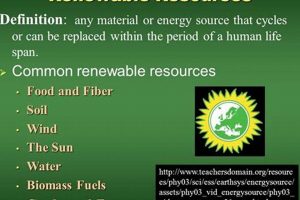
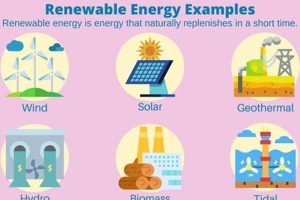
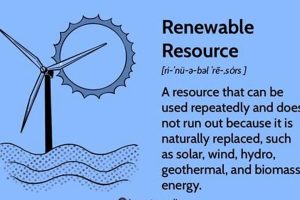
A naturally replenished resource, capable of being used repeatedly because it is replaced faster than it is consumed, is a critical element in sustainable practices. Examples include solar energy, wind power, geothermal energy, and biomass. These sources offer a viable alternative to finite supplies.
The utilization of these resources is essential for mitigating environmental impact and promoting long-term energy security. Historically, societies have relied on such sources, but increased reliance on finite options led to resource depletion and pollution. A renewed focus on these resources offers a pathway to reduce greenhouse gas emissions and lessen dependence on volatile global markets.
The following sections will delve into the specific characteristics, applications, and challenges associated with the implementation and further development of these sustainable energy sources.
Renewable Resource Management
Effective utilization hinges on informed strategies that maximize efficiency and minimize environmental impact. The following points outline key considerations for governments, industries, and individuals.
Tip 1: Prioritize Investment in Research and Development: Enhanced technological innovation is crucial for improving the efficiency and cost-effectiveness of renewable energy systems. Funding for basic research and applied engineering can accelerate the deployment of emerging technologies.
Tip 2: Implement Supportive Policy Frameworks: Governments should enact policies that incentivize adoption, such as tax credits, feed-in tariffs, and renewable portfolio standards. These mechanisms create stable markets and encourage private sector investment.
Tip 3: Diversify Energy Sources: Relying on a single supply introduces vulnerabilities. A diversified portfolio incorporating solar, wind, hydro, and geothermal reduces risk and ensures a more resilient energy supply.
Tip 4: Enhance Grid Infrastructure: Modernizing the electrical grid is essential for integrating intermittent sources, such as solar and wind. Investments in smart grids, energy storage, and transmission infrastructure are necessary to ensure reliability.
Tip 5: Promote Energy Efficiency: Reducing overall demand lowers the pressure on supply and maximizes the impact of existing installations. Building codes, appliance standards, and public awareness campaigns can drive significant improvements in energy efficiency.
Tip 6: Foster Public-Private Partnerships: Collaboration between governments, businesses, and research institutions accelerates innovation and deployment. These partnerships leverage the strengths of each sector to achieve common goals.
Tip 7: Conduct Thorough Environmental Impact Assessments: It is crucial to understand and mitigate the potential environmental impacts of projects, even if they are environmentally friendly, to ensure sustainable development and long-term resilience.
Adopting these strategies will contribute to a more sustainable and secure energy future, while also fostering economic growth and mitigating the effects of climate change.
The subsequent sections will explore specific case studies and address challenges associated with the widespread integration of these environmentally friendly alternatives.
1. Replenishment Rate

Replenishment rate is a fundamental parameter in determining whether a resource qualifies under its definition. It dictates the long-term availability and sustainability of a given supply. Without an adequate rate, a resource, irrespective of other favorable attributes, cannot be considered renewable.
- Quantifying Renewal Capacity
Replenishment rate is measured in terms of the time required for a supply to return to its original level after depletion. For solar energy, the rate is constant and instantaneous. For biomass, it depends on plant growth rates, which can vary widely. Accurate quantification is vital for developing sustainable usage strategies.
- Sustainable Extraction Thresholds
The rate directly influences sustainable extraction thresholds. Harvesting or consumption must not exceed the rate, or else the resource will gradually diminish. In forestry, this equates to harvesting only the timber volume that the forest can regenerate within a given timeframe. Exceeding thresholds leads to depletion and undermines long-term viability.
- Impact of Human Activities on Renewal
Human actions can significantly alter the replenishment. Deforestation reduces biomass renewal, while pollution can hinder water cycles and negatively impact hydroelectric supplies. Sustainable practices must account for and mitigate these impacts to maintain acceptable renewal levels.
- Technological Influence on Acceleration
Technology can play a role in accelerating renewal. Reforestation efforts, improved agricultural practices, and optimized harvesting techniques can all enhance the rate. These technological interventions are crucial for managing resource availability in the face of increasing demand.
In summary, the rate is an intrinsic characteristic that dictates whether a supply can be used repeatedly without depletion. It is intertwined with extraction thresholds, human impact, and technological intervention, all crucial considerations in adhering to the core meaning of naturally replenishing resources.
2. Sustainable Yield

Sustainable yield is inextricably linked to the concept of a replenishable resource, representing the maximum rate at which a resource can be extracted without compromising its ability to regenerate and be available in the future. This concept is crucial for effective management and ensuring long-term usability.
- Balancing Extraction and Regeneration
Sustainable yield necessitates a careful equilibrium between the rate of extraction and the rate of natural regeneration. If extraction exceeds regeneration, the resource base diminishes, ultimately leading to depletion. In fisheries management, this translates to setting catch limits that allow fish populations to maintain healthy breeding stocks, ensuring future harvests.
- Dynamic Assessment and Adjustment
Sustainable yield is not a static value; it requires dynamic assessment and adjustment based on environmental factors, ecosystem health, and resource dynamics. Climate change, habitat loss, and pollution can all affect regeneration rates. Adaptive management strategies are essential to adjust extraction levels in response to these changes, preserving the resource’s long-term availability.
- Economic and Ecological Interdependence
The pursuit of sustainable yield balances economic benefits with ecological integrity. Maximizing short-term profits through over-extraction can lead to long-term economic losses due to resource depletion and ecosystem degradation. Sustainable practices that prioritize long-term resource health often lead to more stable and predictable economic returns.
- Monitoring and Enforcement Mechanisms
Effective monitoring and enforcement mechanisms are critical for ensuring adherence to sustainable yield principles. Regular resource assessments, compliance checks, and penalties for over-extraction are necessary to prevent depletion. These measures require strong governance and collaboration among stakeholders to be effective.
In essence, sustainable yield operationalizes the meaning of resource renewal by providing a practical framework for resource management. It ensures that the act of extraction does not undermine the very essence of the resource, making it a cornerstone of sustainable development and environmental stewardship.
3. Environmental Impact

Environmental impact is a critical consideration in evaluating whether a resource truly aligns with the meaning of “renewable.” While a resource may be replenished, the environmental consequences of its extraction, processing, and utilization must be carefully assessed to ensure its overall sustainability.
- Life Cycle Assessment
A comprehensive life cycle assessment (LCA) is essential to evaluate the full environmental burden of utilizing a resource. This includes examining impacts from raw material extraction, manufacturing, transportation, use, and end-of-life disposal or recycling. Even resources like solar panels and wind turbines have environmental footprints associated with their production and eventual decommissioning.
- Ecosystem Disruption
Extraction and use can disrupt ecosystems and affect biodiversity. Hydroelectric dams, while harnessing replenishable water flow, can alter river ecosystems, fragment habitats, and impact fish migration. Similarly, large-scale biomass cultivation can lead to deforestation and loss of biodiversity if not managed sustainably.
- Pollution and Emissions
Renewable energy systems are not inherently free from pollution. Biomass combustion can release particulate matter and greenhouse gases, albeit potentially less than fossil fuels. Geothermal energy extraction may release trace amounts of greenhouse gases and other pollutants. The overall impact on air and water quality needs careful consideration.
- Resource Depletion and Land Use
The demand for certain materials used in renewable energy technologies, such as rare earth elements in wind turbine magnets or lithium in batteries, can lead to resource depletion in specific regions and potentially harmful mining practices. Furthermore, large-scale solar and wind farms require significant land areas, which can impact land use patterns and ecological habitats.
Ultimately, resources deemed “renewable” must demonstrate a net positive environmental impact compared to finite alternatives. This requires rigorous assessment, responsible management, and continuous innovation to minimize their ecological footprint and maximize their contribution to a sustainable future.
4. Resource Lifecycle
The lifecycle of a resource, encompassing its extraction, processing, utilization, and eventual disposal or recycling, is inextricably linked to its categorization. A comprehensive understanding of this lifecycle is crucial for determining whether a resource truly adheres to the definition of one that is replenishable.
- Extraction and Acquisition Phase
The initial phase, involving the harvesting or collection of the resource, has significant implications. For solar energy, it entails manufacturing solar panels. For biomass, it includes cultivation and harvesting. This phase’s energy intensity, material usage, and potential for habitat disruption directly impact the resource’s overall sustainability. Resources relying on environmentally intensive extraction processes may challenge their status as viable alternatives.
- Processing and Transformation Stage
The processing and transformation of the resource into a usable form demand careful consideration. The refining of biofuels, the manufacturing of wind turbine components, and the construction of hydroelectric dams all require energy and resources. The efficiency of these processes and the emissions generated significantly influence the resource’s net environmental benefit. Processes that consume excessive energy or produce substantial pollution may negate the perceived advantages.
- Utilization and Application Phase
The manner in which the resource is utilized also affects its lifecycle impact. Efficient energy conversion, reduced waste generation, and responsible consumption patterns are crucial. For instance, optimizing the efficiency of solar panels or implementing smart grid technologies to minimize energy losses during transmission enhances the sustainability of solar energy. Conversely, inefficient or wasteful utilization patterns can undermine the resource’s benefits.
- End-of-Life Management
The end-of-life management of a resource is a critical aspect. The recyclability and disposability of components and materials determine the long-term environmental footprint. The proper recycling of solar panels, wind turbine blades, and batteries is essential to prevent the accumulation of waste and the release of hazardous materials into the environment. Effective end-of-life management practices are necessary to ensure that resources remain consistent with sustainability principles.
In summary, a comprehensive assessment of the resource lifecycle is essential for evaluating its true sustainability. Resources deemed replenishable must demonstrate a net positive environmental impact throughout their lifecycle, considering all phases from extraction to disposal. Neglecting any stage can lead to a mischaracterization of the resource’s benefits and undermine its contribution to long-term sustainability goals.
5. Economic Viability

Economic viability constitutes a pivotal element within the scope of resource renewal. Its presence or absence fundamentally influences the practical application and widespread adoption of resources classified as naturally replenishing. A resource may possess favorable environmental attributes and inherent renewability, yet its practical impact remains limited without economic competitiveness in the energy market. This competitiveness hinges on factors such as capital costs, operating expenses, and energy production efficiency. Solar energy, for example, has witnessed increased deployment due to decreasing manufacturing costs and improving energy conversion rates, enhancing its economic attractiveness relative to fossil fuels.
The interplay between economic considerations and renewability extends to policy and investment decisions. Governmental incentives, such as tax credits and feed-in tariffs, are often implemented to bolster the economic viability of developing technologies. These mechanisms aim to reduce the initial capital investment burden and ensure a stable revenue stream for generating facilities, thereby attracting private sector investment and accelerating deployment. Conversely, the absence of supportive economic policies can impede the widespread adoption of even the most environmentally promising solutions, hindering their contribution to sustainable energy portfolios. Hydropower projects, for instance, may face economic challenges due to high upfront construction costs and long payback periods, despite their ability to generate substantial quantities of energy over extended lifespans.
In conclusion, economic viability is not merely a desirable feature, but a critical determinant of whether a resource can effectively contribute to a sustainable energy future. Overcoming economic barriers through technological innovation, supportive policies, and efficient resource management is essential to unlocking the potential of resources classified as naturally replenishing. Addressing economic challenges ensures that these energy sources can effectively compete with conventional alternatives, leading to a transition towards a more sustainable and resilient energy system. This understanding underscores the practical significance of integrating economic analysis into resource evaluation and development strategies, paving the way for widespread acceptance and utilization.
6. Technological Feasibility
Technological feasibility acts as a gatekeeper for the practical manifestation of the resource definition. While a resource might inherently possess the characteristic of natural replenishment, its accessibility and utility are contingent upon the existence and application of appropriate technologies. The ability to harness wind energy, for instance, relies on the development and deployment of wind turbines, power grids capable of integrating fluctuating energy supplies, and energy storage solutions to address intermittency. Without these technological components, wind, regardless of its renewability, remains an untapped potential. The economic viability and environmental impact assessments are implicitly linked to technology; less efficient or material-intensive techniques reduce their value.
The development of more efficient photovoltaic cells provides a case in point. Early solar technology suffered from low conversion rates and high production costs, limiting its widespread adoption. Subsequent advances in materials science and manufacturing processes led to a dramatic increase in cell efficiency and a reduction in production costs. This illustrates the importance of ongoing technological advancement in increasing the practicality and competitiveness of renewable resources. Similar examples can be found in geothermal energy, where enhanced geothermal systems are attempting to extract energy from previously inaccessible resources. The practical adoption of biofuel is influenced heavily by catalytic processes and the sustainability of agricultural management.
In conclusion, technological feasibility is a crucial determinant in realizing the potential of resource renewability. The definition of a resource, therefore, incorporates the element of accessible and practical technology that enables its utilization in a sustainable and economically viable manner. Challenges in this domain require ongoing research, development, and deployment of advanced technologies to maximize the impact of naturally replenishing resources and facilitate the transition to a sustainable energy future. The development of novel material, better power management are example for enhancing that goals.
7. Long-term Availability

Long-term availability forms the cornerstone of the definition of a resource suitable for sustained human use. The characteristic of natural replenishment, inherent in resources classified as such, directly contributes to its continued existence over extended periods. Without this sustained existence, the resource cannot serve as a reliable foundation for long-term energy planning, economic development, or environmental sustainability initiatives. A resource’s potential for renewal is only meaningful if the rate of that renewal ensures availability for future generations, effectively mitigating the risks associated with resource depletion. Solar energy, for example, derives its value from the predictable and continuous supply of solar irradiance, a factor that is expected to persist for billions of years. Wind resources, similarly, benefit from weather patterns that, while variable, provide a consistent potential for energy generation over the long term.
The practical significance of considering long-term availability lies in its influence on infrastructure investments, technological development, and policy decisions. Power plants, transmission lines, and manufacturing facilities built around these sources require substantial capital outlays. The justification for these investments hinges on the assurance that the resources will remain accessible and productive for the duration of their operational lifecycles. Policy frameworks, such as renewable portfolio standards and carbon reduction targets, rely on the predictable contribution of resources to meeting long-term environmental goals. Uncertainty regarding a resource’s long-term availability can create instability in energy markets and hinder the development of sustainable economic strategies. For instance, improperly managed forestry practices leading to deforestation diminish the quantity of biomass available, thereby jeopardizing the viability of long-term bioenergy projects. This demonstrates how even inherently naturally replenishing materials, when not managed effectively, can see a decrease in long-term accessibility.
In summary, long-term availability is not merely a desirable attribute but a defining characteristic. Its presence validates its categorization and establishes its role as a foundation for sustainable development strategies. The absence of guaranteed access jeopardizes the economic viability and environmental sustainability of resource-dependent systems. Safeguarding resources for future use necessitates responsible resource management practices, forward-thinking policy frameworks, and a commitment to technological innovation that ensures continued availability. Resources must be evaluated not only on current conditions but on a projection of ongoing accessibility. This holistic approach is crucial for ensuring sustainability.
Frequently Asked Questions Regarding Renewable Resource Definitions
This section addresses common inquiries and misconceptions concerning the concept of naturally replenishing resources. The following questions and answers aim to provide clarity and promote a deeper understanding of this important topic.
Question 1: What fundamentally distinguishes a naturally replenished resource from a finite resource?
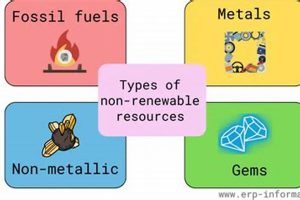
A key differentiator is the capacity for natural regeneration. Finite resources, such as fossil fuels and minerals, are consumed at a rate exceeding their rate of formation, leading to depletion. Conversely, naturally replenished resources are restored at a rate comparable to or exceeding their rate of consumption, ensuring long-term availability.
Question 2: Does the term “renewable” automatically imply environmental sustainability?
While often associated with environmental benefits, it does not inherently guarantee sustainability. The environmental impact associated with extraction, processing, utilization, and disposal must be carefully assessed to determine its overall sustainability. Sustainable management practices are essential to minimize potential negative impacts.
Question 3: How does the concept of “sustainable yield” relate to the definition?
Sustainable yield defines the maximum rate at which a resource can be extracted without compromising its ability to regenerate and be available for future use. Maintaining extraction levels below this threshold is crucial for ensuring the long-term sustainability.
Question 4: What role does technology play in maximizing the potential of these resources?
Technology plays a critical role in enhancing efficiency, reducing costs, and improving the environmental performance. Advancements in areas such as energy conversion, storage, and resource management are essential for unlocking the full potential and facilitating widespread adoption.
Question 5: Are all naturally replenishing resources equally reliable and accessible?
No. Resource availability can vary significantly based on geographic location, climatic conditions, and other factors. Furthermore, some resources, such as solar and wind, are intermittent, requiring energy storage solutions to ensure a consistent and reliable supply. Factors like government regulations, or availability of skilled workers, also play vital roles in accessibility.
Question 6: How can individuals contribute to the sustainable use of these?
Individuals can contribute through various means, including adopting energy-efficient practices, supporting policies that promote renewable energy, reducing consumption, and making informed purchasing decisions that favor sustainably sourced products and services.
Understanding the nuances is essential for making informed decisions regarding energy policy, investment, and sustainable development practices.
The subsequent section will address specific case studies showcasing the successful implementation and challenges associated with resources that are naturally replenishing.
Conclusion
The preceding discussion has thoroughly explored the key elements inherent within the established “definition of renewable resource”. It is essential to emphasize that a comprehensive understanding of the resource concept extends beyond the simple notion of natural replenishment. Factors such as replenishment rate, sustainable yield, environmental impact, resource lifecycle, economic viability, technological feasibility, and long-term availability are equally critical for determining a resource’s suitability as a sustainable energy or material source. Ignoring any of these elements can lead to mischaracterization and ultimately unsustainable practices.
Moving forward, informed decision-making in resource management and energy policy necessitates a holistic assessment process. Investments and policies aimed at promoting resource utilization should consider the interconnectedness of these elements to ensure genuinely sustainable outcomes. Only through a rigorous and comprehensive application of the framework will societies successfully harness the potential of resources, secure long-term environmental benefits, and foster a sustainable future for coming generations.
![Guide to What Energy Resources Are Renewable [+Future] | Renewable Energy Solutions for a Sustainable Future | Clean & Green Power](https://pplrenewableenergy.com/wp-content/uploads/2026/03/th-516-300x200.jpg "Guide to What Energy Resources Are Renewable [+Future] Renewable Energy Solutions for a Sustainable Future | Clean & Green Power")