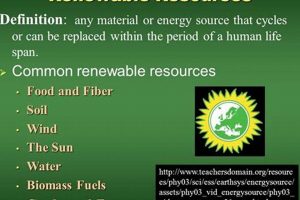
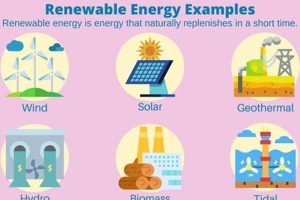
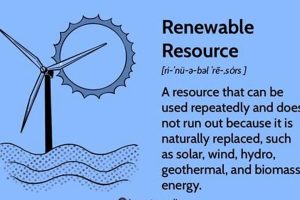
Harnessing naturally replenishing energy sources is paramount to sustainable development. These include sunlight, wind, geothermal heat, water movement, and biomass. Solar power utilizes photovoltaic cells to convert light into electricity, while wind turbines transform kinetic energy into usable power. Geothermal energy taps into the Earth’s internal heat, and hydroelectricity leverages the power of flowing water. Biomass involves burning organic matter for heat or electricity generation.
Adopting these sustainable solutions offers significant advantages. Dependence on finite fossil fuels decreases, mitigating carbon emissions and reducing air pollution. Promoting energy independence and security for nations is also a major benefit. Historically, communities have long relied on basic forms of these resources, such as watermills and windmills. Modern technology, however, allows for significantly more efficient and widespread use.
The subsequent sections will explore each of these individual solutions in more detail, examining their current technologies, environmental impacts, and potential for future growth within the energy sector. Consideration will be given to the practical implementation of these sources, alongside challenges related to infrastructure, cost, and land use.
Implementing Sustainable Energy Options
Effective utilization of naturally replenishing power sources requires careful planning and execution. The following guidelines address key considerations for successful implementation.
Tip 1: Prioritize Resource Assessment: Conduct thorough site-specific assessments to determine the availability and viability of individual power source. For instance, wind power viability depends on average wind speeds, while solar energy effectiveness is linked to average sunlight hours.
Tip 2: Optimize Technology Selection: Select technologies best suited to the available resource and energy needs. Advanced photovoltaic panels, for example, improve light-to-energy conversion. Similarly, select turbine sizes appropriate for anticipated water flow.
Tip 3: Integrate Energy Storage Solutions: Include energy storage capabilities to mitigate intermittency. Battery storage systems enhance the reliability of sunlight and wind power. Pumped hydro systems are a great option when using moving water for energy.
Tip 4: Implement Smart Grid Technologies: Integrate systems with smart grid technologies for efficient distribution and management. This improves the ability to balance energy supply and demand while stabilizing the grid.
Tip 5: Consider Life Cycle Costs: Evaluate the total cost, including installation, maintenance, and decommissioning, over the system’s lifespan. Although initial investment for may be high, long-term operational savings can provide a competitive advantage.
Tip 6: Address Environmental Impacts: Take proactive steps to minimize potential ecological impacts. Ensure proper fish passage at hydroelectric facilities, for example, and conduct thorough environmental impact assessments before beginning any construction.
Successful integration hinges on a holistic approach encompassing careful planning, appropriate technology, and proactive environmental stewardship. Adhering to these guidelines enhances the viability and sustainability of the power solution deployment.
The next section will further investigate obstacles encountered during deployment and explore prospective innovations that could reshape the future of power generation.
1. Sunlight availability

Sunlight availability stands as a fundamental determinant in the viability and efficiency of several naturally replenishing energy sources. Its predictable, yet variable, nature dictates the deployment strategies and technological considerations necessary for maximizing energy output.
- Photovoltaic Energy Conversion Efficiency
The intensity and duration of sunlight directly influence the amount of electricity generated by photovoltaic (PV) cells. Regions with higher solar irradiance, measured in kilowatt-hours per square meter per year (kWh/m/year), offer greater potential for PV system output. For example, the Southwestern United States experiences significantly higher sunlight availability compared to Northern Europe, directly impacting PV system performance. Cloud cover, atmospheric conditions, and seasonal variations also contribute to fluctuations in energy production. High sunlight availability is directly associated with higher energy generation.
- Solar Thermal Energy Systems
Concentrated solar power (CSP) systems, which utilize mirrors or lenses to focus sunlight onto a receiver, are also critically dependent on sunlight availability. These systems require direct sunlight, making them less effective in cloudy or diffuse light conditions. Locations with high direct normal irradiance (DNI) are ideal for CSP plants. For instance, the Atacama Desert in Chile, renowned for its clear skies and high DNI, is a prime location for CSP projects. The efficiency of these systems rises dramatically as direct exposure to sunlight is more persistent, improving their overall economic viability.
- Indirect Solar Resource Utilization
Sunlight’s influence extends beyond direct electricity generation. Solar energy drives the Earth’s weather patterns, influencing wind and wave energy. Differential heating of the atmosphere creates wind currents, a resource that can be tapped by wind turbines. Additionally, solar radiation warms oceans, generating wave energy, which can be harnessed by specialized devices. While not directly converting sunlight to energy, these methods still rely on it to initiate the kinetic processes that are subsequently harvested. The presence of steady and predictable insolation levels enhances the reliability and output of these secondary power methods.
- Energy Storage Integration
Because sunlight availability is intermittent, effective energy storage solutions are crucial. Batteries, pumped hydro storage, and thermal energy storage systems are employed to buffer the variability in solar energy generation. Areas with high sunlight availability but limited storage capacity may experience energy surpluses during peak hours and deficits at other times. Conversely, robust storage systems can smooth out the energy supply, making it more reliable and dispatchable. This facilitates a higher integration of sunlight-derived electricity into energy networks, improving grid stability and reducing reliance on other sources.
The interplay between sunlight availability, technological advancements, and strategic energy storage is paramount for maximizing the contribution of solar power within the broader context of diverse solutions. Effective solar deployment necessitates a comprehensive understanding of local sunlight patterns and the implementation of tailored strategies to optimize energy output. These are essential for a sustainable and resilient energy infrastructure.
2. Wind velocity patterns

Wind velocity patterns represent a critical factor in the efficacy and economic viability of wind power, one of the key naturally replenishing energy sources. Understanding and predicting these patterns is essential for optimizing wind turbine placement, energy production, and integration into existing grids.
- Turbine Placement Optimization
Accurate assessment of wind patterns is paramount for selecting optimal locations for wind turbines. High average wind speeds are generally desirable, but consistency and directionality also play significant roles. Locations exhibiting laminar flow and minimal turbulence ensure stable turbine operation and reduced mechanical stress. For example, wind farms located in mountain passes or coastal regions often benefit from consistently high wind velocities. Precise mapping of wind currents, incorporating both surface and upper-level data, facilitates strategic turbine placement to maximize energy capture.
- Energy Production Forecasting
Predictive models relying on historical and real-time wind data are critical for estimating power output from wind farms. These models incorporate factors such as wind speed, direction, and turbulence intensity to generate accurate forecasts. Short-term forecasts (hours to days) are essential for grid operators to manage power supply and demand, while long-term forecasts (months to years) inform investment decisions and infrastructure planning. The accuracy of these forecasts directly affects the reliability and economic viability of wind energy as a dispatchable power source.
- Grid Integration Challenges
The intermittent nature of wind energy poses significant challenges for grid integration. Fluctuations in wind velocity can lead to unpredictable power surges and drops, potentially destabilizing the electrical grid. Mitigation strategies include utilizing energy storage solutions (e.g., batteries, pumped hydro), employing advanced grid management technologies, and diversifying the energy portfolio with other power sources. Smoothing techniques, such as clustering wind farms across geographically diverse regions, can also help to reduce variability and enhance grid stability.
- Impact of Climate Change
Climate change is projected to alter wind patterns globally, potentially affecting the long-term viability of existing and planned wind farms. Shifting atmospheric circulation patterns and changes in temperature gradients could lead to alterations in wind speed and direction, impacting energy production and turbine lifespan. Comprehensive climate modeling and risk assessment are necessary to understand these potential impacts and adapt wind energy strategies accordingly. Investment in resilient infrastructure and adaptive management practices will be crucial for ensuring the long-term sustainability of wind power generation.
The complex interplay between wind velocity patterns, technological advancements, and climate change necessitates a holistic approach to wind energy development. Continuous monitoring, predictive modeling, and adaptive management strategies are crucial for maximizing the contribution of wind power to the broader landscape of naturally replenishing resources and ensuring a reliable and sustainable energy future. Furthermore, integrating high resolution weather forecast technologies could allow us to harness more potential from it.
3. Geothermal gradient mapping

Geothermal gradient mapping is intrinsically linked to the exploitation of geothermal energy, a key component of the five renewable resources. This mapping involves detailed assessment and representation of the Earth’s subsurface temperatures, indicating the rate at which temperature increases with depth. The gradient is not uniform globally; it varies significantly based on geological factors such as proximity to tectonic plate boundaries, volcanic activity, and the thermal conductivity of subsurface rocks. A higher geothermal gradient often signals the presence of accessible geothermal resources, making mapping a critical initial step in resource identification and development. For instance, regions like Iceland and the Yellowstone National Park area, characterized by high geothermal gradients, are prime locations for geothermal power plants.
The accuracy of geothermal gradient mapping directly affects the efficiency and economic viability of geothermal energy projects. Various techniques are employed, including borehole temperature logging, remote sensing methods, and geophysical surveys. Borehole logging provides direct temperature measurements at different depths, offering high-resolution data. Remote sensing, using satellite or airborne sensors, can detect surface thermal anomalies that may indicate subsurface geothermal activity. Geophysical surveys, such as seismic and magnetotelluric methods, help delineate subsurface geological structures that control heat flow. The data obtained are then integrated to create detailed three-dimensional models of the geothermal gradient, guiding decisions on drilling locations and power plant design. The Olkaria geothermal field in Kenya exemplifies this approach, where detailed mapping has supported the sustainable extraction of geothermal energy, contributing significantly to the nation’s electricity supply.
In summary, geothermal gradient mapping is essential for identifying, assessing, and sustainably managing geothermal energy resources. Its practical significance lies in reducing exploration risks, optimizing resource utilization, and maximizing the economic benefits of geothermal energy production. Challenges remain in areas with complex geological settings and limited data availability, necessitating ongoing research and technological advancements to improve mapping accuracy and resolution. Ultimately, this improved accuracy will support broader utilization of this key renewable resource.
4. Hydropower potential assessment

Hydropower potential assessment is a critical component in evaluating the feasibility and sustainability of harnessing water resources for electricity generation, a key element within the realm of 5 renewable resources. This assessment encompasses a comprehensive evaluation of various factors to determine the viability of hydropower projects.
- Hydrological Analysis
Hydrological analysis forms the foundation of hydropower potential assessment. This involves studying river flow rates, precipitation patterns, and watershed characteristics to estimate the available water resource. Accurate hydrological data are crucial for determining the capacity and energy output of a hydropower facility. For instance, the Three Gorges Dam in China required extensive hydrological studies to assess the Yangtze River’s flow and ensure its ability to supply the project’s power generation needs. Insufficient hydrological analysis can lead to inaccurate estimations, resulting in underperforming or unsustainable hydropower projects.
- Geological and Geotechnical Investigations
Geological and geotechnical investigations are essential for assessing the stability and suitability of dam and reservoir sites. These investigations involve examining soil and rock properties, identifying potential seismic hazards, and evaluating the risk of landslides. The failure of the Malpasset Dam in France in 1959 underscores the importance of thorough geological assessments. Adequate site characterization is crucial for ensuring the long-term structural integrity and safety of hydropower infrastructure.
- Environmental Impact Assessment
Environmental impact assessment (EIA) is an integral part of hydropower potential assessment. EIAs evaluate the potential ecological and social impacts of hydropower projects, including effects on aquatic ecosystems, fish migration, water quality, and local communities. Mitigating measures, such as fish ladders and reservoir management strategies, are often implemented to minimize negative environmental consequences. The Belo Monte Dam in Brazil has faced significant criticism due to its environmental and social impacts, highlighting the need for comprehensive and transparent EIAs.
- Economic and Financial Analysis
Economic and financial analysis determines the economic viability of hydropower projects. This involves assessing construction costs, operating expenses, energy market prices, and potential revenue streams. Financial models are used to evaluate the return on investment and identify potential risks. The viability of a hydropower project often depends on factors such as government subsidies, carbon credits, and long-term power purchase agreements. Accurate economic and financial analysis is critical for attracting investment and ensuring the long-term financial sustainability of hydropower facilities.
These facets of hydropower potential assessment underscore its crucial role in responsible water resource management and the development of sustainable electricity generation within the broader context of renewable energy resources. Detailed assessment processes enhance the potential of hydropower to contribute effectively to a sustainable energy future, especially as technology continues to improve its impact on the world.
5. Biomass sustainable sourcing

Biomass, as one of the 5 renewable resources, derives its renewable status from the sustainable replenishment of organic matter. Sustainable sourcing is paramount to ensuring that biomass energy production remains genuinely renewable and does not deplete resources or damage ecosystems. Unsustainable practices, such as deforestation for biofuel feedstock, negate the environmental benefits and can lead to higher carbon emissions than fossil fuels. Therefore, rigorous protocols are essential for identifying and managing biomass sources.
The concept hinges on practices such as utilizing agricultural residues, sustainably harvested forestry products, and dedicated energy crops grown on marginal lands. Agricultural residues, like corn stover and wheat straw, represent a significant resource that can be converted into biofuels or used for heat and power generation. Sustainable forestry practices, certified by organizations such as the Forest Stewardship Council (FSC), ensure that timber harvesting does not exceed the forest’s regenerative capacity. Dedicated energy crops, such as switchgrass and miscanthus, can be grown on degraded lands unsuitable for food production, minimizing competition for arable land. For instance, the use of sugarcane bagasse, a byproduct of sugar production, in Brazil represents a successful example of sustainable biomass utilization.
Ensuring biomass’s role among the 5 renewable resources requires rigorous adherence to sustainability principles. Life cycle assessments are crucial to evaluate the overall environmental impact, including greenhouse gas emissions, land use change, and water consumption. Certification schemes, such as the Sustainable Biomass Program (SBP), provide frameworks for verifying the sustainability of biomass supply chains. The success of biomass as a renewable energy source is inextricably linked to its sustainable sourcing, requiring continuous monitoring, adaptive management, and a commitment to minimizing environmental and social impacts. Otherwise, biomass risks becoming a non-sustainable power source.
Frequently Asked Questions
The following addresses common queries and clarifies misconceptions regarding naturally replenishing energy options.
Question 1: Are naturally replenishing resources truly inexhaustible?
While fundamentally renewable, some sources require careful management to maintain their long-term availability. Unsustainable practices, such as deforestation for biomass or over-extraction of geothermal fluids, can deplete resources and compromise their renewability.
Question 2: What are the primary limitations of solutions such as sunlight and wind?
Intermittency poses the most significant challenge. Sunlight and wind availability fluctuate, requiring energy storage solutions and smart grid technologies to ensure a reliable power supply.
Question 3: How does hydropower impact aquatic ecosystems?
Hydropower projects can alter river flow regimes, block fish migration routes, and inundate terrestrial habitats. Mitigation measures, such as fish ladders and environmental flow releases, can help minimize these impacts.
Question 4: Is biomass always a carbon-neutral energy source?
No. The carbon neutrality of biomass depends on sustainable sourcing practices. If biomass is derived from deforestation or unsustainable agriculture, it can release more carbon than it sequesters, negating its environmental benefits.
Question 5: What is the role of government policy in promoting naturally replenishing solutions?
Government policies, such as subsidies, tax incentives, and renewable energy mandates, play a crucial role in leveling the playing field and encouraging investment in sustainable energy technologies.
Question 6: Can solutions such as sunlight, wind, and moving water fully replace fossil fuels?
While the transition to 100% power solutions is technically feasible, it requires significant investments in infrastructure, technology development, and policy support. A diversified energy portfolio, incorporating a mix of naturally replenishing options, is likely the most practical approach.
Careful planning and responsible management are essential for maximizing the benefits of naturally replenishing energy sources and minimizing their environmental impacts.
The next section will delve into future trends and innovations in the field of naturally replenishing energy options.
Conclusion
This exploration of the 5 renewable resources sunlight, wind, geothermal heat, moving water, and biomass has illuminated their potential and challenges. Each resource offers unique advantages and limitations, requiring tailored approaches for effective utilization. The significance of sunlight and wind lies in their abundance, but intermittency demands sophisticated storage and grid management solutions. Geothermal energy presents a consistent, baseload power option, though geographical limitations and geological considerations require careful assessment. Moving water has a long-established history in power generation, but environmental impacts necessitate responsible management practices. Biomass, while versatile, relies heavily on sustainable sourcing to avoid ecological degradation.
The transition towards a sustainable energy future demands a commitment to innovation, strategic planning, and responsible resource management. The success of the 5 renewable resources hinges on continued technological advancements, supportive government policies, and a collective understanding of their environmental and economic implications. As the global community confronts the challenges of climate change and energy security, the integration of these resources into a diversified energy portfolio remains a critical imperative. Further research, development, and deployment efforts are essential to unlock their full potential and secure a cleaner, more sustainable energy future for all.
![Guide to What Energy Resources Are Renewable [+Future] | Renewable Energy Solutions for a Sustainable Future | Clean & Green Power](https://pplrenewableenergy.com/wp-content/uploads/2026/03/th-516-300x200.jpg "Guide to What Energy Resources Are Renewable [+Future] Renewable Energy Solutions for a Sustainable Future | Clean & Green Power")