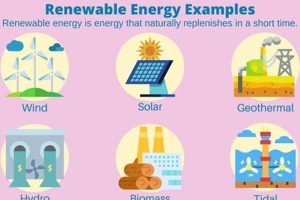
Geothermal energy harnesses heat from the Earth’s interior. This subterranean thermal reservoir, constantly replenished by natural processes, powers various applications, including electricity generation and direct heating. The consistent replenishment rate is a key factor in evaluating its long-term viability as an energy source.
The significance of this energy source lies in its potential to provide a stable and reliable power supply, largely independent of weather conditions that affect other renewable resources like solar and wind. Its utilization also contributes to reduced greenhouse gas emissions compared to fossil fuel-based energy production, aiding in mitigating climate change. Historically, communities near geothermally active regions have utilized these resources for heating and bathing for centuries, predating modern electricity generation.
The following sections will delve into the mechanics of geothermal energy extraction, the different types of geothermal power plants, the environmental considerations associated with its use, and the future prospects of this energy source in a global energy landscape.
Harnessing the Potential of Geothermal Energy
The following points outline key considerations for understanding and utilizing geothermal energy, given its classification as a continuously replenished resource.
Tip 1: Prioritize Sustainable Extraction Rates: Geothermal reservoirs, while continuously replenished, can be depleted if extraction exceeds the recharge rate. Careful monitoring and modeling of reservoir dynamics are essential to prevent long-term damage and ensure sustained energy production.
Tip 2: Implement Closed-Loop Systems: To minimize environmental impact, closed-loop geothermal systems are preferable. These systems circulate water or other fluids through the Earth without direct contact with groundwater aquifers, reducing the risk of contamination and subsidence.
Tip 3: Optimize Plant Efficiency: Maximize the energy output from geothermal power plants by implementing advanced technologies and optimizing plant design. This includes utilizing binary cycle power plants for lower temperature geothermal resources and incorporating combined heat and power (CHP) systems for enhanced efficiency.
Tip 4: Conduct Thorough Environmental Impact Assessments: Prior to developing geothermal projects, conduct comprehensive environmental impact assessments to identify and mitigate potential risks, such as air emissions (hydrogen sulfide), noise pollution, and land disturbance.
Tip 5: Invest in Research and Development: Continued investment in research and development is crucial for advancing geothermal technologies, exploring enhanced geothermal systems (EGS), and improving the economic viability of geothermal energy projects.
Tip 6: Promote Public Awareness: Educate the public about the benefits of geothermal energy as a clean and sustainable energy source. This includes highlighting its reliability, low carbon footprint, and potential for local economic development.
Tip 7: Integrate Geothermal into Smart Grids: Incorporate geothermal energy into smart grid systems to enhance grid stability and reliability. This can be achieved by using geothermal power plants to provide baseload power and balancing intermittent renewable energy sources like solar and wind.
By adhering to these guidelines, geothermal energy can contribute significantly to a sustainable energy future.
The subsequent sections will explore the technological advancements and policy frameworks needed to further promote the widespread adoption of this renewable resource.
1. Heat Replenishment

Heat replenishment is a fundamental aspect that directly determines the sustainability of geothermal energy extraction. Without continuous heat flow from the Earth’s interior, geothermal reservoirs would be rapidly depleted, negating their classification as a continuously available energy source. Understanding the processes governing heat replenishment is crucial for effective reservoir management and ensuring the long-term viability of geothermal power plants.
- Radioactive Decay
Radioactive decay of isotopes within the Earth’s mantle and crust is a primary source of geothermal heat. Isotopes such as uranium, thorium, and potassium undergo decay, releasing energy in the form of heat. This process is continuous and ongoing, contributing significantly to the Earth’s internal heat flux. The consistent nature of radioactive decay ensures a steady supply of thermal energy to geothermal reservoirs.
- Residual Heat from Planetary Formation
The formation of the Earth involved gravitational accretion and intense bombardment, processes that generated substantial heat. A portion of this primordial heat remains trapped within the Earth’s interior. While this residual heat is gradually dissipating, it still contributes to the overall geothermal gradient. The rate of heat dissipation is slow enough that it remains a significant factor over human timescales.
- Convection in the Mantle
Convection currents within the Earth’s mantle play a crucial role in transferring heat from the core to the lithosphere. Hot, buoyant mantle material rises, while cooler, denser material sinks, creating a continuous circulation pattern. This convection process effectively transports heat towards the surface, replenishing thermal energy in geothermal regions. The efficiency of mantle convection influences the overall heat flow and the potential for geothermal energy extraction.
- Magmatic Activity
Magmatic activity, particularly in volcanically active regions, provides a concentrated source of heat. Molten rock (magma) rises from the mantle towards the surface, transferring significant amounts of thermal energy to surrounding rock formations. This heat can be harnessed in geothermal power plants located near volcanic areas. However, the intensity and duration of magmatic activity can vary, necessitating careful monitoring and management of geothermal resources in these regions.
These contributing factors to heat replenishment ensure that geothermal resources, when managed sustainably, can offer a long-term, environmentally sound alternative to fossil fuels. Proper extraction and reservoir management is key to realizing the full benefit of its naturally replenished heat.
2. Sustainable Extraction

Sustainable extraction is intrinsically linked to geothermal energy’s classification as a continuously available resource. The ability to maintain geothermal energy production over extended periods depends directly on extraction rates that do not exceed the natural replenishment rate of heat within the reservoir. Unsustainable extraction practices lead to reservoir depletion, diminished power output, and potentially irreversible damage to the geothermal resource. The consequence is the transformation of a potentially continuously available resource into a finite one.
Consider the case of the Wairakei geothermal field in New Zealand, one of the world’s first large-scale geothermal power plants. Initially, the plant experienced significant subsidence and a decline in steam pressure due to extraction exceeding recharge. This historical example underscores the importance of careful monitoring, reservoir modeling, and adaptive management strategies. Conversely, the Nesjavellir geothermal plant in Iceland demonstrates a commitment to sustainable practices. Injection of condensed steam and careful monitoring of reservoir pressure have helped maintain stable production levels for decades. These real-world examples highlight the practical significance of understanding reservoir dynamics and implementing extraction strategies that align with replenishment rates.
In summary, sustainable extraction is not merely an operational consideration; it is a fundamental requirement for geothermal energy to be legitimately considered a continuously available resource. Challenges remain in accurately assessing replenishment rates and predicting long-term reservoir behavior. However, ongoing research, improved monitoring technologies, and a commitment to adaptive management are essential to ensuring the sustainable utilization of geothermal energy for generations to come. This approach enables the ongoing benefit of a reliable source of power with lower environmental impact than traditional sources.
3. Reservoir Management

Reservoir management forms the cornerstone of ensuring geothermal energy truly qualifies as a continuously available resource. Effective management strategies are essential for maintaining reservoir pressure, optimizing fluid extraction rates, and mitigating potential environmental impacts. Without proper management, even a geothermally active site can suffer depletion, rendering it unsustainable in the long term.
- Monitoring and Modeling
Continuous monitoring of reservoir pressure, temperature, and fluid composition is crucial for understanding its behavior. Data from monitoring wells are used to construct reservoir models that simulate fluid flow and heat transfer. These models allow for prediction of future reservoir performance under different extraction scenarios. Effective monitoring and modeling are critical for making informed decisions about extraction rates and injection strategies, ensuring the longevity of the geothermal resource. For example, the Geysers geothermal field in California employs extensive monitoring and modeling techniques to optimize steam production and manage reservoir pressure, helping to maintain its operational lifespan.
- Injection Strategies
Fluid injection is a common technique used to maintain reservoir pressure and enhance heat recovery. Injected water or condensed steam replenishes the reservoir, counteracting the pressure decline caused by fluid extraction. Careful management of injection rates and locations is essential to prevent thermal breakthrough (premature cooling of production wells) and induced seismicity. The Reykjanes geothermal plant in Iceland successfully utilizes injection strategies to maintain reservoir pressure and enhance steam production, demonstrating the effectiveness of this approach in sustaining geothermal resource availability.
- Extraction Rate Optimization
Determining the optimal extraction rate is a complex process that requires balancing energy production with reservoir sustainability. Extracting fluids too quickly can lead to rapid pressure decline and reduced power output. Conversely, extracting too slowly may limit the economic viability of the geothermal project. Sophisticated reservoir models are used to determine the maximum sustainable extraction rate that allows for long-term energy production without compromising reservoir integrity. Adaptive management strategies, which involve adjusting extraction rates based on real-time reservoir performance, are crucial for ensuring sustained operation.
- Mitigation of Environmental Impacts
Effective reservoir management also involves minimizing potential environmental impacts associated with geothermal energy production. This includes managing the disposal of geothermal fluids, which may contain dissolved minerals and gases, to prevent water contamination. Mitigation strategies, such as reinjection and treatment of geothermal fluids, are essential for protecting the environment. Careful monitoring of ground stability is also necessary to prevent subsidence caused by fluid extraction. By addressing these environmental concerns, reservoir management contributes to the overall sustainability of geothermal energy production, solidifying its position as a continuously available resource.
In conclusion, reservoir management is not simply a technical aspect of geothermal energy production; it is a fundamental requirement for ensuring its long-term sustainability. By implementing effective monitoring, modeling, injection strategies, extraction rate optimization, and mitigation measures, geothermal energy can deliver clean, reliable power for generations to come. These practices collectively ensure that the extraction of geothermal resources aligns with the natural replenishment rates, solidifying its role as a continuously available resource.
4. Environmental Impact

The environmental impact of geothermal energy is a critical consideration in evaluating its standing as a continuously available resource. While generally considered a cleaner alternative to fossil fuels, geothermal energy development is not without environmental consequences. Careful assessment and mitigation strategies are necessary to minimize these impacts and ensure the sustainable utilization of geothermal resources.
- Air Emissions
Geothermal power plants can release air pollutants, including hydrogen sulfide (H2S), carbon dioxide (CO2), and trace amounts of other gases. Hydrogen sulfide is of particular concern due to its odor and potential health effects. Carbon dioxide emissions, while typically lower than those from fossil fuel plants, contribute to greenhouse gas concentrations. The Geysers geothermal field in California, for instance, has implemented abatement technologies to reduce H2S emissions. Effective air emission control technologies are crucial for mitigating these impacts and maintaining air quality.
- Water Use and Contamination
Geothermal power generation often requires water for cooling or for fluid injection to maintain reservoir pressure. Water extraction can deplete local water resources, particularly in arid or semi-arid regions. Additionally, geothermal fluids may contain dissolved minerals and heavy metals that can contaminate surface and groundwater if not properly managed. Reinjection of geothermal fluids into the reservoir is a common practice to minimize water use and prevent contamination. The Hellisheidi geothermal plant in Iceland utilizes advanced water management techniques to minimize water consumption and prevent contamination of local water sources, setting a positive example for sustainable practices.
- Land Use and Ecosystem Disturbance
Geothermal power plants require land for infrastructure, including well pads, pipelines, and power generation facilities. Construction and operation of these facilities can disrupt local ecosystems, fragment habitats, and alter land use patterns. Careful site selection, habitat restoration, and mitigation measures are essential to minimize these impacts. The Olkaria geothermal project in Kenya has implemented environmental management plans to mitigate land use impacts and protect biodiversity in the surrounding area. Minimizing land footprint and implementing effective mitigation strategies are crucial for ensuring the environmental sustainability of geothermal energy projects.
- Induced Seismicity
Geothermal fluid injection can, in some cases, trigger seismic activity. While most induced earthquakes are small and not felt at the surface, larger events can pose a risk to infrastructure and public safety. Careful monitoring of seismic activity and management of injection pressures are essential to minimize the risk of induced seismicity. The Pohang Enhanced Geothermal System (EGS) project in South Korea experienced induced seismic events, leading to its termination. This highlights the importance of thorough geological assessments and proactive management of injection pressures to prevent induced seismicity and ensure the safe and responsible development of geothermal resources.
Minimizing the impacts is essential for long-term continuous availability of geothermal energy. Mitigation measures, coupled with a commitment to sustainable extraction and reservoir management practices, can help ensure that geothermal energy remains a viable and responsible source. Continuous research and development of cleaner geothermal technologies is necessary to further reduce environmental impacts and enhance the sustainability of geothermal energy production. The pursuit of enhanced geothermal systems and closed-loop technologies, among others, holds promise for minimizing environmental footprints while expanding access to geothermal resources.
5. Long-Term Viability
Long-term viability is paramount when assessing whether geothermal energy can justifiably be classified as a continuously available resource. It encompasses the economic, environmental, and technological factors that influence the sustained operation of geothermal power plants and the continued access to geothermal resources over extended periods. Establishing the long-term viability of geothermal projects necessitates a comprehensive approach that addresses potential challenges and ensures that geothermal resources are utilized in a responsible and sustainable manner.
- Resource Depletion and Recharge Rates
The balance between extraction rates and natural recharge rates directly impacts the long-term availability of geothermal resources. Over-extraction can lead to reservoir depletion, reduced power output, and diminished economic returns. Careful monitoring of reservoir pressure, temperature, and fluid composition is essential for determining sustainable extraction rates. Geothermal projects must be designed and managed to ensure that extraction does not exceed the natural replenishment rate of heat within the reservoir. The Larderello geothermal field in Italy, one of the oldest geothermal power producing regions, experienced declines in steam production due to over-exploitation, emphasizing the importance of sustainable extraction practices for long-term viability.
- Technological Advancements and Cost Reductions
Technological innovation plays a critical role in enhancing the long-term viability of geothermal energy. Enhanced Geothermal Systems (EGS), which access heat from deep, hot, and dry rock formations, have the potential to significantly expand geothermal resources. Advancements in drilling technologies, reservoir stimulation techniques, and power plant efficiency can reduce costs and improve the economic competitiveness of geothermal energy. Continuous investment in research and development is essential for unlocking the full potential of geothermal resources and ensuring their long-term availability. The development of supercritical geothermal systems, which utilize extremely hot and high-pressure fluids, represents a promising avenue for enhancing power output and reducing costs, thereby bolstering the long-term viability of geothermal energy.
- Environmental Sustainability and Regulatory Frameworks
Environmental sustainability is integral to the long-term viability of geothermal energy. Minimizing air emissions, protecting water resources, and mitigating land use impacts are essential for maintaining public support and complying with environmental regulations. Robust regulatory frameworks that promote sustainable extraction practices, environmental protection, and community engagement are crucial for ensuring the responsible development of geothermal resources. The implementation of strict environmental standards and monitoring programs can help prevent long-term damage to geothermal reservoirs and ensure their continued availability. Examples include the regulatory oversight in Iceland, which promotes sustainable geothermal practices, and the European Union’s efforts to standardize geothermal regulations across member states.
- Economic Competitiveness and Investment Climate
The economic competitiveness of geothermal energy relative to other energy sources influences its long-term viability. High upfront capital costs and long project development timelines can pose barriers to investment. Government incentives, such as tax credits, feed-in tariffs, and loan guarantees, can help reduce these barriers and attract private investment. A stable and predictable regulatory environment is also essential for creating a favorable investment climate. Geothermal projects must be economically viable to attract financing and ensure their long-term operation. Feed-in tariff policies in Germany, for example, have stimulated the development of geothermal power plants by providing guaranteed revenue streams, thereby enhancing their economic competitiveness and long-term viability.
In conclusion, the long-term viability of geothermal energy hinges on a holistic approach that addresses resource depletion, promotes technological innovation, ensures environmental sustainability, and fosters economic competitiveness. By implementing sustainable extraction practices, investing in research and development, adhering to stringent environmental standards, and creating a favorable investment climate, geothermal energy can provide a reliable and continuously available energy source for generations to come.
6. Technological Advancements
Technological advancements are pivotal in solidifying geothermal energy’s classification as a continuously available resource. The extent to which geothermal resources can be sustainably accessed and utilized is directly influenced by the evolution of relevant technologies. These advancements address key limitations, enhance efficiency, and mitigate environmental impacts, thereby strengthening the long-term renewability of geothermal energy.
Enhanced Geothermal Systems (EGS) exemplify this connection. EGS technology enables access to geothermal resources in regions lacking naturally occurring hydrothermal reservoirs. By fracturing hot, dry rock and circulating water to extract heat, EGS expands the geographic scope of geothermal energy potential. This effectively increases the total accessible geothermal resource base. Similarly, advancements in drilling techniques, such as deep drilling and directional drilling, allow for accessing deeper, hotter, and more productive geothermal reservoirs. Further, binary cycle power plants, which utilize lower-temperature geothermal fluids, broaden the range of usable geothermal resources, turning what was once unusable into a renewable power source. In all instances, the direct result of technological innovation is an enhancement of the renewability characteristics of geothermal resources.
Ultimately, ongoing technological advancements are essential for overcoming the inherent challenges associated with geothermal energy extraction and utilization. These advancements contribute directly to the long-term sustainability and economic viability of geothermal projects, reinforcing the role of geothermal energy as a continuously available resource. Continued investment in research and development within this sector is crucial for unlocking the full potential of geothermal resources and ensuring their contribution to a sustainable energy future.
Frequently Asked Questions About Geothermal Energy’s Renewability
This section addresses common inquiries regarding geothermal energy and its classification as a continuously available resource. The objective is to clarify misconceptions and provide factual information to enhance understanding.
Question 1: Is geothermal energy truly continuously available given that geothermal fields can experience declining productivity?
Declining productivity in certain geothermal fields underscores the importance of sustainable reservoir management. While the Earth’s internal heat is a continuously available resource, localized depletion can occur if extraction rates exceed natural recharge. Effective reservoir management, including reinjection strategies and optimized extraction rates, is crucial to maintaining long-term productivity.
Question 2: What distinguishes geothermal energy as a continuously available resource compared to fossil fuels?
Fossil fuels are finite resources formed over millions of years. Geothermal energy, conversely, taps into the Earth’s internal heat, which is continuously replenished by radioactive decay and residual heat from planetary formation. This continuous replenishment distinguishes it as a continuously available resource, unlike the finite nature of fossil fuels.
Question 3: Does the environmental impact of geothermal energy negate its classification as a continuously available resource?
The environmental impact of geothermal energy, while present, is generally lower than that of fossil fuels. Careful site selection, implementation of mitigation measures (such as air emission control and water reinjection), and adherence to environmental regulations are essential for minimizing these impacts. When managed responsibly, the environmental footprint of geothermal energy does not negate its classification as a continuously available resource.
Question 4: How do Enhanced Geothermal Systems (EGS) contribute to the continuously available nature of geothermal energy?
Enhanced Geothermal Systems (EGS) expand the availability of geothermal energy by accessing heat from deep, hot, and dry rock formations that lack natural permeability. By artificially creating fractures in these rocks and circulating water to extract heat, EGS significantly increases the accessible geothermal resource base, contributing to its classification as a continuously available resource.
Question 5: What role does technological innovation play in ensuring the long-term renewability of geothermal energy?
Technological innovation is crucial for enhancing the efficiency, sustainability, and economic viability of geothermal energy. Advancements in drilling techniques, reservoir stimulation methods, and power plant technologies can reduce costs, expand resource access, and minimize environmental impacts. Continuous technological progress is essential for ensuring the long-term renewability of geothermal energy.
Question 6: Is the economic viability of geothermal energy a factor in determining its classification as a continuously available resource?
Economic viability influences the deployment and utilization of geothermal energy but does not fundamentally alter its classification as a continuously available resource. While economic factors can impact project feasibility, the inherent renewability of the Earth’s internal heat remains constant. Government incentives, technological advancements, and improved market conditions can enhance the economic viability of geothermal energy and facilitate its widespread adoption.
In summary, geothermal energy is a continuously available resource due to the Earth’s internal heat, which is consistently replenished. Sustainable practices, responsible management, and technological innovation are paramount to realizing the full potential of geothermal’s benefits.
The following section provides conclusion regarding our exploration of “is geothermal energy renewable resource”.
Conclusion Regarding Geothermal Energy as a Continuously Available Resource
The preceding analysis confirms that geothermal energy, when managed responsibly, aligns with the criteria of a continuously available resource. The Earth’s internal heat, a primary driver of geothermal systems, is continually replenished through radioactive decay and primordial heat. Sustainable extraction practices, coupled with effective reservoir management and ongoing technological advancements, are critical for ensuring the long-term viability of geothermal resources. Mitigation of environmental impacts is paramount, requiring careful site selection, air emission controls, and responsible water management. The realization of geothermal energy’s potential necessitates continued investment in research, development, and the implementation of robust regulatory frameworks.
The imperative to transition towards sustainable energy sources underscores the significance of geothermal energy as a key contributor to a diversified and resilient energy portfolio. Addressing remaining challenges, such as minimizing induced seismicity and optimizing extraction rates, is crucial for maximizing the contribution of geothermal energy to a cleaner and more sustainable energy future. Therefore, support for technological advancements and policy initiatives should continue, fostering the responsible development and utilization of geothermal resources for generations to come.

![Guide to What Energy Resources Are Renewable [+Future] | Renewable Energy Solutions for a Sustainable Future | Clean & Green Power](https://pplrenewableenergy.com/wp-content/uploads/2026/03/th-516-300x200.jpg "Guide to What Energy Resources Are Renewable [+Future] Renewable Energy Solutions for a Sustainable Future | Clean & Green Power")