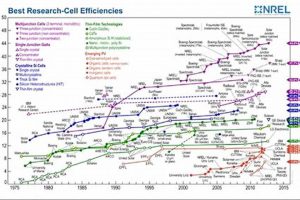
The efficacy of photovoltaic devices in converting sunlight into electricity is a critical metric for evaluating solar energy technology. A leading institution in this field rigorously tests and validates these performance levels. The measurements obtained provide a benchmark for assessing technological advancements and potential for widespread adoption of solar power. An example would be specifying the percentage of solar radiation a particular solar cell model can transform into usable electricity under standardized testing conditions.
High conversion rates are vital for economic viability and reducing reliance on fossil fuels. Improved conversion translates directly into lower electricity costs and a smaller environmental footprint. The consistent pursuit of better performance has driven significant progress in solar technology over the decades. Publicly available validated data allows for fair comparison of products by consumers and installers.
The ongoing research and development efforts in this area pave the way for the introduction of innovative materials, designs, and manufacturing processes. These advancements continuously redefine the possibilities for more sustainable and efficient energy generation, impacting areas such as materials science, engineering, and energy policy.
Enhancing Photovoltaic Performance
Maximizing the power output from solar cells requires a multifaceted approach. Several key factors can significantly impact overall efficacy.
Tip 1: Optimize Material Selection: Employing advanced semiconductor materials with high light absorption coefficients and suitable band gaps is paramount. Perovskite solar cells, for example, demonstrate exceptional performance due to their favorable optoelectronic properties.
Tip 2: Implement Effective Light Trapping: Surface texturing and anti-reflection coatings reduce light reflection and increase the probability of photon absorption. These techniques enhance the amount of light that generates electron-hole pairs within the active material.
Tip 3: Minimize Recombination Losses: Defects and impurities within the semiconductor can lead to the recombination of electron-hole pairs, reducing current. Implementing passivation techniques, such as depositing thin layers of insulating materials, can significantly mitigate these losses.
Tip 4: Improve Contact Quality: High-quality electrical contacts with low resistance are crucial for efficient charge extraction. Careful selection and deposition of contact materials minimize voltage drops and power dissipation.
Tip 5: Optimize Cell Design: Advanced cell architectures, such as interdigitated back contact (IBC) cells, can reduce shading losses and improve charge carrier collection. These designs often require complex fabrication processes.
Tip 6: Maintain Operating Temperature: Solar cell performance decreases with increasing temperature. Implementing thermal management strategies, such as heat sinks and cooling systems, can help maintain optimal operating temperatures.
Tip 7: Careful characterization: Precisely evaluate the cells before and after optimization to identify limiting factors and gauge the effectiveness of any changes or improvements. This step may involve measuring open-circuit voltage, short-circuit current, fill factor, and spectral response.
Adhering to these guidelines can lead to substantial gains in photovoltaic power generation. These techniques have broad applicability across different solar cell technologies.
The insights provided in these tips are foundational for driving further innovation and improvements in renewable energy generation.
1. Validation

Validation, in the context of solar cell efficiency measured and reported by the National Renewable Energy Laboratory (NREL), is paramount for establishing credibility and ensuring reliable data dissemination. The rigorous validation process ensures that reported performance metrics are accurate, reproducible, and comparable across different solar cell technologies and research groups.
- Independent Verification of Measurements
NREL employs stringent protocols to independently verify efficiency measurements submitted by researchers and manufacturers. This involves replicating measurements using NREL’s own equipment and expertise, minimizing the risk of systematic errors or biases. This independent verification process strengthens the confidence in the validity of reported data.
- Adherence to Standard Testing Conditions
Validation requires strict adherence to standard testing conditions, such as standardized irradiance levels, temperature control, and spectral characteristics of the light source. These conditions are defined by international standards organizations like IEC and ASTM. Enforcing these standards ensures that measurements are performed under consistent and well-defined conditions, enabling fair comparisons between different devices.
- Material Characterization and Device Analysis
In addition to efficiency measurements, validation also encompasses thorough material characterization and device analysis. Techniques like spectral response measurements, internal quantum efficiency analysis, and microscopy are employed to understand the underlying factors limiting device performance. This comprehensive analysis provides valuable insights and helps identify areas for improvement.
- Peer Review and Publication
NREL’s validation process often culminates in peer-reviewed publications. This ensures that measurement methodologies, results, and analyses are scrutinized by experts in the field. Publication in reputable scientific journals further strengthens the credibility and dissemination of validated solar cell efficiency data.
These validation procedures, employed by NREL, enhance the trustworthiness and impact of solar cell efficiency data. This rigorous approach provides a reliable foundation for research, development, and commercialization efforts in the field of renewable energy. Data obtained is not just a number; it is a benchmark representing validated performance, thereby advancing the adoption of improved solar cell technology.
2. Optimization

Optimization is intrinsically linked to achieving high solar cell efficiency, as validated by the National Renewable Energy Laboratory (NREL). The pursuit of greater solar cell effectiveness necessitates iterative improvements across various facets of cell design, materials, and fabrication techniques. These improvements contribute directly to the figures benchmarked by NREL. Each incremental enhancement is measured, assessed, and often validated by NREL, making optimization a cornerstone of the progress documented by the laboratory. For instance, NREL’s work with multi-junction solar cells involves optimizing the bandgaps of each layer to capture a broader spectrum of sunlight, a process directly enhancing cell efficiency.
Further, optimization is not a singular event but an ongoing process. It encompasses refining existing technologies and integrating novel materials. Consider the development of perovskite solar cells; significant gains in their efficiency have been realized through optimizing the composition, structure, and interfaces within the perovskite layer. NREL plays a crucial role in characterizing and validating these optimized perovskite devices, thus setting the standard for performance. This continuous cycle of innovation, refinement, and validation is essential for pushing the boundaries of solar cell capabilities and reducing the cost of solar energy.
The relationship between optimization and validated efficiency extends beyond the laboratory. Optimized solar cell designs translate into improved performance in real-world applications. This includes increased energy yield from solar panels, lower levelized cost of electricity (LCOE), and greater overall adoption of solar energy. While challenges persist in terms of long-term stability and scalability, optimization remains the primary driver for overcoming these hurdles and unlocking the full potential of solar cell technology, as recognized by NREL’s ongoing research and assessment efforts.
3. Advancement

Advancement in solar cell technology is inextricably linked to the efficacy metrics validated by the National Renewable Energy Laboratory (NREL). Progress in materials science, device architecture, and fabrication techniques directly influences the benchmarks established by NREL’s rigorous testing and reporting procedures. Novel materials, such as perovskites or quantum dots, are constantly under investigation to surpass the limitations of conventional silicon-based solar cells. For instance, the development of tandem solar cells, which stack different materials with varying bandgaps to absorb a broader spectrum of sunlight, exemplifies a significant advancement validated by NREL’s high-efficiency records. These innovations, when successfully implemented, translate into higher conversion efficiencies, as independently verified by NREL.
The importance of advancement is highlighted by the continuous evolution of solar cell designs and manufacturing processes. Techniques like surface passivation, light trapping, and improved contact metallization have demonstrably improved cell performance. NREL’s validation of these advancements provides credibility and facilitates the adoption of these technologies by the broader solar energy industry. Furthermore, the practical significance of this understanding lies in the ability to predict and accelerate the development of more efficient and cost-effective solar energy solutions. Understanding the materials and architecture properties that NREL-validated advancements hinge upon allows researchers to focus their efforts effectively.
In summary, advancement serves as a critical driver for exceeding existing efficiency limitations, and NREL serves as the validator and disseminator of these breakthroughs. The challenges lie in translating laboratory-scale advancements into commercially viable manufacturing processes. Overcoming these challenges is essential for maximizing the contribution of solar energy to the global energy mix and NREL’s role in validating and reporting on these improvements remains paramount. This ongoing cycle drives solar technology progress.
4. Standardization

The reliable measurement and reporting of solar cell efficiency require adherence to rigorous standardization protocols. The National Renewable Energy Laboratory (NREL) plays a crucial role in validating and disseminating these standardized methodologies. Standardization ensures that efficiency data is both accurate and comparable across different research groups and manufacturers. Without standardized testing conditions, variations in irradiance, temperature, and spectral characteristics of the light source would introduce significant uncertainty and render efficiency comparisons meaningless. For instance, NREL’s adoption of ASTM and IEC standards for solar cell testing provides a common framework for evaluating performance, eliminating ambiguity and fostering confidence in the reported data.
Standardization extends beyond testing protocols to encompass material characterization and device fabrication techniques. Standardized procedures for material deposition, surface passivation, and contact formation are essential for achieving reproducible results and minimizing variability in cell performance. Furthermore, standardized data reporting formats facilitate the efficient sharing and analysis of efficiency data within the solar energy community. An illustrative example is the establishment of consensus standards for measuring the spectral response of solar cells, enabling researchers to accurately assess the cell’s ability to convert different wavelengths of light into electricity. This standardization empowers researchers to make more informed decisions regarding cell design and optimization.
In conclusion, standardization is not merely a procedural formality; it is an indispensable component of accurately determining and communicating solar cell efficiency. The adoption of standardized methodologies, validated and promoted by NREL, ensures data integrity, facilitates technology transfer, and accelerates the development of more efficient and cost-effective solar energy solutions. Challenges remain in harmonizing standards across different international organizations and adapting standards to emerging solar cell technologies. However, the ongoing efforts to promote standardization are vital for driving innovation and fostering trust in the rapidly evolving field of solar energy.
5. Benchmarking
Benchmarking serves as a critical function in evaluating progress and guiding future research within the field of solar cell technology. It relies heavily on the validated data produced by the National Renewable Energy Laboratory (NREL) to provide meaningful context and targets for advancement.
- Establishing Performance Baselines
NREL’s independently verified efficiency measurements establish performance baselines against which novel solar cell technologies can be assessed. These baselines provide a clear understanding of the current state-of-the-art and highlight areas where improvements are most needed. For example, the Shockley-Queisser limit, while theoretical, provides a performance ceiling. By benchmarking against NREL’s validated performance metrics, researchers can quantify the proximity of their devices to this limit and identify avenues for surpassing it through innovative approaches like multi-junction cells.
- Facilitating Technology Comparison
Benchmarking, using NREL’s data, facilitates the comparative analysis of different solar cell materials and designs. This allows researchers to identify the most promising technologies for further development and investment. For example, comparing the performance of perovskite solar cells against traditional silicon cells, using NREL’s data as a reference point, helps determine their potential for widespread adoption and highlights areas where perovskites require further refinement, such as long-term stability.
- Guiding Research and Development Efforts
By tracking trends in solar cell efficiency over time, benchmarking informs strategic research and development decisions. Areas demonstrating consistent gains relative to others become priority targets. NREL’s ongoing validation of new technologies provides the data necessary to assess the impact of specific research initiatives, such as the development of novel light-trapping schemes or advanced passivation techniques. Benchmarking assists in allocating resources efficiently and maximizing the return on investment in solar energy research.
- Informing Policy and Investment Decisions
Benchmarking provides valuable information for policymakers and investors seeking to promote the adoption of solar energy. NREL’s efficiency data informs decisions regarding incentive programs, funding priorities, and technology roadmaps. By quantifying the progress made in solar cell technology, benchmarking demonstrates the viability of solar energy as a sustainable and cost-effective energy source, encouraging further investment and policy support.
In conclusion, benchmarking relies heavily on the rigorous data produced by the National Renewable Energy Laboratory, facilitating progress. This dependence supports informed decision-making across various sectors and fosters continued innovation within the field.
Frequently Asked Questions
This section addresses common inquiries regarding solar cell efficiency measurements and validation conducted by the National Renewable Energy Laboratory (NREL).
Question 1: What is the significance of solar cell efficiency data validated by NREL?
NREL’s validated efficiency data serves as a benchmark for assessing solar cell technology, ensuring accuracy, reliability, and comparability across different devices and research groups. It provides a foundation for informed research and development efforts.
Question 2: How does NREL validate solar cell efficiency measurements?
NREL employs stringent protocols to independently verify efficiency measurements, adhering to standardized testing conditions and conducting thorough material characterization and device analysis. This often culminates in peer-reviewed publications.
Question 3: Why is standardization important for solar cell efficiency measurements?
Standardization ensures that efficiency data is both accurate and comparable, eliminating ambiguity and fostering confidence in the reported results. It facilitates technology transfer and collaboration within the solar energy community.
Question 4: How does NREL contribute to the advancement of solar cell technology?
NREL facilitates the progress through its independent validation of novel materials, device architectures, and fabrication techniques that promise to improve cell performance. This validation provides credibility and accelerates the adoption of innovative technologies.
Question 5: What role does benchmarking play in the development of efficient solar cells?
Benchmarking provides performance baselines, facilitates technology comparison, and guides research and development efforts by tracking trends in solar cell efficiency over time. It informs strategic decisions regarding resource allocation and investment.
Question 6: Can NREL validated laboratory efficiencies translate to real-world applications?
While NREL validates laboratory efficiencies, the translation to real-world performance is influenced by various factors such as module integration, environmental conditions, and system design. Optimization efforts are underway to minimize performance losses and maximize the energy yield of solar installations.
NREL’s contribution is vital for understanding and promoting reliable progress in solar cell technology.
This concludes the frequently asked questions. The next section will be…
Conclusion
This exploration has detailed the critical role the National Renewable Energy Laboratory plays in validating and disseminating solar cell efficiency data. The processes of validation, optimization, advancement, standardization, and benchmarking are all integral to enhancing photovoltaic performance. NREL’s commitment to rigorous testing and independent verification provides the foundation for accurately assessing technological progress and informing strategic decisions within the solar energy sector.
Continued investment in research and development, coupled with adherence to standardized methodologies, is essential for unlocking the full potential of solar energy. The pursuit of higher efficiency translates directly into reduced costs, greater accessibility, and a more sustainable energy future. The ongoing efforts to refine measurement techniques and validate emerging technologies will be pivotal in driving further innovation and expanding the adoption of solar power worldwide.