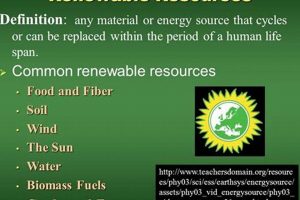
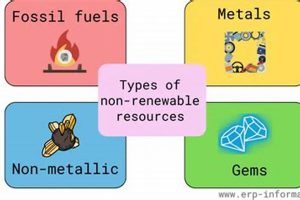
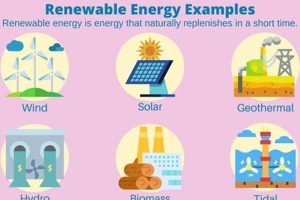
The classification of energy sources hinges on their rate of replenishment compared to human consumption. Resources considered inexhaustible within a human timescale are often labeled renewable. Solar, wind, and hydro power fall under this category, as their source is continuously replenished by natural processes. Conversely, finite resources, such as fossil fuels, are extracted at a rate exceeding their natural replenishment, leading to depletion.
The question of whether power derived from nuclear fission constitutes a renewable source is complex. Uranium, the primary fuel source in many reactors, exists in finite quantities within the Earth’s crust. Its extraction mirrors that of other mined resources like coal or natural gas. However, advanced reactor designs and fuel cycles, such as breeder reactors, can potentially extend the availability of nuclear fuel significantly by creating more fissile material than they consume. Moreover, research into nuclear fusion, which utilizes isotopes of hydrogen found abundantly in seawater, holds the promise of a virtually limitless energy source.
The ongoing debate surrounding its classification centers on the resource base, technological advancements, and sustainability considerations. Exploring the different fuel cycles, waste management strategies, and future reactor technologies is essential for a comprehensive understanding. The resource implications of its current usage, potential future advancements, and the environmental impact should be considered in assessing its long-term viability.
Considerations on Resource Classification
Examining the classification of power derived from nuclear fission requires careful consideration of resource availability, technological advancements, and sustainability factors. Understanding these aspects is crucial for informed decision-making.
Tip 1: Assess Uranium Reserves: Acknowledge the finite nature of readily accessible uranium ore. Current reactor technologies predominantly rely on uranium, and its extraction poses environmental considerations similar to other mining activities.
Tip 2: Explore Breeder Reactor Technology: Investigate breeder reactor designs. These reactors can convert non-fissile isotopes into usable fuel, effectively extending the availability of nuclear fuel resources and potentially minimizing waste.
Tip 3: Evaluate Thorium Fuel Cycles: Research thorium-based fuel cycles. Thorium is more abundant than uranium, and its fuel cycle may offer advantages in terms of waste production and proliferation resistance.
Tip 4: Invest in Fusion Research: Support ongoing research and development in nuclear fusion. Fusion, if successfully realized, holds the potential for a nearly inexhaustible energy source utilizing deuterium and tritium, readily available from seawater.
Tip 5: Analyze Waste Management Strategies: Evaluate different approaches to nuclear waste management, including geological repositories, advanced reprocessing techniques, and transmutation technologies. Effective waste management is crucial for the long-term sustainability.
Tip 6: Conduct Life Cycle Assessments: Perform comprehensive life cycle assessments of nuclear power, considering all stages from fuel extraction to plant decommissioning. This provides a more accurate picture of its environmental impact.
Tip 7: Consider Energy Return on Investment (EROI): Assess the EROI of power derived from nuclear fission, comparing the energy produced to the energy required for fuel extraction, processing, plant construction, and waste disposal. A high EROI is indicative of a sustainable energy source.
Effective resource management, coupled with technological innovation, can significantly impact the long-term viability. Continued research and development are crucial for enhancing sustainability and maximizing the benefits of this energy source.
Considering these factors provides a foundation for evaluating the classification of nuclear power and its role in a sustainable energy future.
1. Uranium Availability

The classification of power generated from nuclear fission as a renewable energy source is fundamentally linked to the availability of uranium. Uranium serves as the primary fuel in the majority of contemporary nuclear reactors. Its presence within the Earth’s crust is finite; therefore, current operational models relying solely on uranium depletion are inherently unsustainable when evaluated against the strict definition of a renewable resource. The rate of uranium extraction far surpasses any natural replenishment, echoing the resource dynamics of non-renewable fossil fuels. A direct cause-and-effect relationship exists: limited uranium reserves directly constrain the long-term potential for the continued use of current nuclear fission technology as a truly renewable energy source.
The understanding of uranium availability holds practical significance. For example, geological surveys and resource estimations influence investment decisions in nuclear power infrastructure. Countries with substantial uranium reserves may view nuclear energy as a more secure and viable option compared to nations lacking domestic resources. Furthermore, fluctuations in uranium market prices directly impact the economic feasibility of nuclear power generation. A scarcity-induced price surge could render nuclear power economically uncompetitive with alternative energy sources, regardless of its other merits. The development and deployment of more efficient uranium enrichment processes, as well as the exploration of unconventional uranium deposits, aim to mitigate concerns regarding resource depletion.
In conclusion, while nuclear fission offers benefits such as low greenhouse gas emissions during operation, the finite nature of uranium reserves presents a significant challenge to its classification as a renewable resource. The development and adoption of advanced reactor technologies, such as breeder reactors or thorium-based reactors, which can extend the usability of nuclear fuels, are essential steps towards addressing this limitation. The resource constraints posed by uranium availability underscore the need for continued research and development in alternative nuclear fuel cycles and ultimately inform the long-term role of nuclear power in a sustainable energy future.
2. Breeder Reactors

Breeder reactors represent a critical technological approach to address the resource limitations associated with the prevailing classification. These reactors possess the unique capability to generate more fissile material than they consume during operation. Unlike conventional reactors that primarily utilize uranium-235, breeder reactors can convert abundant, non-fissile isotopes such as uranium-238 or thorium-232 into fissile plutonium-239 or uranium-233, respectively. This conversion process significantly expands the potential fuel supply available for nuclear power generation, effectively mitigating the concerns surrounding uranium resource depletion. The direct correlation between breeder reactor deployment and the long-term availability of nuclear fuel underscores their importance in the discourse surrounding its potential as a renewable energy source.
The implementation of breeder reactor technology has profound implications for energy security and resource management. For instance, nations with limited uranium reserves could substantially enhance their energy independence by adopting breeder reactor technology. Furthermore, the enhanced fuel efficiency of these reactors reduces the demand for uranium mining, mitigating the associated environmental impacts. The practical application of breeder reactor technology can be observed in experimental and prototype reactors worldwide, such as the BN-800 reactor in Russia. While widespread adoption faces challenges related to cost, safety, and proliferation concerns, continued research and development are essential to overcome these hurdles and unlock the full potential of breeder reactor technology. These efforts include advancements in reactor design, fuel fabrication, and waste management strategies.
In conclusion, breeder reactors play a pivotal role in addressing the question of resource sustainability. By extending the usability of available nuclear fuel resources, they offer a pathway towards classifying power derived from nuclear fission as a more sustainable energy source. The successful implementation of breeder reactor technology requires sustained investment in research and development, coupled with robust regulatory frameworks to ensure safety and prevent nuclear proliferation. The interplay between resource availability, technological innovation, and responsible governance will ultimately determine the extent to which breeder reactors can contribute to a more sustainable energy future, and whether, under certain conditions and with advanced technologies, its classification can be reasonably argued as more renewable-like.
3. Thorium Potential

The evaluation of whether power derived from nuclear fission constitutes a renewable energy source necessitates an examination of alternative fuel cycles. Thorium, an element more abundant than uranium, presents a significant alternative. Investigating the potential of thorium fuel cycles is crucial for a comprehensive assessment.
- Abundance and Availability
Thorium is approximately three to four times more abundant in the Earth’s crust than uranium. This increased availability directly impacts the long-term sustainability of nuclear power, potentially alleviating concerns about resource depletion. The greater abundance suggests that reliance on power derived from nuclear fission could be extended, albeit not infinitely, compared to current uranium-based systems.
- Fuel Cycle Characteristics
Thorium fuel cycles offer inherent advantages. The primary fissile product, uranium-233, is more easily utilized and less prone to proliferation compared to plutonium produced in uranium cycles. This could lead to a more secure and sustainable energy future. The relative ease of uranium-233 utilization also impacts reactor design, potentially leading to simpler and more efficient systems.
- Waste Production
Thorium fuel cycles generally produce less plutonium and other transuranic waste compared to uranium cycles. This reduction in long-lived radioactive waste is a significant advantage from a waste management perspective, reducing the burden on future generations. A decrease in the generation of transuranic elements also influences the overall radiotoxicity of the waste stream, potentially simplifying long-term storage requirements.
- Reactor Designs and Development
The implementation of thorium fuel cycles necessitates specialized reactor designs, such as Molten Salt Reactors (MSRs) and Advanced Heavy Water Reactors (AHWRs). While these reactor designs are not as mature as conventional uranium-fueled reactors, ongoing research and development efforts are focused on demonstrating their viability and safety. Successful deployment of these reactor technologies is critical for realizing the full potential of thorium as a sustainable nuclear fuel.
The multifaceted potential of thorium, encompassing its abundance, favorable fuel cycle characteristics, reduced waste production, and ongoing reactor design development, significantly contributes to the discussion of whether power derived from nuclear fission can be considered a more sustainable energy source. While thorium itself is not renewable, its more abundant nature and potential for improved fuel cycles offer a pathway to extending the usability of nuclear resources, thereby influencing the overall assessment of its sustainability.
4. Fusion Prospects
The long-term sustainability of energy production is inextricably linked to the development of nuclear fusion. Unlike nuclear fission, which relies on finite resources like uranium, fusion utilizes isotopes of hydrogen, primarily deuterium and tritium, as fuel. Deuterium exists abundantly in seawater, rendering it a virtually inexhaustible resource. Tritium can be produced through the interaction of neutrons with lithium, another relatively abundant element. Consequently, the successful realization of fusion power would alleviate the resource constraints that currently prevent nuclear energy (fission) from being classified as renewable. The shift from a finite fuel source to a practically limitless one is the fundamental connection between fusion prospects and its classification as a renewable resource.
Several international collaborations, such as the International Thermonuclear Experimental Reactor (ITER) project, exemplify the global effort to harness fusion energy. These projects aim to demonstrate the scientific and technological feasibility of fusion as a viable energy source. The successful operation of a fusion reactor would have far-reaching consequences, potentially transforming the global energy landscape. It could provide a clean, secure, and sustainable energy supply for future generations, reducing reliance on fossil fuels and mitigating the adverse effects of climate change. Furthermore, fusion power does not produce long-lived radioactive waste, minimizing the environmental burden associated with waste disposal. The inherent safety characteristics of fusion reactors, coupled with the abundance of fuel, make it an attractive alternative to conventional energy sources.
While the technological challenges associated with achieving sustained fusion reactions are substantial, continued progress in plasma physics and materials science offers promise. Overcoming these challenges is crucial for realizing the full potential of fusion energy. The long-term implications of successful fusion extend beyond simply generating electricity. It could unlock new possibilities in areas such as space exploration, materials processing, and isotope production. The development of fusion power represents a paradigm shift in energy production, potentially transitioning nuclear energy from a resource-constrained technology to a virtually inexhaustible and sustainable energy source, ultimately impacting any considerations about whether such energy could be categorized as renewable.
5. Waste Management

The long-term management of radioactive waste generated by nuclear fission reactors is inextricably linked to any classification of the technology as a renewable energy source. High-level radioactive waste, comprising spent nuclear fuel, contains highly radioactive fission products and transuranic elements with extremely long half-lives. The safe and secure disposal of this waste for tens of thousands of years poses a significant environmental and societal challenge. The accumulation of radioactive waste, without a demonstrated long-term disposal solution, undermines the claim that nuclear fission can be considered sustainable. A direct causal relationship exists: inadequate waste management practices directly diminish the potential for it to be regarded as an ecologically sound and, thus, akin to a renewable energy resource.
Effective waste management strategies are essential for mitigating the environmental risks associated with the technology. Geological repositories, designed to isolate radioactive waste deep underground, represent the current consensus for long-term disposal. The selection and construction of such repositories require extensive geological investigations, community engagement, and robust regulatory oversight. Examples of planned or operating geological repositories include Yucca Mountain in the United States (though currently inactive) and Onkalo in Finland. Furthermore, research into advanced waste treatment technologies, such as partitioning and transmutation, aims to reduce the volume and radiotoxicity of nuclear waste. Partitioning separates the waste stream into different components, while transmutation converts long-lived radionuclides into shorter-lived or stable isotopes. These advanced treatment methods could significantly reduce the long-term burden associated with radioactive waste disposal. These efforts demonstrate practical approaches to minimize the impact and maximize the safety surrounding nuclear byproducts.
In conclusion, effective and responsible handling is a critical component in assessing its sustainability. The absence of a comprehensive and globally accepted solution for long-term waste disposal poses a significant impediment to its classification as a truly sustainable or renewable-like energy source. Continued research and development in waste management technologies, coupled with transparent and accountable governance, are essential for addressing this challenge and improving the environmental footprint. Without demonstrably safe and sustainable waste management practices, questions about the sustainability remain, hindering its ability to be viewed as an ecologically sound power source.
6. EROI

Energy Return on Investment (EROI) is a crucial metric for evaluating the sustainability of any energy source, including nuclear. EROI quantifies the ratio of energy produced by a source to the energy invested in its extraction, processing, construction, operation, and waste disposal. A high EROI indicates a more efficient and sustainable energy system. In the context of nuclear fission, a robust EROI is necessary but not sufficient to classify the energy source as renewable. While nuclear fuel itself is finite, a high EROI suggests that the energy gained from its use significantly outweighs the energy expenditure required, potentially justifying its role in a sustainable energy mix. Conversely, a low EROI signals inefficiencies and unsustainable practices, regardless of other environmental benefits, thereby diminishing any claim to a renewable-like status.
The EROI of nuclear power plants varies depending on factors such as reactor design, fuel enrichment processes, and waste management strategies. Older reactor designs or inefficient fuel cycles may exhibit lower EROI values, reflecting higher energy inputs relative to output. Advanced reactor designs, such as breeder reactors, aim to improve EROI by generating more fissile material than they consume. Furthermore, efficient waste management techniques, including reprocessing and volume reduction, can lower the energy expenditure associated with waste disposal, thereby boosting the overall EROI. The life cycle assessment framework is critical for accurately determining the EROI. It must encompass uranium mining, milling, enrichment, fuel fabrication, reactor construction and operation, decommissioning, and long-term waste storage or reprocessing. A comprehensive life cycle perspective is essential for comparing EROI values across different energy technologies and informing policy decisions.
Ultimately, while a high EROI is desirable for any energy source, it does not, by itself, qualify nuclear fission as renewable. The finite nature of uranium resources remains a fundamental limitation. However, a strong EROI, coupled with technological advancements in fuel cycles, waste management, and reactor designs, can enhance the sustainability profile and contribute to a more justifiable argument for nuclear energy’s role in a lower-carbon future. It is therefore essential that the overall EROI remain sufficiently high to warrant the use of nuclear power over other less energy-intensive (although possibly more carbon-intensive) options, particularly when considering the long-term implications of nuclear waste disposal and resource depletion.
Frequently Asked Questions
This section addresses common queries surrounding the classification of nuclear energy in relation to renewable resources. The goal is to offer clarity based on current scientific understanding and technological limitations.
Question 1: Is uranium a renewable resource?
Uranium, the primary fuel for conventional nuclear reactors, is a finite resource extracted from the Earth’s crust. As such, it does not meet the criteria for a renewable resource, which is replenished at a rate comparable to its consumption.
Question 2: Do breeder reactors change its classification as a resource?
Breeder reactors enhance fuel utilization by converting non-fissile materials into usable fuel. While this extends the lifespan of nuclear fuel reserves, it does not fundamentally transform uranium into a renewable resource. It is a more efficient use of an existing resource but it does not replenish that resource.
Question 3: What is the role of thorium in this discussion?
Thorium is more abundant than uranium and can be used as nuclear fuel. Like uranium, however, thorium is a finite resource. The adoption of thorium-based fuel cycles would improve resource availability but would not render it a renewable resource.
Question 4: Is nuclear fusion a renewable energy source?
Nuclear fusion, which uses isotopes of hydrogen as fuel, has the potential to be a virtually inexhaustible energy source. Deuterium, a hydrogen isotope used in fusion, is abundant in seawater. If fusion technology becomes commercially viable, it would represent a significant step towards a truly sustainable energy supply.
Question 5: How does waste management impact the discussion?
The safe and secure disposal of radioactive waste generated by nuclear fission is a crucial consideration. The long-term storage requirements for nuclear waste pose environmental challenges that must be addressed for nuclear energy to be considered a sustainable option. Improper waste management undermines any claim of renewability.
Question 6: Does Energy Return on Investment (EROI) matter?
Energy Return on Investment (EROI) measures the ratio of energy produced to the energy invested. A high EROI is desirable, but it alone does not qualify nuclear as renewable, given that the starting resources used for fuel are not renewable.
In summary, while technological advancements enhance the sustainability of power derived from nuclear fission and may extend its usability, the fundamental limitation of finite fuel resources prevents it from being classified as renewable under current definitions. Research into fusion technologies holds the potential to overcome these limitations.
The following section explores the economic aspects of power generation derived from nuclear fission. This provides additional context for comprehensive understanding.
Conclusion
The comprehensive analysis of whether power derived from nuclear fission constitutes a renewable resource reveals a complex landscape. While technological advancements, such as breeder reactors and thorium fuel cycles, extend the usability of available resources and improve the Energy Return on Investment, the finite nature of uranium and thorium fundamentally restricts its classification as renewable. The promise of nuclear fusion offers a pathway towards a truly sustainable energy source, yet significant technological hurdles remain. Effective waste management strategies are paramount to minimizing environmental impact and enabling responsible utilization.
The question of “is nuclear energy renewable resource” necessitates ongoing evaluation, considering evolving technologies and sustainability imperatives. Informed decision-making regarding energy policy requires a nuanced understanding of resource limitations, technological potential, and environmental responsibilities. The pursuit of sustainable energy solutions demands continued innovation, rigorous assessment, and a commitment to responsible resource management for the benefit of future generations.

![Guide to What Energy Resources Are Renewable [+Future] | Renewable Energy Solutions for a Sustainable Future | Clean & Green Power](https://pplrenewableenergy.com/wp-content/uploads/2026/03/th-516-300x200.jpg "Guide to What Energy Resources Are Renewable [+Future] Renewable Energy Solutions for a Sustainable Future | Clean & Green Power")