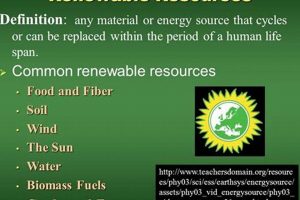
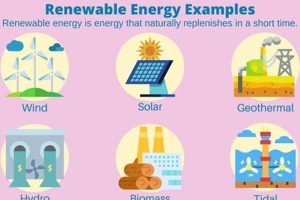
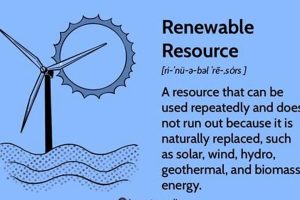
A naturally replenished resource is one that is restored by natural processes at a rate comparable to its rate of consumption by humans or other users. These resources originate from sources that are essentially inexhaustible on a human timescale. Sunlight, wind, geothermal heat, and water are common examples, representing energy or materials constantly renewed by the Earth’s natural systems.
The utilization of such resources offers numerous advantages, including a reduced reliance on finite reserves and a decreased environmental impact due to lower emissions and pollution compared to traditional energy sources. Historically, societies have harnessed these resources, such as using wind for sailing and water for powering mills. Increased awareness of environmental sustainability has led to a renewed focus on developing and implementing technologies that efficiently capture and utilize these assets.
Understanding the characteristics and potential of these resources is crucial for a sustainable future. This article will delve into specific types, explore the technologies used to harness them, and discuss the economic and environmental implications of their widespread adoption.
Harnessing Resources That Replenish
Employing resources with natural replenishment mechanisms necessitates strategic planning and responsible execution to ensure long-term effectiveness and minimize potential drawbacks.
Tip 1: Conduct Thorough Resource Assessments: Prior to investment, comprehensively evaluate the availability and consistency of the resource in the target location. Solar irradiation levels, wind patterns, or geothermal gradients must be precisely quantified to project potential energy output accurately.
Tip 2: Prioritize Technological Efficiency: Select technologies optimized for the specific resource and environment. Consider factors such as conversion efficiency, maintenance requirements, and operational lifespan when comparing different systems.
Tip 3: Implement Diversified Energy Portfolios: Reliance on a single type of resource exposes systems to variability. Combining multiple types such as solar, wind, and hydropower enhances overall stability and resilience.
Tip 4: Invest in Energy Storage Solutions: Fluctuations in resource availability can be mitigated through the use of energy storage technologies, like batteries or pumped hydro storage. This ensures a consistent supply, even during periods of low resource availability.
Tip 5: Incorporate Smart Grid Technologies: Implement smart grid systems for efficient distribution and management. This allows for better load balancing, real-time monitoring, and integration of smaller-scale generation sources into the larger grid infrastructure.
Tip 6: Minimize Environmental Impact: Implement strategies to mitigate potential environmental consequences, such as habitat disruption, noise pollution, or visual impact. Careful site selection, impact assessments, and mitigation measures are crucial.
Tip 7: Advocate for Supportive Policies: Encourage the development and implementation of policies that incentivize adoption and support the development of infrastructure. This includes tax incentives, feed-in tariffs, and streamlined permitting processes.
Successful integration depends on diligent planning, informed technological choices, and a commitment to responsible environmental stewardship. By adhering to these principles, individuals and organizations can maximize the benefits of these resources while minimizing negative consequences.
These guidelines provide a foundation for exploring the specific applications and challenges associated with individual resource types in greater detail.
1. Naturally Replenished
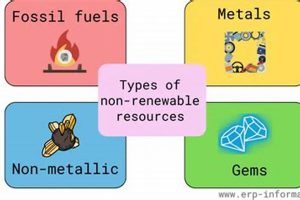
The concept of being “naturally replenished” is intrinsically linked to the definition of resources that renew. This characteristic forms the bedrock upon which the entire understanding of such resources is built. A resource cannot be considered renewable unless it is demonstrably restored by natural processes at a rate equal to, or exceeding, its rate of depletion. The presence of this natural restorative capacity distinguishes it from finite resources like fossil fuels, which are consumed far faster than their geological formation allows. Consequently, the ability of a resource to self-renew is not merely a desirable attribute; it is a fundamental prerequisite for its categorization as something renews.
The significance of this inherent replenishment manifests in various ways. For instance, solar radiation, continuously emitted by the sun, powers photovoltaic cells to generate electricity. Similarly, the evaporation-precipitation cycle ensures a consistent supply of fresh water in rivers and lakes, vital for hydroelectric power generation. Wind, driven by solar-induced temperature gradients, propels wind turbines. Without the sustained input of solar energy driving these natural processes, neither wind nor water would offer a viable, continually available power source. Deforestation practices exemplify a negative relationship; excessive tree removal without adequate replanting undermines the forests capacity to regenerate, transitioning it from to non-renewable resource.
In summary, the attribute of being “naturally replenished” underpins the feasibility and sustainability aspects. This intrinsic capacity allows us to view them as assets capable of providing long-term benefits without causing the depletion issues associated with finite reserves. Understanding this principle is not merely academic; it informs resource management strategies, technological development, and policy decisions aimed at fostering a future powered by sustainable and environmentally sound means.
2. Sustainable Extraction
Sustainable extraction is a cornerstone of resource management and is inextricably linked to the defining characteristics of resources that are replenished naturally. While inherent renewability provides the potential for long-term resource availability, it is the implementation of sustainable extraction practices that ensures this potential is realized. The following highlights critical facets of sustainable extraction as it relates to resources with natural replenishment.
- Extraction Rate Management
Extraction rate management involves carefully controlling the speed at which resources are harvested or utilized. For resources that are self-renewing, the extraction rate must not exceed the rate at which the resource regenerates. Overfishing, for example, depletes fish stocks faster than they can reproduce, compromising their long-term availability and transforming what should be a resource that is replenished into a dwindling one. Similarly, excessive groundwater pumping can lead to aquifer depletion, negating the resource’s capacity for renewal. Effective extraction rate management is thus crucial for maintaining the stability of these assets.
- Minimizing Environmental Impact
Sustainable extraction methodologies prioritize the reduction of ecological harm associated with resource utilization. For instance, hydroelectric power, while reliant on a renewable water source, can disrupt aquatic ecosystems if dam construction and operation are not carefully managed. Wind farms, similarly, must be strategically located to minimize bird and bat mortality. Sustainable extraction, therefore, involves the employment of practices that mitigate habitat destruction, water pollution, and other adverse environmental effects associated with harvesting these resources.
- Technological Efficiency and Innovation
Advancements in technology play a significant role in promoting sustainable extraction. More efficient solar panels, wind turbines, and geothermal energy systems allow for greater energy output with less environmental disturbance. Precision agriculture techniques can optimize water usage and reduce fertilizer runoff. Continuous innovation is essential for refining extraction processes, reducing waste, and maximizing the utilization of resources.
- Community Engagement and Social Equity
Sustainable extraction necessitates the active involvement of local communities and the equitable distribution of benefits. This includes respecting traditional land rights, providing employment opportunities, and ensuring that the extraction process does not disproportionately impact marginalized populations. Community engagement fosters a sense of ownership and responsibility, leading to more sustainable and equitable resource management outcomes.
In summary, sustainable extraction is the crucial link between inherent renewability and long-term resource availability. By carefully managing extraction rates, minimizing environmental impacts, leveraging technological advancements, and fostering community engagement, it is possible to harness the potential of these assets while safeguarding their long-term viability. Without sustainable practices, even resources that are self-renewing can be rapidly depleted, undermining their value and threatening the ecosystems and communities that depend on them.
3. Environmental Friendliness

The characteristic of environmental friendliness is central to the significance of resources with natural replenishment. These resources are viewed as advantageous partly because their utilization tends to result in less environmental degradation than the use of finite reserves. This reduced impact stems from several factors, including lower greenhouse gas emissions, reduced air and water pollution, and minimal habitat disruption, provided sustainable extraction practices are observed. For example, solar power generation produces electricity without directly releasing carbon dioxide into the atmosphere, a significant advantage over coal-fired power plants. Similarly, wind energy harnesses a natural force without generating harmful byproducts associated with fossil fuel combustion.
However, the equation between resources that are replenished and environmental friendliness is not absolute. The environmental impact of harnessing these resources varies depending on the specific technology employed and the scale of deployment. Large-scale hydroelectric dams can inundate vast areas of land, displacing communities and disrupting river ecosystems. Wind farms, if improperly sited, can pose a threat to bird populations. Geothermal energy extraction can release greenhouse gases, albeit in smaller quantities than fossil fuel combustion. Therefore, careful consideration of the entire life cycle of extraction, processing, and utilization is required to fully assess the environmental implications. Life Cycle Assessments (LCAs) play a crucial role in quantifying these impacts and guiding responsible resource management.
In conclusion, environmental friendliness is a key attribute that distinguishes most resources that replenish naturally, but it is not an inherent guarantee. Realizing the full potential of their reduced environmental burden demands meticulous planning, sustainable practices, and a commitment to minimizing adverse effects throughout the entire lifecycle. Properly managed, the shift toward these resources holds significant promise for mitigating climate change, reducing pollution, and fostering a more environmentally sustainable energy future.
4. Long-Term Availability

Long-term availability forms a cornerstone of resource planning, particularly when evaluating sources defined by their capacity for natural replenishment. This concept extends beyond simple renewability, emphasizing the sustained provision of a resource for future generations. Consideration of factors impacting its continued accessibility is paramount.
- Sustainable Yield Management
Sustainable yield management involves extracting a resource at a rate that allows natural regeneration to maintain a consistent supply over extended periods. This principle is especially crucial in fisheries management. Overfishing depletes fish stocks, compromising their long-term availability despite the species’ capacity for reproduction. Effective yield management requires accurate population assessments, regulated fishing quotas, and habitat protection measures to ensure resource persistence.
- Climate Change Impacts
Climate change poses a significant challenge to the long-term availability of some resources that are replenished naturally. Alterations in precipitation patterns can reduce water availability in certain regions, impacting hydropower generation and irrigation. Rising sea levels threaten coastal ecosystems, affecting fisheries and aquaculture. Understanding and mitigating climate change impacts are, therefore, essential for safeguarding these assets for the future.
- Technological Advancements and Adaptation
Technological advancements play a crucial role in ensuring the sustained availability of resources that are replenished. Improved water management techniques, such as drip irrigation and rainwater harvesting, can enhance water use efficiency. Advancements in energy storage technologies, such as batteries and pumped hydro, can mitigate the intermittency of solar and wind power. Adaptation strategies are necessary to cope with changing environmental conditions and maintain resource security.
- Policy and Regulatory Frameworks
Effective policy and regulatory frameworks are essential for promoting the long-term availability of these resources. These frameworks should establish clear resource management guidelines, incentivize sustainable practices, and address potential conflicts between competing resource users. Strong enforcement mechanisms are necessary to ensure compliance and prevent overexploitation. Policy interventions, such as carbon pricing and renewable energy mandates, can also drive investment in technologies and practices that enhance long-term resource security.
The emphasis on long-term availability underlines the need for a holistic approach to resource management, integrating ecological, economic, and social considerations. Sustaining the provision of these assets demands proactive planning, adaptive management strategies, and a commitment to safeguarding the interests of future generations. By addressing these facets, societies can realize the full potential of relying on naturally replenished sources while ensuring their continued accessibility for years to come.
5. Resource Management

Resource management is inextricably linked to the very definition of resources characterized by their ability to replenish naturally. While the intrinsic capacity for self-renewal is a defining attribute, the effective management of these resources determines whether this potential is realized over the long term. Resource management encompasses the strategies, policies, and practices employed to ensure the sustainable utilization and preservation of such assets. In essence, it acts as the vital link connecting the theoretical potential of replenishability with the practical reality of long-term availability.
Consider the example of a sustainably managed forest. The forest’s capacity to regenerate trees naturally makes it a resource that replenishes; however, without responsible forestry practices such as selective logging, reforestation efforts, and fire prevention measures, the forest could be depleted faster than it can regenerate. This mismanagement would negate its value as a sustainable resource, transforming it into a finite one. Similarly, effective management of water resources involves regulating water usage, minimizing pollution, and protecting watersheds to ensure continued access to fresh water supplies. Wind energy requires careful siting of wind farms to minimize ecological impact and address community concerns, illustrating how management decisions directly impact the sustainability of even the cleanest sources. It is because of the necessity of applying sustainable resource management practices that effective oversight constitutes an essential, though sometimes tacit, component of the description of resources with natural replenishment.
In conclusion, resource management is not merely an ancillary consideration but an integral element within the broader understanding of resources that self-renew. While the inherent capacity for self-renewal provides the potential for long-term availability, it is diligent resource management that transforms this potential into a tangible reality. Challenges such as climate change, population growth, and technological advancements require adaptive and innovative management strategies to ensure that these resources continue to provide benefits to present and future generations. This interplay between inherent renewability and responsible management defines the true essence of their value.
6. Technological Applications

Technological applications represent the instrumental bridge that translates the theoretical potential of replenishable resources into tangible benefits. These applications are not merely add-ons but are integral components in realizing the viability and scalability of harnessing the inherent capabilities of naturally renewing assets.
- Energy Conversion Systems
Energy conversion systems, such as photovoltaic (PV) arrays for solar energy and wind turbines for wind energy, are fundamental in capturing and transforming resources that replenish into usable forms of energy, typically electricity. The efficiency and reliability of these systems directly impact the economic viability of power projects. Advances in PV technology, resulting in higher conversion efficiencies and lower manufacturing costs, have driven widespread adoption of solar power. Similarly, developments in wind turbine design, resulting in larger rotor diameters and increased power ratings, have enhanced the cost-effectiveness of wind energy. The specific technical characteristics of these energy conversion systems and their capacity to perform effectively within a specific geographic locale are critical considerations.
- Energy Storage Solutions
Energy storage solutions address the intermittency challenge associated with some resources. Solar and wind energy generation fluctuate depending on weather conditions, necessitating the incorporation of energy storage systems, such as batteries or pumped hydro storage, to ensure a consistent and reliable power supply. Improvements in battery technology, with higher energy densities and longer lifespans, are expanding the deployment of grid-scale energy storage. Pumped hydro storage, while requiring specific geographic conditions, offers a mature and cost-effective means of storing large amounts of energy. Without effective energy storage, the practical application of solar and wind resources is significantly constrained.
- Smart Grid Technologies
Smart grid technologies enable the efficient integration and management of resources into existing power grids. Smart grids utilize advanced sensors, communication networks, and control systems to optimize energy distribution, balance supply and demand, and improve grid stability. These technologies facilitate the seamless integration of distributed generation sources, such as rooftop solar PV systems, into the grid. Smart grid infrastructure also enables real-time monitoring and control, allowing for faster response to grid disturbances and improved overall grid performance. The deployment of smart grid technologies is essential for maximizing the benefits of incorporating diverse power resources and achieving a more resilient and sustainable energy system.
- Materials Science Innovations
Materials science innovations play a crucial role in enhancing the performance and durability of renewable energy technologies. Advances in materials science have led to the development of more efficient and durable solar cell materials, such as perovskites, which offer the potential for lower manufacturing costs and higher conversion efficiencies. New materials are also being developed for wind turbine blades, enabling larger rotor diameters and improved aerodynamic performance. Similarly, research into new battery materials is driving improvements in energy storage capacity and lifespan. Materials science innovations are, therefore, critical for advancing the performance, cost-effectiveness, and long-term viability of renewable energy technologies.
These technological applications, spanning energy conversion, storage, smart grids, and materials science, collectively determine the degree to which resources that are replenished can be effectively harnessed to meet energy demands sustainably. Continuous innovation in these areas is crucial for unlocking the full potential of these resources and transitioning toward a cleaner, more secure energy future.
7. Economic Viability

Economic viability is an essential consideration in the context of resources with natural replenishment. While the environmental and sustainability benefits of these resources are widely recognized, their practical adoption hinges significantly on their economic competitiveness relative to conventional energy sources. The interplay between cost, performance, and market factors determines the extent to which these resources can displace fossil fuels and contribute to a sustainable energy transition. If the harnessing and distribution costs exceed the obtainable revenues or cannot compete with those of traditional methods, its real-world deployment will be severely restricted, thus diminishing its practical definition.
The costs associated with generating electricity from resources that replenish have decreased substantially in recent years, driven by technological advancements, economies of scale, and supportive government policies. Solar photovoltaic (PV) and wind energy, in particular, have experienced significant cost reductions, making them competitive with, and in some cases cheaper than, coal and natural gas in many regions. This cost competitiveness has spurred significant growth in the deployment of solar and wind capacity worldwide. However, the economic viability of renewable energy projects varies depending on factors such as resource availability, financing costs, and grid infrastructure. For example, solar projects in sun-rich regions are generally more economically attractive than those in regions with lower solar irradiance. Government subsidies, tax credits, and feed-in tariffs can also play a crucial role in improving the economic attractiveness of these projects. Investment in appropriate infrastructure to handle energy distribution represents another influential economic factor.
In conclusion, economic viability is a critical determinant of the widespread adoption of resources with natural replenishment. While technological innovation and supportive policies have significantly improved the economic competitiveness of renewable energy, challenges remain in certain sectors and regions. Addressing these challenges through continued innovation, strategic policy interventions, and efficient market mechanisms is essential for realizing the full potential of resources that are naturally replenished as a sustainable and economically sound energy solution. Without this, their very status is placed in jeopardy.
Frequently Asked Questions About Resources with Natural Replenishment
This section addresses common inquiries regarding the definition, characteristics, and implications of relying on resources with natural replenishment.
Question 1: What fundamentally distinguishes a resource that replenishes from a finite resource?
The core distinction lies in the rate of replenishment. Resources that self-renew are restored by natural processes at a rate comparable to, or exceeding, their rate of consumption. Finite resources, like fossil fuels, accumulate over geological timescales vastly exceeding human lifespans, rendering their consumption unsustainable in the long term.
Question 2: Does the capacity for natural replenishment guarantee the long-term availability of a resource?
No. The inherent capacity for natural replenishment is a necessary but not sufficient condition for long-term availability. Sustainable management practices, including regulated extraction rates, habitat protection, and pollution control, are essential to prevent overexploitation and ensure continued access.
Question 3: Are all resources with natural replenishment equally environmentally benign?
While generally less environmentally damaging than fossil fuels, the extraction and utilization of naturally replenished resources can have environmental consequences. Large-scale hydroelectric dams can disrupt aquatic ecosystems, and improperly sited wind farms can pose a threat to bird populations. A comprehensive Life Cycle Assessment is essential to determine the true environmental impact.
Question 4: How does climate change affect the availability of resources that replenish naturally?
Climate change can significantly alter the availability of these resources. Changes in precipitation patterns can affect water resources, and rising sea levels can impact coastal ecosystems. Adapting to these changes through improved water management, resilient infrastructure, and proactive conservation efforts is crucial.
Question 5: What role does technology play in harnessing resources that replenish naturally?
Technology is critical for efficiently capturing and converting the energy from these resources into usable forms, such as electricity or heat. Advances in solar panel efficiency, wind turbine design, and energy storage technologies are driving down costs and increasing the viability of utilization.
Question 6: Why is economic viability important for resources with natural replenishment?
Economic competitiveness is essential for widespread adoption. If the costs of extracting, processing, and utilizing these resources are too high relative to conventional alternatives, their deployment will be limited, hindering the transition to a sustainable energy system.
In summary, the effective management, appropriate technology, and economic considerations are all key to successfully employing resources that are replenished naturally. Their true value is in their potential to deliver a more sustainable future.
The subsequent sections will delve further into specific examples and case studies.
Defining a Sustainable Future
This exploration of what is a renewable resource definition has underscored the multifaceted nature of their potential and limitations. It has highlighted that the classification goes beyond mere natural replenishment, encompassing sustainable extraction, environmental responsibility, long-term availability, effective management, technological applications, and economic viability. The absence of any single facet diminishes the resource’s classification.
The path toward a sustainable future requires a comprehensive understanding and diligent application of these principles. Continued research, responsible policy, and unwavering commitment to innovation are essential to fully harness the potential of these sources and secure a future where energy and resources are both abundant and ecologically sound.
![Guide to What Energy Resources Are Renewable [+Future] | Renewable Energy Solutions for a Sustainable Future | Clean & Green Power](https://pplrenewableenergy.com/wp-content/uploads/2026/03/th-516-300x200.jpg "Guide to What Energy Resources Are Renewable [+Future] Renewable Energy Solutions for a Sustainable Future | Clean & Green Power")