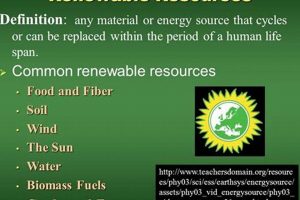
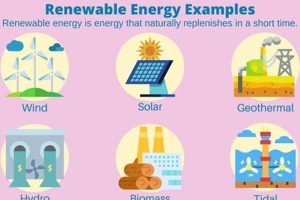
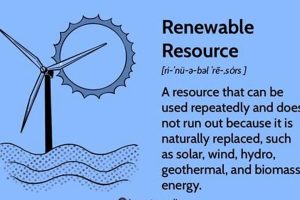
Resources that naturally replenish over a human timescale represent a crucial element of sustainable resource management. Solar energy, derived from the constant radiation emitted by the sun, stands as a primary illustration. Wind power, harnessed through turbines to generate electricity, is another significant instance. Geothermal energy, utilizing heat from the Earth’s interior, also qualifies. Water resources, including hydropower and tidal energy, are further demonstrative cases, provided they are managed responsibly to ensure continuous availability.
The utilization of these resources provides significant benefits, including reduced reliance on fossil fuels and decreased greenhouse gas emissions, contributing to mitigating climate change. Historically, many of these sources, such as wind and water, were employed in pre-industrial societies for basic tasks like milling grain and powering transportation. Modern technologies have significantly enhanced the efficiency and scale of their extraction and conversion into usable energy, offering potent alternatives to conventional energy sources.
The following sections will delve into the specific technologies associated with harnessing these environmentally-friendly sources. A comparative analysis of the advantages and disadvantages of each will also be presented. Considerations regarding infrastructural requirements and economic viability for implementing these sustainable practices will subsequently be addressed.
Guidance on Implementing Replenishable Resource Strategies
This section presents actionable guidance for effectively integrating renewable energy sources into various contexts, from individual households to large-scale industrial operations. Practical advice and considerations are outlined to promote sustainable resource management.
Tip 1: Conduct a Comprehensive Energy Audit: Before investing in any renewable technology, thoroughly assess current energy consumption patterns. This evaluation identifies areas of inefficiency and helps determine the appropriate scale of renewable energy systems required. For instance, a household might discover that improving insulation reduces heating needs, thereby lowering the demand on a solar heating system.
Tip 2: Prioritize Passive Solar Design: When constructing new buildings or renovating existing ones, implement passive solar design principles. Orient structures to maximize sunlight exposure during colder months and minimize it during warmer months. This reduces reliance on active heating and cooling systems, further decreasing energy consumption. Overhanging eaves and strategically placed trees are examples of passive solar techniques.
Tip 3: Explore Government Incentives and Rebates: Many governments offer financial incentives to encourage the adoption of renewable energy technologies. Research available grants, tax credits, and rebates at the local, regional, and national levels. These programs can significantly reduce the initial investment cost of renewable energy systems, making them more financially accessible.
Tip 4: Consider Community Solar Programs: If individual solar installations are not feasible due to space constraints or financial limitations, explore community solar programs. These initiatives allow multiple households or businesses to collectively invest in a shared solar array and receive credit on their electricity bills for the energy produced. This fosters collaboration and expands access to solar energy.
Tip 5: Integrate Energy Storage Solutions: Renewable energy sources, such as solar and wind, are intermittent in nature. To ensure a consistent power supply, consider integrating energy storage solutions, such as battery systems. These systems store excess energy generated during peak production periods and release it when demand is high or when renewable sources are unavailable. This enhances the reliability and resilience of renewable energy systems.
Tip 6: Optimize Water Usage: Implement water conservation measures to reduce the demand on water-related renewable energy sources, such as hydropower. Install low-flow fixtures, repair leaks promptly, and utilize rainwater harvesting systems for non-potable uses. Reduced water consumption minimizes the need for extensive water infrastructure and preserves the integrity of aquatic ecosystems.
These guidelines emphasize the importance of informed planning, strategic implementation, and proactive resource management when embracing renewable energy. By adopting these practices, individuals, businesses, and communities can contribute to a more sustainable energy future.
The subsequent discussion will explore potential challenges and obstacles to widespread adoption of renewable energy, along with proposed strategies to overcome them.
1. Solar Radiation Abundance

Solar radiation abundance represents a pivotal factor in the context of renewable energy resources. It directly influences the viability and effectiveness of solar energy technologies, establishing it as a primary driver in the discussion of renewable energy solutions.
- Geographic Distribution of Solar Irradiance
The intensity of solar radiation varies significantly across geographical locations. Regions near the equator generally receive higher levels of solar irradiance compared to polar regions. This distribution dictates the energy yield of solar power installations, impacting the economic feasibility of solar projects in different areas. For instance, solar farms in desert regions like the Sahara or the Southwestern United States benefit from consistently high solar irradiance, resulting in higher electricity production.
- Technological Advancements in Solar Capture
Technological progress is continuously enhancing the efficiency of solar energy capture. Photovoltaic (PV) cells, the core component of solar panels, are becoming more adept at converting sunlight into electricity. Innovations in materials science, such as perovskite solar cells, promise to further improve energy conversion rates. Concentrated solar power (CSP) technologies, which use mirrors to focus sunlight onto a receiver, are also being refined to increase efficiency and reduce costs.
- Seasonal Variability and Energy Storage
Solar radiation abundance fluctuates throughout the year due to seasonal changes and weather patterns. In temperate climates, solar energy production is typically higher during the summer months and lower during the winter. This variability necessitates the integration of energy storage solutions, such as batteries, to ensure a consistent and reliable energy supply. Grid-scale battery storage is becoming increasingly important for managing the intermittency of solar power and stabilizing the electricity grid.
- Economic Considerations and Scalability
The economic viability of solar energy is directly linked to solar radiation abundance. Regions with high irradiance can achieve lower levelized costs of electricity (LCOE), making solar power more competitive with traditional energy sources. Furthermore, the scalability of solar energy projects, from residential rooftop installations to large-scale solar farms, allows for diverse deployment options. Government policies, such as feed-in tariffs and tax incentives, play a crucial role in promoting the adoption of solar energy technologies and accelerating the transition to a renewable energy economy.
The multifaceted relationship between solar radiation abundance, technological advancement, and economic considerations highlights its central role among replenishable sources. The continuous improvement in solar energy technologies, coupled with favorable economic conditions and supportive government policies, will further solidify the place of solar power as a cornerstone of sustainable energy.
2. Wind Kinetic Conversion

Wind kinetic conversion, the process of transforming the energy of moving air into electricity, constitutes a fundamental component in the realm of replenishable power sources. Its significance stems from the consistent availability of wind resources across diverse geographical locations, making it a viable alternative to fossil fuels.
- Aerodynamic Principles of Wind Turbine Operation
Wind turbines operate based on aerodynamic principles, primarily lift and drag. Blades are designed to generate lift as wind flows over them, causing the rotor to rotate. This rotational motion is then converted into electricity via a generator. Different turbine designs, such as horizontal-axis and vertical-axis turbines, employ varying aerodynamic strategies to maximize energy capture. For instance, horizontal-axis turbines, the most common type, utilize airfoil-shaped blades to efficiently convert wind energy into mechanical energy.
- Geographic Variability and Wind Resource Assessment
The kinetic potential of wind varies significantly depending on geographical location and prevailing atmospheric conditions. Coastal regions, mountain passes, and open plains typically experience higher and more consistent wind speeds. Wind resource assessment involves detailed analysis of wind speed data, wind direction, and turbulence intensity to determine the suitability of a location for wind power development. Wind farms are strategically located in areas with high wind resource potential to maximize energy generation. For example, the Great Plains region of the United States is known for its abundant wind resources and hosts numerous large-scale wind farms.
- Grid Integration Challenges and Solutions
Integrating wind power into the electricity grid presents challenges due to the intermittent nature of wind resources. Fluctuations in wind speed can lead to variability in power output, requiring grid operators to balance supply and demand. Solutions to mitigate these challenges include advanced forecasting techniques, energy storage systems (e.g., batteries), and grid modernization. Improved grid infrastructure and smart grid technologies enhance the reliability and stability of the electricity supply while accommodating variable renewable energy sources.
- Environmental Considerations and Mitigation Strategies
While wind power offers significant environmental advantages over fossil fuels, it is not without environmental impacts. Potential impacts include avian and bat mortality, noise pollution, and visual impacts on the landscape. Mitigation strategies include careful site selection, turbine design modifications, and operational adjustments to minimize harm to wildlife. Environmental impact assessments are conducted to evaluate potential impacts and implement appropriate mitigation measures. Sustainable wind power development balances energy production with environmental protection.
These facets underscore the complex relationship between wind kinetic conversion and the broader framework of sustainable sources. By optimizing aerodynamic designs, strategically siting wind farms, addressing grid integration challenges, and mitigating environmental impacts, wind power can play a crucial role in transitioning to a clean energy future, exemplifying one of the most promising examples of naturally replenishing energy.
3. Geothermal Heat Gradient

The geothermal heat gradient, the gradual increase in temperature with depth within the Earth’s interior, constitutes the driving force behind geothermal energy, an example of a replenishable resource. This gradient arises from residual heat from Earth’s formation and the decay of radioactive isotopes in the mantle and crust. The magnitude of the gradient varies geographically, with areas near tectonic plate boundaries and volcanic hotspots exhibiting significantly higher temperature gradients than stable continental regions. These higher gradients enable efficient extraction of geothermal energy for various applications, including electricity generation and direct-use heating.
The practical significance of understanding the geothermal heat gradient lies in optimizing geothermal energy extraction. Geothermal power plants tap into high-temperature reservoirs deep underground to produce steam, which drives turbines connected to generators. In areas with lower gradients, enhanced geothermal systems (EGS) are employed. EGS involves fracturing hot, dry rocks deep beneath the surface and circulating water through the fractures to extract heat. Iceland, a country located on the Mid-Atlantic Ridge, exemplifies successful utilization of geothermal energy due to its high geothermal gradient, providing a substantial portion of its electricity and heating needs. Likewise, the Geysers geothermal field in California, a region with significant geological activity, is a prominent example of a large-scale geothermal power production site.
In conclusion, the geothermal heat gradient is a fundamental parameter in determining the viability and efficiency of accessing geothermal energy. Its understanding facilitates optimized site selection, improved extraction technologies, and expanded utilization of this underutilized replenishable asset. Addressing the challenges of EGS technology, such as induced seismicity and high initial costs, is crucial for unlocking the full potential of geothermal energy as a significant contributor to a sustainable energy future, helping move society further from reliance on non-renewable sources.
4. Hydropower Potential Energy
Hydropower potential energy, derived from the gravitational force acting upon water stored at elevation, stands as a well-established example of a replenishable resource. Its widespread implementation globally underscores its relevance in the context of sustainable energy production.
- Conversion of Potential Energy to Kinetic Energy
The operation of hydroelectric power plants hinges on the conversion of potential energy, stored in water reservoirs, into kinetic energy as water flows downhill. This kinetic energy drives turbines connected to electrical generators. The efficiency of this conversion is determined by the height of the water column (head) and the volume of water flow. The Hoover Dam, a prominent example, exemplifies the large-scale implementation of this principle. The water stored in Lake Mead possesses substantial potential energy, which is efficiently converted to kinetic energy to generate electricity for the southwestern United States.
- Environmental Impacts of Hydropower Development
While hydropower provides a clean energy source, its development often entails significant environmental consequences. Dam construction can alter river ecosystems, disrupt fish migration patterns, and inundate terrestrial habitats. The Three Gorges Dam in China, the world’s largest hydroelectric power station, illustrates both the immense energy generation capacity and the extensive environmental disruptions associated with large-scale hydropower projects. Mitigation strategies, such as fish ladders and environmental flow releases, are crucial for minimizing these impacts.
- Pumped Storage Hydropower as Energy Storage
Pumped storage hydropower serves as a valuable energy storage solution within power grids. During periods of low electricity demand, excess energy is used to pump water from a lower reservoir to an upper reservoir. When demand increases, the water is released back down to generate electricity. This closed-loop system provides a flexible and reliable means of storing energy, improving grid stability and facilitating the integration of intermittent replenishable resources like solar and wind. The Bath County Pumped Storage Station in Virginia, USA, is one of the largest pumped storage facilities globally, providing critical grid support services.
- Run-of-River Hydropower Systems
Run-of-river hydropower represents an alternative approach to traditional dam-based hydropower. These systems utilize the natural flow of a river to generate electricity, minimizing the need for large reservoirs and reducing environmental impacts. Run-of-river projects typically have smaller footprints and cause less disruption to river ecosystems. However, their power output is more susceptible to seasonal variations in river flow. Numerous small-scale run-of-river projects are being developed worldwide to harness the potential of smaller rivers and streams while minimizing environmental consequences.
The facets of hydropower potential energy, from the efficient conversion process to the environmental considerations and energy storage capabilities, underscore its multifaceted role among examples of replenishable resource strategies. While significant benefits exist, a balanced approach incorporating environmental sustainability is imperative to harness the full potential of hydroelectricity effectively.
5. Biomass Carbon Neutrality

Biomass carbon neutrality is a concept that positions biomass as a potentially sustainable resource within the spectrum of replenishable energy options. The underlying principle suggests that the carbon dioxide (CO2) released during the combustion of biomass is offset by the CO2 absorbed during the plant’s growth, resulting in a net-zero carbon emission profile. However, achieving true carbon neutrality with biomass requires careful consideration of various factors.
- Sustainable Sourcing and Reforestation Efforts
The carbon neutrality of biomass is contingent upon sustainable sourcing practices. Forests and agricultural lands must be managed responsibly to ensure continuous carbon sequestration. Reforestation and afforestation initiatives play a critical role in offsetting carbon emissions associated with biomass combustion. For instance, utilizing sustainably harvested wood from responsibly managed forests, where replanting rates match or exceed harvesting rates, can contribute to maintaining carbon stocks and supporting the carbon neutrality claim.
- Lifecycle Assessment and Transportation Impacts
A comprehensive lifecycle assessment is essential for evaluating the true carbon footprint of biomass. This assessment includes accounting for emissions associated with biomass cultivation, harvesting, processing, transportation, and combustion. Long-distance transportation of biomass can significantly increase its carbon footprint, potentially negating the benefits of carbon neutrality. Local sourcing of biomass, such as using agricultural residues or wood waste from nearby forestry operations, can minimize transportation emissions and improve the overall sustainability profile.
- Combustion Efficiency and Technology Advancements
The efficiency of biomass combustion technologies directly impacts the carbon emissions associated with biomass energy production. Advanced combustion technologies, such as gasification and pyrolysis, can improve energy conversion rates and reduce emissions compared to traditional burning methods. Implementing these technologies in biomass power plants can enhance the carbon neutrality of biomass energy. Furthermore, carbon capture and storage (CCS) technologies can be integrated with biomass power plants to capture CO2 emissions and prevent them from entering the atmosphere, further mitigating climate impacts.
- Land Use Change and Indirect Emissions
Land use change associated with biomass production can have significant implications for carbon emissions. Converting forests or grasslands to energy crop plantations can release stored carbon into the atmosphere, offsetting the carbon sequestration benefits of biomass. Indirect emissions, such as those associated with fertilizer production and application, must also be considered. Avoiding land use change and promoting the use of marginal lands for biomass production can minimize negative impacts on carbon emissions and biodiversity. For example, using non-food crops grown on degraded lands can provide a sustainable source of biomass without competing with food production or displacing natural habitats.
The various facets of biomass carbon neutrality discussed underscore the complexities involved in its consideration as a replenishable resource. While theoretically carbon neutral, the actual sustainability of biomass energy depends heavily on responsible land management, efficient combustion technologies, and holistic lifecycle assessments. These factors highlight the need for rigorous analysis and sustainable practices to ensure that biomass energy truly contributes to a low-carbon future and the ongoing search for truly renewable resource examples.
6. Tidal Gravitational Forces

Tidal gravitational forces, arising from the interaction between the Earth, the Moon, and the Sun, are the fundamental driver behind tidal energy, a specialized instance among examples of a replenishable resource. The gravitational attraction exerted by these celestial bodies creates predictable and cyclical sea level fluctuations known as tides. The potential energy inherent in these tidal fluctuations can be harnessed to generate electricity, offering a predictable and reliable source of renewable power.
The direct relationship between tidal gravitational forces and tidal energy generation is exemplified by tidal barrage systems and tidal stream generators. Tidal barrages, such as the Rance Tidal Power Station in France, utilize dam-like structures to create a head difference between the water level on either side. As tides flow in and out, water passes through turbines within the barrage, generating electricity. Tidal stream generators, akin to underwater wind turbines, harness the kinetic energy of tidal currents to turn turbines, producing electricity. The MeyGen project in Scotland, a large-scale tidal stream project, demonstrates the feasibility of extracting energy from strong tidal currents in specific coastal locations. The predictability of tidal cycles, dictated by celestial mechanics, allows for accurate forecasting of power generation, a significant advantage over intermittent sources like solar and wind. However, the environmental impacts of tidal energy projects, such as altering tidal flow patterns and affecting marine ecosystems, necessitate careful site selection and mitigation strategies. Furthermore, the capital costs associated with tidal energy infrastructure are substantial, requiring significant investment in research, development, and deployment.
In summary, tidal gravitational forces are inextricably linked to the feasibility and potential of tidal energy as a replenishable resource. Understanding these forces is critical for designing and optimizing tidal energy extraction technologies. While tidal energy offers a predictable and reliable source of power, addressing the environmental and economic challenges associated with its implementation is crucial for realizing its full potential as a sustainable energy solution and further enriching the range of renewable resource examples available.
Frequently Asked Questions About Replenishable Resources
The following questions address common inquiries and misconceptions regarding the utilization and implementation of energy strategies based on examples of a renewable resource.
Question 1: What constitutes a primary defining characteristic to qualify an energy source as replenishable?
A key characteristic is the ability of the source to naturally regenerate within a human timescale, ensuring its continued availability without depletion. Resources like solar radiation, wind, and geothermal heat exemplify this quality.
Question 2: How significant is the role of technological advancement in maximizing the utility of these energy sources?
Technological progress is pivotal. Enhanced conversion efficiencies in solar panels, improved turbine designs for wind energy, and advanced geothermal extraction techniques amplify the energy output and economic viability of these resources.
Question 3: Is the implementation of replenishable energy sources universally devoid of environmental impact?
The assumption of zero environmental impact is inaccurate. Hydropower can disrupt aquatic ecosystems, wind farms may pose risks to avian populations, and biomass combustion can release pollutants. Careful planning and mitigation strategies are crucial to minimize these effects.
Question 4: What are the primary impediments hindering the widespread adoption of replenishable energy solutions?
Challenges include the intermittent nature of certain sources (e.g., solar and wind), the high initial investment costs associated with infrastructure development, and the need for grid modernization to accommodate fluctuating energy inputs.
Question 5: Can reliance on these resources ensure complete energy independence for a nation or region?
Achieving complete energy independence solely through these resources is complex. Diversification of energy sources, strategic energy storage solutions, and interconnected grid systems are essential for ensuring a reliable and resilient energy supply.
Question 6: What role do governmental policies and incentives play in fostering the growth of the replenishable energy sector?
Governmental support mechanisms, such as tax credits, feed-in tariffs, and regulatory frameworks, are instrumental in incentivizing investment, promoting innovation, and creating a level playing field for replenishable energy technologies to compete with conventional energy sources.
These inquiries highlight the complexities and nuances surrounding the deployment of energy strategies centered on examples of a renewable resource. A balanced perspective, incorporating technological innovation, environmental stewardship, and supportive policy frameworks, is essential for realizing the full potential of these resources.
The subsequent discussion will delve into specific case studies showcasing successful applications of replenishable energy technologies and the lessons learned from these implementations.
Conclusion
This exploration of examples of a renewable resource has illuminated the diverse array of naturally replenishing energy sources available. From the inexhaustible supply of solar radiation and wind kinetic conversion to the more localized potential of geothermal heat gradients and tidal gravitational forces, each option presents a unique set of opportunities and challenges. The assessment of biomass carbon neutrality reveals the importance of sustainable practices in ensuring its environmental integrity. Hydropower potential energy, while well-established, underscores the need for careful environmental considerations.
The transition towards a sustainable energy future hinges on a comprehensive understanding of these examples of a renewable resource and the strategic implementation of appropriate technologies. Continued research, technological innovation, and supportive policy frameworks are essential for realizing the full potential of these environmentally sound alternatives and mitigating the impacts of conventional energy production. The long-term viability of human society depends on a commitment to responsible resource management and a decisive shift towards renewable energy solutions.
![Guide to What Energy Resources Are Renewable [+Future] | Renewable Energy Solutions for a Sustainable Future | Clean & Green Power](https://pplrenewableenergy.com/wp-content/uploads/2026/03/th-516-300x200.jpg "Guide to What Energy Resources Are Renewable [+Future] Renewable Energy Solutions for a Sustainable Future | Clean & Green Power")