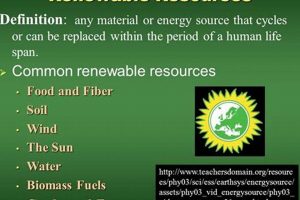
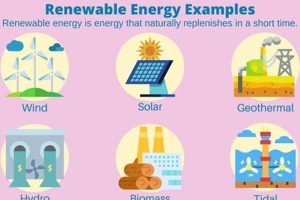
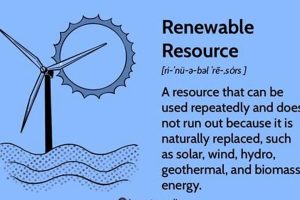
A naturally replenished energy source, such as solar, wind, geothermal, and hydropower, is continuously available and can be harnessed without depletion. These sources stand in contrast to finite reserves like fossil fuels, which require millions of years to form. Examples include solar radiation used for electricity generation, wind power captured by turbines, and the Earth’s internal heat tapped for heating and electricity.
The utilization of these sustainable alternatives provides numerous advantages, including reduced greenhouse gas emissions, diminished dependence on volatile global energy markets, and the creation of new economic opportunities in the green technology sector. Historically, societies have relied on such resources, such as wood for fuel and water for milling, but modern technology expands their applicability and efficiency to meet present and future energy demands. This reliance promotes energy security and environmental stewardship.
The following discussion will delve deeper into the specifics of these sustainable energy alternatives, including their implementation, advantages, limitations, and potential to reshape the global energy landscape, focusing on policy implications and technological advancements that drive their widespread adoption.
Strategies for Leveraging Sustainable Energy Sources
This section offers guidance on optimizing the integration of sustainable energy alternatives, promoting efficient utilization and maximizing long-term benefits.
Tip 1: Diversify Energy Portfolio: Reliance on a single sustainable source introduces vulnerabilities. A diversified approach, incorporating solar, wind, and geothermal, enhances grid stability and reduces dependence on intermittent sources.
Tip 2: Implement Energy Storage Solutions: Intermittency remains a challenge for some sustainable sources. Employing battery storage, pumped hydro, or thermal energy storage systems mitigates fluctuations, ensuring a consistent energy supply.
Tip 3: Invest in Smart Grid Technology: Smart grids optimize energy distribution and consumption. Advanced metering infrastructure, real-time monitoring, and automated controls improve efficiency and reduce waste.
Tip 4: Prioritize Energy Efficiency Measures: Reducing overall energy demand lowers the need for large-scale sustainable infrastructure. Implement energy-efficient building designs, appliances, and industrial processes.
Tip 5: Support Policy and Incentives: Government policies play a crucial role in driving adoption. Advocate for renewable energy mandates, tax incentives, and carbon pricing mechanisms.
Tip 6: Promote Public Awareness and Education: Increased understanding fosters wider acceptance and adoption. Educate the public about the benefits, challenges, and opportunities associated with sustainable energy.
Tip 7: Foster Collaboration and Innovation: Cross-sector collaboration accelerates technological advancements. Support research and development, public-private partnerships, and technology transfer initiatives.
Adherence to these strategies fosters the effective integration of sustainable energy sources, contributing to a resilient, environmentally responsible, and economically viable energy future.
The subsequent sections will further elaborate on the challenges and future trends in the sector, concluding with a summary of the broader implications for society and the environment.
1. Replenishment

Replenishment is a foundational characteristic integral to the definition of a naturally renewed energy source. It distinguishes these resources from finite reserves and ensures their long-term viability. The rate at which a resource is replenished must equal or exceed the rate of consumption for it to be considered sustainable. This principle underpins the entire concept of sustainable energy practices.
- Natural Processes and Renewal
The mechanism through which a given energy source is renewed is based on natural cycles and processes. For solar energy, it is the continuous radiation emitted by the sun. For wind, it is atmospheric convection driven by solar heating. For geothermal, it is the Earth’s internal heat generated from radioactive decay. These natural processes ensure a perpetual energy flow, provided that these natural systems remain in balance.
- Rate of Renewal vs. Consumption
A crucial aspect is the balance between the extraction rate and the natural renewal rate. If usage exceeds the replacement rate, even a naturally replenished source can be depleted, leading to environmental consequences and undermining its sustainability. Sustainable management practices are therefore essential to ensure that extraction remains within the resource’s regenerative capacity. For example, over-extraction of groundwater, even though water is naturally replenished, can lead to aquifer depletion and land subsidence.
- Impact of Human Activities on Replenishment
Human activities can either enhance or diminish the natural replenishment processes. Deforestation can reduce the capacity of forests to sequester carbon, affecting climate regulation and, indirectly, altering weather patterns that influence wind and solar resources. Sustainable land management and conservation efforts are crucial for maintaining and enhancing the regenerative capacity of these natural resources.
- Technological Enhancements to Replenishment
While nature provides the base replenishment, technological interventions can optimize the utilization of resources. For instance, advanced irrigation techniques can improve water use efficiency in agriculture, reducing the demand on groundwater resources and ensuring their sustainable replenishment. Similarly, enhanced geothermal systems can expand the accessibility and utilization of geothermal resources, increasing their overall contribution to the energy mix.
The principle of renewal is central to the utility and sustainability of naturally renewed energy alternatives. Understanding the interplay between natural processes, human activities, and technological interventions is essential for the responsible and effective utilization of these resources, ensuring their long-term availability and minimizing environmental impact. Effective management of the balance between extraction and replacement is key to fulfilling the promise of continuous energy supply and preserving the integrity of the environment.
2. Sustainability

The concept of sustainability is intrinsically linked to the very nature of a naturally renewed energy source. Inherent within the definition of such a resource is the capacity for continuous provision without compromising the ability of future generations to meet their own energy needs. Sustainability, therefore, acts not merely as a desirable attribute but as a fundamental condition defining a genuine naturally renewed alternative.
The cause-and-effect relationship is evident: the sustainable utilization of a resource is contingent upon its capacity for replenishment, which in turn, ensures its continuous availability. For example, consider solar energy; its sustainable use hinges on the inexhaustible supply of solar radiation. Conversely, the unsustainable extraction of groundwater can lead to depletion, ultimately negating its capacity as a naturally renewed resource. The inclusion of “Sustainability” in the definition underscores the obligation to manage these resources responsibly, minimizing environmental impacts and ensuring their long-term availability.
Real-world applications reinforce this understanding. Sustainable forestry practices guarantee a continuous supply of biomass for energy, while unsustainable deforestation practices deplete forests, reducing their carbon sequestration capacity and impacting overall ecosystem health. Similarly, the responsible development of wind farms mitigates impacts on wildlife, whereas poorly planned projects can disrupt migratory patterns and degrade habitats. Ultimately, the sustainability component of naturally renewed resource definitions underscores the need for informed, responsible management to ensure long-term availability and minimize unintended environmental consequences.
3. Natural Cycles

The functionality of naturally renewed energy resources is inextricably linked to Earth’s inherent natural cycles. These cycles, driven by solar radiation, geothermal activity, and gravitational forces, dictate the continuous replenishment characteristic of such resources. The definition encompasses this reliance, underscoring that the resource’s availability is contingent upon the undisturbed continuation of these natural processes. Disruptions to these cycles, whether caused by climate change or unsustainable resource management, directly threaten the long-term viability of these energy sources.
Consider the water cycle: Evaporation, precipitation, and runoff fuel hydropower generation. Changes in precipitation patterns due to climate change can significantly impact the availability of water for hydroelectric dams, affecting their power output. Similarly, wind patterns, influenced by atmospheric pressure gradients and solar heating, drive wind turbines. Alterations in these patterns, potentially stemming from deforestation or urbanization, can diminish wind energy potential in certain regions. Geothermal energy, derived from the Earth’s internal heat, represents a cycle of heat transfer from the planet’s core to the surface. While less susceptible to immediate external disruptions, the long-term sustainability of geothermal resources depends on maintaining the geological integrity of extraction sites and avoiding over-exploitation, which could deplete subsurface reservoirs.
Understanding the interplay between natural cycles and these energy resources is crucial for informed resource management and sustainable energy planning. It necessitates integrated approaches that consider not only energy production but also the broader environmental context and potential feedback loops. Preservation of forests, responsible water management, and mitigation of climate change are essential for safeguarding the long-term availability of naturally renewed energy resources. Furthermore, embracing technological innovation, such as advanced weather forecasting and water conservation techniques, will enhance our ability to adapt to changing environmental conditions and ensure the continued viability of these crucial energy sources.
4. Environmental Impact
The environmental impact constitutes a pivotal consideration within the definition of naturally renewed energy sources. While lauded for their sustainability, these resources are not entirely devoid of ecological consequences. A comprehensive understanding necessitates evaluating the potential negative effects alongside the inherent benefits, thereby ensuring responsible and informed implementation. The relationship between energy source selection and resulting environmental alteration is one of cause and effect, requiring careful analysis to minimize harm and maximize the long-term advantages of these resources. In essence, any evaluation of a naturally renewed energy source’s suitability must incorporate a thorough environmental impact assessment.
Specific examples underscore the importance of this consideration. Large-scale hydroelectric projects, while providing significant power output, can alter river ecosystems, impede fish migration, and inundate vast tracts of land. Wind farms, similarly, may pose a threat to avian populations, necessitate habitat alteration for construction, and generate noise pollution. Solar energy, though generally regarded as benign, requires extensive land use for photovoltaic arrays and involves the use of materials with potential environmental implications during manufacturing and disposal. Geothermal energy, although relatively clean, can release trace amounts of greenhouse gases and trigger seismic activity in certain geological conditions. These examples highlight the necessity of site-specific assessments and mitigation strategies to minimize the environmental footprint of naturally renewed energy infrastructure. Practical applications include stringent environmental regulations, the implementation of advanced monitoring technologies, and the adoption of best practices in project design and operation.
In conclusion, the environmental impact forms an indispensable component of the definition of naturally renewed energy alternatives. Acknowledging and addressing the potential negative consequences, through rigorous assessment and proactive mitigation, is paramount for realizing the full promise of sustainable energy. Challenges remain in quantifying and predicting all potential impacts, necessitating continuous research and development of environmentally sensitive technologies. Ultimately, the successful integration of naturally renewed energy sources requires a commitment to minimizing ecological harm and maximizing societal benefits, balancing the needs of energy production with the preservation of natural ecosystems and biodiversity.
5. Resource Management

Effective resource management is paramount to realizing the long-term potential of naturally renewed energy sources. It encompasses the strategic planning, allocation, and oversight necessary to ensure the sustainable utilization of these resources while mitigating potential negative impacts. Its relevance is directly tied to the definition of such energy sources, as mismanagement can undermine their renewability and compromise their ecological integrity.
- Sustainable Harvesting and Extraction
This facet focuses on methods that prevent depletion of the resource. For example, in forestry, sustainable harvesting involves replanting trees at a rate that matches or exceeds the rate of extraction for biomass energy. In geothermal energy, it entails monitoring reservoir pressure and temperature to prevent over-extraction, which can lead to reservoir cooling and reduced energy output. The implications of unsustainable harvesting practices include resource depletion, ecosystem degradation, and reduced energy availability.
- Infrastructure Planning and Siting
Appropriate infrastructure planning minimizes environmental disruption and maximizes energy output. For instance, the strategic placement of wind turbines considers wind patterns, avian migration routes, and noise pollution to optimize energy capture while minimizing ecological impacts. In hydropower, dam construction requires careful consideration of river ecosystems and potential impacts on aquatic species. Poor planning can lead to habitat fragmentation, reduced biodiversity, and social displacement.
- Waste Management and Recycling
This aspect addresses the proper disposal and reuse of materials used in renewable energy technologies. For solar panels, it involves developing recycling processes to recover valuable materials like silicon and rare earth elements, reducing the environmental footprint associated with panel manufacturing and disposal. Waste management also includes the responsible handling of byproducts from geothermal energy production, such as geothermal brines, to prevent soil and water contamination. Inadequate waste management can lead to pollution, resource depletion, and health risks.
- Regulatory Frameworks and Monitoring
Effective regulatory frameworks are essential for ensuring compliance with environmental standards and promoting sustainable practices. These frameworks often include permitting processes, environmental impact assessments, and monitoring programs to track resource usage and environmental conditions. For instance, government regulations may limit the amount of water that can be diverted for hydropower or set standards for noise emissions from wind turbines. Continuous monitoring of environmental parameters, such as water quality and air emissions, provides crucial data for adaptive management and ensures that renewable energy projects operate within acceptable environmental limits.
These interconnected facets of resource management directly influence the ability to harness naturally renewed energy sources sustainably. By employing responsible harvesting practices, optimizing infrastructure planning, implementing effective waste management strategies, and establishing robust regulatory frameworks, it is possible to maximize the benefits of these resources while minimizing their environmental footprint. Effective resource management is not merely an operational concern; it is an integral component of ensuring the long-term viability and responsible utilization of naturally renewed energy alternatives.
6. Economic Viability

The economic viability of a naturally renewed energy source is a critical determinant of its widespread adoption and long-term sustainability. The definition inherently implies not only environmental soundness but also the capacity to compete effectively with conventional energy sources within existing market structures. The cause-and-effect relationship is evident: if these alternatives are economically uncompetitive, their penetration into the energy market will be limited, irrespective of their environmental benefits. Economic viability, therefore, assumes importance as a key component, dictating the feasibility and scalability of a truly sustainable energy solution. Consider solar energy; its viability has drastically improved due to decreasing panel costs and increasing efficiency, leading to broader market integration. Similarly, wind energy’s competitiveness depends on factors such as wind resource availability, turbine technology advancements, and government subsidies.
Further analysis reveals practical applications of this principle. For instance, feed-in tariffs and tax incentives stimulate investment in renewable energy projects by improving their financial returns. Technological advancements, such as more efficient solar cells and larger wind turbines, reduce the levelized cost of energy (LCOE), making these sources more attractive to consumers and investors. In addition, carbon pricing mechanisms, like carbon taxes or cap-and-trade systems, internalize the environmental costs of fossil fuels, thereby enhancing the relative competitiveness of naturally renewed energy options. Government policies play a crucial role in shaping the economic landscape and fostering the widespread deployment of these alternatives.
In conclusion, economic viability is inextricably linked to the very definition of sustainable energy alternatives. Ensuring competitiveness requires a multifaceted approach that includes technological innovation, supportive government policies, and market mechanisms that accurately reflect the environmental costs of traditional energy sources. Challenges remain in achieving cost parity across diverse geographical locations and energy markets, necessitating continuous research and development, streamlined regulatory processes, and innovative financing models. Ultimately, the successful transition to a sustainable energy future hinges on making these alternatives economically attractive and accessible to a broad range of consumers and industries.
Frequently Asked Questions About Naturally Replenished Energy Sources
This section addresses common inquiries concerning the characteristics, applications, and viability of energy sources that are naturally renewed. It aims to provide clarity on key aspects of these resources, their benefits, limitations, and role in the global energy landscape.
Question 1: What fundamental characteristic differentiates a naturally replenished energy source from a non-renewable one?
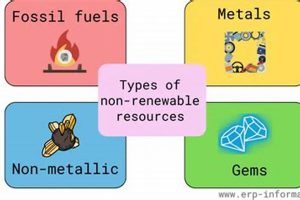
The distinguishing factor lies in the rate of regeneration. A naturally replenished source renews itself within a relatively short timeframe, often within a human lifespan, ensuring its continuous availability. Non-renewable sources, conversely, exist in finite quantities and require geological timescales to form.
Question 2: Does the term “naturally replenished” imply zero environmental impact?
No. While generally considered more environmentally benign than fossil fuels, the extraction, processing, and utilization of naturally replenished sources can have ecological consequences. Careful planning and mitigation strategies are essential to minimize these impacts.
Question 3: Is the availability of these resources consistent across all geographical regions?
Availability varies significantly depending on location. Solar resources are abundant in sunny regions, wind resources are prevalent in coastal and mountainous areas, and geothermal resources are concentrated in volcanically active zones.
Question 4: What role does technology play in enhancing the utilization of naturally replenished energy sources?
Technological advancements are critical for improving the efficiency, reliability, and cost-effectiveness of these resources. Innovations in solar cell technology, wind turbine design, and energy storage systems are crucial for their widespread adoption.
Question 5: Are naturally replenished energy sources capable of meeting global energy demands?
Potentially, yes. However, realizing this potential requires substantial investments in infrastructure, technological development, and policy support. A diversified energy portfolio, incorporating a mix of renewable sources, is essential.
Question 6: What are the primary barriers hindering the large-scale deployment of naturally replenished energy sources?
Barriers include intermittency (e.g., solar and wind), high upfront costs, grid integration challenges, regulatory hurdles, and competition from established fossil fuel industries. Overcoming these challenges requires a concerted effort from governments, industries, and researchers.
In summary, naturally replenished energy sources offer a pathway towards a more sustainable energy future, but their successful integration requires careful planning, technological innovation, and supportive policies. Addressing the associated challenges is crucial for realizing their full potential.
The next section will explore the future prospects and emerging trends in the field of naturally renewed energy sources.
Conclusion
The preceding exploration of the “def of renewable resource” has underscored its multifaceted nature. The definition transcends a simple categorization, encompassing elements of continuous replenishment, environmental stewardship, resource management, and economic viability. These intertwined aspects form the bedrock of sustainable energy systems and are critical for mitigating the long-term impacts of climate change. The implementation and scaling of these resources present both opportunities and challenges that demand careful consideration.
Continued research, technological innovation, and strategic policy frameworks are essential for realizing the full potential of renewable alternatives. A concerted global effort, grounded in responsible resource utilization and a commitment to environmental preservation, is necessary to transition towards a more sustainable energy future. This transition represents not only an environmental imperative but also an opportunity for economic growth and enhanced global energy security.
![Guide to What Energy Resources Are Renewable [+Future] | Renewable Energy Solutions for a Sustainable Future | Clean & Green Power](https://pplrenewableenergy.com/wp-content/uploads/2026/03/th-516-300x200.jpg "Guide to What Energy Resources Are Renewable [+Future] Renewable Energy Solutions for a Sustainable Future | Clean & Green Power")