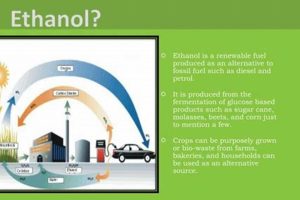
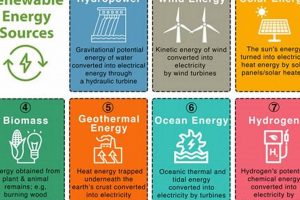
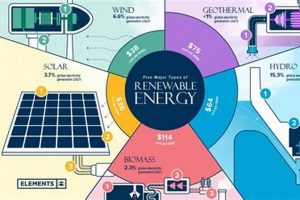
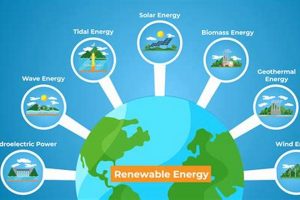
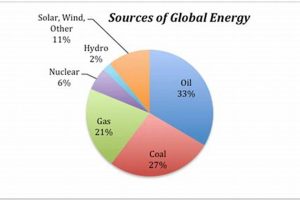
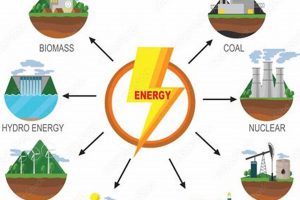
Visual representations depicting power generation from naturally replenishing resources play a crucial role in education and advocacy. These depictions illustrate methods of harnessing energy from sources that are sustainable and have minimal environmental impact, such as solar, wind, hydro, and geothermal power. For example, an illustration may show photovoltaic panels converting sunlight into electricity or a wind turbine transforming kinetic energy into usable power.
The significance of these visual aids lies in their ability to communicate complex concepts in an accessible manner. They are instrumental in raising awareness about the advantages of sustainable energy, fostering public understanding, and promoting investment in clean technologies. Historically, simplistic diagrams were used to explain basic renewable energy principles; however, modern illustrations often incorporate detailed schematics and realistic renderings to enhance comprehension and engagement.
This discussion will delve into the various techniques employed in creating effective and informative visual portrayals of green energy technologies. It will also explore the specific artistic considerations and practical applications related to the development and use of these illustrative materials across different sectors.
Guidance on Illustrating Sustainable Power Generation
Effective visual representations of sustainable energy technologies require careful planning and execution. The following points outline key considerations for creating impactful depictions of renewable energy sources.
Tip 1: Emphasize Clarity and Accuracy: Focus on conveying accurate technical information about the depicted system. A clear illustration avoids ambiguity and ensures viewers correctly understand the energy generation process. Use labels and callouts to identify key components and their functions.
Tip 2: Prioritize Visual Hierarchy: Establish a clear visual path to guide the viewer’s eye. Use elements like size, color, and contrast to emphasize the most important aspects of the technology. Direct attention to the energy source, conversion mechanism, and output.
Tip 3: Consider the Target Audience: Tailor the complexity and style to the intended audience. A technical drawing for engineers will differ significantly from an educational illustration for the general public. Adapt the level of detail and terminology accordingly.
Tip 4: Utilize Realistic Renderings When Appropriate: Realistic depictions can enhance engagement and believability, particularly when illustrating large-scale installations. However, maintain accuracy and avoid embellishments that could misrepresent the technology’s capabilities or environmental impact.
Tip 5: Incorporate Environmental Context: Show the power generation method in its natural environment. This provides context and helps viewers visualize the technology’s integration with the surrounding ecosystem. Depict any associated infrastructure, such as power lines or substations, accurately.
Tip 6: Use Color Strategically: Employ color to differentiate components, highlight energy flows, and create visual interest. Choose colors that align with established conventions for renewable energy, such as blue for water and yellow for solar. Avoid using colors that could imply inaccurate or misleading information.
Tip 7: Ensure Scalability and Reproducibility: Create illustrations that can be easily scaled and reproduced across different formats, from small print publications to large-scale digital displays. Maintain a consistent style and level of detail across all versions.
The effective creation of visual aids for sustainable power generation hinges on a combination of technical understanding, artistic skill, and a commitment to accuracy. By adhering to these principles, illustrators can contribute to greater public awareness and acceptance of green energy technologies.
These guidelines serve as a foundation for creating impactful and informative illustrations. Subsequent discussions will explore specific techniques and approaches for visualizing diverse types of sustainable power generation systems.
1. Educational Accessibility

Illustrations of naturally replenishing power sources play a critical role in facilitating understanding across diverse audiences. The effectiveness of these visualizations hinges on their ability to convey complex technical information in a readily digestible format. Educational accessibility ensures that the benefits and potential of sustainable energy are communicated effectively, fostering broader public engagement and support.
- Simplified Representations of Complex Systems
Visual aids simplify intricate energy generation processes, breaking them down into manageable components. For instance, a diagram of a solar panel might illustrate the conversion of sunlight into electricity using arrows and labeled components, thus bypassing the need for a detailed understanding of semiconductor physics. This simplification is vital for reaching non-technical audiences, including students and the general public.
- Visual Metaphors for Abstract Concepts
Abstract concepts such as energy efficiency and grid integration are often challenging to grasp. Visual metaphors can bridge this gap by representing intangible ideas in a tangible form. An illustration comparing energy consumption in a traditional incandescent bulb versus an LED bulb effectively demonstrates energy savings, even without delving into the specific technical details of each technology.
- Diverse Communication Mediums
Effective communication requires utilizing a variety of mediums to cater to different learning styles. Visual representations can be adapted for various formats, from printed materials and online infographics to interactive simulations and animated videos. The availability of these materials across multiple platforms increases the likelihood that individuals will encounter and engage with the information.
- Culturally Relevant Visuals
Educational accessibility also necessitates culturally relevant visual elements. Illustrations that incorporate familiar landscapes, architectural styles, and demographic representations resonate more effectively with local communities. Depicting a wind farm in a rural setting relevant to the target audience strengthens the connection and promotes understanding of the technology’s applicability within their specific context.
By prioritizing simplified representations, utilizing visual metaphors, employing diverse communication mediums, and incorporating culturally relevant elements, illustrations of naturally replenishing energy sources can significantly enhance educational accessibility. This increased accessibility is essential for fostering informed decision-making and accelerating the transition towards a more sustainable energy future.
2. Technical Accuracy

Technical accuracy is paramount in depictions of naturally replenishing power sources due to the potential for misinterpretation and subsequent flawed decision-making. Inaccurate or misleading visualizations can distort public understanding of the technology’s performance, cost-effectiveness, and environmental impact. This, in turn, can negatively influence public policy, investment decisions, and consumer behavior. The connection between precise technical representation and informed action is therefore crucial. For instance, an illustration inaccurately depicting the efficiency of a solar panel installation could lead to unrealistic expectations and disillusionment among potential adopters. Conversely, technically sound diagrams promote trust and facilitate effective implementation.
The importance of technical correctness extends beyond public perception to the realm of engineering and design. Detailed schematics, precise dimensions, and accurate materials specifications are essential for engineers and technicians involved in the construction, operation, and maintenance of renewable energy systems. Visualizations used in technical documentation must adhere to industry standards and reflect the actual functionality of the depicted components. Consider, for example, the detailed wiring diagrams necessary for the safe and effective installation of a geothermal heating system. In this context, a single error can result in system malfunction, safety hazards, and financial losses. Therefore, clear and technically valid drawings are not merely aesthetic enhancements but essential working documents.
In conclusion, technical accuracy serves as a foundational element in illustrations of naturally replenishing power sources. It ensures that visual communications are not only informative but also reliable and trustworthy. Upholding this standard requires collaboration between illustrators and subject matter experts, rigorous quality control procedures, and a commitment to continuous improvement. By prioritizing technical correctness, visual depictions of renewable energy technologies can contribute to a more informed and sustainable energy future.
3. Environmental Context

The depiction of naturally replenishing power generation methods within an environmental setting is critical to conveying their intended benefits and potential impacts. An accurate representation goes beyond simply illustrating the technology itself; it necessitates showcasing the interaction between the power source and its surroundings. This contextualization allows viewers to assess the technology’s integration with existing ecosystems and to understand the potential trade-offs involved in its implementation. For instance, an illustration of a hydroelectric dam should depict not only the dam structure but also the river’s altered course, the potential impact on aquatic habitats, and the mitigation measures in place to minimize ecological disruption. Failing to provide this comprehensive environmental picture can result in a skewed perception of the technology’s sustainability.
Consider the example of wind turbine visualizations. An image showing a single turbine against a vast, unpopulated landscape may appear environmentally benign. However, a more comprehensive illustration would include the presence of multiple turbines in close proximity, the associated access roads, and the potential impact on bird migration patterns. Similarly, illustrations of solar farms should extend beyond the panels themselves to depict land use changes, the potential for habitat fragmentation, and the integration of vegetation management strategies. These examples highlight the importance of presenting a realistic portrayal of the environmental context, enabling stakeholders to make informed decisions based on a full understanding of the technology’s effects. Without this contextualization, visualizations risk promoting an idealized and potentially misleading view of renewable energy technologies.
In summary, the relationship between environmental context and depictions of naturally replenishing power sources is essential for transparency and informed decision-making. Including accurate representations of the technology’s integration with its surrounding ecosystem allows for a more complete understanding of its benefits, drawbacks, and overall sustainability. This approach ensures that visualizations serve as effective tools for promoting responsible energy development and fostering a sustainable future. Omitting or downplaying environmental considerations undermines the credibility of visual representations and hinders the progress towards a truly sustainable energy landscape.
4. Inspirational Visualization

The intersection of inspirational visualization and depictions of naturally replenishing energy sources represents a critical element in driving public support and investment. Visual representations, when crafted to inspire, transcend mere data presentation and tap into emotional drivers, fostering a sense of hope and possibility regarding the future of energy. These visualizations serve as a catalyst for action, motivating individuals and organizations to embrace sustainable practices and technologies. For example, an image depicting a thriving community powered entirely by solar energy, showcasing clean air and vibrant green spaces, evokes a positive vision that contrasts sharply with the environmental concerns associated with fossil fuels. This emotional resonance enhances the persuasive power of the depiction, making the benefits of renewable energy more tangible and desirable.
The effectiveness of inspirational visualization stems from its ability to bridge the gap between abstract concepts and real-world applications. A well-designed visualization can showcase the potential benefits of transitioning to a renewable energy economy, highlighting job creation, reduced reliance on foreign energy sources, and improved public health outcomes. The visual impact of seeing a wind farm seamlessly integrated into a rural landscape, coexisting harmoniously with agricultural activities, can be far more compelling than statistical data alone. Furthermore, inspirational depictions can counter the pervasive cynicism surrounding climate change and technological limitations, offering a tangible sense of progress and solutions. Architectural renderings showcasing sustainable urban designs, integrating solar panels, green roofs, and efficient energy systems, offer a glimpse into a future where cities are not only environmentally friendly but also aesthetically pleasing and livable.
In summary, inspirational visualization serves as a potent tool for promoting the adoption of naturally replenishing energy sources. By creating compelling and emotionally resonant depictions, these visualizations can overcome barriers to understanding, foster a sense of optimism, and inspire action towards a sustainable energy future. Challenges remain in ensuring accuracy and avoiding overly idealized representations, but the potential benefits of using visualization to inspire support for renewable energy are substantial. Effective use of this approach links directly to broader goals of environmental stewardship, economic development, and improved quality of life.
5. Advocacy Tool

Visual representations of sustainable power generation methods function as potent advocacy tools. They are utilized to influence public opinion, inform policy decisions, and promote investment in naturally replenishing energy technologies. Their effectiveness stems from their ability to communicate complex information in an accessible and persuasive manner.
- Policy Influence through Visual Data
Visualizations of renewable energy deployment and its associated benefits, such as reduced carbon emissions and job creation, are presented to policymakers to support legislative action and regulatory changes. For example, comparative charts illustrating the declining costs of solar and wind power alongside the increasing costs of fossil fuels are employed to advocate for renewable energy subsidies and carbon pricing mechanisms.
- Public Awareness Campaigns
Illustrations are used extensively in public awareness campaigns to promote understanding of renewable energy technologies and their environmental advantages. Infographics depicting the carbon footprint of different energy sources, coupled with visuals showcasing the operational functionality of sustainable technologies, are distributed through social media, educational materials, and community events to foster public support.
- Investment Attraction
Potential investors are often presented with visual renderings of proposed renewable energy projects to demonstrate their viability and potential return on investment. These renderings incorporate realistic depictions of the project site, the technology in operation, and the anticipated environmental and economic benefits to build confidence and attract funding. Detailed schematics of proposed technology are also used to support the claims.
- Countering Misinformation
Visual aids are deployed to counteract misinformation and skepticism surrounding renewable energy. Side-by-side comparisons of renewable energy infrastructure and traditional power plants, highlighting the differences in emissions and environmental impact, serve to address concerns and dispel myths related to the reliability and cost-effectiveness of sustainable technologies. These visual contrasts are effective in shifting public perception and promoting acceptance.
The diverse applications of visual representations as advocacy tools underscore their importance in advancing the widespread adoption of naturally replenishing power sources. By effectively communicating the benefits, addressing concerns, and influencing key stakeholders, these illustrations play a crucial role in shaping a sustainable energy future. Continuous innovation in visualization techniques and a commitment to accuracy remain essential to maintaining their effectiveness as advocacy instruments.
Frequently Asked Questions about Visual Depictions of Sustainable Power
This section addresses common inquiries regarding the creation and utilization of visual representations of power generated from naturally replenishing resources. The aim is to provide clarity and guidance on aspects related to their development and interpretation.
Question 1: What is the primary purpose of a “renewable energy source drawing”?
The main objective is to communicate the principles, functionality, and benefits of green energy technologies in an accessible and understandable manner. These visuals facilitate education, advocacy, and informed decision-making among diverse audiences.
Question 2: How does technical accuracy influence the effectiveness of a visual representation of sustainable power?
Technical accuracy is crucial as it ensures the reliability and credibility of the information conveyed. Precise depictions of system components, energy flows, and performance characteristics are necessary for fostering trust and enabling informed evaluations by technical experts and the general public.
Question 3: Why is it important to depict a “renewable energy source” within its environmental context?
Illustrating the technology within its surrounding environment provides a comprehensive understanding of its potential environmental impacts, both positive and negative. This contextualization allows for a balanced assessment of the technology’s sustainability and promotes responsible implementation strategies.
Question 4: What are the key elements of an “inspirational visualization” of green energy?
Inspirational visualizations aim to evoke positive emotions and a sense of hope regarding the future of energy. They often showcase the tangible benefits of green technologies, such as cleaner air, improved public health, and thriving communities, to motivate adoption and investment.
Question 5: How can illustrations of green technologies function as advocacy tools?
Visual representations are used to influence public opinion, inform policy decisions, and attract investment in sustainable power sources. They communicate complex data in a persuasive manner, highlighting the advantages of renewable energy and addressing potential concerns.
Question 6: What are the ethical considerations in creating and utilizing these visuals?
Ethical considerations include ensuring accuracy, avoiding misleading representations, and acknowledging potential environmental impacts. Visuals should promote a balanced and informed perspective on green technologies, rather than an overly idealized or biased view.
In summary, the effective creation and utilization of visual depictions of sustainable power require a commitment to accuracy, context, and ethical considerations. These visuals play a significant role in promoting understanding and advancing the transition towards a more sustainable energy future.
The following section will explore the future trends and emerging technologies in the field of green energy visualization.
Conclusion
This examination has underscored the multifaceted role of illustrative depictions of naturally replenishing power generation methods. Their function extends beyond mere artistic representation, serving as critical tools for education, technical understanding, environmental awareness, inspiration, and advocacy. The efficacy of these visuals hinges upon a commitment to accuracy, contextual relevance, and ethical considerations, ensuring they inform and persuade responsibly.
Continued development and strategic deployment of these illustrations will be crucial in shaping public perception and driving the adoption of sustainable energy technologies. As the energy landscape evolves, the capacity to effectively communicate the benefits and complexities of green power sources remains paramount for achieving a sustainable and resilient future. The visual language of renewable energy is a vital component of that ongoing transformation.