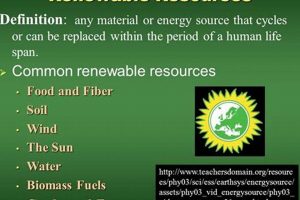
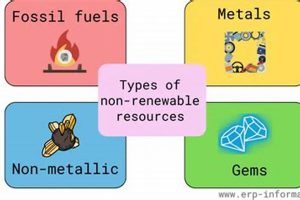
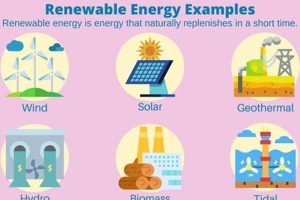
A naturally replenishing energy source offers a sustainable alternative to finite fossil fuels. Solar power, derived from the sun’s radiant energy, serves as a prominent illustration of such a resource. This form of energy is harnessed through photovoltaic cells, which convert sunlight directly into electricity, and through solar thermal systems, which use sunlight to heat water or air.
The utilization of this inexhaustible resource reduces dependence on conventional fuel sources, mitigating greenhouse gas emissions and contributing to a cleaner environment. Historically, harnessing the sun’s energy was limited by technology and cost; however, advancements have significantly improved efficiency and affordability, making it an increasingly viable option for power generation.
Understanding the characteristics and benefits of various sustainable energy options, including wind, hydro, and geothermal, is crucial for a transition towards a more environmentally conscious energy future. Exploring these diverse methods will allow for informed decision-making regarding energy policy and individual consumption habits.
Renewable Energy Resource Selection Guidance
Strategic selection requires a comprehensive understanding of available options and their associated implications. Consider these points before making a decision.
Tip 1: Evaluate Resource Availability: Determine the regional potential for each sustainable resource. For example, solar energy is best suited for regions with high solar irradiance, while wind energy requires consistently strong wind patterns.
Tip 2: Assess Environmental Impact: Each energy source has unique environmental considerations. Hydropower, while renewable, can significantly alter aquatic ecosystems. Carefully evaluate potential disruptions and mitigation strategies.
Tip 3: Analyze Economic Viability: Conduct a thorough cost-benefit analysis for each option, including initial investment, operational expenses, and potential long-term savings. Consider government incentives and tax credits to reduce upfront costs.
Tip 4: Prioritize Grid Integration: Investigate how seamlessly each energy source can be integrated into the existing power grid. Intermittency challenges, such as those associated with solar and wind, may require energy storage solutions.
Tip 5: Explore Energy Storage Options: Research available energy storage technologies, such as battery storage, pumped hydro, or thermal energy storage, to address intermittency issues and ensure a reliable energy supply.
Tip 6: Consider Community Acceptance: Engage with local communities to address concerns and ensure support for renewable energy projects. Public acceptance is crucial for the successful implementation of sustainable energy initiatives.
Tip 7: Review Regulatory Framework: Familiarize yourself with local, state, and federal regulations pertaining to the development and operation of sustainable energy projects. Compliance is essential for project success.
Careful consideration of these factors will enable informed decisions regarding sustainable energy resources, contributing to a more resilient and environmentally responsible energy future.
These guidelines facilitate a move towards practical application.
1. Solar irradiance

Solar irradiance, defined as the power per unit area received from the Sun in the form of electromagnetic radiation, is a critical factor in determining the viability of solar energy as a sustainable resource. Its magnitude directly impacts the efficiency and output of solar energy technologies.
- Direct Conversion Efficiency
Higher levels of irradiance correlate with increased energy production from photovoltaic (PV) systems. The higher the irradiance, the more photons are available to excite electrons in the PV material, leading to a greater electrical current. In regions with consistently high irradiance, solar power plants can achieve higher capacity factors and lower levelized costs of energy.
- Geographic Suitability
Solar irradiance levels vary significantly by location. Regions near the equator, and those with clear skies and minimal atmospheric obstruction, generally experience higher irradiance. For example, the southwestern United States and the Sahara Desert are prime locations for large-scale solar energy deployment due to their high annual irradiance.
- Technological Optimization
Solar panel technologies are continuously being developed to maximize energy capture under varying irradiance conditions. Concentrated solar power (CSP) systems utilize mirrors to focus sunlight onto a receiver, which can then generate electricity even under diffuse irradiance conditions. Advancements in PV materials and cell designs also aim to improve performance under lower irradiance levels.
- Economic Implications
Solar irradiance directly influences the economic viability of solar energy projects. Regions with higher irradiance require fewer solar panels to generate a given amount of electricity, reducing capital costs. This, in turn, lowers the overall cost of energy production, making solar power more competitive with traditional fossil fuel-based energy sources.
The dependence of solar energy output on irradiance underscores the importance of accurate resource assessment and technological optimization in harnessing the sun’s energy effectively. Understanding and accounting for spatial and temporal variations in irradiance is essential for the successful deployment and operation of solar energy systems, furthering its role as a sustainable energy resource.
2. Wind velocity
Wind velocity, defined as the speed of air movement, is a fundamental parameter determining the efficacy of wind energy conversion systems. As a kinetic energy resource, the potential for power generation is directly proportional to the cube of the wind speed. This relationship underscores the critical importance of site selection based on prevailing wind patterns and velocities for wind farm development. The effect of wind velocity variations directly influences turbine power output, impacting economic feasibility and energy grid stability.
Regions with consistently high average wind speeds, such as coastal areas, high plains, and mountain passes, are particularly suited for wind energy deployment. For example, the wind farms in the North Sea and the Great Plains of the United States benefit from persistent high winds, resulting in higher capacity factors and reduced levelized costs of electricity. However, the intermittent nature of wind necessitates integration with energy storage solutions or grid management strategies to ensure a reliable power supply. Furthermore, sophisticated turbine control systems are employed to optimize energy capture across a range of wind velocities, preventing damage during extreme wind events and maximizing energy yield under typical conditions. Understanding wind velocity characteristics, including diurnal and seasonal variations, is therefore paramount for efficient and predictable operation of wind energy installations.
In summary, wind velocity is intrinsically linked to the viability of wind power as a renewable resource. Accurate assessment of wind resource potential, combined with advanced turbine technology and grid integration strategies, is essential for harnessing the energy potential of wind effectively. This, in turn, contributes to a diversified energy portfolio and a reduction in reliance on fossil fuels, promoting environmental sustainability and energy security.
3. Hydropower potential
Hydropower potential is intrinsically linked to renewable energy generation, as it represents the theoretical maximum energy output achievable from water resources within a specific geographical area. This potential is primarily determined by two key factors: the volume of water flow and the hydraulic head, which is the difference in elevation between the water source and the turbine. Regions with substantial rainfall and significant elevation changes, such as mountainous areas with large rivers, generally exhibit high hydropower potential. Harnessing this potential provides a renewable alternative to fossil fuel-based power generation.
The conversion of hydropower potential into electricity occurs through the construction of dams and hydroelectric power plants. These facilities capture the kinetic energy of flowing water, converting it into mechanical energy via turbines, which in turn drive generators to produce electricity. Notable examples of regions effectively utilizing their hydropower potential include Norway, where nearly all electricity is generated from hydropower, and countries in South America like Brazil and Paraguay, which have invested significantly in large-scale hydroelectric projects. However, while hydropower is a renewable energy resource, its development can have significant environmental impacts, including altering river ecosystems, displacing communities, and contributing to greenhouse gas emissions from decomposing vegetation in reservoirs. Careful environmental assessments and mitigation strategies are essential for sustainable hydropower development.
In conclusion, hydropower potential is a crucial component of renewable energy portfolios, offering a significant and reliable source of power when developed responsibly. Understanding the interplay between water resources, geographical characteristics, and technological advancements is vital for maximizing the benefits of hydropower while minimizing its environmental consequences. The ongoing research and development in areas such as run-of-river hydropower and small-scale hydro aim to further refine and optimize the use of this renewable resource, promoting a more sustainable energy future.
4. Geothermal gradient
The geothermal gradient, representing the rate of increasing temperature with respect to increasing depth in the Earth’s interior, is a key factor in the viability of geothermal energy. This energy form, extracted from the Earth’s internal heat, exemplifies a renewable resource due to the continuous heat flow from the planet’s core. The magnitude of the geothermal gradient influences the accessibility and economic feasibility of geothermal power plants. Regions with high geothermal gradients, such as Iceland and areas along tectonic plate boundaries, offer readily available high-temperature resources suitable for electricity generation. This contrasts with areas having lower gradients, which may only support direct-use applications like heating buildings or greenhouses.
Geothermal power plants function by tapping into underground reservoirs of hot water or steam. These resources are brought to the surface, where the steam is used to drive turbines connected to electricity generators. The efficiency of this process is directly dependent on the temperature of the geothermal resource; higher temperatures allow for greater power output. In areas with lower geothermal gradients, enhanced geothermal systems (EGS) are sometimes employed. EGS involves fracturing hot, dry rocks deep underground and circulating water through these fractures to extract heat. This technology expands the potential for geothermal energy production to a wider range of geographical locations. For instance, the Soultz-sous-Forts project in France demonstrates EGS technology in an area with a moderate geothermal gradient.
In summary, the geothermal gradient is a critical determinant of geothermal energy’s potential as a renewable resource. Areas with high gradients offer direct, cost-effective opportunities for electricity generation, while EGS technologies are expanding the reach of geothermal power to regions with less favorable natural conditions. The continued development and deployment of geothermal energy contribute to diversified energy portfolios, reducing reliance on fossil fuels and mitigating greenhouse gas emissions. However, challenges related to resource exploration, drilling costs, and induced seismicity require ongoing research and careful management to ensure the sustainable utilization of this renewable energy source.
5. Biomass availability

Biomass availability serves as a foundational element for bioenergy production, thereby directly influencing the feasibility of biomass as a renewable energy resource. The sustainable harvesting and accessibility of organic matter, encompassing agricultural residues, forestry products, and dedicated energy crops, dictates the potential for conversion into biofuels, heat, and electricity. Regions with abundant and sustainably managed biomass resources possess a comparative advantage in leveraging bioenergy technologies. For instance, countries with extensive forestry industries, such as Sweden and Finland, have successfully integrated biomass-based heating and power generation into their energy mix. Conversely, regions with limited biomass resources may face challenges in developing large-scale bioenergy projects.
The composition and characteristics of available biomass also influence the selection and efficiency of conversion technologies. Lignocellulosic biomass, derived from woody plants and agricultural waste, requires specific pretreatment processes to facilitate efficient conversion into biofuels or biogas. Dedicated energy crops, such as switchgrass and miscanthus, are cultivated specifically for their high biomass yields and adaptability to different environmental conditions. The economic viability of biomass energy projects depends heavily on the logistics and cost-effectiveness of biomass supply chains, including harvesting, transportation, and storage. In the United States, initiatives like the Biomass Crop Assistance Program have aimed to incentivize the cultivation and utilization of biomass for energy production, highlighting the importance of supportive policies.
In summary, biomass availability is an indispensable determinant of bioenergy’s viability as a renewable resource. Sustainable management practices, efficient supply chains, and appropriate conversion technologies are essential for maximizing the potential of biomass energy while minimizing environmental impacts. The effective utilization of biomass resources contributes to diversified energy portfolios and promotes a transition towards a more sustainable energy future. Further research and development in areas such as advanced biofuels and biomass gasification are crucial for unlocking the full potential of biomass energy as a reliable and environmentally sound alternative to fossil fuels.
6. Tidal range

Tidal range, defined as the vertical difference between high tide and low tide, is a fundamental factor in determining the viability of tidal energy as a renewable resource. The magnitude of the tidal range directly impacts the potential energy that can be harnessed by tidal power generation technologies. Larger tidal ranges result in greater water volumes moving through a tidal energy system, leading to increased electricity generation. Regions with substantial tidal ranges, such as the Bay of Fundy in Canada and the Severn Estuary in the United Kingdom, are prime locations for tidal power projects.
Tidal energy conversion systems, including tidal barrages and tidal stream generators, rely on the predictable rise and fall of tides. Tidal barrages, which are dam-like structures built across estuaries, capture water during high tide and release it through turbines during low tide. Tidal stream generators, analogous to underwater wind turbines, extract energy from the flow of tidal currents. The effectiveness of both systems is directly proportional to the tidal range. For example, the La Rance tidal power plant in France, one of the world’s oldest and largest, benefits from a significant tidal range, enabling substantial power generation. The intermittent nature of tidal energy, due to the cyclical patterns of tides, necessitates integration with energy storage solutions or grid management strategies to ensure a reliable power supply.
In summary, tidal range is a critical determinant of tidal energy’s potential as a renewable resource. Accurate assessment of tidal range characteristics, combined with appropriate technology selection and grid integration strategies, is essential for harnessing the energy potential of tides effectively. The development and deployment of tidal energy contribute to diversified energy portfolios, reducing reliance on fossil fuels and promoting environmental sustainability. However, challenges related to environmental impacts, construction costs, and technological advancements require ongoing research and careful management to ensure the responsible utilization of this renewable energy source.
Frequently Asked Questions
This section addresses common inquiries regarding the nature, implementation, and impact of sustainable energy solutions.
Question 1: What constitutes a sustainable power source?
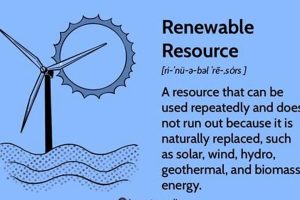
A sustainable power source is defined as an energy resource that replenishes naturally at a rate equal to or greater than its rate of consumption. Such resources do not deplete over time and minimize environmental impact.
Question 2: How does solar power operate as a sustainable solution?
Solar power utilizes photovoltaic cells to convert sunlight into electricity. As sunlight is a perpetually available resource, solar energy is considered renewable and sustainable. Ongoing research continues to improve the efficiency and cost-effectiveness of solar technologies.
Question 3: What are the environmental advantages of utilizing renewable resources?
The environmental advantages include reduced greenhouse gas emissions, diminished air and water pollution, and decreased dependence on finite fossil fuels. Transitioning to sustainable resources mitigates climate change and promotes ecological preservation.
Question 4: What role does governmental policy play in the adoption of sustainable solutions?
Governmental policies, such as tax incentives, subsidies, and regulatory mandates, significantly influence the adoption of sustainable power sources. These policies can level the playing field, making renewable technologies economically competitive with traditional energy sources.
Question 5: What is the relationship between energy storage and the reliability of renewable sources?
Energy storage technologies, such as battery storage and pumped hydro, enhance the reliability of intermittent renewable sources like solar and wind. Storage solutions enable the capture and release of energy, ensuring a consistent power supply even when the primary resource is not immediately available.
Question 6: How can individuals contribute to the widespread adoption of renewable energy?
Individuals can contribute by adopting energy-efficient practices, investing in renewable energy systems for their homes or businesses, supporting policies that promote sustainable energy, and educating others about the benefits of renewable resources. Collective action is essential for driving systemic change.
Understanding the principles and practicalities of sustainable resources is paramount for creating a more environmentally responsible energy future. Continued innovation and informed decision-making are critical for realizing the full potential of renewable energy.
The next section will explore case studies.
The Significance of Renewable Energy Resource Examples
This exploration has underscored that a tangible instance of a sustainable energy sourcebe it solar, wind, hydro, geothermal, or biomassprovides critical pathways toward mitigating reliance on finite fossil fuels. Each resource presents distinct advantages and challenges, demanding comprehensive evaluation based on geographical suitability, environmental impact, and economic viability. Careful consideration of these factors enables informed decision-making regarding energy policy and individual consumption habits.
Continued research, technological innovation, and supportive policy frameworks are essential for maximizing the potential of sustainable options. The transition to a diversified and environmentally responsible energy future hinges on the collective commitment to embrace and further develop these inexhaustible sources of power, securing long-term energy security and ecological well-being for generations to come.
![Guide to What Energy Resources Are Renewable [+Future] | Renewable Energy Solutions for a Sustainable Future | Clean & Green Power](https://pplrenewableenergy.com/wp-content/uploads/2026/03/th-516-300x200.jpg "Guide to What Energy Resources Are Renewable [+Future] Renewable Energy Solutions for a Sustainable Future | Clean & Green Power")