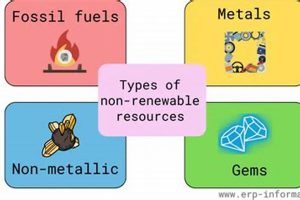
The scientific characterization of finite natural materials, where the rate of consumption exceeds the rate of natural replenishment, is a crucial area of study. These materials, formed over geological timescales, are exhaustible. Common examples include fossil fuels like coal, petroleum, and natural gas, as well as nuclear fuels such as uranium. The investigation focuses on their formation, extraction, processing, and, critically, the environmental impacts associated with their use.
Understanding these resources is paramount due to their significant role in modern energy production and various industrial processes. Their utilization, however, presents considerable environmental challenges, including greenhouse gas emissions, air and water pollution, and habitat destruction. A historical perspective reveals how the widespread adoption of these resources has driven economic growth but simultaneously contributed to growing ecological concerns, prompting the need for sustainable alternatives and responsible management.
The subsequent sections of this article will delve into the specific scientific principles governing the formation and depletion of these materials, explore the technological advancements aimed at optimizing their extraction and utilization, and critically analyze the environmental and societal consequences associated with their continued use. Furthermore, it will examine the emerging research and development efforts focused on developing renewable energy sources as viable replacements, and strategies for mitigating the negative impacts associated with the present reliance on them.
Guiding Principles for Understanding and Managing Finite Resources
The effective study and responsible management of exhaustible natural materials require a multidisciplinary approach. The following guidelines emphasize key considerations within the realm of earth and environmental studies, focusing on the sustainable use and minimization of adverse consequences.
Tip 1: Emphasize Comprehensive Resource Assessments: Perform thorough geological and geophysical surveys to accurately estimate reserve quantities and spatial distributions. Quantifying the available resource base is essential for informed strategic planning.
Tip 2: Prioritize Enhanced Recovery Techniques: Invest in research and development to improve extraction efficiencies from existing reserves. This includes advanced methods such as hydraulic fracturing with responsible management of wastewater and carbon capture for use in enhanced oil recovery.
Tip 3: Integrate Life Cycle Analysis: Conduct comprehensive assessments of the environmental impacts at each stage, from extraction and processing to transportation and combustion. This facilitates the identification of mitigation strategies to reduce the overall footprint.
Tip 4: Promote Carbon Capture and Storage (CCS) Technologies: Accelerate the deployment of CCS technologies to reduce atmospheric emissions from power plants and industrial facilities. This requires robust monitoring and verification protocols to ensure long-term storage integrity.
Tip 5: Support Renewable Energy Alternatives: Substantially increase investment in research, development, and deployment of renewable energy technologies, such as solar, wind, geothermal, and biomass. Diversifying the energy mix is crucial for long-term sustainability.
Tip 6: Implement Stringent Environmental Regulations: Enforce rigorous environmental regulations to minimize pollution and protect ecosystems during the extraction, transportation, and use. This includes monitoring air and water quality and implementing remediation measures for contaminated sites.
Tip 7: Foster International Collaboration: Facilitate knowledge sharing and technology transfer among countries to promote best practices in resource management and environmental protection. This collaborative approach is vital for addressing global challenges.
Adhering to these principles facilitates informed decision-making regarding the utilization and long-term sustainability of these critical, yet finite, materials. Focusing on efficiency, mitigation, and a transition to renewable alternatives is vital to balance economic development with environmental preservation.
The subsequent sections of this article will build upon these guiding principles, providing in-depth analyses of specific technologies, policies, and research endeavors that contribute to a more sustainable energy future.
1. Depletion Rate

The depletion rate is a fundamental component in understanding the finite natural resources. It quantifies the speed at which such a resource is being consumed relative to its total reserves and the rate at which it is naturally replenished, which, by definition, is significantly slower than consumption for finite sources. The characterization of these resource critically hinges on an accurate assessment of depletion rates, as this metric dictates the long-term availability and sustainability of a given resource. For example, the current depletion rate of global oil reserves, driven by industrial demand and transportation needs, far exceeds the natural geological processes that create petroleum. This disparity necessitates strategic planning for alternative energy sources and improved energy efficiency.
Furthermore, an elevated rate influences both economic and environmental considerations. Economically, rapid depletion leads to increased scarcity, resulting in higher prices and potential geopolitical instability as nations compete for dwindling supplies. Environmentally, accelerated extraction can intensify ecological damage, including habitat destruction, pollution, and greenhouse gas emissions. Understanding the interplay between depletion rate, economic pressures, and environmental consequences is vital for policymakers and resource managers. For example, the depletion of rare earth minerals, essential for electronics manufacturing, poses both supply chain vulnerabilities and environmental risks due to the often unregulated mining practices.
In conclusion, a clear understanding of depletion rates is not merely an academic exercise but a practical imperative. It informs decisions about resource management, energy policy, and technological innovation. Addressing the challenges posed by accelerating depletion rates requires a multifaceted approach that includes conservation efforts, the development of renewable alternatives, and responsible resource extraction practices, all of which are integral to mitigating the potential adverse effects on both the global economy and the environment.
2. Formation Timescale
The temporal dimension of creation is pivotal within the scientific characterization of finite natural materials. The protracted duration required for geological processes to generate these resources, often spanning millions of years, directly contrasts with the comparatively rapid pace of human consumption, thereby defining their non-renewable nature.
- Geological Processes
Formation involves intricate geological processes occurring over extensive periods. For instance, the creation of fossil fuels such as petroleum and natural gas entails the anaerobic decomposition of organic matter, followed by sedimentation, compaction, and thermal maturation deep within the Earth’s crust. These processes demand specific conditions and significant durations, making the replenishment of these resources practically infeasible on human timescales.
- Resource Availability
The length of the formation timescale directly impacts the availability of these materials. Deposits are finite and constrained by the geological history of specific regions. Discoveries of new deposits are becoming increasingly infrequent, and many existing reserves are reaching depletion. The limited supply, relative to global demand, underscores the economic and geopolitical significance of these resources and the imperative for sustainable management.
- Environmental Implications
Extraction and utilization of these materials can have significant environmental repercussions. The slow formation rate means that environmental damage caused by extraction, such as habitat destruction and pollution, is effectively irreversible within a human lifespan. Furthermore, the combustion of fossil fuels releases greenhouse gases, contributing to climate change at a rate far exceeding the Earth’s capacity to naturally sequester carbon.
- Resource Management Strategies
Considering the formation timescale is crucial for formulating effective resource management strategies. Sustainable practices should prioritize conservation, efficiency improvements, and the development of alternative energy sources that can be replenished on shorter timescales. Strategies also need to consider the long-term implications of resource depletion, including economic diversification and adaptation to a post-fossil fuel future.
Understanding the relationship between formation timescales and resource consumption is essential for a comprehensive scientific characterization of finite resources. It highlights the critical need for a transition toward sustainable energy systems and responsible management of the remaining reserves to mitigate environmental harm and ensure long-term economic stability.
3. Environmental Impact

The evaluation of environmental consequences is a central tenet of the scientific characterization of finite natural resources. The extraction, processing, and utilization of these materials invariably exert significant pressure on ecosystems, atmospheric composition, and long-term environmental stability. A comprehensive assessment of these impacts is essential for informed decision-making and the formulation of effective mitigation strategies.
- Atmospheric Pollution
The combustion of fossil fuels, a primary energy source derived from finite natural materials, releases substantial quantities of greenhouse gases, including carbon dioxide, methane, and nitrous oxide, into the atmosphere. These emissions contribute to global warming and climate change, leading to sea-level rise, altered weather patterns, and increased frequency of extreme weather events. Furthermore, the release of particulate matter and other pollutants from combustion processes degrades air quality, posing health risks to human populations. For example, coal-fired power plants are significant contributors to both greenhouse gas emissions and localized air pollution, necessitating the implementation of cleaner combustion technologies and the transition to renewable energy sources.
- Habitat Destruction
The extraction of finite natural materials, such as coal mining and oil drilling, often involves significant alteration and destruction of natural habitats. Surface mining operations can decimate ecosystems, while oil spills and pipeline leaks contaminate soil and water resources, disrupting ecological balance and endangering wildlife. Deforestation associated with resource extraction further exacerbates habitat loss and reduces biodiversity. The environmental damage associated with tar sands extraction in Alberta, Canada, exemplifies the extensive habitat destruction and pollution that can result from the exploitation of unconventional oil resources.
- Water Contamination
The extraction and processing of finite natural materials can lead to substantial water contamination. Mining operations can release heavy metals and other pollutants into waterways, rendering them unsafe for human consumption and harming aquatic life. Hydraulic fracturing, a technique used to extract shale gas and oil, poses risks of groundwater contamination from fracking fluids and methane leakage. Furthermore, the discharge of industrial wastewater from processing facilities can introduce a variety of pollutants into rivers and lakes, disrupting aquatic ecosystems and impacting water quality. For instance, the release of mercury from gold mining operations contaminates rivers in many regions, posing significant health risks to local communities.
- Waste Generation and Disposal
The extraction and processing of these materials generate significant quantities of waste products, including mining tailings, slag, and ash. Improper disposal of these wastes can lead to soil and water contamination, as well as air pollution from dust and emissions. The long-term storage of nuclear waste from nuclear power plants poses unique challenges due to its radioactivity and persistence in the environment. Effective waste management strategies, including waste reduction, recycling, and safe disposal methods, are essential for minimizing the environmental footprint of finite natural resource utilization. The legacy of abandoned mine sites, characterized by acid mine drainage and soil contamination, underscores the importance of responsible waste management practices.
These facets of environmental impact underscore the critical need for a comprehensive scientific understanding of the consequences associated with reliance on finite natural materials. The integration of environmental considerations into resource management practices, coupled with the development of sustainable alternatives, is crucial for mitigating ecological damage and ensuring long-term environmental sustainability. Further research and technological innovation are needed to minimize pollution, restore degraded ecosystems, and transition toward a more environmentally benign energy future, all of which are essential components of responsible finite natural resource governance.
4. Extraction Technology

Extraction technology represents a critical component within the scientific characterization of finite natural materials. It directly influences the economic feasibility, environmental impact, and ultimate availability of these resources. The sophistication and efficiency of extraction methods dictate the accessibility of reserves, which subsequently affects the rate of depletion and the potential for environmental degradation. Improved techniques can unlock previously inaccessible deposits, altering resource estimates, but simultaneously introduce new environmental challenges. For instance, the advent of hydraulic fracturing has significantly expanded the recoverable reserves of natural gas, but it has also raised concerns regarding water contamination and induced seismicity.
The development and application of extraction technology is intrinsically linked to the scientific investigation of these materials because it informs our understanding of resource distribution, geological formations, and the physical and chemical properties governing their extraction. Scientific advancements in geology, geophysics, and engineering are essential for optimizing extraction processes and mitigating associated risks. The Deepwater Horizon oil spill in the Gulf of Mexico serves as a stark reminder of the potential catastrophic consequences of inadequately tested or poorly managed extraction technologies. It highlights the necessity for rigorous scientific evaluation and stringent regulatory oversight to ensure the responsible and safe utilization of finite resources. The investigation into the causes of the disaster revealed deficiencies in both the technology and the regulatory framework, leading to a reassessment of offshore drilling practices and safety protocols.
In conclusion, extraction technology is not merely a tool for accessing resources; it is an integral facet of the scientific definition, influencing the economic viability, environmental sustainability, and ultimately, the long-term availability of these finite materials. A comprehensive scientific understanding necessitates a holistic approach, integrating technological advancements with rigorous environmental assessments and responsible resource management strategies. The ongoing pursuit of more efficient, environmentally sound extraction technologies is crucial for ensuring the responsible utilization of these materials and mitigating the adverse consequences associated with their depletion.
5. Economic Viability

Economic viability is intrinsically linked to the scientific characterization of finite natural materials, directly influencing their extraction, processing, and market accessibility. A scientifically informed understanding of these resources, encompassing geological assessments, extraction technologies, and environmental impacts, informs the economic feasibility of their exploitation. The economic potential of a resource dictates the investment in extraction technologies, infrastructure, and processing facilities. This interaction shapes the utilization patterns of finite materials, influencing their availability and environmental consequences. For example, the economic viability of deep-sea mining is contingent upon the development of cost-effective extraction technologies and a thorough assessment of environmental risks to ensure profitability and compliance with environmental regulations. The science behind resource assessment and extraction, therefore, is not separate from, but inherently informs, economic decisions.
Furthermore, the economic viability of finite materials is dynamic, subject to fluctuations in market prices, technological advancements, and regulatory policies. High market prices can incentivize the extraction of previously uneconomical deposits, while technological innovations can reduce extraction costs and increase resource availability. Regulatory policies, such as carbon taxes and emission standards, can influence the relative economic competitiveness of different resource types. The economic viability of shale gas, for example, was dramatically altered by the advent of hydraulic fracturing and horizontal drilling, transforming it from an uneconomical resource into a major energy source. The economic assessment requires scientific understanding of resource potential and extraction costs combined with analysis of environmental regulation and energy policy.
In conclusion, economic viability is not simply a financial metric but is intrinsically intertwined with the scientific evaluation of finite natural materials. A comprehensive scientific characterization must incorporate economic considerations to inform resource management strategies, technological development, and policy decisions. Understanding the complex interplay between scientific, economic, and regulatory factors is essential for ensuring the sustainable and responsible utilization of these crucial, yet finite, resources, thereby mitigating environmental damage and promoting long-term economic stability, and also fostering innovation for new resource recovery methods.
6. Resource Geology
Resource geology forms a cornerstone of the scientific characterization of exhaustible natural materials. It provides the foundational understanding of the Earth’s crustal architecture and the processes governing the formation, distribution, and concentration of these finite resources. Without the insights derived from resource geology, a comprehensive assessment of these materials would be incomplete, hindering informed decision-making regarding their extraction, utilization, and long-term sustainability. Understanding the geological context is fundamental to determining reserve size, quality, and accessibility, all of which are essential for economic and strategic planning. The location and formation of fossil fuel deposits, for instance, are intimately linked to specific geological settings, such as sedimentary basins where organic matter accumulated and underwent transformation over millions of years. Similarly, the occurrence of metallic ore deposits is governed by magmatic, hydrothermal, and metamorphic processes that concentrate valuable minerals in particular geological environments.
The practical application of resource geology extends to various aspects of finite natural resource management. For example, detailed geological surveys and modeling are essential for identifying and delineating potential reserves. Seismic surveys, well logging, and core sampling provide valuable data about subsurface geological structures and the properties of rock formations, aiding in the accurate estimation of resource volumes and extraction feasibility. Furthermore, resource geology plays a crucial role in assessing the environmental impacts associated with resource extraction. Understanding the geological context can help predict and mitigate potential risks such as groundwater contamination, land subsidence, and seismic activity. The geological stability of a proposed storage site for nuclear waste, for instance, must be thoroughly evaluated to ensure the long-term safety of the surrounding environment. Improper geologic assessment has led to environmental catastrophes involving oil spills and collapse of mining operations, emphasizing the necessity of diligent geological survey and predictive modeling during all phases of resource extraction.
In summary, resource geology constitutes an indispensable component of the scientific characterization of exhaustible natural materials. It furnishes the fundamental knowledge base necessary for understanding their origin, distribution, and the potential environmental consequences associated with their exploitation. The integration of resource geology into resource management practices is crucial for ensuring the sustainable and responsible utilization of these finite resources and for mitigating the risks associated with their extraction. Continuing research and advancements in geological surveying techniques and modeling are vital for expanding our understanding of Earth’s resource potential and for developing more effective strategies for managing these critical assets.
7. Energy Density

Energy density, defined as the amount of energy stored in a given system or region of space per unit volume or mass, stands as a pivotal factor in the scientific assessment of exhaustible natural materials. Its significance stems from its direct influence on resource extraction costs, transportation logistics, and the overall efficiency of energy production, thereby shaping the economic and environmental implications of resource utilization.
- Economic Implications
Higher energy density generally translates to lower extraction, transportation, and storage costs per unit of energy. Fossil fuels, particularly crude oil and natural gas, exhibit high energy densities, contributing to their historical economic competitiveness and widespread adoption. This economic advantage has incentivized the development of sophisticated extraction and processing technologies, further enhancing their availability and affordability. Conversely, lower energy density resources may require more extensive infrastructure and processing, increasing capital and operating expenses. This economic differential contributes to the persistent reliance on higher energy density exhaustible resources, despite their environmental consequences.
- Environmental Footprint
The energy density of a resource significantly influences its environmental footprint. Resources with lower energy density often necessitate larger-scale extraction operations and more extensive land use, resulting in increased habitat destruction and ecosystem disruption. The processing and transportation of lower energy density resources can also contribute to higher emissions of pollutants and greenhouse gases per unit of energy delivered. The extraction of tar sands, characterized by their lower energy density compared to conventional crude oil, exemplifies the environmental challenges associated with exploiting lower energy density resources, requiring significant energy input for upgrading and releasing substantial quantities of greenhouse gases.
- Technological Considerations
Technological advancements in extraction, processing, and energy conversion are often driven by the desire to enhance the energy density and overall efficiency of resource utilization. Improved extraction techniques, such as enhanced oil recovery methods, can increase the yield from existing reserves, effectively improving the energy density of the recoverable resource base. Similarly, advanced combustion technologies and power generation systems can enhance the efficiency of energy conversion, maximizing the energy output from a given quantity of fuel. The development of more efficient batteries and fuel cells, for example, aims to increase the energy density of energy storage systems, enabling the widespread adoption of electric vehicles and renewable energy sources.
- Resource Depletion and Sustainability
The interplay between energy density and resource depletion is fundamental to the long-term sustainability of exhaustible natural materials. The exploitation of higher energy density resources initially delays the onset of resource scarcity, but ultimately accelerates the rate of depletion due to their relative ease of extraction and utilization. As higher energy density reserves are exhausted, there is increasing pressure to exploit lower energy density resources, leading to higher costs and greater environmental impacts. This depletion dynamic underscores the need for a transition toward renewable energy sources and the implementation of strategies for energy conservation and efficiency. The declining energy return on energy invested (EROI) for many extraction projects, from oil to minerals, demands that energy density be considered alongside environmental and economic factors when evaluating project feasibility.
The multifaceted relationship between energy density and the scientific characterization of exhaustible natural materials underscores its importance in shaping resource utilization patterns, economic considerations, environmental impacts, and long-term sustainability. A comprehensive assessment of these materials must incorporate a thorough understanding of energy density and its implications for resource management and energy policy. Understanding is further crucial in developing efficient processes to recover unconventional sources and finding new innovative green energy.
Frequently Asked Questions
This section addresses common inquiries regarding the scientific framework employed to understand exhaustible natural materials, their formation, and associated impacts. The intent is to provide clarity on frequently encountered concepts within this critical field of study.
Question 1: What constitutes the scientific definition of a finite natural material?
It encompasses resources, typically of geological origin, that are consumed at a rate exceeding their natural replenishment. This definition considers their formation timescales, environmental impacts, and extraction technologies.
Question 2: Why is the scientific characterization of these materials important?
It enables informed decision-making regarding resource management, environmental protection, and the development of sustainable alternatives, promoting responsible utilization.
Question 3: How does resource geology contribute to understanding?
Resource geology elucidates the geological processes responsible for the formation and distribution of resources, providing crucial context for assessment and extraction.
Question 4: What role does energy density play in the scientific assessment?
Energy density influences extraction costs, transportation logistics, and energy production efficiency, impacting economic feasibility and environmental consequences.
Question 5: What are the primary environmental impacts associated with the utilization?
Impacts encompass atmospheric pollution, habitat destruction, water contamination, and waste generation, all requiring comprehensive scientific evaluation for mitigation.
Question 6: How does economic viability factor into the equation?
Economic viability is contingent upon extraction costs, market prices, and environmental regulations, influencing resource exploitation and the pursuit of sustainable alternatives.
This FAQ section has provided a concise overview of key concepts related to the scientific characterization of exhaustible natural resources. A more in-depth exploration of these topics is crucial for effective resource management and the transition to a sustainable energy future.
The following section will delve into case studies illustrating the practical application of these scientific principles in real-world scenarios.
Conclusion
The foregoing discussion has delineated the core elements comprising the framework for understanding the science definition of the finite natural resources. The scientific study underscores the importance of considering formation timescales, depletion rates, environmental impacts, extraction technologies, economic viability, resource geology, and energy density. Each element plays a crucial role in comprehending the challenges and opportunities associated with their use.
A comprehensive scientific perspective is essential for responsible resource management, informed policy decisions, and fostering innovation in renewable energy technologies. Further research and interdisciplinary collaboration are imperative to ensure a sustainable energy future. The continued reliance on exhaustible resources demands rigorous scientific evaluation, mitigation strategies, and a commitment to transitioning toward a more environmentally benign energy landscape.

![Guide to What Energy Resources Are Renewable [+Future] | Renewable Energy Solutions for a Sustainable Future | Clean & Green Power](https://pplrenewableenergy.com/wp-content/uploads/2026/03/th-516-300x200.jpg "Guide to What Energy Resources Are Renewable [+Future] Renewable Energy Solutions for a Sustainable Future | Clean & Green Power")