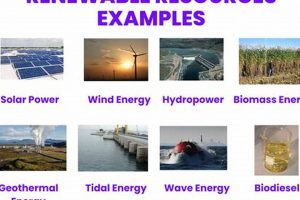
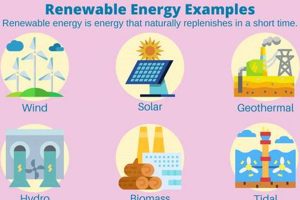
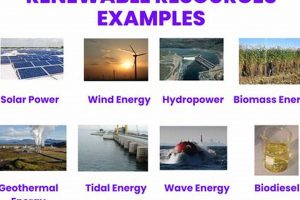
Harnessing power from naturally replenishing sources presents a sustainable alternative to fossil fuels. Solar energy, captured through photovoltaic cells or thermal systems, converts sunlight into electricity or heat. Wind power, generated by turbines converting kinetic energy from air currents, offers large-scale electricity production. Hydropower, utilizing the potential energy of flowing or falling water, provides a consistent and reliable energy supply. Geothermal energy, derived from the Earth’s internal heat, can be used for direct heating, electricity generation, and other applications.
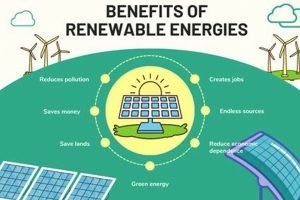
The adoption of these energy technologies reduces reliance on finite resources, mitigates greenhouse gas emissions, and diversifies energy portfolios. Historically, the utilization of such sources has been limited by technological constraints and economic factors. However, advancements in technology and increasing awareness of environmental impacts have spurred significant growth in their deployment worldwide. The economic benefits include job creation, energy independence, and reduced fuel price volatility.
The subsequent sections will delve into the specific characteristics, advantages, and challenges associated with each of these power generating options, examining their current status and potential for future development, as well as their role in the global transition toward a sustainable energy future. Factors such as efficiency, environmental impact, scalability, and cost-effectiveness will be carefully considered.
Implementation Strategies
Optimizing the integration of varied sustainable energy approaches requires a multifaceted strategy. This section outlines key considerations for effective deployment and utilization.
Tip 1: Prioritize Regional Suitability: Assess the specific geographical and climate conditions of a region to determine the most effective resource. Solar power is generally more viable in areas with high solar irradiance, while wind power benefits from consistent wind speeds. Hydropower requires suitable water resources and topography, and geothermal energy depends on accessible geothermal reservoirs.
Tip 2: Diversify Energy Portfolio: Implement a mix of technologies to ensure a stable and reliable energy supply. Reliance on a single resource can be vulnerable to weather variations or resource depletion. A balanced approach enhances energy security and minimizes risk.
Tip 3: Invest in Storage Solutions: Incorporate energy storage systems, such as batteries or pumped hydro storage, to address the intermittent nature of some resources. These systems can store excess energy generated during peak production periods and release it when demand exceeds supply, improving grid stability.
Tip 4: Develop Smart Grid Infrastructure: Modernize grid infrastructure to enable efficient distribution and management of electricity generated from diverse sources. Smart grids facilitate bidirectional communication between energy producers and consumers, optimizing energy flow and reducing waste.
Tip 5: Incentivize Adoption Through Policy: Governments and regulatory bodies should implement policies that incentivize the development and deployment of sustainable technologies. This may include tax credits, subsidies, feed-in tariffs, and renewable energy mandates.
Tip 6: Promote Public Awareness and Education: Increase public understanding of the benefits and feasibility of sustainable energy. Educating consumers about energy efficiency and conservation can reduce overall demand and promote the adoption of sustainable practices.
Tip 7: Support Research and Development: Invest in ongoing research and development to improve the efficiency, affordability, and scalability of energy technologies. This includes exploring new materials, designs, and applications.
Successful application depends on careful planning, strategic investment, and supportive policies. The benefits of these steps will contribute to a more sustainable and resilient energy future.
The following segment will explore the challenges and opportunities associated with large-scale adoption and future trends in the sector.
1. Resource Availability

The feasibility and scalability of harnessing wind, solar, hydro, and geothermal energy are fundamentally determined by the geographic distribution and abundance of these natural assets. Resource availability dictates the potential output and economic viability of specific energy projects.
- Solar Irradiance and Geographic Location
The intensity of sunlight varies significantly across the globe, influencing the efficiency of solar power generation. Regions near the equator typically receive higher solar irradiance, making them more suitable for solar farms. Factors such as cloud cover, latitude, and atmospheric conditions play crucial roles in determining the annual energy yield from solar installations. For example, the Sahara Desert presents vast potential for solar energy, but infrastructure and transmission challenges persist.
- Wind Patterns and Topography
Wind resources are influenced by regional weather patterns, topography, and altitude. Coastal areas and mountain passes often experience stronger and more consistent winds, making them ideal locations for wind turbines. The Great Plains region of the United States, for instance, benefits from strong prevailing winds, supporting large-scale wind energy production. Wind resource mapping helps identify areas with high wind potential for optimal turbine placement.
- Hydrological Cycle and Water Resources
Hydropower relies on the availability of flowing water, which is determined by precipitation patterns, river basin characteristics, and dam infrastructure. Regions with abundant rainfall and mountainous terrain, such as the Himalayas and the Andes, offer significant hydropower potential. However, environmental considerations, including impacts on aquatic ecosystems and water rights, must be carefully managed. Drought conditions and changes in precipitation patterns due to climate change can affect hydropower generation capacity.
- Geothermal Gradients and Geological Activity
Geothermal energy depends on the presence of underground reservoirs of hot water or steam, which are typically found in areas with volcanic activity or tectonic plate boundaries. Iceland, with its abundant geothermal resources, exemplifies the potential for geothermal heating and electricity generation. The availability of geothermal resources is influenced by factors such as geothermal gradient, permeability of rocks, and depth of geothermal reservoirs. Enhanced geothermal systems (EGS) are being developed to access geothermal resources in areas with lower natural permeability.
The successful deployment of sustainable energy requires a thorough assessment of resource availability, considering both geographic factors and environmental constraints. Optimizing the match between energy technology and resource potential is critical for maximizing efficiency and minimizing environmental impacts. Understanding these dynamics is paramount for informed decision-making in the transition to a sustainable energy future.
2. Technological Advancements

Technological progress is a crucial driver in expanding the viability and efficiency of solar, wind, hydro, and geothermal energy. Advancements directly influence cost-effectiveness, scalability, and environmental impact, thereby determining the adoption rate and overall contribution of these sustainable alternatives to the global energy supply. The continuous improvement in materials science, engineering design, and grid integration techniques is essential for overcoming inherent limitations and enhancing performance. For example, the development of higher efficiency photovoltaic cells, such as perovskite solar cells, promises to significantly increase the energy conversion rate of solar panels, reducing land use requirements and lowering the levelized cost of energy. Similarly, innovations in wind turbine blade design, such as longer blades and more aerodynamic profiles, have enabled turbines to capture more energy from lower wind speeds, expanding the geographic areas suitable for wind farms.
Furthermore, advancements in energy storage technologies, such as lithium-ion batteries and pumped hydro storage, are pivotal for addressing the intermittency challenges associated with solar and wind. The ability to store excess energy generated during peak production periods and release it when demand exceeds supply ensures a more stable and reliable energy flow. Smart grid technologies, including advanced sensors, communication networks, and control algorithms, facilitate the seamless integration of variable energy sources into the existing grid infrastructure. These smart grid solutions enable real-time monitoring, automated control, and optimized energy distribution, improving grid resilience and reducing transmission losses. Enhanced Geothermal Systems (EGS), which involve fracturing hot, dry rocks deep underground to create artificial geothermal reservoirs, represent a technological breakthrough that can significantly expand access to geothermal resources in regions lacking natural hydrothermal systems.
In summary, ongoing technological advancements are indispensable for unlocking the full potential of sustainable energy sources. Addressing challenges related to efficiency, cost, and grid integration through continuous innovation is vital for a successful transition to a low-carbon energy future. The investments in research and development across various engineering and scientific disciplines are warranted to realize that future.
3. Environmental Impact Reduction

The integration of wind, solar, hydro, and geothermal energy is significantly driven by the imperative to minimize environmental degradation associated with conventional fossil fuel-based energy production. These resources offer a pathway to diminish greenhouse gas emissions, reduce air and water pollution, and conserve natural resources.
- Mitigation of Greenhouse Gas Emissions
Fossil fuel combustion releases substantial quantities of carbon dioxide and other greenhouse gases, contributing to climate change. Solar, wind, hydro, and geothermal energy produce minimal to no greenhouse gas emissions during operation. Hydropower construction can result in initial greenhouse gas emissions due to land clearing and reservoir creation, but operational emissions are typically low. The widespread adoption of sustainable sources helps to decarbonize the energy sector, thereby mitigating the adverse effects of climate change.
- Reduction of Air and Water Pollution
Traditional power plants emit pollutants such as sulfur dioxide, nitrogen oxides, and particulate matter, which degrade air quality and pose health risks. These emissions are largely absent in solar, wind, hydro, and geothermal operations. Mining and transportation of fossil fuels can also lead to water contamination. Geothermal energy may release trace amounts of hydrogen sulfide, requiring appropriate emission control measures. The transition to these energy resources reduces the incidence of respiratory illnesses and protects water resources.
- Conservation of Natural Resources
Fossil fuels are finite resources that require extensive extraction and processing, often causing habitat destruction and ecological damage. Sustainable sources, by contrast, utilize naturally replenishing resources. Hydropower, while renewable, can alter river ecosystems and affect fish migration. Geothermal energy requires careful management of groundwater resources to ensure long-term sustainability. Responsible deployment minimizes the environmental footprint and conserves valuable resources.
- Land Use Considerations
Solar and wind farms can require significant land areas, potentially impacting agricultural land or natural habitats. Careful planning and site selection are crucial to minimize land use conflicts. Rooftop solar installations can mitigate land use concerns. Hydropower dams can inundate large areas of land, affecting biodiversity and displacing communities. Geothermal plants have a smaller land footprint compared to fossil fuel power plants. Optimizing land use strategies is essential for minimizing environmental impacts.
These diverse impact reduction aspects highlight the pivotal role of wind, solar, hydro, and geothermal power in fostering a more sustainable and environmentally responsible energy landscape. Though no energy production method is without environmental consequence, the shift toward these sources significantly lessens the impacts associated with fossil fuels, creating an environmentally conscious future.
4. Economic Feasibility

The economic viability of solar, wind, hydro, and geothermal energy is a critical determinant of their widespread adoption and long-term sustainability. Economic feasibility encompasses several interconnected factors that influence investment decisions, market competitiveness, and overall energy system costs. These factors must be carefully considered to evaluate the true value proposition of these sustainable alternatives.
- Levelized Cost of Energy (LCOE)
LCOE represents the average net present cost of electricity generation for a facility over its lifetime, allowing for a standardized comparison across different energy technologies. Declining LCOE for solar and wind energy, driven by technological advancements and economies of scale, has made them increasingly competitive with fossil fuel-based power plants. Hydro and geothermal energy often have lower LCOEs in regions with favorable resource conditions. The continued reduction of LCOE is essential for driving further adoption.
- Capital Costs and Investment Incentives
The initial capital investment required for sustainable energy projects can be substantial, posing a barrier to entry. Governments and regulatory bodies often provide investment incentives, such as tax credits, subsidies, and feed-in tariffs, to reduce the financial burden and encourage investment. These incentives play a crucial role in leveling the playing field and making sustainable energy more attractive to investors. The availability of low-cost financing and innovative financing mechanisms further enhances economic viability.
- Operating and Maintenance (O&M) Costs
O&M costs encompass the ongoing expenses associated with operating and maintaining energy facilities, including labor, equipment repairs, and insurance. Solar and wind energy typically have lower O&M costs compared to fossil fuel and nuclear power plants, reducing long-term operational expenses. Hydropower requires regular maintenance of dams and reservoirs, while geothermal energy may involve costs associated with managing geothermal fluid. Minimizing O&M costs is crucial for ensuring the long-term economic sustainability.
- Grid Integration Costs and Revenue Streams
Integrating variable energy sources, such as solar and wind, into the electricity grid can incur additional costs related to grid upgrades, transmission infrastructure, and balancing services. These costs must be factored into the overall economic assessment. Revenue streams from energy sales, grid services, and carbon credits contribute to the economic viability. Participation in wholesale electricity markets and the development of innovative grid integration solutions can enhance revenue opportunities.
The economic feasibility of renewable energy projects hinges on the interplay of LCOE, capital costs, O&M expenses, and grid integration considerations. Supportive policies, technological advancements, and innovative business models play critical roles in enhancing the economic competitiveness and accelerating the transition to a sustainable energy future. The ongoing evolution of the energy landscape requires a holistic economic assessment that considers both direct costs and broader societal benefits.
5. Grid Integration Challenges

Integrating electricity generated from sustainable sources, specifically solar, wind, hydro, and geothermal power, presents a series of technical and operational challenges to existing electrical grids. These challenges stem primarily from the variable and often intermittent nature of certain sources, particularly solar and wind, which do not consistently produce power like traditional baseload generators such as coal or nuclear plants. This variability necessitates significant adjustments to grid infrastructure and operational strategies to maintain system stability and reliability.
The inherent intermittency of solar and wind necessitates sophisticated forecasting techniques to predict power output fluctuations accurately. Without reliable forecasts, grid operators face difficulties in balancing supply and demand, leading to potential voltage and frequency instability. Furthermore, the geographically dispersed nature of many renewable energy installations, often located far from population centers, requires investments in transmission infrastructure to transport electricity efficiently. Congestion on transmission lines can limit the amount of renewable energy that can be delivered to consumers. Examples of these challenges are evident in regions with high penetration of wind power, such as Texas and Iowa, where managing grid congestion and accommodating variability are ongoing concerns. In Germany, the expansion of solar power has necessitated upgrades to distribution networks to handle the influx of power from distributed generation sources.
Grid integration challenges also extend to the need for flexible generation resources that can quickly ramp up or down to compensate for fluctuations in renewable energy output. Natural gas-fired power plants are often used for this purpose, but this reliance can diminish the overall environmental benefits of integrating renewables. Energy storage technologies, such as batteries and pumped hydro, offer a promising solution for mitigating intermittency but are still in the early stages of widespread deployment. Addressing the difficulties associated with integrating sustainable sources requires a multifaceted approach that includes advanced forecasting, grid modernization, energy storage deployment, and the development of flexible generation resources. Successfully overcoming these challenges is essential for unlocking the full potential of solar, wind, hydro, and geothermal power and transitioning to a more sustainable energy future.
6. Energy Storage Solutions

The effective deployment of wind, solar, hydro, and geothermal resources is intrinsically linked to the availability and implementation of adequate energy storage technologies. The variable nature of some sources necessitates solutions for balancing supply and demand, enhancing grid stability, and maximizing the utilization of these clean energy sources. Energy storage bridges the gap between intermittent supply and consistent demand, allowing for a more reliable and efficient energy system.
- Battery Energy Storage Systems (BESS)
BESS technologies, encompassing lithium-ion, flow batteries, and other chemistries, provide a means to store excess electricity generated during periods of high production and release it during periods of low production or high demand. Large-scale BESS installations are increasingly being deployed alongside wind and solar farms to smooth out output fluctuations and provide grid services such as frequency regulation and voltage support. The Hornsdale Power Reserve in South Australia serves as a prominent example, demonstrating the ability of BESS to stabilize the grid and prevent blackouts. This technology is essential for integrating a higher proportion of variable resources.
- Pumped Hydro Storage (PHS)
PHS involves pumping water from a lower reservoir to an upper reservoir during periods of low demand and releasing it through turbines to generate electricity during periods of high demand. PHS is a mature and proven technology with large-scale storage capacity. While geographically constrained by the availability of suitable topography and water resources, PHS offers a cost-effective solution for long-duration storage and grid stabilization. Examples include the Bath County Pumped Storage Station in Virginia, USA, and numerous facilities in Europe and Asia. PHS complements hydropower generation directly but can also be used in conjunction with other renewable sources.
- Compressed Air Energy Storage (CAES)
CAES involves compressing air and storing it underground in caverns or depleted natural gas reservoirs. When electricity is needed, the compressed air is released, heated, and expanded through turbines to generate power. CAES offers a large-scale storage capacity and can provide long-duration storage. However, it is geographically constrained by the availability of suitable geological formations. Examples of CAES facilities include the McIntosh plant in Alabama, USA, and projects in Europe. CAES systems can improve the dispatchability of wind and solar power.
- Thermal Energy Storage (TES)
TES technologies store energy in the form of heat or cold, which can be used for heating, cooling, or electricity generation. TES systems can be integrated with solar thermal power plants to store heat during the day and generate electricity at night. TES can also be used in district heating and cooling systems to improve energy efficiency and reduce peak demand. Examples of TES applications include concentrated solar power plants with molten salt storage and ice storage systems for commercial buildings. TES enhances the efficiency and reliability of geothermal and solar thermal energy systems.
Energy storage solutions are indispensable for realizing the full potential of electricity generation. Battery, pumped hydro, compressed air, and thermal storage all play distinct roles in mitigating intermittency, enhancing grid stability, and improving the overall efficiency of these resources. These technologies collectively contribute to a more sustainable and reliable energy system, enabling a greater reliance on environmentally friendly electricity sources.
7. Policy And Regulation
Governmental policies and regulatory frameworks exert a profound influence on the development, deployment, and integration of wind, solar, hydro, and geothermal power. These interventions shape market incentives, reduce investment risks, and establish standards for environmental protection and grid reliability. The presence or absence of supportive policies can directly determine the economic viability and competitiveness of these technologies, thereby accelerating or hindering their adoption rates. For example, feed-in tariffs, which guarantee a fixed price for electricity generated from sources, have been instrumental in driving the growth of the wind and solar industries in countries such as Germany and Spain. Conversely, the absence of clear and consistent policies can create uncertainty, discourage investment, and impede progress towards a cleaner energy mix.
Regulatory mechanisms also play a critical role in ensuring the responsible development and operation of these facilities. Environmental regulations govern the siting, construction, and decommissioning of power plants, mitigating potential impacts on ecosystems and communities. Grid interconnection standards establish technical requirements for integrating resources into the electricity grid, maintaining system stability and preventing disruptions. Renewable Portfolio Standards (RPS) mandate that a certain percentage of electricity sold by utilities must come from sustainable sources, creating a demand-side pull for these technologies. The establishment of clear regulatory guidelines promotes investor confidence and ensures that are developed in a sustainable and socially responsible manner. For instance, environmental impact assessments are often required before constructing hydropower dams to evaluate and mitigate potential effects on aquatic ecosystems and water resources. Similarly, siting regulations for wind farms address concerns related to noise pollution and avian mortality.
Effective policies and regulations are essential for fostering a level playing field, reducing market barriers, and promoting the long-term sustainability of wind, solar, hydro, and geothermal power. The design and implementation of these interventions require careful consideration of economic incentives, environmental impacts, and grid integration challenges. International cooperation and knowledge sharing can facilitate the adoption of best practices and the harmonization of standards. Clear, consistent, and well-enforced policies and regulations are critical for accelerating the transition to a low-carbon energy future and realizing the full potential of these electricity generation options.
Frequently Asked Questions
The following section addresses common inquiries concerning sustainable power generation technologies, offering clear and concise information for better understanding.
Question 1: How does the geographical location affect the efficiency of diverse sustainable power sources?
The suitability of a region significantly impacts the performance of these technologies. Solar energy benefits from high solar irradiance, typically found near the equator. Wind energy relies on consistent wind speeds, often prevalent in coastal areas. Hydropower requires suitable water resources and topography, while geothermal energy depends on accessible geothermal reservoirs.
Question 2: What are the primary limitations to widespread adoption of this power sector?
Significant limitations include intermittency, high upfront capital costs, and grid integration challenges. The intermittent nature of solar and wind power necessitates energy storage solutions and grid upgrades. Initial capital investments can be substantial, and integrating variable sources into existing grids requires careful planning and infrastructure improvements.
Question 3: What role does energy storage play in enhancing the viability of sustainable power?
Energy storage solutions, such as batteries and pumped hydro, mitigate the intermittency of solar and wind. These systems store excess energy during peak production and release it when demand is high, improving grid stability and reliability.
Question 4: How do government policies and regulations influence the development and deployment of this technology?
Government policies and regulations significantly shape the market incentives and reduce investment risks. Feed-in tariffs, tax credits, and renewable portfolio standards create a favorable environment for development. Clear regulatory guidelines promote investor confidence and ensure responsible development.
Question 5: What are the long-term environmental implications?
Adopting this energy system reduces greenhouse gas emissions, air and water pollution, and conserves natural resources. Environmental impact assessments are essential to minimize potential land use conflicts and ecosystem disruptions.
Question 6: What are the long-term economical implications?
The long-term economics are heavily affected by the technological improvements and the efficiency of integration in the electric grid and the stability of the new technologies. Lower LCOE and reduced O&M costs contribute to long-term economic sustainability.
The information provided addresses the key aspects of wind, solar, hydro, and geothermal energy. Understanding these elements is crucial for informed decision-making and effective deployment.
The following section will delve into future trends and innovations shaping the evolution of this industry.
Conclusion
This exploration of four renewable energy resources reveals the intricate balance between technological potential, economic feasibility, and environmental responsibility. The viability of solar, wind, hydro, and geothermal power hinges on sustained innovation, strategic investment, and comprehensive policy frameworks. The integration of these resources into existing energy infrastructures requires careful consideration of grid stability, energy storage solutions, and resource availability.
The long-term success of this energy transition necessitates a commitment to continuous improvement and adaptive strategies. As technology evolves and environmental awareness grows, the future energy landscape will be shaped by informed decisions and a collective dedication to a sustainable future. The sustained evaluation and advancement of these four technologies will be essential in securing a reliable and environmentally conscious energy supply for generations to come.
![Top 5: What are Renewable Resources? [Explained] | Renewable Energy Solutions for a Sustainable Future | Clean & Green Power](https://pplrenewableenergy.com/wp-content/uploads/2026/03/th-165-300x200.jpg "Top 5: What are Renewable Resources? [Explained] Renewable Energy Solutions for a Sustainable Future | Clean & Green Power")