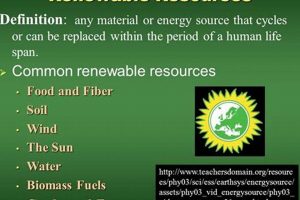
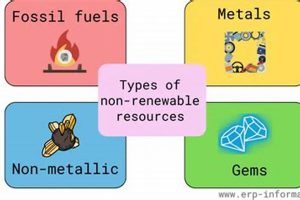
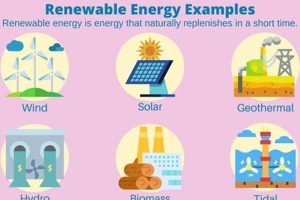
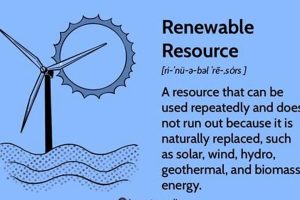
A natural resource is considered replenishable if it is restored by natural processes at a rate comparable to its rate of consumption by humans or other users. Solar energy, wind, and hydropower are examples of these types of resources. These sources stand in contrast to finite resources, which exist in fixed amounts or are replenished at a rate significantly slower than their consumption.
The utilization of resources that can be naturally replenished offers significant advantages, including a reduced reliance on finite supplies, decreased environmental impact (such as lower carbon emissions compared to fossil fuels), and the potential for long-term sustainability. Historically, societies have depended on such resources for basic needs, but recent technological advancements have expanded their application in energy production and other sectors.
This understanding of replenishable sources is fundamental to discussions about energy policy, environmental conservation, and sustainable development. Subsequent sections will explore specific examples, the technologies used to harness them, and the challenges and opportunities associated with their widespread adoption.
Harnessing Replenishable Resources
Effective utilization of replenishable resources requires careful planning, investment, and ongoing maintenance. The following guidelines provide insight into maximizing the benefits of these resources while minimizing potential drawbacks.
Tip 1: Assess Resource Availability: Conduct a thorough assessment of available replenishable resources in a given area. This includes evaluating solar irradiance, wind speeds, hydro potential, and geothermal gradients. Accurate assessment informs appropriate technology selection and project feasibility.
Tip 2: Prioritize Efficient Technologies: Select technologies optimized for resource capture and conversion efficiency. For example, high-efficiency solar panels or advanced wind turbine designs maximize energy output from available resources.
Tip 3: Implement Energy Storage Solutions: Address intermittency issues associated with certain replenishable resources by integrating energy storage solutions. Battery storage, pumped hydro, or thermal storage can stabilize energy supply and improve grid reliability.
Tip 4: Invest in Grid Modernization: Modernize grid infrastructure to accommodate distributed replenishable energy generation. Smart grids with advanced metering and control systems facilitate efficient integration and management of variable energy sources.
Tip 5: Establish Supportive Policies: Advocate for policies that incentivize the development and deployment of replenishable energy technologies. Feed-in tariffs, tax credits, and renewable portfolio standards can drive investment and market growth.
Tip 6: Promote Public Awareness: Educate the public about the benefits of replenishable resources and the importance of sustainable energy practices. Increased awareness can foster support for replenishable energy projects and encourage adoption of energy-efficient technologies.
Tip 7: Emphasize Life Cycle Analysis: Account for the entire life cycle of a replenishable energy system, from resource extraction to manufacturing, operation, and decommissioning. This approach identifies potential environmental impacts and ensures truly sustainable practices.
Following these guidelines can facilitate a more effective transition to a sustainable energy future based on the responsible utilization of replenishable resources.
The subsequent discussion will delve into the challenges and opportunities associated with specific replenishable resource technologies.
1. Naturally Replenished

The characteristic of being “naturally replenished” constitutes a defining criterion of resources that are readily restored by ecological cycles or other natural means. This inherent property distinguishes it from resources that are finite or exhaustible, and forms a vital link to understanding a basic definition of a sustainable source of energy or materials.
- Regenerative Capacity
Regenerative capacity refers to the ability of a resource to restore itself within a reasonable timeframe through natural processes. Forests, for example, exhibit regenerative capacity through tree growth and reseeding, replenishing timber resources over time. This is important because it establishes a potential for sustainable harvest if management practices are based on an understanding of this natural growth cycle. This capacity is essential to differentiating between sources that can be managed for continuous use and those that are essentially consumed.
- Solar Radiation
Solar radiation exemplifies a perpetually replenished resource. The sun constantly emits energy in the form of electromagnetic radiation, providing a continuous supply of light and heat. Solar technologies such as photovoltaics and solar thermal systems harness this energy, converting it into electricity or heat. Unlike fossil fuels, the availability of solar energy is not limited by geological reserves, though it does vary with time of day, seasons, and location. Thus, solar energy is considered renewable and central to the discussion of replenishable resources.
- Hydrological Cycle
The hydrological cycle, which includes evaporation, precipitation, and runoff, continuously replenishes water resources. Rainwater replenishes aquifers, rivers, and lakes, providing freshwater for various uses, including drinking water, irrigation, and hydropower generation. Proper management of watersheds and water conservation practices are critical to maintaining the integrity of the hydrological cycle and ensuring the sustainable supply of freshwater, a key replenishable resource.
- Wind Patterns
Wind is a replenishable resource created by the uneven heating of the Earth’s surface by solar radiation. Wind patterns are continuously generated, providing a source of kinetic energy that can be harnessed by wind turbines to generate electricity. The consistent nature of prevailing winds in certain regions makes them suitable for wind farm development. As with solar, wind is naturally and continuously available, making it a key component of a replenishable energy portfolio.
These facets demonstrate how the principle of natural replenishment fundamentally defines a sustainable source. The ability of a resource to renew itselfwhether it be through ecological cycles, constant energy emission, or perpetual motiondetermines its classification as a “naturally replenished” resource and its eligibility as part of a replenishable energy strategy.
2. Sustainable Rate

The term “sustainable rate” represents a pivotal element in defining a replenishable resource. It signifies the rate at which a resource can be utilized without depleting its availability for future generations. If consumption exceeds the replenishment rate, the resource transitions from being replenishable to unsustainable, negating its long-term viability. This balance is critical for ensuring the continued availability of resources such as forests, fisheries, and freshwater supplies.
Forest management provides a practical example. A forest can be considered a replenishable resource if trees are harvested at a rate no greater than the rate of new tree growth. Sustainable forestry practices involve careful planning and monitoring to ensure that the harvest rate remains within the forest’s capacity to regenerate. Overharvesting, on the other hand, leads to deforestation, soil erosion, and loss of biodiversity, transforming the forest into a non-replenishable entity. Similarly, fisheries management must adhere to sustainable catch limits to prevent overfishing and the collapse of fish populations. Exceeding the sustainable rate disrupts the marine ecosystem and jeopardizes the long-term availability of fish as a food source.
Understanding and adhering to the principle of the sustainable rate is essential for the responsible management of replenishable resources. Challenges arise in accurately assessing replenishment rates and enforcing sustainable practices in the face of economic pressures and competing interests. However, failing to maintain a sustainable rate compromises the very essence of a replenishable resource, transforming it into a finite supply with detrimental consequences for both present and future generations.
3. Energy Source

The designation “energy source” is intrinsic to the definition of a replenishable resource. Replenishable resources, by definition, provide a continuous or cyclical source of energy derived from natural processes. These sources offer alternatives to finite fossil fuels and contribute to a more sustainable energy economy. Wind, solar, hydro, geothermal, and biomass are prominent examples, each harnessing a distinct natural phenomenon to generate power. The availability of these energy sources differentiates replenishable options from resources used for other purposes, such as materials or minerals. Their primary utility lies in their capacity to generate usable energy, whether electrical, thermal, or mechanical.
Solar photovoltaic panels exemplify the connection. Sunlight, a perpetually available energy source, is converted directly into electricity. Wind turbines capture the kinetic energy of wind, transforming it into mechanical and then electrical energy. Hydropower dams utilize the potential energy of water stored at higher elevations to drive turbines and generate electricity. Geothermal plants tap into the Earth’s internal heat to produce steam, which then powers turbines. Biomass power plants burn organic matter, such as wood or agricultural waste, to generate heat and electricity. Each case demonstrates the fundamental role of the natural “energy source” in defining the nature and utility of the replenishable resource.
The understanding of energy sources as related to sustainable resources has practical significance in energy policy and infrastructure development. Investment in replenishable energy technologies hinges on the recognition of these sources’ long-term availability and environmental benefits. Overcoming challenges associated with intermittency and storage, and ensuring grid integration are crucial for maximizing the potential of replenishable energy sources. Effectively harnessing and managing these naturally occurring energy supplies is essential for achieving a sustainable energy future and mitigating the environmental impacts of fossil fuel dependence.
4. Reduced Impact
The concept of “reduced impact” is intrinsically linked to the definition of a replenishable resource. It addresses the environmental consequences associated with extracting, processing, and utilizing resources for energy or other purposes. Replenishable resources are characterized by a lower environmental footprint compared to finite resources, particularly fossil fuels, due to their natural replenishment processes and often cleaner extraction and conversion methods. The degree to which a resource minimizes negative environmental effects is a key determinant of its classification within the replenishable category.
Fossil fuel combustion, for instance, releases greenhouse gases, contributing to climate change and air pollution. In contrast, solar, wind, and hydropower generate electricity with minimal or no direct greenhouse gas emissions during operation. While the manufacturing and installation of replenishable energy technologies do involve some environmental impact, a life cycle assessment reveals that their overall carbon footprint is significantly lower than that of fossil fuel-based systems. Sustainable forestry practices, compared to deforestation, preserve biodiversity, maintain soil health, and sequester carbon, mitigating environmental damage. The choice between utilizing finite resources and replenishable resources often hinges on the imperative to minimize ecological disruption and promote environmental stewardship.
The practical significance of recognizing the “reduced impact” aspect of replenishable resources lies in informed decision-making regarding energy policy, resource management, and technological development. Incorporating environmental considerations into resource planning and prioritizing replenishable alternatives can lead to a more sustainable and resilient future. Continual innovation in replenishable energy technologies further reduces their environmental impact, making them an increasingly attractive option for meeting energy demands while safeguarding the environment.
5. Resource Availability
The factor of “resource availability” is critical when considering a sustainable source. It directly influences the practicality and viability of utilizing a replenishable option in place of a finite one. Understanding where and in what quantity a resource exists is paramount for evaluating its potential contribution to energy production or material needs.
- Geographic Distribution
The geographic distribution of replenishable resources varies significantly. Solar irradiance is abundant in desert regions, while wind resources are concentrated in coastal areas and open plains. Hydropower potential depends on river systems and elevation gradients. Geothermal energy is localized near tectonic plate boundaries and volcanic activity. The uneven distribution of these resources necessitates careful planning to match energy demands with available supplies. Regions lacking certain resources must either import them or invest in technologies to harness less abundant alternatives. For example, northern latitudes with limited solar irradiance may rely more heavily on wind or hydropower, highlighting the importance of geographic diversity in resource availability.
- Temporal Variability
Temporal variability refers to fluctuations in resource availability over time. Solar energy varies diurnally and seasonally, while wind patterns can change hourly or daily. Hydroelectric power generation depends on precipitation patterns and water availability. Biomass production is subject to agricultural cycles. The intermittent nature of many replenishable resources poses challenges for grid stability and requires the implementation of energy storage solutions or the integration of diverse energy sources. Batteries, pumped hydro storage, and smart grid technologies mitigate temporal variability by storing excess energy during periods of high availability and releasing it during periods of low availability. Thus, understanding and managing temporal variability is essential for reliable utilization.
- Technological Accessibility
Technological accessibility dictates the extent to which a resource can be effectively harnessed with current technologies. While solar energy is widely available, the efficiency and cost-effectiveness of solar panels influence the economic viability of solar power generation. Deep geothermal resources require advanced drilling and extraction technologies to access the heat. Similarly, offshore wind farms demand robust turbine designs and installation techniques. The development of more efficient and affordable technologies expands the range of replenishable resources that can be economically exploited. Investment in research and development is crucial for improving technological accessibility and unlocking the full potential of these resources. This ultimately determines which theoretical sources can contribute practically.
- Regulatory and Policy Frameworks
Regulatory and policy frameworks influence the economic viability and deployment of replenishable energy projects. Supportive policies, such as feed-in tariffs, tax incentives, and renewable portfolio standards, encourage investment in these resources and accelerate their adoption. Streamlined permitting processes and clear regulatory guidelines reduce project development timelines and costs. Conversely, restrictive regulations or inadequate infrastructure can hinder the deployment of replenishable energy technologies. Government policies play a critical role in shaping the resource availability landscape by creating a favorable environment for investment and innovation.
The factors outlined above demonstrate how “resource availability” influences the practical application and economic viability of renewable options. It underscores the importance of assessing geographic distribution, managing temporal variability, improving technological accessibility, and establishing supportive policy frameworks to unlock the full potential of these resources for a sustainable energy future.
6. Long-term Viability
Long-term viability is a fundamental characteristic inextricably linked to the defining attributes of a replenishable resource. It represents the capacity of a resource to remain available and functional over extended periods, ensuring sustained benefits for future generations. This aspect distinguishes truly replenishable resources from those that may be renewable in the short term but unsustainable in the long run due to mismanagement or environmental degradation.
- Ecosystem Resilience
Ecosystem resilience plays a crucial role in long-term viability by ensuring that the natural systems supporting the resource remain healthy and functional. For example, sustainable forestry practices maintain forest ecosystems’ biodiversity, soil health, and water quality, enabling the forest to regenerate and provide timber and other ecosystem services indefinitely. In contrast, deforestation and unsustainable agricultural practices degrade ecosystems, reducing their capacity to support long-term resource availability. This factor is therefore essential to maintain a truly replenishable state, avoiding depletion or irreversible damage.
- Resource Management Strategies
Effective resource management strategies are essential for guaranteeing long-term viability. Fisheries management, for example, involves setting catch limits based on scientific assessments of fish populations to prevent overfishing and allow populations to replenish themselves. Similarly, water resource management requires balancing water withdrawals with natural recharge rates to ensure sustainable water supplies for human consumption and ecosystem health. The absence of robust resource management strategies leads to resource depletion and undermines long-term viability. Responsible strategies are essential for achieving sustainability and preventing what would otherwise be a replenishable resource from collapsing or becoming unusable.
- Climate Change Adaptation
Climate change presents a significant challenge to the long-term viability of many replenishable resources. Changes in temperature, precipitation patterns, and sea levels can alter ecosystems, disrupt resource cycles, and increase the frequency of extreme events, such as droughts and floods. Climate change adaptation strategies are therefore necessary to enhance the resilience of resources to climate impacts. These strategies may include diversifying water sources, implementing drought-resistant crops, and restoring coastal wetlands to protect against sea-level rise. Failure to adapt to climate change can compromise the long-term viability of resources even if they are otherwise sustainably managed. Proactive adaptation ensures their sustained availability amid global environmental shifts.
- Technological Innovation
Technological innovation can contribute to the long-term viability of replenishable resources by improving their efficiency, reducing their environmental impact, and expanding their applicability. For example, advancements in solar panel technology have increased the efficiency of solar energy conversion, making it more economically viable and reducing its land footprint. Similarly, improvements in wind turbine design have enhanced the reliability and performance of wind energy generation. Technological innovation can also enable the utilization of resources that were previously inaccessible or uneconomical. Investment in research and development is essential for unlocking the full potential of replenishable resources and ensuring their long-term viability. This factor is crucial in allowing technological developments to adapt or even enhance the sustainability and efficiency of a given replenishable source over extended time periods.
These facets highlight the interconnectedness of long-term viability with the concept of what constitutes a replenishable resource. Sustaining the benefits derived from such sources requires a holistic approach that integrates ecological integrity, effective management, climate change adaptation, and technological advancements. Neglecting any of these aspects can compromise the long-term viability of resources, undermining their potential to contribute to a sustainable future.
Frequently Asked Questions
This section addresses common inquiries regarding the definition and characteristics of replenishable resources, aiming to clarify misconceptions and provide a deeper understanding of their significance.
Question 1: Are all natural resources considered replenishable?
No, not all natural resources qualify. The distinction lies in the rate of replenishment. A natural resource is considered replenishable if it is restored by natural processes at a rate comparable to its rate of consumption. Finite resources, such as fossil fuels, exist in fixed amounts or are replenished at a significantly slower rate.
Question 2: What distinguishes a replenishable energy source from a replenishable material resource?
The primary distinction lies in their intended use. Replenishable energy sources, such as solar, wind, and hydropower, are utilized for energy generation. Replenishable material resources, such as forests or fish stocks, provide raw materials for various industries. While both are replenished naturally, their application and management strategies differ.
Question 3: Does the utilization of sources always have a minimal environmental impact?
While the utilization of these sources generally results in a lower environmental impact compared to finite resources, it is not entirely without consequence. The manufacturing, installation, and decommissioning of replenishable energy technologies can have environmental footprints. Sustainable practices and life cycle assessments are essential to minimize these impacts.
Question 4: How does geographic location affect the availability of sources?
Geographic location significantly influences availability. Solar irradiance varies with latitude, wind resources are concentrated in specific regions, and hydropower depends on river systems. The uneven distribution necessitates strategic planning and investment in diverse energy sources to ensure a reliable supply.
Question 5: How can the intermittency of some, like solar and wind, be addressed?
The intermittency can be mitigated through energy storage solutions, such as batteries, pumped hydro storage, and thermal storage. Additionally, grid modernization and the integration of diverse energy sources contribute to a more stable and reliable energy supply.
Question 6: What role do government policies play in promoting the utilization of sustainable resources?
Government policies, such as feed-in tariffs, tax incentives, and renewable portfolio standards, play a crucial role in incentivizing the development and deployment of sustainable energy technologies. Supportive policies create a favorable investment climate and accelerate the transition to a more sustainable energy economy.
In summary, understanding the nuances of replenishable resourcestheir definition, characteristics, and associated challengesis essential for making informed decisions regarding energy policy and resource management. Prioritizing these alternatives is vital for a sustainable future.
The subsequent section will explore the future prospects and innovations within the replenishable energy sector.
Understanding What is a Renewable Resource
This exposition has clarified the defining characteristics of sources capable of natural replenishment. Emphasized were the importance of a sustainable consumption rate, the role of these sources as potential energy providers, their lower environmental impact compared to finite resources, the relevance of resource availability depending on geographic location, and their long-term viability, subject to responsible management and adaptation strategies. The investigation underscored that proper understanding of these features is vital for accurate resource categorization and effective sustainable strategies.
The ongoing transition toward greater utilization of sources demands continued research, technological innovation, and policy adjustments. The long-term health of both the environment and the global economy hinges on the effective adoption of these energy and material sources for future use.
![Guide to What Energy Resources Are Renewable [+Future] | Renewable Energy Solutions for a Sustainable Future | Clean & Green Power](https://pplrenewableenergy.com/wp-content/uploads/2026/03/th-516-300x200.jpg "Guide to What Energy Resources Are Renewable [+Future] Renewable Energy Solutions for a Sustainable Future | Clean & Green Power")