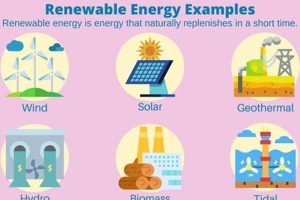
Geothermal energy harnesses heat from the Earth’s interior. This subterranean thermal reservoir is continuously replenished by radioactive decay within the planet’s core and mantle, along with residual heat from Earth’s formation. Unlike fossil fuels, which are finite and exhaustible, this source of energy is naturally replenished on a human timescale. An example of its application is the generation of electricity using steam from underground reservoirs or direct heating of buildings and infrastructure.
This energy source offers significant advantages over traditional methods. It contributes to a reduction in greenhouse gas emissions compared to burning fossil fuels. Furthermore, geothermal power plants have a small physical footprint relative to their energy output, minimizing land use impacts. Historically, its use dates back to ancient Roman times for heating purposes. Modern applications have expanded to include large-scale electricity generation and industrial processes.
The sustainable nature of this energy stems from the continual heat flow from the Earth’s interior, classifying it as a resource that renews itself naturally. It is crucial to understand the mechanisms of heat extraction and reservoir management to ensure the longevity and sustainability of geothermal systems. The following sections will explore specific aspects of this process.
Geothermal Energy Sustainability
Ensuring the ongoing viability of geothermal resources requires a commitment to best practices in resource management and technological innovation. The following points highlight crucial considerations for preserving the renewable characteristic of this energy source.
Tip 1: Implement Reservoir Monitoring: Continuous monitoring of subsurface conditions, including temperature, pressure, and fluid levels, is essential. Data analysis enables informed decisions regarding extraction rates and reservoir recharge. Over-extraction can lead to reservoir depletion, compromising long-term productivity.
Tip 2: Employ Sustainable Extraction Rates: Extraction rates should be carefully calibrated to match the natural replenishment rate of the geothermal reservoir. Modeling and simulation techniques can aid in determining optimal extraction levels, preventing premature reservoir decline.
Tip 3: Utilize Reinjection Techniques: Reinjecting cooled geothermal fluids back into the reservoir helps to maintain pressure and temperature, prolonging the lifespan of the resource. Furthermore, it reduces the risk of subsidence and minimizes environmental impacts related to wastewater disposal.
Tip 4: Optimize Well Field Design: Strategic placement and spacing of production and injection wells can maximize heat recovery and minimize interference between wells. Proper well field design ensures efficient utilization of the available geothermal resource.
Tip 5: Invest in Advanced Technologies: Continued research and development of advanced technologies, such as Enhanced Geothermal Systems (EGS), can unlock access to geothermal resources in areas previously deemed unsuitable for conventional geothermal development. EGS involves creating artificial fractures in hot, dry rock to enhance permeability and facilitate heat extraction.
Tip 6: Conduct Regular Environmental Impact Assessments: Comprehensive environmental impact assessments should be conducted prior to and during geothermal development. These assessments should evaluate potential impacts on air and water quality, land use, and biodiversity. Mitigation measures should be implemented to minimize any adverse effects.
By adhering to these recommendations, the long-term sustainability of geothermal resources can be significantly enhanced. These practices ensure the continued availability of this clean and reliable energy source.
The subsequent section will summarize the overall benefits and future potential of responsibly harnessed geothermal energy.
1. Constant Heat Replenishment

Constant heat replenishment is a foundational element in defining the sustainable nature of geothermal energy. The Earth’s internal heat, continuously generated through radioactive decay and primordial heat, sustains the geothermal gradient, making it a renewable resource. This continuous supply allows for the ongoing extraction of thermal energy without depleting the source, provided that extraction rates are managed appropriately.
- Radioactive Decay as a Driver
Radioactive decay within the Earth’s mantle and core generates a substantial amount of heat. This process involves the spontaneous transformation of unstable atomic nuclei, releasing energy in the form of heat. Elements such as uranium, thorium, and potassium contribute significantly to this heat production. This ongoing process ensures a continuous source of thermal energy available for geothermal exploitation. Without this constant radioactive decay, the Earth’s internal temperature would decrease over time, diminishing the potential for geothermal power generation.
- Primordial Heat from Earth’s Formation
A significant portion of the Earth’s internal heat originates from the planet’s formation. Gravitational accretion and differentiation processes during the Earth’s early history generated immense amounts of thermal energy. While this heat is slowly dissipating over geological timescales, it remains a substantial contributor to the overall geothermal gradient. This primordial heat acts in concert with radioactive decay to maintain a relatively stable and abundant source of energy accessible through geothermal systems.
- Geothermal Gradient Maintenance
The constant influx of heat from radioactive decay and primordial sources maintains the geothermal gradient, which is the rate of temperature increase with depth. This gradient is essential for the formation of exploitable geothermal resources. High geothermal gradients are found in areas with active volcanism or tectonic activity, where heat flow from the Earth’s interior is particularly high. These regions are ideal for geothermal power generation as the required temperatures for steam production can be reached at relatively shallow depths.
- Long-Term Sustainability Implications
The continuous heat replenishment from within the Earth underscores the long-term sustainability of geothermal energy. Unlike fossil fuels, which are finite resources subject to depletion, the heat source for geothermal energy is continuously renewed. This renewability ensures that geothermal resources can provide a reliable and sustainable source of energy for centuries, provided that extraction rates are carefully managed to avoid over-exploitation and that reinjection practices are implemented to maintain reservoir pressure and temperature.
In conclusion, the phenomenon of constant heat replenishment, driven by radioactive decay and primordial heat, is central to geothermal energy’s classification as a renewable resource. These factors ensure the continuous availability of thermal energy, provided that sustainable extraction and reservoir management practices are implemented. The ongoing supply of heat distinguishes geothermal energy from finite fossil fuels and highlights its potential as a long-term, sustainable energy solution.
2. Earth's Internal Radiogenic Decay

Earth’s internal radiogenic decay is a fundamental process that underpins geothermal energy’s classification as a renewable resource. This decay, primarily involving isotopes of uranium, thorium, and potassium, releases significant amounts of heat within the Earth’s mantle and core. This heat is conducted outwards, contributing to the geothermal gradient the increasing temperature with depth within the Earth’s crust. Without this continuous heat generation, the Earth’s internal temperature would gradually decline, rendering geothermal energy extraction unsustainable over relevant timescales. Therefore, radiogenic decay serves as the primary energy source for geothermal systems, continuously replenishing the thermal energy extracted for power generation and direct use applications.
The importance of this decay becomes evident when considering practical applications. For instance, regions with high concentrations of radioactive elements in the crust, such as certain areas of Iceland and New Zealand, exhibit significantly higher geothermal gradients. This results in shallower, higher-temperature geothermal reservoirs, making energy extraction more economically viable. Geothermal power plants in these regions leverage this readily available heat to generate electricity with minimal fossil fuel input. Furthermore, the consistent rate of radiogenic decay ensures a relatively stable and predictable heat flux over geological timescales, providing a reliable foundation for long-term geothermal resource planning and development. The sustained heat flow also permits the replenishment of geothermal reservoirs through the percolation of groundwater, further enhancing their renewable nature.
In conclusion, radiogenic decay acts as the cornerstone of geothermal renewability. It provides the continuous thermal energy input necessary to maintain viable geothermal gradients, supporting the sustained extraction of heat for various applications. Recognizing the direct linkage between Earth’s internal radiogenic decay and the availability of geothermal energy is crucial for understanding the practical significance of this renewable resource and for implementing sustainable extraction and management practices to ensure its long-term viability.
3. Sustainable Extraction Practices
The designation of geothermal energy as a renewable resource is inextricably linked to the implementation of sustainable extraction practices. The Earth’s internal heat, while continuously replenished, can be depleted locally if extraction rates surpass the reservoir’s natural recharge capacity. Therefore, sustainable extraction becomes a critical component in ensuring the long-term viability of geothermal energy systems. Practices such as monitoring reservoir pressure and temperature, controlling fluid withdrawal rates, and employing reinjection techniques directly influence the renewability of the resource. Failing to adhere to these practices leads to reservoir depletion, reduced energy output, and potential land subsidence, effectively negating the resource’s renewable attributes.
An example of the impact of extraction practices can be observed in the Geysers geothermal field in California. Initial over-extraction resulted in declining steam production and reduced power output. This situation prompted the implementation of water injection programs to replenish the reservoir and stabilize steam production. This intervention highlights the direct cause-and-effect relationship between extraction methods and the sustainability of geothermal energy generation. The practical significance lies in recognizing that simply tapping into an underground heat source is insufficient; careful management and responsible extraction are paramount to preserving the resource’s renewable character. Furthermore, ongoing research into enhanced geothermal systems (EGS) aims to unlock resources in areas with limited natural permeability, requiring even more sophisticated extraction and fluid management strategies to ensure long-term sustainability.
In summary, the renewability of geothermal energy is contingent upon the adoption of sustainable extraction practices. These practices ensure that the rate of energy withdrawal does not exceed the rate of natural replenishment, thereby preserving the long-term productivity of the resource. Challenges remain in accurately assessing reservoir characteristics and predicting the impacts of extraction activities, necessitating continuous monitoring, adaptive management, and ongoing research. By prioritizing sustainable extraction, the potential of geothermal energy as a reliable and environmentally sound renewable resource can be fully realized.
4. Reinjection Preserves Resource

Reinjection is a critical component of sustainable geothermal energy utilization, directly influencing the long-term renewability of the resource. By returning extracted fluids back into the geothermal reservoir, reinjection mitigates resource depletion and enhances operational longevity.
- Pressure Maintenance
Reinjection sustains reservoir pressure, which is essential for maintaining steam or hot water production rates. Without reinjection, pressure declines, leading to reduced well productivity and potentially rendering the resource uneconomical. The Ahuachapan geothermal field in El Salvador, for example, utilizes reinjection to counteract pressure decline and sustain power generation.
- Temperature Stabilization
Returning cooled geothermal fluids to the reservoir helps stabilize subsurface temperatures. This mitigates thermal drawdown, preventing a gradual decrease in the temperature of the produced fluids, which directly affects power generation efficiency. The Nesjavellir power plant in Iceland exemplifies this by employing extensive reinjection to maintain stable reservoir temperatures.
- Subsidence Mitigation
Fluid extraction can lead to land subsidence, posing risks to infrastructure and the environment. Reinjection helps counteract this by maintaining subsurface pore pressure, reducing the likelihood of ground deformation. The Wairakei geothermal field in New Zealand demonstrates the challenges of subsidence without adequate reinjection strategies.
- Environmental Impact Reduction
Reinjection minimizes the surface disposal of geothermal fluids, which can contain dissolved minerals and gases that pose environmental risks. By returning these fluids to the reservoir, reinjection reduces the potential for surface contamination and minimizes the environmental footprint of geothermal operations. The utilization of closed-loop systems further reduces environmental impacts.
These interconnected aspects of reinjection directly support the ongoing availability of geothermal energy. By maintaining reservoir pressure and temperature, mitigating subsidence, and reducing environmental impact, reinjection ensures the long-term productivity of geothermal resources, solidifying their classification as renewable.
5. Minimal Depletion Over Time
The characteristic of minimal depletion over time is fundamental to the classification of geothermal energy as a renewable resource. This attribute signifies that the rate of heat extraction from a geothermal reservoir is substantially lower than the rate at which the Earth naturally replenishes that heat. The implication is that geothermal energy can be sustainably harvested for extended periods without significant degradation of the resource. Several factors contribute to achieving minimal depletion, including appropriate reservoir management, controlled extraction rates, and implementation of reinjection strategies. The successful application of these principles ensures the long-term viability of geothermal systems. Failure to maintain minimal depletion leads to reduced energy output and potential abandonment of the resource, thereby undermining its renewability.
The Larderello geothermal field in Italy provides a historical case study. Early exploitation practices, lacking adequate reservoir management, resulted in significant pressure declines and reduced steam production. Subsequent implementation of reinjection and improved extraction techniques has helped to stabilize the reservoir, demonstrating the practical impact of minimizing depletion over time. Similarly, research into Enhanced Geothermal Systems (EGS) aims to tap into vast geothermal resources in regions with low permeability. However, the long-term sustainability of EGS hinges on maintaining minimal depletion through precise control of fluid injection and extraction, presenting a significant engineering and geological challenge. Advanced monitoring technologies and sophisticated reservoir modeling are essential tools for assessing the potential for depletion and optimizing extraction strategies.
In conclusion, the connection between minimal depletion over time and the renewability of geothermal energy is both direct and critical. Sustained energy production requires careful management to ensure that extraction does not outpace natural replenishment. While technological advancements are expanding access to geothermal resources, the long-term viability of these systems depends on maintaining minimal depletion through effective reservoir management practices. The challenge lies in balancing energy demands with the imperative to preserve the resource for future generations, necessitating ongoing research and development in sustainable geothermal energy technologies.
Frequently Asked Questions about Geothermal Energy Renewability
This section addresses common inquiries and clarifies aspects of geothermal energy’s classification as a renewable resource.
Question 1: How is geothermal energy considered renewable when heat extraction cools the Earth?
Geothermal energy is classified as renewable because the rate of heat extraction is minuscule compared to the Earth’s total heat content and the continuous heat generated by radioactive decay within the planet’s core and mantle. The Earth’s natural processes replenish the extracted heat at a rate that far exceeds human consumption.
Question 2: Can geothermal reservoirs be depleted, and if so, how does this align with the concept of renewability?
While geothermal reservoirs can experience localized depletion if mismanaged, responsible extraction practices, such as controlled withdrawal rates and reinjection of fluids, mitigate this risk. Sustainable management ensures that the reservoir’s recharge rate balances the extraction rate, maintaining the resource’s long-term viability. Therefore, depletion is preventable with proper strategies.
Question 3: What role does reinjection play in maintaining the renewability of geothermal resources?
Reinjection is crucial for preserving the renewability of geothermal resources. By returning extracted fluids to the reservoir, it helps maintain pressure, stabilize temperatures, and prevent land subsidence. Furthermore, reinjection reduces the need for surface disposal of potentially harmful geothermal fluids, minimizing environmental impacts and extending the lifespan of the resource.
Question 4: Is geothermal energy truly renewable everywhere, or only in specific geological locations?
While geothermal energy is most readily accessible in areas with high geothermal gradients, such as volcanic regions or areas with thin crust, advancements in technology, particularly Enhanced Geothermal Systems (EGS), are expanding its potential in regions with lower natural permeability. EGS allows for the creation of artificial reservoirs, tapping into previously inaccessible geothermal resources, thereby increasing its geographic applicability.
Question 5: How do environmental concerns associated with geothermal energy production impact its classification as a renewable resource?
Environmental concerns, such as induced seismicity, greenhouse gas emissions, and water usage, are actively addressed through stringent regulations and technological innovations. Mitigation strategies, including careful site selection, closed-loop systems, and carbon capture technologies, minimize environmental impacts. When implemented effectively, these measures ensure that geothermal energy remains a comparatively clean and sustainable renewable resource.
Question 6: How does the scale of geothermal energy production compare to other renewable energy sources, and how does this affect its long-term potential?
While geothermal energy production currently accounts for a smaller share of global energy generation compared to sources like solar and wind, its potential for growth is significant. Geothermal resources offer a reliable, baseload power supply, unlike intermittent sources. As technology improves and EGS becomes more widespread, geothermal energy is expected to play an increasingly important role in the global transition to renewable energy sources, providing a consistent and sustainable power option.
Geothermal resources, managed responsibly, constitutes a significant asset in the global renewable energy portfolio.
Considerations regarding geothermal systems are pertinent. The discussion now shifts to geothermal energy potential.
Conclusion
This exploration has illuminated the core principles underpinning the classification of geothermal energy as a renewable resource. The continuous replenishment of heat from the Earth’s interior, driven by radiogenic decay and primordial heat, forms the basis of its sustainability. Furthermore, responsible extraction practices, including controlled withdrawal rates and reinjection techniques, are essential for maintaining reservoir integrity and preventing depletion. Minimal depletion over time, coupled with environmental impact mitigation strategies, solidifies geothermal energy’s position as a viable, long-term energy solution.
The future of energy production requires a commitment to sustainable resources. Continued research, development, and responsible management are paramount to fully realizing its potential. Embracing geothermal energy contributes to a diversified and resilient energy portfolio, fostering a cleaner and more sustainable future for generations to come. The proper geothermal operation contribute to the world energy security.

![Guide to What Energy Resources Are Renewable [+Future] | Renewable Energy Solutions for a Sustainable Future | Clean & Green Power](https://pplrenewableenergy.com/wp-content/uploads/2026/03/th-516-300x200.jpg "Guide to What Energy Resources Are Renewable [+Future] Renewable Energy Solutions for a Sustainable Future | Clean & Green Power")