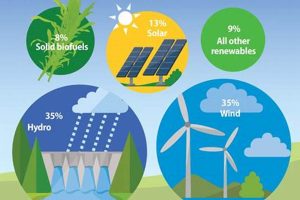
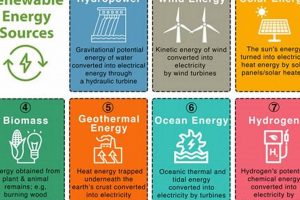
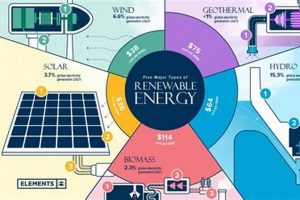
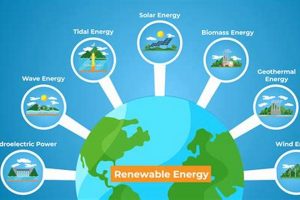
Resources derived from the Earth’s inherent processes, such as sunlight, wind, geothermal heat, and flowing water, offer sustainable alternatives to conventional power generation. Solar radiation, for instance, can be converted into electricity through photovoltaic cells, while wind turbines harness kinetic energy to produce mechanical or electrical power. Geothermal reservoirs deep within the Earth provide a source of heat that can be utilized for electricity generation or direct heating applications. The movement of water in rivers and oceans can be harnessed through hydroelectric dams and tidal energy systems.
The adoption of these Earth-derived resources is crucial for mitigating the environmental impact associated with fossil fuels, reducing greenhouse gas emissions, and promoting energy independence. Historically, civilizations have utilized water and wind power for various purposes, but advancements in technology have significantly enhanced the efficiency and scalability of these resources. This shift towards renewable options presents an opportunity to create a more sustainable and resilient energy future for generations to come. Furthermore, the decentralized nature of many renewable technologies can enhance energy security and reduce reliance on centralized power grids.
The following sections will delve deeper into specific types of such resources, exploring their technological advancements, economic considerations, and environmental implications. Analysis will also be provided on their integration into existing energy infrastructure and future potential within the global energy landscape.
Harnessing Earth’s Power
The following insights are designed to guide informed decision-making regarding the implementation and optimization of resources derived from natural processes.
Tip 1: Resource Assessment is Paramount: Before embarking on any project, conduct a thorough assessment of the available resources. Solar irradiance levels, wind speeds, geothermal gradient, and hydrological data should be meticulously analyzed to determine the feasibility and potential output of a specific location.
Tip 2: Diversify Energy Portfolio: Reliance on a single resource can introduce vulnerabilities. Integrating multiple options, such as solar and wind, can create a more resilient and reliable energy supply.
Tip 3: Invest in Energy Storage: The intermittent nature of some resources necessitates the incorporation of energy storage solutions. Battery storage, pumped hydro, and thermal storage systems can smooth out fluctuations and ensure a consistent power supply.
Tip 4: Prioritize Grid Integration: Seamless integration with existing power grids is crucial for large-scale adoption. This requires careful planning, infrastructure upgrades, and adherence to grid codes.
Tip 5: Emphasize Technological Innovation: Continuously monitor and adopt advancements in technologies to enhance efficiency and reduce costs. New materials, improved turbine designs, and advanced control systems can significantly improve the economic viability of these resources.
Tip 6: Secure Policy Support: Favorable government policies, such as tax incentives, feed-in tariffs, and renewable energy mandates, can accelerate deployment and attract investment. Actively engage with policymakers to advocate for supportive measures.
Tip 7: Conduct Life Cycle Assessments: Evaluate the environmental impact of technologies throughout their entire life cycle, from manufacturing to decommissioning. This ensures that the adoption of these resources truly contributes to sustainability.
Strategic planning, technological innovation, and supportive policies are essential for maximizing the benefits of this. Careful resource assessment and diversified portfolios are critical steps. Continued research and development is also necessary.
The subsequent sections will further explore the policy and technological implications of this, ensuring that these strategic considerations inform the next stages of the energy transition.
1. Renewability

Renewability constitutes a fundamental characteristic of resources obtained from the Earth’s inherent processes. These resources are replenished at a rate comparable to, or exceeding, their rate of consumption. This inherent quality contrasts sharply with finite resources, such as fossil fuels, where extraction permanently diminishes the available supply. The continuous influx of solar radiation, the cyclical nature of wind patterns, the perpetual movement of water, and the persistent geothermal heat from the Earth’s core are examples of phenomena that underpin the renewability of these Earth-derived energy options. Without this characteristic, the long-term viability and environmental advantages of employing these resources would be significantly compromised. Solar radiation, for example, exemplifies a renewable resource due to its continuous emanation from the sun. Wind and hydropower, as a result of atmospheric effects, are also continuously replenished.
The importance of renewability stems directly from its impact on resource sustainability. A renewable resource, managed responsibly, can provide a continuous stream of energy with minimal depletion of the originating source. This sustainable model reduces reliance on geographically concentrated, finite resources and mitigates the geopolitical and environmental risks associated with their extraction and combustion. The development of technologies that harness renewable energy sources, such as solar panels, wind turbines, and hydroelectric dams, directly translates into a more secure and environmentally responsible energy future. The effective long-term use of hydropower resources requires appropriate management and a consistent water supply, as evidenced by regions utilizing dams in the management of energy resources.
In conclusion, renewability is not merely an attribute but a defining feature that distinguishes sources from depletable energy stores. This characteristic underpins their sustainability and long-term economic and environmental value. While challenges remain in optimizing the utilization and integration of resources, the inherent renewability factor ensures their pivotal role in the transition towards a more secure and environmentally conscious energy future. Understanding the practical significance of renewability is critical for energy policy and the design of sustainable energy systems.
2. Accessibility
Accessibility, in the context of Earth-derived energy, refers to the degree to which these resources can be readily harnessed and utilized, considering geographical, technological, economic, and regulatory constraints. It is a multi-faceted concept that significantly influences the feasibility and widespread adoption of energy generation from these sources.
- Geographical Availability
The spatial distribution of these resources varies significantly across the globe. Solar irradiation is abundant in equatorial regions, while wind resources are concentrated in coastal areas and open plains. Geothermal potential is localized near tectonic plate boundaries, and hydroelectric power relies on the presence of rivers and elevation changes. This uneven distribution necessitates tailored energy strategies that align with regional resource endowments. For example, a desert region may find solar power highly accessible, while a mountainous area may favor hydroelectric generation.
- Technological Readiness
The maturity and availability of technologies required to convert resources into usable energy forms significantly impact accessibility. While solar photovoltaic technology is relatively mature and widely deployed, emerging technologies like advanced geothermal systems or wave energy converters face technological hurdles that limit their accessibility. The cost and efficiency of these technologies also play a crucial role in determining their economic viability and subsequent accessibility. The development of cost-effective energy storage technologies, for example, enhances the accessibility of intermittent resources like solar and wind.
- Economic Viability
The economic costs associated with resource extraction, infrastructure development, and energy conversion directly affect accessibility. High upfront capital costs or unfavorable levelized costs of energy (LCOE) can hinder the development of projects, particularly in developing nations or regions with limited financial resources. Government incentives, subsidies, and carbon pricing mechanisms can improve the economic accessibility of these energy options by reducing the financial burden on developers and consumers. The accessibility of geothermal power, for instance, is often dependent on the availability of government incentives to offset high drilling costs.
- Regulatory and Policy Frameworks
The existence of clear and supportive regulatory frameworks is essential for facilitating the development and deployment. Streamlined permitting processes, grid interconnection policies, and renewable energy mandates can significantly improve accessibility by reducing bureaucratic barriers and creating a stable investment climate. Conversely, complex regulations, unclear ownership rights, or discriminatory grid access policies can impede project development and limit accessibility. Favorable regulations around net metering, for example, increase the accessibility of solar power for homeowners.
These diverse facets highlight that accessibility is not simply a matter of resource abundance but rather a complex interplay of geographical, technological, economic, and regulatory factors. Addressing these challenges through targeted policies, technological innovation, and strategic investments is critical for unlocking the full potential of Earth’s energy and promoting a sustainable energy transition.
3. Sustainability

Sustainability forms the cornerstone of the value proposition for Earth-derived energy. The capacity to meet present energy demands without compromising the ability of future generations to meet their own needs is intrinsically linked to the reliance on such resources. The causation is clear: the finite nature of fossil fuels necessitates a shift towards resources that are perpetually replenished. Sustainability, therefore, is not merely a desirable attribute of energy, but a fundamental requirement for long-term energy security and environmental stewardship. The importance of this lies in the potential to decouple economic progress from environmental degradation.
One practical example of this connection is the implementation of solar power in remote communities. By harnessing sunlight, these communities can achieve energy independence, reducing their reliance on diesel generators which are both costly and environmentally damaging. This provides a sustainable energy solution, fostering economic development while minimizing environmental impact. Furthermore, sustainable forestry practices coupled with biomass energy generation exemplify this interconnectedness. By carefully managing forest resources and using biomass for energy, it is possible to achieve a renewable energy source that also supports forest ecosystems and local economies. This approach demands a holistic perspective, considering not only the energy production but also the broader ecological and societal implications.
Understanding the practical significance of this interconnection is crucial for policymakers, businesses, and individuals. It requires a long-term perspective, embracing the principles of resource conservation, environmental protection, and social equity. While challenges remain in transitioning to a fully sustainable energy system, the inherent renewability and reduced environmental impact of Earth’s intrinsic resources offer a clear pathway towards a more resilient and equitable future. The transition requires sustained investment in research and development, supportive policy frameworks, and a commitment to responsible resource management to ensure that these resources truly contribute to a sustainable energy future.
4. Cost-Effectiveness

Cost-effectiveness is a crucial determinant in the widespread adoption of energy derived from natural processes. While the environmental benefits are significant, economic viability remains a primary driver for both consumers and utility providers. The initial investment costs associated with technologies like solar photovoltaic systems, wind turbines, and geothermal plants can be substantial, representing a significant barrier to entry. However, a comprehensive analysis extends beyond upfront expenses to encompass operational costs, fuel expenses (or lack thereof), maintenance requirements, and the lifespan of the equipment. The declining costs of solar panel manufacturing and wind turbine technology, for instance, have dramatically improved the cost-effectiveness of these energy sources over the past decade, rendering them increasingly competitive with traditional fossil fuel-based power generation.
Government incentives, such as tax credits, subsidies, and feed-in tariffs, play a vital role in enhancing the cost-effectiveness of naturally derived energy. These mechanisms effectively reduce the initial financial burden on consumers and investors, making renewable projects more attractive. Furthermore, the absence of fuel costs associated with many natural sources significantly contributes to their long-term economic advantage. Once operational, solar and wind farms require minimal ongoing expenses, while fossil fuel plants necessitate continuous procurement of coal, natural gas, or oil. This differential is particularly pronounced in regions with volatile fossil fuel prices. Real-world examples of areas that have leveraged the reduced expense to establish themselves as leaders in renewable energy includes countries in the middle east which benefit from abundant sunshine to generate solar power at scale.
Therefore, understanding the interplay of initial capital costs, operational expenses, government policies, and technological advancements is essential for evaluating the true cost-effectiveness of Earth’s energy options. While challenges remain in achieving cost parity with fossil fuels in all regions and applications, the trajectory indicates a continued decline in renewable energy costs, driven by technological innovation and economies of scale. Continued investment in research and development, coupled with supportive policy frameworks, is necessary to unlock the full potential of naturally-derived energy and establish a sustainable and economically viable energy future.
5. Environmental Impact
The environmental impact associated with energy production constitutes a critical consideration in evaluating the viability and sustainability of diverse energy sources. While the use of resources found in nature generally presents a more benign environmental profile compared to fossil fuels, a nuanced understanding of the specific impacts across the lifecycle of these technologies is essential for informed decision-making.
- Land Use
The deployment of utility-scale solar and wind farms often necessitates significant land areas, potentially impacting ecosystems and agricultural land. Careful site selection and mitigation strategies are crucial to minimize habitat disruption and land degradation. For example, situating solar farms on previously disturbed land or brownfield sites can reduce the environmental footprint. Similarly, offshore wind farms minimize land use impacts but introduce concerns regarding marine ecosystems. The trade-offs between land use and energy production require careful assessment and planning.
- Wildlife Interactions
Wind turbines can pose a threat to avian and bat populations through collisions. Solar facilities can also impact wildlife through habitat alteration and thermal effects. Mitigation measures, such as bird deterrents, optimized turbine placement, and wildlife-friendly solar designs, are essential to minimize these impacts. Ongoing monitoring and research are necessary to assess the effectiveness of these measures and adapt management strategies accordingly.
- Water Usage
Hydropower generation can alter river flow regimes, impacting aquatic ecosystems and downstream water availability. Geothermal power plants may also require water for cooling purposes. Careful water resource management and the implementation of closed-loop cooling systems can minimize water consumption and mitigate the potential for ecological disruption. Small-scale hydro projects and run-of-river systems can offer a more sustainable alternative to large dams.
- Material Extraction and Manufacturing
The production of solar panels, wind turbines, and other renewable energy technologies requires the extraction of raw materials and the manufacturing of components, which can have environmental consequences. Responsible sourcing of materials, recycling initiatives, and the development of more sustainable manufacturing processes are crucial for minimizing the lifecycle environmental impacts of these technologies. Life Cycle Assessments can provide a holistic evaluation of the environmental burdens associated with each stage of the production process.
In summary, while the adoption of Earth-derived resources represents a significant step towards a more sustainable energy future, a thorough assessment and mitigation of the associated environmental impacts are paramount. Continuous technological innovation, responsible resource management, and informed policy decisions are essential to maximize the environmental benefits and minimize the potential drawbacks of these energy sources. The integration of environmental considerations into all stages of project development is crucial for ensuring the long-term sustainability of the energy transition.
Frequently Asked Questions About Resources Derived from Natural Processes
The following section addresses common inquiries regarding power generation from naturally replenished sources, providing clarity on key aspects related to their implementation and impact.
Question 1: Are naturally derived energy sources consistently reliable, given their dependence on weather conditions?
The reliability of energy generation from weather-dependent sources, such as solar and wind, is subject to variability. However, strategies such as energy storage solutions and grid diversification can mitigate these fluctuations. Furthermore, advancements in forecasting technologies enhance the predictability of energy output.
Question 2: What are the primary environmental concerns associated with large-scale solar and wind farms?
Concerns primarily relate to land use, potential impacts on wildlife (particularly birds and bats), and the visual impact on landscapes. Careful site selection, mitigation strategies, and adherence to environmental regulations can minimize these concerns.
Question 3: Are natural energy sources truly sustainable, considering the resources required for their construction and maintenance?
While the manufacturing of solar panels, wind turbines, and other related infrastructure does require resources, lifecycle assessments generally indicate a significantly lower environmental footprint compared to fossil fuel-based energy systems. Furthermore, ongoing efforts to improve manufacturing processes and promote recycling contribute to increased sustainability.
Question 4: What is the potential for energy storage technologies to enhance the integration of energy into existing power grids?
Energy storage technologies, such as batteries and pumped hydro, play a crucial role in mitigating the intermittency challenges associated with weather-dependent resources. They enable the storage of excess energy generated during peak production periods and its release during periods of high demand or low energy generation, thereby enhancing grid stability and reliability.
Question 5: What are the key policy mechanisms that can promote the adoption of these renewable energy options?
Effective policy mechanisms include feed-in tariffs, tax incentives, renewable energy standards, and carbon pricing mechanisms. These policies incentivize investment in and deployment of renewable energy technologies, creating a more favorable economic environment for their widespread adoption.
Question 6: How does geothermal energy differ from other Earth-derived energy sources in terms of availability and applicability?
Geothermal energy, while not as ubiquitously available as solar or wind, offers a consistent and baseload power source, independent of weather conditions. Its applicability is geographically constrained to regions with accessible geothermal resources, but it provides a reliable and carbon-free energy option in those locations.
In summary, effective deployment of this energy requires a holistic understanding of its characteristics, potential impacts, and the role of policy and technology in optimizing its integration into existing energy systems.
The following section will delve into the economic considerations.
Conclusion
This exploration has elucidated the multifaceted nature of natural energy sources, emphasizing their potential as a cornerstone of a sustainable energy future. The analysis has encompassed aspects ranging from renewability and accessibility to cost-effectiveness and environmental impact, providing a comprehensive perspective on the challenges and opportunities associated with their deployment. It has also been demonstrated that, while challenges remain, strategic planning, technological innovation, and supportive policies are essential for maximizing the benefits of earth’s energy options.
The transition towards a greater reliance on resources found in nature is not merely an environmental imperative but also an economic and societal necessity. Continued research, development, and implementation are crucial to realizing the full potential of these resources and securing a more sustainable and resilient energy future. Therefore, future action and policy are necessary for making those sources available for human life.