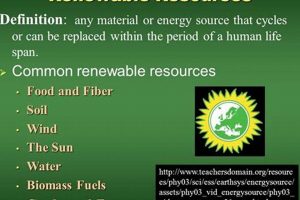
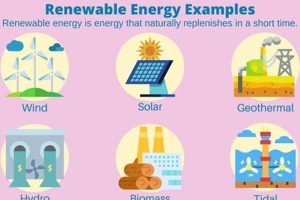
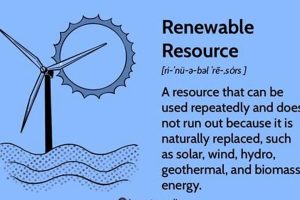
Resources replenished by natural processes at a rate comparable to or faster than their rate of consumption are considered sustainable. Sunlight is a prime illustration, consistently available and harnessed through solar energy technologies. Wind, driven by atmospheric pressure differences and solar heating, provides another inexhaustible energy source captured by turbines. Water, continuously recycled through the hydrological cycle of evaporation, condensation, and precipitation, supports hydroelectric power and sustains ecosystems. Geothermal energy, derived from the Earths internal heat, offers a constant supply of energy in volcanically active regions. Biomass, organic matter from plants and animals, can be used as a fuel source, with responsible forestry and agricultural practices ensuring continuous renewal.
The utilization of these resources mitigates reliance on finite fossil fuels, lessening greenhouse gas emissions and contributing to a more stable climate. Their widespread adoption enhances energy security, reducing dependence on volatile global markets. Historically, societies relied heavily on these elements for survival. Modern technology now allows for more efficient and large-scale exploitation, driving innovation in sustainable development. By embracing these resources, nations can foster cleaner environments, create new economic opportunities, and build more resilient infrastructures.
The subsequent sections will further explore the various means of harnessing solar energy, wind power, hydroelectricity, geothermal resources, and biomass, detailing their current applications, technological advancements, and future potential for meeting global energy demands.
Optimizing Use of Replenishable Earth Materials
The effective and responsible management of naturally self-restoring assets is crucial for long-term sustainability. Implementation of the following guidelines will promote optimal utilization and conservation.
Tip 1: Prioritize Diversification of Energy Sources: Reliance on a single source increases vulnerability to disruptions. Invest in a portfolio of energy generation methods solar, wind, hydro, and geothermal to ensure a stable and resilient energy supply.
Tip 2: Implement Sustainable Harvesting Practices: For resources such as timber and biomass, adhere to harvesting practices that allow for regeneration and prevent deforestation. This includes selective logging, reforestation efforts, and careful management of agricultural residues.
Tip 3: Promote Water Conservation: Implement water-efficient technologies in agriculture, industry, and residential sectors. Address water scarcity through improved irrigation techniques, rainwater harvesting, and wastewater recycling.
Tip 4: Invest in Research and Development: Continuous innovation is essential for improving the efficiency and cost-effectiveness of harnessing these assets. Support research into advanced materials, energy storage solutions, and efficient conversion technologies.
Tip 5: Establish Robust Regulatory Frameworks: Clear and effective regulations are crucial for managing access and preventing overexploitation. Regulations should promote responsible resource management and ensure that environmental impacts are minimized.
Tip 6: Foster Public Awareness and Education: Educate the public about the importance of sustainable resource management. Encourage responsible consumption patterns and promote citizen participation in conservation efforts.
Tip 7: Encourage International Collaboration: Global challenges require coordinated solutions. Facilitate the sharing of knowledge, technologies, and best practices across borders to promote sustainable resource management worldwide.
Adherence to these guidelines will facilitate responsible stewardship, ensuring the long-term availability and benefits derived from Earth’s replenishable resources. Such measures are essential for securing a sustainable future for subsequent generations.
The concluding section will synthesize the preceding information, offering a comprehensive perspective on the role of these assets in shaping a sustainable future.
1. Solar Irradiance

Solar irradiance, the power per unit area received from the sun in the form of electromagnetic radiation, stands as a foundational component among replenishable sources. Its magnitude directly influences the viability and efficiency of various energy harvesting technologies and biological processes.
- Photovoltaic Conversion Efficiency
Higher irradiance levels directly increase the electrical power output of solar panels. Regions with greater solar intensity benefit from increased energy production per panel, reducing the land area and material resources required to achieve specific energy generation targets. For example, the concentrated solar power plants in the Mojave Desert leverage high solar irradiance to generate significant electricity.
- Photosynthesis and Biomass Production
Solar radiation drives photosynthesis, the process by which plants convert carbon dioxide and water into organic matter and oxygen. Higher irradiance fosters more rapid plant growth, leading to increased biomass production that can be utilized for biofuels or other bio-based products. The fertile lands of the Amazon basin exemplify the link between high solar irradiance and biomass productivity.
- Thermal Energy Applications
Solar irradiance is harnessed for direct thermal applications, such as solar water heating and solar air conditioning. High irradiance levels facilitate faster heating of water and air, reducing the energy input required for these processes. Mediterranean countries, with their abundant sunshine, extensively utilize solar thermal systems for residential and commercial heating.
- Water Evaporation and Hydrological Cycle
Solar radiation drives the evaporation of water, a crucial phase in the hydrological cycle that replenishes freshwater sources. Higher irradiance intensifies evaporation rates, influencing precipitation patterns and affecting the availability of water resources for hydropower generation and irrigation. Arid and semi-arid regions are particularly sensitive to variations in solar irradiance affecting water availability.
In summary, solar irradiance underpins the effectiveness of several replenishable resources. Its variability directly impacts the yield of solar energy, influences biomass production, affects thermal applications, and plays a key role in the water cycle, highlighting its central role in sustainable energy systems.
2. Wind Velocity
Wind velocity, a measure of the speed of air movement, is a fundamental driver in renewable energy generation, particularly concerning wind power. Its magnitude and consistency directly impact the feasibility and efficiency of wind energy conversion systems, thereby influencing the overall contribution of wind energy to the portfolio of replenishable resources.
- Power Generation Efficiency
The power generated by a wind turbine is proportional to the cube of the wind speed. A small increase in wind velocity results in a significantly larger increase in power output. Sites with higher average wind speeds are therefore more economically viable for wind farm development. Coastal regions and elevated areas often exhibit consistently higher wind velocities, making them prime locations for large-scale wind energy projects. For example, the North Sea wind farms benefit from strong, consistent winds, contributing substantially to the energy needs of several European nations.
- Turbine Design and Operation
Wind velocity dictates the design parameters of wind turbines. Blades must be engineered to withstand specific wind speeds and turbulence levels. Regions with extreme wind conditions require more robust turbine designs, while areas with lower average wind speeds may benefit from turbines optimized for lower cut-in speeds (the minimum wind speed required for operation). Turbine control systems continuously adjust blade pitch and yaw to optimize energy capture across varying wind velocities, ensuring both efficiency and structural integrity.
- Site Selection and Resource Assessment
Accurate assessment of wind velocity is critical for site selection in wind energy projects. Wind resource maps, generated from meteorological data and computational models, are used to identify areas with high wind potential. Detailed wind measurements, often collected using anemometers mounted on meteorological towers, provide crucial data for estimating energy production and assessing project feasibility. Investments in accurate wind resource assessment minimize risks associated with lower-than-expected energy yields.
- Grid Integration and Energy Storage
Variations in wind velocity lead to fluctuations in power generation from wind farms. Effective grid integration requires sophisticated forecasting tools to predict wind power output and manage grid stability. Energy storage solutions, such as batteries and pumped hydro storage, can mitigate the intermittency associated with wind energy by storing excess power during periods of high wind velocity and releasing it during periods of low wind velocity, ensuring a reliable energy supply.
In conclusion, wind velocity is a key determinant of the effectiveness of wind energy. Its consistent measurement and careful consideration directly impact energy generation efficiency, optimal turbine design, strategic site selection, and efficient grid integration. As technology advances, improving the capacity to forecast and manage wind velocity fluctuations is central to unlocking the full potential of wind as a primary renewable energy source. The ability to effectively leverage wind resources is essential for diversifying the energy mix and reducing reliance on fossil fuels.
3. Hydro Cycle

The hydrological cycle, a continuous process involving evaporation, transpiration, condensation, precipitation, and runoff, is intrinsically linked to several replenishable assets. It is the driving force behind hydroelectric power, sustaining water availability for irrigation and potable water supplies, and significantly influencing terrestrial and aquatic ecosystems. Disruptions to the cycle, whether through climate change or human activities, pose a direct threat to the sustainability of these water-dependent resources. For example, reduced precipitation in the Colorado River Basin directly impacts hydroelectric power generation at the Hoover Dam and water availability for millions of people in the southwestern United States. Deforestation, by decreasing transpiration, diminishes local rainfall patterns, hindering groundwater recharge and impacting agricultural productivity.
Hydroelectric power, derived from the potential energy of elevated water, constitutes a major source of renewable electricity. Dams and reservoirs are designed to regulate water flow, enabling consistent energy production. However, dam construction can have adverse environmental impacts, including altered river ecosystems and displacement of human populations. Sustainable water management practices, such as optimizing dam operations for both energy generation and ecosystem health, are crucial for maximizing the benefits while minimizing negative consequences. Furthermore, the utilization of run-of-river hydropower, which minimizes reservoir construction, offers a more environmentally friendly alternative for energy generation. Proper management of water resources is a critical element in maintaining agricultural productivity. Efficient irrigation systems, such as drip irrigation and precision agriculture techniques, reduce water consumption while maximizing crop yields. The integration of rainwater harvesting and greywater recycling into urban planning further alleviates the strain on potable water supplies, enhancing resilience to water scarcity.
In conclusion, the hydrological cycle is not merely a natural phenomenon but a vital component underpinning a multitude of replenishable assets. Its sustainability is directly contingent upon responsible water management practices, climate change mitigation, and ecosystem conservation. Recognizing and addressing the intricate connections between the cycle and these water-dependent resources is paramount for securing a resilient and sustainable future.
4. Geothermal Gradient

The geothermal gradient, representing the rate of increasing temperature with respect to increasing depth in the Earth’s interior, serves as a fundamental driver for geothermal energy. This resource, derived from the Earth’s internal heat, is classified as a renewable resource due to the continuous heat flow from the planet’s core. The gradient’s magnitude significantly influences the viability and characteristics of diverse geothermal applications.
- Geothermal Power Generation
High geothermal gradients enable efficient electricity generation through geothermal power plants. These plants utilize steam or hot water extracted from underground reservoirs to drive turbines connected to generators. Locations with steeper geothermal gradients, such as Iceland and the Taupo Volcanic Zone in New Zealand, support commercially viable power generation. These areas benefit from shallower access to high-temperature resources, reducing drilling costs and improving overall energy output. In contrast, regions with lower gradients may necessitate enhanced geothermal systems (EGS) to create artificial reservoirs, increasing the complexity and expense of harnessing the resource.
- Direct Use Applications
Moderate geothermal gradients facilitate direct use applications, including space heating, aquaculture, and industrial processes. Geothermal heat pumps utilize the relatively constant ground temperature to provide efficient heating and cooling for buildings. Geothermal resources are also employed in greenhouses to extend growing seasons and in fish farms to maintain optimal water temperatures. Reykjavik, Iceland, exemplifies the widespread use of geothermal energy for district heating. Such applications reduce reliance on fossil fuels, contributing to decarbonization efforts and enhancing energy efficiency.
- Hydrothermal Systems and Reservoir Characteristics
The geothermal gradient influences the formation and characteristics of hydrothermal systems, which are crucial for geothermal resource development. High gradients promote the convection of groundwater, creating hydrothermal reservoirs with elevated temperatures and pressures. The permeability and porosity of the surrounding rock formations determine the reservoir’s capacity and sustainability. Geothermal exploration techniques, including geological surveys, geochemical analyses, and geophysical methods, are used to characterize these reservoirs and assess their potential for energy production. Understanding the interplay between the geothermal gradient and reservoir characteristics is essential for optimizing resource extraction and minimizing environmental impacts.
- Geothermal Gradient Mapping and Resource Assessment
Accurate mapping of the geothermal gradient is essential for assessing geothermal resource potential at regional and global scales. Geothermal atlases and databases compile temperature measurements from boreholes, heat flow data, and geological information to delineate areas with high geothermal potential. Geothermal gradient maps aid in identifying promising locations for geothermal exploration and development. Satellite-based thermal infrared imagery can also be used to detect surface manifestations of geothermal activity, complementing ground-based measurements. Reliable geothermal gradient data are crucial for attracting investment in geothermal energy projects and promoting sustainable resource management.
The geothermal gradient serves as a critical factor in evaluating the feasibility and potential of geothermal energy projects. Its magnitude affects power generation efficiency, influences the availability of direct use applications, and determines the characteristics of hydrothermal systems. The accurate assessment and mapping of the geothermal gradient are therefore essential for promoting the sustainable utilization of this perpetually replenishing resource. Furthermore, the technological advancements such as enhanced geothermal systems may allow the utilization of previously untapped resources, thereby widening the applicability of geothermal power.
5. Biomass Productivity

Biomass productivity, the rate at which organic matter is generated by plants through photosynthesis, is intrinsically linked to several replenishable resources. It constitutes a crucial component of biomass energy, determining the potential for biofuels, bioenergy, and bioproducts. The efficiency of biomass productivity dictates the sustainability of utilizing these resources and their contribution to mitigating climate change. For instance, fast-growing tree species like willow and poplar, cultivated in managed plantations, exhibit high biomass productivity, allowing for rapid carbon sequestration and a sustainable supply of feedstock for bioenergy plants. Similarly, algal biomass cultivated in bioreactors demonstrates substantial productivity, offering a promising avenue for producing biofuels without competing with agricultural land. Conversely, practices that degrade land, reduce photosynthetic capacity, or deplete soil nutrients diminish biomass productivity, undermining the renewability of these resources.
Furthermore, biomass productivity directly affects the carbon cycle and ecosystem health. Increased plant growth sequesters atmospheric carbon dioxide, mitigating greenhouse gas emissions. Healthy ecosystems with high biomass productivity support diverse food webs, enhance soil fertility, and improve water quality. Sustainable agricultural practices, such as no-till farming and cover cropping, enhance soil organic matter, leading to increased biomass productivity and reduced erosion. Agroforestry systems, which integrate trees into agricultural landscapes, provide multiple benefits, including enhanced biomass production, improved soil health, and increased biodiversity. The effectiveness of these practices in augmenting biomass productivity is essential for enhancing the sustainability of agricultural systems and mitigating their environmental impacts.
In conclusion, biomass productivity is a foundational element of sustainable bioenergy and bioproducts. Optimizing biomass productivity through sustainable land management practices and technological innovation is essential for maximizing the benefits of these replenishable assets. Recognizing the interconnectedness between biomass productivity, ecosystem health, and climate change mitigation is crucial for fostering a transition towards a more sustainable and resilient future. By carefully managing and enhancing biomass productivity, humans can harness the power of naturally replenishing resources to meet energy needs, while simultaneously protecting the planet for future generations.
6. Tidal Variation

Tidal variation, the periodic rise and fall of sea levels caused by the gravitational forces exerted by the Moon and the Sun in conjunction with the Earth’s rotation, represents a predictable and potentially significant resource for energy generation. As a component of naturally self-replenishing sources, it presents a stark contrast to depletable fossil fuels and offers a route toward sustainable energy production. The consistent and cyclical nature of tidal fluctuations allows for reliable energy capture, albeit with specific geographic limitations. The exploitation of tidal variation hinges upon the construction of specialized infrastructure, such as tidal barrages or submerged turbines, designed to harness the kinetic energy of tidal currents. These installations convert the mechanical energy of moving water into electrical power. For example, La Rance Tidal Power Station in France, operational since 1966, capitalizes on substantial tidal range in the Rance estuary to generate electricity, demonstrating the long-term feasibility of tidal energy technology. The operational principle involves impounding water behind a barrage during high tide and then releasing it through turbines during low tide, and vice versa, effectively leveraging the height difference between the high and low water marks.
The viability of tidal energy is closely linked to geographical factors. Coastal regions with substantial tidal ranges and strong tidal currents provide the most suitable sites for harnessing tidal energy. Areas such as the Bay of Fundy in Canada, known for having the highest tidal range in the world, and the Pentland Firth in Scotland, characterized by strong tidal currents, have been identified as prime locations for large-scale tidal energy projects. However, the construction and operation of tidal energy infrastructure raise environmental concerns. Tidal barrages can alter tidal flow patterns, impacting sediment transport and potentially affecting marine ecosystems. Submerged turbines pose risks to marine life, including potential collisions with moving blades and disruptions to habitat. Thorough environmental impact assessments and careful site selection are therefore essential to mitigate negative consequences and ensure the responsible development of tidal energy projects. Technological advancements are aimed at developing more environmentally benign turbine designs and minimizing the ecological footprint of tidal energy installations.
In summation, tidal variation represents a noteworthy, naturally replenished energy resource with the potential to contribute to a diversified energy portfolio. The reliability and predictability of tidal fluctuations offer a distinct advantage over intermittent renewable sources like solar and wind power. However, the widespread adoption of tidal energy hinges on technological advancements, cost reductions, and rigorous environmental safeguards. Prudent planning, considering both energy generation and ecological sustainability, will be crucial for unlocking the full potential of tidal energy as a component of the larger framework of renewable sources. Further development and deployment of tidal energy technologies are critical for mitigating reliance on fossil fuels and fostering a more sustainable energy future.
7. Wave Energy
Wave energy, derived from the motion of ocean surface waves, constitutes a substantial component among renewable resources. These waves are generated by wind transferring energy to the water surface, a continuous process driven by solar heating of the Earth and its atmosphere. Consequently, wave energy can be considered an indirect form of solar energy, categorized as a sustainable natural asset due to the ongoing and replenishing nature of wave formation. Wave energy converters (WECs) are technologies designed to capture this energy and transform it into usable electricity. Several distinct WEC designs exist, including oscillating water columns, oscillating body converters, and overtopping devices, each leveraging wave motion differently to drive turbines or hydraulic systems that generate power. The Pelamis Wave Energy Converter, for instance, a semi-submerged articulated structure, used the wave-induced motion of its sections to pump hydraulic fluid, driving electrical generators. Similarly, oscillating water column devices trap air in a chamber above the water surface, and the rising and falling waves force air through a turbine.
The potential of wave energy is significant, particularly in coastal regions exposed to consistent and energetic wave climates. Areas such as the west coasts of Europe, North America, and Australia exhibit substantial wave energy resources. However, wave energy technologies face numerous challenges, including survivability in harsh marine environments, grid integration, and cost-effectiveness. Wave energy conversion devices must withstand extreme weather conditions, including storms and high wave amplitudes, necessitating robust and durable designs. Furthermore, the intermittent nature of wave energy necessitates energy storage solutions or integration with other renewable energy sources to ensure a reliable power supply. Environmental considerations are also paramount, including potential impacts on marine ecosystems and coastal processes. Environmental impact assessments are essential for wave energy projects to minimize potential harm to marine life and habitats. The development of wave energy technologies requires a multidisciplinary approach, integrating engineering, oceanography, and environmental science.
In summation, wave energy holds promise as a valuable constituent of sustainable energy sources. Its derivation from a persistent natural process, the interaction of wind and water, classifies it unequivocally as an example of renewable natural resources. Overcoming the technological and environmental hurdles will unlock its capacity to contribute meaningfully to a diversified energy mix and reduce dependence on fossil fuels. Focused research and development, accompanied by careful environmental stewardship, are crucial for realizing the full potential of wave energy as a key component within the renewable energy landscape. Future implementation hinges on strategic placement and technological sophistication to minimize disturbances while optimizing harvestable energy.
Frequently Asked Questions Regarding Renewable Natural Resources
The following section addresses common inquiries and clarifies key aspects related to naturally replenishing Earth elements. These questions aim to enhance understanding of their importance and sustainable utilization.
Question 1: What fundamentally differentiates such assets from non-renewable counterparts?
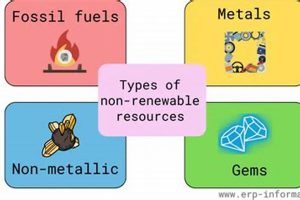
Renewable assets replenish naturally over a human timescale, ensuring continuous availability when managed responsibly. Non-renewable assets, conversely, exist in finite quantities and cannot be replenished once depleted.
Question 2: How does solar irradiance affect the sustainability of photovoltaic energy production?
Solar irradiance directly impacts the efficiency of photovoltaic conversion. Higher levels of irradiance yield greater electrical power output, optimizing energy production and minimizing resource requirements per unit of energy generated.
Question 3: Why is biomass productivity considered a critical factor in sustainable biofuel production?
Biomass productivity dictates the rate at which organic matter is generated. High productivity ensures a sustainable supply of feedstock for biofuel production, minimizing competition with food crops and reducing land-use impacts.
Question 4: What role does the hydrological cycle play in sustaining hydropower generation?
The hydrological cycle continuously replenishes water resources essential for hydropower. A stable and well-managed cycle ensures consistent water flow, enabling reliable energy production from hydroelectric facilities.
Question 5: How does the geothermal gradient influence the feasibility of geothermal energy projects?
The geothermal gradient determines the accessibility and temperature of subsurface heat resources. Steeper gradients facilitate easier access to high-temperature resources, enhancing the viability and reducing the costs of geothermal power generation.
Question 6: What are the primary environmental concerns associated with tidal energy extraction?
Tidal energy extraction can potentially alter tidal flow patterns, disrupt sediment transport, and impact marine ecosystems. Thorough environmental impact assessments and careful site selection are crucial to mitigate these risks.
These elements play a crucial role in achieving a sustainable future, proper management of them is essential.
The succeeding section will summarize the key principles discussed, providing a comprehensive overview of examples of renewable natural resources and their implications for sustainable development.
Conclusion
The exploration of examples of renewable natural resources underscores their indispensable role in shaping a sustainable future. From the inexhaustible power of solar irradiance and the kinetic energy of wind to the cyclical processes of the hydrological cycle and the Earth’s internal geothermal heat, these assets offer alternatives to finite fossil fuels. Furthermore, sustainably managed biomass, the predictable forces of tidal variation, and the persistent motion of ocean waves present avenues for diversified energy portfolios and reduced environmental impact.
The responsible development and utilization of these naturally replenished assets are paramount. Technological innovation, strategic resource management, and rigorous environmental safeguards are essential for maximizing their potential while minimizing ecological disruption. The future hinges on a commitment to harnessing these resources effectively, ensuring their enduring contribution to global energy needs and a more sustainable planet for subsequent generations. Continued research and investment are crucial to unlock the full capabilities of these assets and secure a resilient energy future.
![Guide to What Energy Resources Are Renewable [+Future] | Renewable Energy Solutions for a Sustainable Future | Clean & Green Power](https://pplrenewableenergy.com/wp-content/uploads/2026/03/th-516-300x200.jpg "Guide to What Energy Resources Are Renewable [+Future] Renewable Energy Solutions for a Sustainable Future | Clean & Green Power")