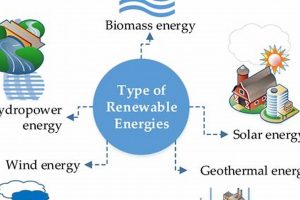
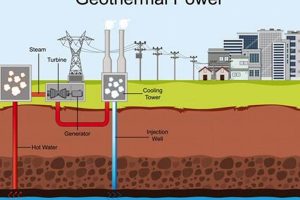
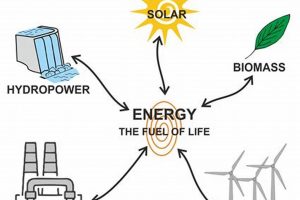
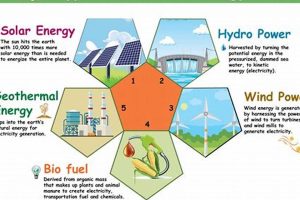
Sources of power that naturally replenish, such as solar, wind, geothermal, hydro, and biomass, offer alternatives to finite fossil fuels. These energy types are characterized by their ability to be replenished within a human lifetime, mitigating depletion concerns. For instance, photovoltaic cells convert sunlight into electricity, while wind turbines harness kinetic energy from moving air masses. Geothermal plants utilize heat from the Earth’s interior, and hydroelectric dams leverage the potential energy of water stored at higher elevations.
The adoption of these sustainable power options is crucial for mitigating climate change, reducing greenhouse gas emissions, and enhancing energy security. Historically, societies have relied on conventional fuels, leading to environmental degradation and geopolitical vulnerabilities. Shifting towards these alternative solutions provides long-term environmental advantages, diminishes reliance on finite resources, and fosters local job creation in manufacturing, installation, and maintenance sectors. Moreover, distributed generation through smaller-scale systems enhances grid resilience.
The subsequent sections will delve into the specific characteristics, advantages, disadvantages, technological advancements, and economic considerations associated with the different types of these sustainable power options. Analysis will encompass the environmental impacts, cost-effectiveness, and scalability potential of each technology. Furthermore, it will explore the policy frameworks and incentives that promote their deployment and integration into existing energy infrastructure.
Deployment Strategies for Sustainable Energy Infrastructure
The following guidelines offer insight into the effective implementation of alternative energy systems for diverse applications. These tips are designed to optimize performance, minimize environmental impact, and ensure long-term economic viability.
Tip 1: Conduct Thorough Resource Assessment: Prior to investment, conduct comprehensive assessments of the renewable energy resource potential at the installation site. For solar projects, this includes evaluating solar irradiance levels and shading patterns. For wind energy, analyze wind speed and direction data over a multi-year period. For geothermal applications, assess the availability and temperature of subsurface thermal resources.
Tip 2: Optimize System Sizing and Configuration: Design the renewable energy system to match the specific energy demand profile of the application. Oversizing the system can lead to wasted energy and unnecessary capital expenditures. Consider incorporating energy storage solutions, such as batteries or thermal storage, to enhance system reliability and grid stability.
Tip 3: Integrate Smart Grid Technologies: Implement smart grid technologies to enable efficient integration of renewable energy sources into the existing electrical grid. These technologies include advanced metering infrastructure (AMI), demand response programs, and real-time monitoring and control systems. This integration enhances grid flexibility and reduces curtailment of renewable energy generation.
Tip 4: Prioritize Environmental Sustainability: Select renewable energy technologies that minimize environmental impacts throughout their lifecycle. This includes considering the environmental footprint of manufacturing, installation, operation, and decommissioning. Implement mitigation measures to minimize impacts on wildlife, water resources, and land use.
Tip 5: Secure Favorable Financing and Incentives: Explore available government incentives, tax credits, and financing options to reduce the upfront cost of renewable energy projects. These incentives can significantly improve the economic viability of these systems and accelerate their deployment. Develop a robust financial model that accounts for long-term operating costs and revenue streams.
Tip 6: Ensure Proper Operation and Maintenance: Implement a comprehensive operation and maintenance (O&M) program to ensure the long-term performance and reliability of the renewable energy system. Regular inspections, preventative maintenance, and prompt repairs are essential for maximizing energy production and minimizing downtime. Skilled technicians and remote monitoring capabilities are crucial for effective O&M.
Tip 7: Promote Public Awareness and Education: Educate the public about the benefits of the renewable energy system and its impact on the environment and the economy. Engage with stakeholders to address concerns and foster support for alternative energy development. Transparency and open communication are essential for building trust and acceptance.
Adherence to these guidelines will promote effective deployment, ultimately yielding enhanced energy security, reduced emissions, and a more sustainable energy future.
The subsequent section will consider challenges associated with widespread use and recommendations for mitigating those challenges.
1. Resource Availability

The accessibility and abundance of a particular energy source significantly dictate the practicality and scalability of different alternative energy technologies. The geographic distribution of solar irradiance, for instance, directly influences the viability of photovoltaic power generation in specific regions. Areas with consistently high solar irradiance levels are inherently more suitable for large-scale solar power deployment. Similarly, consistent high wind speed regimes are critical for the effective operation of wind farms. These conditions determine the energy conversion potential and subsequent economic feasibility of such projects. The absence of sufficient resource intensity presents a fundamental barrier to the implementation of specific alternative energy systems, regardless of technological advancements.
Geothermal energy relies on subsurface thermal gradients, which vary significantly across the globe. Regions with accessible high-temperature geothermal reservoirs, such as Iceland or the western United States, are uniquely positioned to leverage geothermal power for electricity generation and direct heating applications. Hydroelectric power is similarly constrained by hydrological factors, specifically the availability of suitable river systems and topographic features conducive to dam construction. Biomass energy, derived from organic matter, depends on agricultural productivity and forestry practices within a given region. The logistical challenges of transporting biomass over long distances can significantly impact its economic viability.
In summary, resource availability forms the bedrock of the viability equation for all alternative energy technologies. Projects must be strategically located to capitalize on abundant and accessible natural resources to ensure cost-effectiveness and long-term operational success. Understanding these geographical constraints is crucial for informed decision-making in energy infrastructure development and policy planning, as limitations in resource accessibility can hinder deployment and impact the overall effectiveness of transitioning to a sustainable energy mix.
2. Technological Efficiency

Technological efficiency plays a pivotal role in determining the economic viability and overall effectiveness of deploying alternative energy systems. It represents the capacity of a technology to convert an energy resource into usable electricity or heat. Improved efficiency translates directly into higher energy output for a given input, reducing both operating costs and the environmental footprint of the generation process.
- Photovoltaic Cell Conversion Rates
The efficiency of photovoltaic (PV) cells, which convert sunlight into electricity, is a critical factor in solar energy production. First-generation silicon-based PV cells typically achieve efficiencies in the range of 15-20%. Newer technologies, such as thin-film and multi-junction cells, can exhibit higher efficiencies, sometimes exceeding 40% in laboratory settings. Higher PV cell efficiency reduces the land area required for solar farms and lowers the per-kilowatt-hour cost of electricity generated. However, the cost of higher efficiency PV material often offsets these benefits. Continuous research focuses on improving efficiency and reducing the cost.
- Wind Turbine Power Coefficients
Wind turbine efficiency is characterized by its power coefficient (Cp), which represents the fraction of wind energy that a turbine can effectively convert into mechanical energy. The Betz limit, a theoretical maximum, dictates that no turbine can convert more than 59.3% of the kinetic energy in wind into mechanical energy. Modern turbines can reach Cp values of 40-50%. Improving blade design, yaw control systems, and generator technology enables higher power coefficients and increased electricity generation from wind resources. These improvements allow turbines to operate more efficiently in a wider range of wind conditions, increasing electricity output at lower average wind speeds.
- Geothermal Plant Capacity Factors
Geothermal power plant efficiency is often expressed as its capacity factor, which reflects the percentage of time the plant operates at its maximum power output. Geothermal plants that tap into high-temperature, high-enthalpy reservoirs can achieve high capacity factors, often exceeding 90%, due to the consistent and reliable nature of the geothermal resource. Enhanced Geothermal Systems (EGS), which extract heat from dry rock formations, present technological challenges in terms of reservoir creation and heat extraction efficiency. Advancements in drilling techniques, hydraulic fracturing, and heat transfer fluids are essential for improving the efficiency and economic viability of EGS plants.
- Hydroelectric Turbine Design
Hydroelectric power generation depends on the efficiency of hydraulic turbines in converting the potential energy of water into mechanical energy, which in turn drives generators to produce electricity. The design of the turbine runner (the rotating part of the turbine) is critical for maximizing efficiency. Different turbine designs, such as Francis, Kaplan, and Pelton turbines, are optimized for specific head (water pressure) and flow rate conditions. Improvements in turbine design, materials, and control systems can enhance efficiency and reduce cavitation, erosion, and other forms of wear and tear, improving the overall lifespan and performance of hydroelectric plants.
In conclusion, technological efficiency stands as a critical driver of the adoption and scaling of alternative energy technologies. Continuous advancements in materials science, engineering design, and control systems are essential for improving the conversion rates, capacity factors, and overall performance of solar, wind, geothermal, and hydroelectric power generation systems. The pursuit of higher efficiency leads to lower energy production costs, reduces environmental impact, and enhances the competitiveness of renewable energy in the global energy market. Further developments could lead to unforeseen adoption of various power solutions.
3. Economic Viability

The economic viability of alternative energy systems is a pivotal determinant in their widespread adoption and integration into the global energy landscape. The cost-effectiveness of these technologies, relative to conventional fossil fuels, directly influences investment decisions and the pace of transition to a sustainable energy future. The economic viability is not solely determined by upfront costs but also operational costs, energy market dynamics, and regulatory frameworks.
- Levelized Cost of Energy (LCOE)
LCOE serves as a critical metric for comparing the cost-effectiveness of different energy generation technologies. It encompasses the total cost of building and operating a power plant over its lifetime, divided by the total energy produced. Decreasing LCOE values for solar, wind, and other sustainable resources have significantly enhanced their competitiveness relative to coal and natural gas. For instance, large-scale solar and wind projects in regions with abundant resources now boast LCOE values comparable to, or even lower than, conventional power plants, without considering externalized environmental costs. Policy incentives, economies of scale, and technological advancements continue to drive down LCOE values, further bolstering their economic appeal.
- Incentive Structures and Policy Support
Government policies and incentive structures exert a substantial influence on the economic viability of sustainable energy technologies. Subsidies, tax credits, feed-in tariffs, and carbon pricing mechanisms can significantly enhance the economic attractiveness of these systems by offsetting upfront costs and providing revenue streams. For instance, production tax credits for wind energy have spurred substantial investment in wind power capacity in the United States. Carbon pricing mechanisms, such as cap-and-trade systems or carbon taxes, can internalize the environmental costs of fossil fuels, making resources relatively more competitive. The effectiveness of these policies hinges on their stability, predictability, and alignment with long-term energy goals.
- Grid Parity and Market Integration
Grid parity, the point at which sustainable energy resources can generate electricity at a cost equal to or lower than that of electricity purchased from the grid, is a crucial milestone in their market integration. Achieving grid parity signifies that these resources can compete directly with conventional power plants without relying on subsidies or incentives. As solar and wind costs continue to decline, grid parity is becoming increasingly common in many regions. The ability to integrate these resources into the existing electricity grid effectively is also essential for their economic viability. Factors such as grid capacity, transmission infrastructure, and energy storage solutions play a critical role in facilitating the integration and ensuring grid stability.
- Job Creation and Economic Development
The alternative energy sector presents significant opportunities for job creation and economic development. The manufacturing, installation, operation, and maintenance of these technologies generate employment across a range of skill levels. Investments in sustainable energy projects can stimulate economic growth, particularly in rural and underserved communities. For instance, the development of large-scale wind farms and solar plants can create jobs in manufacturing, construction, and engineering, as well as boost local economies through increased property tax revenues and business activity. The economic benefits of sector development contribute to the overall viability of these technologies and foster public support for their deployment.
In summation, the economic viability of these resources is a multifaceted consideration encompassing LCOE, policy support, grid integration, and economic development impacts. These aspects are not independent but intertwined, shaping the competitive landscape and influencing investment decisions in the energy sector. As costs continue to fall, supportive policies remain in place, and grid infrastructure evolves, it is positioned to play an increasingly prominent role in meeting global energy demands.
4. Environmental Impact

The integration of alternative energy sources aims to mitigate the adverse effects of traditional fossil fuels on the environment. While often considered environmentally benign, these power options are not without ecological implications. A comprehensive assessment of their environmental footprint is crucial for making informed decisions about energy policy and infrastructure development.
- Land Use Requirements
Large-scale solar and wind farms necessitate significant land areas for deployment, potentially leading to habitat loss, fragmentation, and displacement of wildlife. The construction of hydroelectric dams can inundate vast tracts of land, altering river ecosystems and displacing local communities. Biomass energy production may compete with food production, leading to deforestation or conversion of natural habitats to agricultural land. Careful site selection and mitigation strategies are essential to minimize the ecological impacts associated with land use.
- Wildlife Impacts
Wind turbines can pose a threat to birds and bats, resulting in mortality through collisions. Solar power plants can cause harm to wildlife through habitat disruption, displacement, and thermal impacts. Hydropower dams can impede fish migration, alter river flows, and affect aquatic habitats. Mitigation measures, such as turbine siting guidelines, bird deterrent systems, and fish passage structures, are necessary to minimize the impacts on wildlife populations. Rigorous environmental impact assessments are crucial for identifying and addressing potential risks.
- Resource Extraction and Manufacturing
The production of alternative energy technologies relies on the extraction of raw materials, such as rare earth elements for wind turbines and silicon for solar panels. Mining and processing these materials can lead to habitat destruction, water pollution, and soil contamination. The manufacturing of these technologies also requires energy and resources, contributing to greenhouse gas emissions and waste generation. Sustainable sourcing practices and responsible manufacturing processes are essential to minimize the environmental footprint associated with the production of alternative energy equipment.
- Life Cycle Emissions
Although they generate minimal greenhouse gas emissions during operation, alternative energy systems have life cycle emissions associated with their manufacturing, transportation, installation, and decommissioning. The life cycle emissions can vary depending on the specific technology, manufacturing processes, and energy sources used in production. Conducting life cycle assessments is crucial for comprehensively evaluating the environmental impacts of these systems and identifying opportunities for emission reductions. The promotion of recycling and end-of-life management strategies can further reduce the life cycle emissions.
The deployment of sustainable energy sources offers substantial environmental benefits compared to fossil fuels, the ecological impacts must be carefully considered and mitigated. Comprehensive environmental assessments, responsible sourcing practices, and sustainable operational strategies are essential for minimizing the footprint and maximizing the environmental advantages of this move to sustainable power sources.
5. Scalability Potential
Scalability potential directly determines the capacity of varied sustainable power alternatives to meet substantial portions of global energy demand. The practical impact of an energy source, irrespective of its sustainability credentials, is limited if it cannot be implemented at a scale sufficient to meaningfully displace conventional energy production. Solar photovoltaic technology exemplifies this principle. Its modular nature lends itself well to distributed generation, such as rooftop installations, and large-scale utility plants. This inherent flexibility has facilitated rapid growth in solar energy capacity worldwide, demonstrating a substantial scalability potential. Conversely, geothermal energy, while possessing considerable long-term potential, is geographically constrained to regions with accessible geothermal resources, thus limiting its scalability on a global scale, though targeted deployments can be highly effective.
Wind power’s scalability is influenced by several factors, including land availability, wind resource quality, and grid infrastructure capacity. Offshore wind farms address land use concerns but require more complex engineering and higher capital investments. Enhanced grid infrastructure, including high-voltage transmission lines, is crucial for transporting wind energy from resource-rich regions to population centers. Biomass energy faces scalability challenges due to land use competition with food production, sustainability concerns regarding feedstock sourcing, and potential air quality impacts from combustion. Advanced biofuel technologies, such as those derived from algae or non-food crops, offer a pathway to improve the scalability of biomass energy while minimizing its environmental footprint. Hydropower, while a mature renewable technology, faces constraints due to limited suitable sites for new large-scale dams and environmental concerns associated with dam construction.
Ultimately, the ability of these resources to contribute significantly to the global energy mix hinges on overcoming scalability barriers. This involves technological innovation, policy support, infrastructure development, and sustainable resource management. The assessment of scalability potential must consider not only the technical feasibility of expanding production but also the environmental, social, and economic implications of large-scale deployment. Overcoming limitations in the various approaches will involve a multi-pronged approach that encompasses technology development, supportive regulations, and strategic infrastructure investments. These efforts, working in concert, are essential to unlocking the potential for these resources to meet a substantial share of global energy needs.
6. Policy Support

Government and regulatory frameworks exert a decisive influence on the development, deployment, and market integration of sustainable energy technologies. Policy support mechanisms shape the economic viability, investment climate, and competitive landscape, thereby determining the extent to which these resources can effectively contribute to a sustainable energy mix. A consistent and well-designed policy environment is crucial for overcoming market barriers and accelerating the transition to a low-carbon energy economy.
- Feed-in Tariffs (FITs)
FITs guarantee a fixed price for each unit of renewable electricity fed into the grid, providing long-term revenue certainty for project developers. This mechanism incentivizes investment in these resources by reducing financial risk and ensuring predictable returns. Germany’s Energiewende, for example, initially relied heavily on FITs to stimulate rapid growth in solar and wind power capacity. The success of FITs depends on setting appropriate tariff levels that reflect the costs of generation while avoiding excessive subsidies. Adaptations may be required to address changing technology costs and market conditions.
- Renewable Portfolio Standards (RPS)
RPS mandates require electricity providers to source a specified percentage of their power from renewable energy sources by a target date. This creates a demand-driven market for sustainable energy certificates, driving investment in new generation capacity. States in the United States, such as California and New York, have implemented ambitious RPS targets, which have spurred significant deployment of solar, wind, and other alternative energy technologies. The effectiveness of RPS depends on the stringency of the targets, the availability of renewable resources, and the design of the credit trading mechanism.
- Tax Incentives and Subsidies
Tax credits, rebates, and direct subsidies can reduce the upfront costs and improve the economic viability of renewable energy projects. Investment tax credits (ITCs) and production tax credits (PTCs) provide financial benefits to developers, encouraging investment in solar, wind, and other technologies. Subsidies can also support research and development efforts, fostering innovation and reducing technology costs. The effectiveness of tax incentives and subsidies depends on their magnitude, duration, and accessibility. Sunset clauses and phase-out schedules may be necessary to ensure fiscal responsibility and promote market-based competition.
- Carbon Pricing Mechanisms
Carbon pricing mechanisms, such as carbon taxes and cap-and-trade systems, internalize the environmental costs of fossil fuels, making renewable energy technologies more economically competitive. A carbon tax imposes a direct levy on carbon emissions, while a cap-and-trade system sets a limit on overall emissions and allows companies to trade emission allowances. Carbon pricing mechanisms can incentivize investment in clean energy technologies by increasing the relative cost of fossil fuels. The effectiveness of carbon pricing depends on the level of the carbon price, the scope of coverage, and the presence of complementary policies.
The effectiveness of policy support mechanisms hinges on their design, implementation, and consistency. Well-designed policies can effectively overcome market barriers, reduce technology costs, and accelerate the transition to a sustainable energy future. Conversely, poorly designed or inconsistent policies can create uncertainty, discourage investment, and hinder the deployment of this technologies. A stable and predictable policy environment is essential for fostering long-term investment and driving innovation in the renewable energy sector.
7. Energy Storage

The intermittent nature of certain renewable energy sources, notably solar and wind, presents a significant challenge to grid stability and reliable power supply. Energy storage systems mitigate this variability by capturing excess energy generated during periods of high production and releasing it during periods of low production or high demand. This capability is crucial for integrating substantial quantities of variable renewable energy into the existing energy infrastructure. Without effective storage solutions, the full potential of solar and wind power cannot be realized, and grid operators face challenges in maintaining a consistent balance between supply and demand.
Various energy storage technologies are employed to address this intermittency. Lithium-ion batteries, for instance, are widely used for grid-scale storage due to their relatively high energy density and rapid response times. These batteries are increasingly deployed alongside solar and wind farms to smooth output fluctuations and provide ancillary services to the grid. Pumped hydro storage, another mature technology, involves pumping water to a higher elevation during periods of surplus energy and releasing it through turbines to generate electricity during periods of peak demand. Thermal energy storage systems store heat or cold for later use in heating or cooling applications. For example, solar thermal power plants often incorporate thermal storage to extend their operating hours beyond daylight.
The effective deployment of energy storage technologies is essential for maximizing the utilization of these renewable power sources and ensuring a reliable, low-carbon energy supply. The continued development and cost reduction of energy storage solutions are critical for enabling a transition towards a more sustainable and resilient energy system. Innovation in battery technology, alternative storage methods, and smart grid integration will further enhance the value and versatility of energy storage in the context of a renewable-dominated power grid. The role of this storage will continue to grow as adoption grows in the power sector.
Frequently Asked Questions
The subsequent section addresses common inquiries concerning the application and implications of alternative, naturally replenishing power options.
Question 1: What are the primary examples of sustainable energy sources?
The main kinds include sunlight, wind, geothermal heat, water movement (hydropower), and biomass. These resources are characterized by their ability to be naturally replenished within a human timescale, thus mitigating depletion concerns.
Question 2: How can implementing these sustainable options impact greenhouse gas emissions?
The substitution of conventional fossil fuels with these resources leads to a substantial reduction in greenhouse gas emissions. This is due to the absence, or significant reduction, of carbon dioxide and other pollutants released during electricity generation and usage.
Question 3: Are these sustainable energy solutions universally applicable across all geographic locations?
The viability of specific sustainable energy technologies is contingent upon regional factors, climatic conditions, and resource accessibility. For example, solar power is most efficient in regions with high solar irradiance. Wind power relies on consistent wind speeds, while geothermal energy depends on subsurface thermal gradients.
Question 4: What role does energy storage play in ensuring the reliability of these resources?
Due to the intermittent nature of resources like solar and wind, energy storage systems are critical for maintaining a consistent power supply. Technologies such as batteries, pumped hydro, and thermal storage capture excess energy during peak generation periods for release during periods of low production or high demand.
Question 5: What are the main hurdles to the widespread adoption of these resources?
Challenges include high upfront costs, intermittency, land use requirements, infrastructure limitations, and regulatory barriers. Overcoming these hurdles necessitates technological advancements, supportive policies, and strategic investments in grid modernization.
Question 6: How do government policies influence the deployment and expansion of these systems?
Government policies play a pivotal role through incentives like feed-in tariffs, tax credits, renewable portfolio standards, and carbon pricing mechanisms. These policies stimulate investment, reduce financial risks, and create a stable market environment for these technologies.
In essence, the strategic implementation of these renewable power options hinges on a holistic approach that considers technological feasibility, economic viability, environmental impact, and supportive policy frameworks. These diverse sources offer a sustainable pathway to meeting global energy demands while mitigating the detrimental effects of traditional energy sources.
The subsequent section will consider case studies of successful “various renewable energy resources” adoption across the globe.
Conclusion
This exploration has detailed the diverse landscape of “various renewable energy resources,” emphasizing their individual characteristics, benefits, and limitations. From solar and wind to geothermal and hydropower, these energy sources offer viable alternatives to fossil fuels, promising reduced greenhouse gas emissions and enhanced energy security. Successful integration requires careful consideration of resource availability, technological efficiency, economic viability, environmental impact, scalability potential, policy support, and energy storage solutions. No single resource is a panacea; rather, a diversified approach tailored to regional conditions is paramount.
The path toward a sustainable energy future necessitates sustained investment, technological innovation, and informed policy decisions. The challenges are substantial, but the potential rewardsa cleaner environment, a more resilient energy infrastructure, and a more sustainable economyare immeasurable. Continued research, development, and deployment of “various renewable energy resources” are crucial for ensuring a stable and prosperous future for generations to come.