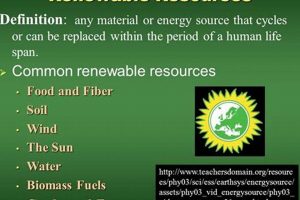
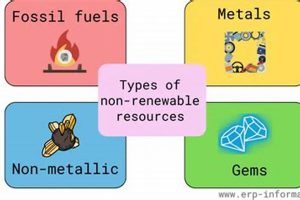
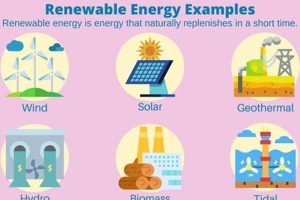
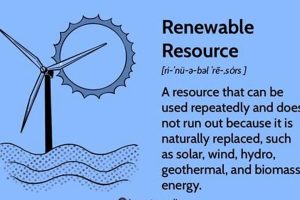
Systems and technologies that draw power from naturally replenishing sources represent a critical component of sustainable energy practices. Examples include solar panels converting sunlight into electricity, wind turbines harnessing kinetic energy, hydroelectric dams utilizing the force of moving water, geothermal plants tapping into the Earth’s internal heat, and biomass power plants using organic matter as fuel. These methodologies stand in contrast to those relying on finite fossil fuels or nuclear fission.
The adoption of power generation methods drawing from inexhaustible inputs offers substantial advantages. Reduced reliance on non-renewable sources contributes to decreased greenhouse gas emissions, mitigating climate change impacts. Furthermore, the geographic distribution of these resources can enhance energy security, lessening dependence on politically volatile regions. Historically, the development and refinement of these technologies have been driven by both environmental concerns and the pursuit of cost-effective alternatives to traditional energy production.
The following discussion delves into the specific applications and advancements within each of these sustainable energy sectors. It explores the technological innovations driving increased efficiency and reduced costs, while also addressing the challenges associated with widespread implementation and integration into existing energy grids. Furthermore, it analyzes the economic and environmental implications of transitioning towards a predominantly sustainable energy infrastructure.
Optimizing Systems Powered by Renewable Sources
The following guidance focuses on maximizing the efficiency and effectiveness of technologies powered by perpetually available inputs, ensuring long-term sustainability and resource utilization.
Tip 1: Prioritize Energy Efficiency. Reduction in overall energy demand minimizes the requirements from any source, including renewable ones. Conduct energy audits and implement measures to reduce consumption before increasing generation capacity.
Tip 2: Implement Smart Grid Technologies. Smart grids allow for optimized distribution and storage of generated power. Integration of intelligent systems ensures that the flow of electricity is managed effectively, reducing waste and improving overall grid stability.
Tip 3: Diversify Renewable Energy Portfolio. Relying on a single source carries inherent risks. Combining solar, wind, geothermal, and hydroelectric power enhances resilience and provides a more stable energy supply, mitigating fluctuations due to weather or other environmental factors.
Tip 4: Invest in Energy Storage Solutions. Intermittency is a primary challenge. Battery storage, pumped hydro storage, and other energy storage technologies are vital for capturing excess power during peak production and releasing it when demand is high, but renewable generation is low.
Tip 5: Optimize Site Selection. Careful consideration of location is paramount. Solar installations should be positioned for maximum sunlight exposure, wind turbines should be placed in areas with consistent wind speeds, and geothermal plants should be situated near accessible geothermal resources.
Tip 6: Ensure Proper Maintenance and Monitoring. Regular inspections and maintenance are crucial for maintaining optimal performance and preventing costly repairs. Implementing remote monitoring systems allows for early detection of potential issues, minimizing downtime and maximizing energy production.
Tip 7: Develop Policy Frameworks Supportive of Renewable Resources. Governments should adopt policies that encourage development and adoption of renewable resources. Some effective strategies include tax incentives, subsidies, and streamlined permitting processes.
Adhering to these recommendations contributes to a more robust, reliable, and environmentally responsible energy system, lessening reliance on finite resources and fostering a sustainable future.
The subsequent section will explore specific case studies demonstrating successful implementation of these strategies in various contexts, providing tangible examples of the benefits achievable through effective planning and execution.
1. Inexhaustible Resource Availability

The characteristic of inexhaustible resource availability forms the bedrock upon which power generation from renewable sources is built. Without this fundamental attribute, the concept of sustainable energy production would be rendered untenable. The long-term viability of any system drawing power from a renewable source hinges directly on the continuous and virtually unlimited nature of its primary input.
- Continuous Replenishment
The key facet lies in the natural process of continuous replenishment, ensuring the long-term sustainability of the energy source. Solar radiation, wind patterns, and geothermal heat are continually renewed by natural processes. This ongoing replenishment differentiates renewable resources from finite fossil fuels, which are depleted upon extraction. The stability and predictability of these cycles directly impact the planning and investment decisions for renewable energy projects.
- Geographic Distribution Impact
While fundamentally inexhaustible, the practical availability of these resources varies significantly based on geographic location. Regions with high solar irradiance are better suited for solar energy production, while areas with consistent wind patterns favor wind power. The specific geographic distribution of a resource dictates the feasibility and cost-effectiveness of its exploitation, influencing regional energy strategies and infrastructure development.
- Technology and Access Limitations
Despite resource abundance, practical access is limited by the available technology and infrastructure. Even where a renewable source is theoretically abundant, conversion to usable energy requires specialized equipment and efficient processes. Investments in research, development, and deployment of advanced technologies are crucial to unlock the full potential of inexhaustible resources, making energy production more efficient and accessible.
- Environmental Considerations
The extraction or utilization of inexhaustible resources is not entirely devoid of environmental impact. Hydroelectric dams, while utilizing a renewable water cycle, can alter river ecosystems. Wind turbines can pose risks to avian populations. Sustainable development necessitates careful consideration of these potential impacts, implementing mitigation strategies to minimize harm to the environment and surrounding ecosystems.
In sum, the attribute of inexhaustible resource availability is both a promise and a challenge for “what gets its energy from a renewable resource”. It ensures the potential for long-term sustainable energy production but demands careful planning, technological innovation, and environmental stewardship to effectively harness this potential without causing undue harm.
2. Environmental impact mitigation

The reduction of adverse environmental effects constitutes a primary driver for the increasing adoption of systems powered by renewable sources. These methodologies, in contrast to conventional fossil fuel-based systems, present opportunities to significantly decrease pollution and other detrimental environmental outcomes.
- Reduced Greenhouse Gas Emissions
Fossil fuel combustion results in substantial emissions of greenhouse gases, primary contributors to climate change. Shifting energy production to systems deriving power from continuously available sources drastically curtails these emissions. Solar, wind, and geothermal technologies, during operation, produce negligible greenhouse gases, mitigating the atmospheric accumulation of carbon dioxide and other pollutants.
- Decreased Air and Water Pollution
Traditional power plants, fueled by coal or natural gas, release harmful pollutants into the air and water. These pollutants include particulate matter, sulfur dioxide, nitrogen oxides, and heavy metals, contributing to respiratory illnesses, acid rain, and water contamination. Renewable energy sources, with the exception of biomass combustion, do not produce these pollutants during energy generation. This results in cleaner air and water resources, improving public health and ecosystem integrity.
- Minimized Land Use Impacts
While large-scale renewable energy projects can require significant land areas, their overall land-use impact is often less severe than that of fossil fuel extraction and transportation. Coal mining, oil drilling, and pipeline construction disrupt ecosystems and can lead to habitat destruction and soil erosion. Solar farms and wind turbine installations, though requiring land, can often coexist with agricultural activities or be sited on previously disturbed land. Furthermore, the environmental impact can be minimized through careful planning and site selection.
- Lowered Water Consumption
Many conventional power plants rely on substantial quantities of water for cooling purposes. This water consumption can strain local water resources, particularly in arid or semi-arid regions. Renewable energy technologies, such as solar photovoltaic and wind power, generally have significantly lower water requirements than fossil fuel or nuclear power plants, mitigating pressure on water resources.
The demonstrated reductions in greenhouse gas emissions, air and water pollution, land use impacts, and water consumption associated with energy systems leveraging perpetually available resources underscore their critical role in environmental stewardship. The integration of these technologies into energy infrastructure represents a vital strategy for achieving a sustainable and environmentally responsible energy future.
3. Technological advancement imperative

Continuous progress in technology is a prerequisite for the widespread and effective utilization of resources categorized as “what gets its energy from a renewable resource.” Efficiency, cost-effectiveness, and reliability are directly correlated with advancements in materials science, engineering, and energy storage.
- Enhanced Energy Conversion Efficiency
Improvements in photovoltaic cell design, wind turbine blade aerodynamics, and geothermal energy extraction methods lead to greater energy output from the same resource input. For example, the development of perovskite solar cells promises higher efficiencies than traditional silicon-based cells. Similarly, advancements in wind turbine blade design are enabling the capture of more energy from lower wind speeds. Increased conversion efficiencies directly translate to reduced costs per unit of energy produced.
- Advanced Energy Storage Solutions
The intermittent nature of many resources demands effective energy storage solutions. Development of advanced battery technologies, such as lithium-ion, sodium-ion, and solid-state batteries, is crucial for storing energy generated during peak production periods and releasing it when demand exceeds supply. Pumped hydro storage and compressed air energy storage are additional technologies that contribute to grid stabilization and reliability. The evolution of energy storage enables greater integration of resources into existing grids.
- Smart Grid Integration Technologies
Integrating renewable energy sources into existing electrical grids requires intelligent management systems that can handle fluctuating energy inputs and maintain grid stability. Smart grid technologies, including advanced sensors, communication networks, and control algorithms, enable real-time monitoring and control of energy flows. These systems enhance grid resilience and allow for the efficient distribution of power across vast networks.
- Materials Science Innovations
The development of new materials with enhanced properties is vital for improving the performance and durability of renewable energy technologies. Corrosion-resistant alloys for geothermal plants, lightweight composites for wind turbine blades, and transparent conductive oxides for solar cells are examples of materials innovations that contribute to increased efficiency and reduced maintenance costs. Materials science plays a key role in extending the lifespan and improving the overall economic viability of renewable energy systems.
These facets of technological advancement are indispensable for realizing the full potential of resources categorized as “what gets its energy from a renewable resource.” Continuous investment in research and development is necessary to overcome technical challenges, reduce costs, and ensure the long-term sustainability of energy systems relying on renewable inputs.
4. Decentralized power potential

The inherent nature of certain renewable energy sources lends itself readily to decentralized power generation. Unlike conventional power plants that rely on centralized infrastructure and long-distance transmission lines, systems powered by perpetually available inputs can be deployed at or near the point of consumption. Solar photovoltaic panels on rooftops, small-scale wind turbines in rural areas, and geothermal heat pumps for individual buildings exemplify this distributed energy model. The cause is the resource’s widespread availability; the effect is the possibility of locally generated power, reducing transmission losses and enhancing energy independence. This potential is of critical importance, permitting communities and individuals to become active participants in energy production, rather than passive consumers.
Microgrids offer a practical application of decentralized power potential. These localized energy networks, often incorporating resources, can operate independently or in conjunction with the main grid. They enhance resilience by providing backup power during grid outages and allow for greater control over energy costs. Numerous communities in remote areas and islands have adopted microgrids based on wind and solar energy, reducing their dependence on expensive and unreliable fossil fuel shipments. Industrial facilities also leverage decentralized resources, such as combined heat and power systems fueled by biomass, to improve energy efficiency and reduce their carbon footprint.
In summary, the decentralized power potential inherent in many energy resources fosters a more resilient, equitable, and sustainable energy system. By enabling localized generation and empowering communities to control their energy destiny, it represents a significant departure from the traditional centralized model. Challenges remain in terms of grid integration and regulatory frameworks, but the benefits of decentralized generation are increasingly clear, making it a crucial component of the ongoing transition to a renewable energy-based economy.
5. Long-term cost competitiveness

The connection between long-term cost competitiveness and systems powered by resources lies in the ongoing reduction in the levelized cost of energy (LCOE) associated with these technologies. The LCOE, a measure of the average net present cost of electricity generation for a plant over its lifetime, has declined dramatically for solar, wind, and other renewable sources in recent years. This decline is primarily attributable to technological advancements, economies of scale, and improved manufacturing processes. As the initial capital costs of renewable energy systems decrease and their operating lifespans increase, their long-term cost competitiveness relative to fossil fuel-based power plants improves. This trend makes renewable energy an increasingly attractive option for utilities, businesses, and consumers, driving further investment and deployment.
The importance of long-term cost competitiveness as a component of systems that is exemplified by the case of solar power. Solar photovoltaic (PV) technology has experienced a precipitous drop in price over the past decade, becoming cost-competitive with coal and natural gas in many regions. Utility-scale solar projects are now routinely bid at prices below those of new fossil fuel plants, even without subsidies. This price advantage, coupled with the environmental benefits of solar energy, is driving its rapid adoption worldwide. Wind power has followed a similar trajectory, becoming increasingly competitive with conventional sources. These real-life examples demonstrate that long-term cost competitiveness is not just a theoretical concept but a tangible reality that is transforming the energy landscape. The practical significance of this understanding is that it allows policymakers and investors to make informed decisions about energy investments, prioritizing those that offer the greatest long-term economic and environmental benefits. However, the practical implementation encounters barriers in the form of subsidies for fossil fuels and the intermittency of sources of energy.
In summary, the interplay between long-term cost competitiveness and systems that operate on continually renewing resource streams is a crucial factor in the ongoing transition to a sustainable energy economy. While challenges remain in integrating these intermittent sources into existing grids and addressing legacy subsidies for fossil fuels, the long-term economic advantages of renewable energy are becoming increasingly clear. Continued technological innovation and policy support will be essential to further reduce costs and accelerate the deployment of renewable energy technologies, ensuring a cleaner, more affordable, and more secure energy future.
Frequently Asked Questions
The following questions and answers address prevalent concerns regarding the generation of power from sources naturally replenished. These responses aim to provide clarity on key aspects of these systems.
Question 1: How do electricity generation costs using resources compare with those of traditional power plants?
The levelized cost of energy (LCOE) from technologies such as solar and wind has decreased significantly in recent years, becoming competitive with, or even lower than, that of fossil fuel-based plants in many locations. Factors such as technology advancements, economies of scale, and fuel price volatility influence this comparison.
Question 2: What strategies are used to address the intermittency of solar and wind energy?
Energy storage technologies, such as batteries and pumped hydro, help to mitigate the variability of these resources. Smart grid technologies also play a role in managing energy flow and balancing supply and demand.
Question 3: What are the primary environmental advantages of resource-powered systems?
These systems produce minimal greenhouse gas emissions during operation, contributing to climate change mitigation. They also generate less air and water pollution than fossil fuel plants, improving public health and environmental quality.
Question 4: What are some of the limitations of resources and how those can be addressed?
Location dependency, such as wind availability in coastal areas and sunlight, can be limiting factors. Improved technologies and strategies can be used to improve on limitations and further improve the effectiveness of the technology.
Question 5: Does the process have any impact on endangered species?
Careful evaluation and analysis are needed to ensure the process will not endanger the environment or wildlife. Sustainable practices can be done to minimize any impacts and make sure the ecosystem is balanced.
Question 6: What role do government policies play in promoting the adoption of resource-powered systems?
Government policies, such as tax incentives, subsidies, renewable energy mandates, and carbon pricing, can accelerate the deployment of these systems. These policies create a level playing field and encourage investment in technologies.
These answers underscore the potential of energy sourced from perpetually available inputs to address energy security and environmental challenges. Continued technological development and supportive policy frameworks are essential for realizing this potential.
The subsequent segment will delve into specific strategies for optimizing the performance and integration of these systems into existing power grids.
Renewable Energy Conclusion
The preceding analysis has underscored the critical significance of power generation reliant on perpetually available resources. From the inexhaustible nature of the sources themselves to the imperative of mitigating environmental impacts, the deployment of these systems represents a fundamental shift in energy production paradigms. Long-term cost competitiveness, coupled with the potential for decentralized power networks, further reinforces the strategic importance of this energy transition.
Sustained commitment to technological innovation, coupled with strategically designed policy frameworks, remains paramount. Continued research and development are essential for enhancing energy conversion efficiencies, advancing storage solutions, and optimizing grid integration. The future energy landscape hinges on the collective action of policymakers, industry stakeholders, and individual consumers to accelerate the adoption of these sustainable practices, fostering a cleaner, more resilient, and economically viable energy future.
![Guide to What Energy Resources Are Renewable [+Future] | Renewable Energy Solutions for a Sustainable Future | Clean & Green Power](https://pplrenewableenergy.com/wp-content/uploads/2026/03/th-516-300x200.jpg "Guide to What Energy Resources Are Renewable [+Future] Renewable Energy Solutions for a Sustainable Future | Clean & Green Power")