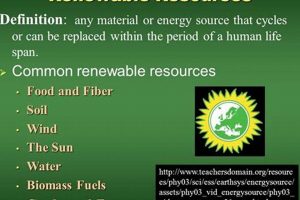
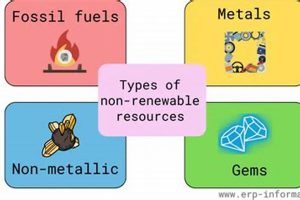
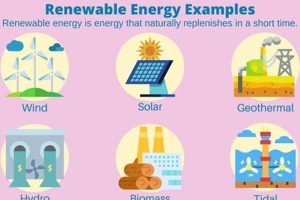
Sources of energy that are naturally replenished on a human timescale, such as sunlight, wind, rain, tides, and geothermal heat, provide a sustainable alternative to finite resources. These energy sources are continuously available, in contrast to fossil fuels and nuclear fuels, which are extracted from the Earth and will eventually be depleted. Examples include solar photovoltaic panels converting sunlight into electricity, wind turbines harnessing kinetic energy, and hydroelectric dams generating power from flowing water.
The adoption of naturally replenishing energy sources offers significant environmental and economic advantages. Utilizing these resources reduces greenhouse gas emissions, mitigates air and water pollution, and lessens dependence on volatile global energy markets. Historically, societies have relied on some forms of these resources, such as wood for heating and wind for sailing. However, advancements in technology have enabled more efficient and widespread utilization of these resources to meet modern energy demands.
The following sections will delve into the specifics of harnessing these naturally replenished energy sources, examining the technological innovations, policy considerations, and challenges associated with their implementation. The discussion will also address the potential of these resources to contribute to a more sustainable and secure energy future.
Guidance on Utilizing Naturally Replenishing Energy Sources
Effective management and integration of naturally replenishing energy sources are critical for achieving energy independence and environmental sustainability. The following guidance highlights key considerations for maximizing the benefits of these resources.
Tip 1: Diversify Energy Portfolio: Over-reliance on a single type of naturally replenishing source introduces vulnerability to fluctuations in availability. Integrating multiple sources, such as solar, wind, and geothermal, enhances reliability.
Tip 2: Invest in Energy Storage Solutions: Intermittency is inherent to certain types of naturally replenishing energy sources. Developing robust energy storage systems, including battery storage and pumped hydro, mitigates this issue.
Tip 3: Modernize Grid Infrastructure: An aging or inadequate grid infrastructure can hinder the efficient transmission of energy generated from dispersed sources. Upgrading grid infrastructure to accommodate bidirectional power flow and smart grid technologies is essential.
Tip 4: Implement Supportive Policy Frameworks: Government policies, including feed-in tariffs, tax incentives, and renewable energy standards, create a stable investment environment and drive adoption.
Tip 5: Prioritize Research and Development: Continuous investment in research and development is crucial for improving the efficiency, cost-effectiveness, and reliability of naturally replenishing energy technologies.
Tip 6: Promote Public Awareness and Education: Increasing public awareness regarding the benefits and feasibility of naturally replenishing energy sources fosters acceptance and encourages adoption at the individual and community levels.
Tip 7: Conduct Comprehensive Environmental Impact Assessments: Thoroughly evaluating the environmental impacts of large-scale naturally replenishing energy projects, such as wind farms and solar arrays, ensures minimal disruption to ecosystems.
Adhering to these guidelines facilitates the successful integration of naturally replenishing energy sources, contributing to a cleaner, more sustainable, and secure energy future.
The subsequent sections will further explore the economic viability, technological advancements, and societal implications associated with the widespread adoption of these vital resources.
1. Sustainable energy source

The designation “sustainable energy source” is inextricably linked to the definition of resources that are continuously and naturally replenished. The ability of an energy source to meet present needs without compromising the ability of future generations to meet their own defines sustainability. Resources that are naturally replenished, such as solar, wind, and geothermal energy, inherently possess this characteristic. The continuous availability of these resources distinguishes them from finite fossil fuels, whose extraction and consumption deplete reserves and contribute to environmental degradation. Therefore, their ability to meet long-term energy demands establishes them as sustainable options. For instance, a solar power installation designed for a multi-decade lifespan provides consistent energy generation with minimal environmental impact beyond the initial construction, illustrating the sustainable nature of the resource.
The adoption of the sustainable energy source component within these resources is not merely an environmentally responsible choice but also an economically prudent strategy. While initial investment costs for infrastructure may be substantial, the long-term operational costs are significantly lower compared to fossil fuel-based systems. This is due to the absence of fuel costs and the reduced maintenance requirements of many naturally replenishing energy technologies. Furthermore, the decreasing cost of technologies such as solar photovoltaic panels and wind turbines enhances their economic competitiveness. For example, numerous communities have transitioned to wind power generation, securing long-term energy contracts at prices competitive with or lower than conventional sources. This highlights the economic viability and sustainable benefits of such approaches.
In summary, the relationship between naturally replenished resources and their classification as a sustainable energy source hinges on their ability to provide continuous energy without depleting reserves or causing long-term environmental harm. Addressing the intermittency challenges through energy storage solutions and smart grid technologies is crucial for maximizing their potential. The transition to a sustainable energy future necessitates the widespread adoption of these resources, supported by effective policies, technological advancements, and a commitment to long-term environmental stewardship. Their development, however, requires careful planning and consideration of ecological impacts to avoid compromising the very sustainability they aim to achieve.
2. Environmentally responsible choice

The designation “environmentally responsible choice,” when applied to resources that are naturally replenished, underscores the imperative to minimize ecological impact while meeting energy demands. The selection of these energy sources represents a deliberate effort to mitigate the adverse consequences associated with conventional energy production.
- Reduced Greenhouse Gas Emissions
Harnessing solar, wind, geothermal, and hydroelectric power significantly reduces or eliminates the emission of greenhouse gases, a primary driver of climate change. Unlike fossil fuel combustion, these sources do not release carbon dioxide, methane, or nitrous oxide into the atmosphere during energy generation. The deployment of these technologies is a direct intervention in mitigating the escalating global warming trend.
- Diminished Air and Water Pollution
The extraction, processing, and combustion of fossil fuels release harmful pollutants into the air and water, contributing to respiratory illnesses, acid rain, and water contamination. Resources that are naturally replenished, on the other hand, offer a cleaner alternative. While manufacturing processes for renewable energy technologies may generate some pollution, the operational phase is significantly less impactful. Consequently, embracing these resources translates to improved public health outcomes and ecosystem preservation.
- Conservation of Natural Resources
The utilization of naturally replenished energy sources reduces the reliance on finite and depleting resources such as coal, oil, and natural gas. This conservation extends beyond energy resources to include land use impacts. For example, responsible siting of wind farms and solar arrays minimizes habitat disruption and preserves biodiversity. The efficient use of water resources in hydroelectric power generation and geothermal energy extraction further exemplifies this conservation principle.
- Minimized Waste Generation
Nuclear power generation produces radioactive waste that requires long-term storage and poses potential environmental risks. Fossil fuel combustion generates ash and other waste products that contribute to landfill burden and environmental pollution. Resources that are naturally replenished produce minimal waste during energy generation. While end-of-life management of renewable energy technologies requires careful consideration, the overall waste generation is significantly lower compared to conventional energy sources.
In conclusion, the adoption of resources that are naturally replenished as an “environmentally responsible choice” is a multifaceted endeavor encompassing reduced emissions, pollution mitigation, resource conservation, and minimized waste generation. The continued development and deployment of these technologies are crucial for achieving a sustainable energy future and safeguarding the health of the planet.
3. Continuously naturally replenished

The core characteristic defining resources as renewable is their capacity to be continuously and naturally replenished. This ongoing replenishment distinguishes them from finite resources like fossil fuels, which are extracted from the Earth at a rate exceeding their natural formation. The “continuously naturally replenished” aspect ensures long-term availability, making these resources a sustainable option for meeting energy demands. Without this characteristic, a resource, regardless of its environmental benefits during use, could not be considered truly renewable. For example, solar energy is continuously replenished by the sun, wind energy is driven by atmospheric processes constantly regenerating, and geothermal energy is sustained by the Earth’s internal heat.
The practical significance of understanding this continuous replenishment lies in its implications for long-term energy planning and security. Because these resources are perpetually available, investment in their infrastructure provides a reliable energy source, reducing dependence on politically volatile or environmentally damaging finite resources. Moreover, the continuous nature of replenishment allows for decentralized energy generation, empowering communities and reducing transmission losses. For instance, rooftop solar installations enable homeowners to generate their own electricity, reducing reliance on centralized power grids. Similarly, wind farms strategically located in windy areas can provide a consistent power supply, contributing to regional energy independence.
In conclusion, the principle of continuous natural replenishment is the foundational element defining a resource as renewable. This characteristic guarantees long-term availability, promotes energy security, and enables sustainable energy practices. While technological challenges remain in harnessing these resources effectively, their inherent ability to be continuously replenished makes them a critical component of a sustainable energy future. Failure to recognize and prioritize resources with this characteristic would perpetuate reliance on finite sources, exacerbating environmental problems and jeopardizing long-term energy security. Their consistent availability, however, makes renewable resources a sound option for future energy production that can be incorporated into long-term planning.
4. Diverse energy applications
The phrase “Diverse energy applications” highlights a critical attribute of naturally replenishing resources: their adaptability to a wide range of energy needs. This versatility stems from the inherent characteristics of each resource and the technological advancements enabling their utilization. The ability to serve multiple energy sectors, from electricity generation to transportation and heating, underscores the importance of these resources in a comprehensive energy transition. Real-world examples demonstrate this diversity, with solar energy powering homes, businesses, and vehicles; wind energy driving electricity grids; and geothermal energy providing heating and cooling solutions for buildings and industrial processes. This adaptability is crucial because it allows for a more resilient and decentralized energy system, reducing reliance on single-source dependencies.
The practical significance of understanding the diverse applications of naturally replenishing resources extends to policy decisions and investment strategies. Acknowledging the broad utility of these resources allows for targeted incentives and infrastructure development to support their widespread adoption. For example, recognizing the potential of biomass for both electricity generation and biofuel production can lead to integrated strategies for waste management and energy production. Similarly, understanding the role of geothermal energy in district heating systems can drive investments in geothermal exploration and infrastructure. By leveraging the inherent diversity of these resources, societies can optimize their energy mix and achieve greater energy independence.
In conclusion, the connection between “Diverse energy applications” and resources that replenish naturally is fundamental to their value as sustainable energy sources. Their adaptability to various energy needs enhances their resilience, promotes energy security, and enables a more decentralized and efficient energy system. While challenges remain in optimizing the integration of these diverse applications, their potential to transform the energy landscape is undeniable. Recognizing and supporting this diversity is essential for realizing the full potential of naturally replenishing resources and achieving a sustainable energy future.
5. Economically viable options
The economic viability of naturally replenished resources is a crucial factor in their widespread adoption and integration into existing energy infrastructure. The cost-effectiveness of solar, wind, geothermal, and hydroelectric power generation directly influences their competitiveness against conventional fossil fuel-based alternatives. As technological advancements drive down the levelized cost of energy (LCOE) for these resources, they increasingly become economically attractive options for utilities, businesses, and individual consumers. For instance, solar photovoltaic (PV) systems have experienced significant cost reductions in recent years, making them competitive with or even cheaper than grid electricity in many regions. Similarly, advancements in wind turbine technology have lowered the cost of wind energy, allowing for its expansion into areas previously deemed economically unfeasible. This reduced cost is a cause of and effect from investment. Investment and development lower cost and lower cost drive further investment.
The economic benefits of naturally replenished energy resources extend beyond direct energy cost savings. These resources can create new jobs in manufacturing, installation, and maintenance, stimulating economic growth in local communities. Furthermore, they can reduce dependence on imported fossil fuels, enhancing energy security and reducing exposure to volatile global energy markets. For example, the development of a local wind farm can create employment opportunities for residents, attract investment to the area, and provide a stable, affordable source of electricity for the community. Such a scenario not only provides economic stimuli but also reduces the dependence of the region on traditional energy providers. The reduction in fuel costs further reduces municipal operating expenses. Additionally, incentives and policies that promote the economic viability of these resources, such as tax credits and feed-in tariffs, play a critical role in accelerating their deployment. These incentives make renewable energy projects more financially attractive, encouraging investment and driving down costs further.
In summary, the economic viability of resources that replenish naturally is intrinsically linked to their widespread adoption and the transition to a sustainable energy future. Lowered costs, job creation, enhanced energy security, and supportive policies contribute to the economic competitiveness of these resources. However, challenges remain, including the need for grid modernization to accommodate intermittent renewable energy sources and the upfront capital costs associated with some projects. Addressing these challenges through continued innovation and strategic investment is essential for unlocking the full economic potential of these resources and achieving a cleaner, more secure, and prosperous energy future.
6. Technologically evolving solutions

The ongoing advancement of technology is intrinsically linked to the viability and efficiency of resources that are naturally replenished. Technological innovation continually improves the means by which these resources are harnessed, stored, and integrated into existing energy infrastructures. Progress in materials science, engineering, and information technology are driving significant improvements in resource utilization.
- Enhanced Energy Capture Efficiency
Technological advancements are continuously increasing the efficiency of energy capture from sources such as solar, wind, and geothermal. For example, improvements in photovoltaic cell materials and design now allow for higher conversion rates of sunlight into electricity. Similarly, advancements in wind turbine blade aerodynamics and control systems enable more effective extraction of kinetic energy from the wind. These efficiency gains directly translate to increased energy output from the same resource input, reducing the overall cost and environmental footprint of renewable energy generation.
- Improved Energy Storage Capabilities
One of the primary challenges associated with these resources is their intermittency. Technological solutions are actively addressing this limitation through the development of more efficient and cost-effective energy storage technologies. Advancements in battery technology, such as lithium-ion and flow batteries, are enabling the storage of surplus energy generated during peak production periods for use during periods of low resource availability. Additionally, pumped hydro storage and compressed air energy storage offer large-scale storage solutions for grid-level balancing. These storage technologies are essential for ensuring a reliable and consistent supply of renewable energy.
- Smarter Grid Integration
Integrating resources that are naturally replenished into existing electricity grids requires sophisticated grid management systems. Technological solutions, such as smart grids, are enabling more efficient and reliable integration of renewable energy sources. Smart grids utilize advanced sensors, communication networks, and control algorithms to monitor and manage energy flow in real-time. This allows for the dynamic balancing of supply and demand, the efficient distribution of renewable energy, and the mitigation of grid instability caused by intermittent sources. Furthermore, smart grid technologies facilitate the participation of distributed renewable energy resources, such as rooftop solar panels, in the overall energy system.
- Advanced Materials for Durability and Sustainability
The longevity and environmental impact of renewable energy technologies are influenced by the materials used in their construction. Technological advancements are driving the development of more durable and sustainable materials for wind turbines, solar panels, and other renewable energy infrastructure. For example, researchers are exploring the use of biodegradable materials in solar panels to reduce their environmental impact at the end of their lifecycle. Similarly, advancements in materials science are leading to the development of stronger and more corrosion-resistant materials for wind turbine blades, extending their lifespan and reducing maintenance costs. The focus on sustainable materials is crucial for ensuring the long-term environmental benefits of the transition to renewable energy.
In conclusion, “Technologically evolving solutions” are fundamental to realizing the full potential of resources that replenish naturally. Continuous innovation in energy capture efficiency, storage capabilities, grid integration, and sustainable materials is essential for driving down costs, improving reliability, and minimizing the environmental footprint of renewable energy systems. As technology continues to advance, these resources will play an increasingly prominent role in meeting global energy demands in a sustainable and economically viable manner.
7. Crucial for future
The assertion that resources which replenish naturally are “Crucial for future” reflects a growing global consensus on the necessity of transitioning to sustainable energy systems. This emphasis stems from the recognition that continued reliance on finite fossil fuels presents significant environmental, economic, and geopolitical challenges that threaten long-term societal well-being.
- Mitigation of Climate Change
The most pressing reason resources that are naturally replenished are essential for the future lies in their potential to mitigate climate change. The combustion of fossil fuels releases greenhouse gases, contributing to global warming and its associated consequences, including rising sea levels, extreme weather events, and disruptions to ecosystems. Widespread adoption of resources that are naturally replenished, such as solar, wind, and geothermal energy, offers a pathway to decarbonize energy systems and limit the severity of climate change impacts. This is not merely an environmental imperative but also a necessary step to safeguard future economies and societies from the devastating consequences of unchecked global warming.
- Enhancement of Energy Security
Dependence on fossil fuels creates vulnerabilities related to supply disruptions and price volatility. Resources that are naturally replenished offer a means to enhance energy security by diversifying energy sources and reducing reliance on imported fuels. Countries with abundant resources, such as solar irradiance or wind resources, can leverage these assets to generate their own electricity, reducing their vulnerability to geopolitical instability and market fluctuations. A diversified energy mix is a more robust energy supply.
- Promotion of Sustainable Economic Growth
The transition to a renewable energy economy presents significant opportunities for sustainable economic growth. Investments in renewable energy technologies can create new jobs in manufacturing, installation, and maintenance, stimulating economic activity and driving innovation. Furthermore, the reduced operating costs associated with some resources that are naturally replenished, such as solar and wind power, can lower energy bills for consumers and businesses, freeing up capital for other investments. Green industry jobs provide stability and economic growth by providing a buffer against the cost of fossil fuels. The economic growth, however, must also consider the environmental impact of production and disposal.
- Preservation of Natural Resources
The extraction and combustion of fossil fuels can cause significant environmental damage, including air and water pollution, habitat destruction, and depletion of natural resources. Resources that are naturally replenished offer a cleaner and more sustainable alternative. By harnessing energy from the sun, wind, and Earth’s heat, societies can reduce their impact on ecosystems and preserve natural resources for future generations. This is not simply a matter of environmental stewardship but also a recognition that healthy ecosystems provide essential services, such as clean air and water, that are vital for human well-being. These renewable sources provide a means to enjoy the environment instead of damaging it through the extraction and use of fossil fuels.
In conclusion, the designation of resources that replenish naturally as “Crucial for future” is firmly grounded in their potential to address climate change, enhance energy security, promote sustainable economic growth, and preserve natural resources. While challenges remain in their widespread deployment, the long-term benefits of transitioning to a renewable energy economy far outweigh the costs. The commitment to developing and deploying these resources is not simply an option but a fundamental imperative for safeguarding the well-being of future generations.
Frequently Asked Questions Regarding Renewable Resources
This section addresses common inquiries and clarifies misconceptions surrounding renewable resources and their role in the global energy landscape.
Question 1: What constitutes a renewable resource?
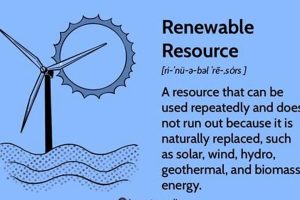
A renewable resource is characterized by its natural replenishment rate on a human timescale. Resources such as solar, wind, geothermal, and hydro power fall under this definition as they are continuously renewed by natural processes.
Question 2: Are resources labeled “renewable” truly inexhaustible?
While renewable resources are replenished naturally, their availability can fluctuate due to factors such as weather patterns or geographic limitations. Furthermore, the infrastructure required to harness these resources has a finite lifespan and requires periodic maintenance and eventual replacement.
Question 3: What are the primary environmental benefits associated with renewable resources?
The primary environmental benefit is the reduction in greenhouse gas emissions compared to fossil fuel-based energy generation. Renewable resources also minimize air and water pollution, conserve finite resources, and generate less waste.
Question 4: Are renewable energy sources economically competitive with traditional fossil fuels?
The economic competitiveness of renewable energy sources varies depending on location, technology, and government policies. In many regions, solar and wind power are now cost-competitive with or even cheaper than fossil fuels. However, factors such as intermittency and grid integration costs can still pose economic challenges.
Question 5: How can the intermittency of some renewable resources be addressed?
Intermittency challenges can be mitigated through energy storage solutions, such as batteries and pumped hydro, as well as smart grid technologies that enable dynamic balancing of supply and demand. Geographic diversification of renewable energy sources can also help to reduce the impact of local weather patterns.
Question 6: What role do government policies play in promoting the adoption of renewable resources?
Government policies, such as feed-in tariffs, tax incentives, and renewable energy standards, are crucial for creating a stable investment environment and driving the adoption of renewable resources. These policies can help to level the playing field and accelerate the transition to a sustainable energy future.
Understanding these key aspects facilitates informed decision-making regarding the deployment and utilization of resources that replenish naturally.
The subsequent section explores the future prospects for this vital energy sector.
Renewable Resources Are
This exposition has detailed the fundamental nature of resources that naturally replenish, underscoring their sustainability, environmental benefits, and economic viability. The discussion has illuminated diverse energy applications, technological advancements driving their efficiency, and their crucial role in securing a sustainable energy future. The continued development and responsible deployment of these resources represent a critical shift away from reliance on finite and environmentally damaging fossil fuels.
The pursuit of a future powered by renewable resources necessitates sustained commitment to research, innovation, and supportive policy frameworks. A failure to prioritize these resources will perpetuate existing environmental and economic vulnerabilities. The urgency of climate change demands immediate and decisive action, making the widespread adoption of resources that are continuously replenished not merely an option, but an imperative for the preservation of a habitable planet.
![Guide to What Energy Resources Are Renewable [+Future] | Renewable Energy Solutions for a Sustainable Future | Clean & Green Power](https://pplrenewableenergy.com/wp-content/uploads/2026/03/th-516-300x200.jpg "Guide to What Energy Resources Are Renewable [+Future] Renewable Energy Solutions for a Sustainable Future | Clean & Green Power")