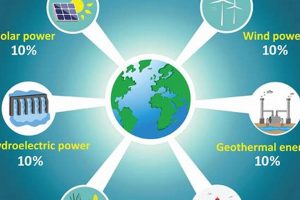
The classification of power generation methods often involves categorizing them as either renewable or non-renewable. Renewability implies that the energy source is naturally replenished at a rate comparable to or faster than its consumption. Common examples of renewable sources include solar, wind, and hydropower, which derive energy from continuously available natural processes. These contrast with fossil fuels, which are finite resources accumulated over geological timescales. The ability of a process to replenish its fuel source determines its classification.
The pursuit of abundant and sustainable energy drives substantial research and development efforts globally. A source with the potential to provide near-limitless clean power would significantly impact energy security and environmental sustainability. The historical context of energy production highlights a transition from reliance on finite resources to exploring more sustainable options, driven by concerns about resource depletion and climate change. The economic and geopolitical implications of controlling primary energy sources further emphasize the importance of developing sustainable alternatives.
This examination will delve into the underlying principles of a specific advanced energy process. It will analyze its fuel source and assess whether it meets the criteria for being considered a renewable resource. The analysis will further explore the sustainability aspects, technological hurdles, and potential impacts of this technology on the global energy landscape.
Understanding Fusion as a Potential Energy Source
The following points offer a framework for evaluating this energy process in the context of sustainability and resource management.
Tip 1: Fuel Source Assessment: Determine the origin and availability of the fuel required. If the fuel is derived from a virtually inexhaustible resource, this represents a key argument for sustainability.
Tip 2: Waste Product Analysis: Evaluate the byproducts produced during the energy generation process. Minimal long-lived radioactive waste is a desirable characteristic for environmental acceptance.
Tip 3: Resource Depletion Impact: Consider the impact on other natural resources during the fuel extraction or processing phases. A low environmental footprint is crucial.
Tip 4: Energy Balance Evaluation: Analyze the net energy gain of the entire process, from fuel acquisition to energy production. A significantly positive energy balance is essential for viability.
Tip 5: Technological Feasibility Review: Understand the technological challenges associated with achieving sustained and efficient energy production. Current limitations and research progress should be carefully considered.
Tip 6: Economic Viability Studies: Assess the projected costs of building and operating facilities. Economic competitiveness is a critical factor for widespread adoption.
Tip 7: Infrastructure Requirements: Evaluate the necessary infrastructure for fuel transport, processing, and energy distribution. Existing infrastructure can reduce implementation barriers.
By carefully considering these factors, a more informed assessment can be made regarding the long-term potential of this technology as a viable energy solution.
These insights offer a basis for deeper exploration into the complexities and possibilities surrounding this technology.
1. Fuel abundance

Fuel abundance represents a crucial parameter in assessing whether a potential energy source qualifies as renewable. An energy source with a limited fuel supply cannot be considered sustainable in the long term, regardless of other beneficial characteristics. The availability of fuel dictates the capacity to provide sustained energy output over extended periods, a defining attribute of renewable energy systems.
- Deuterium Reserves in Seawater
Deuterium, an isotope of hydrogen, serves as a primary fuel for many fusion reactor designs. It exists in vast quantities within seawater, with an estimated concentration of approximately 30 grams per cubic meter. This substantial reservoir represents a virtually inexhaustible supply, sufficient to meet global energy demands for millennia. Accessing this abundant resource requires relatively simple extraction processes, enhancing the feasibility of deuterium-based fusion.
- Lithium Availability for Tritium Breeding
Tritium, another essential fuel component, is radioactive and scarce in nature. Fusion reactors are designed to “breed” tritium from lithium, a relatively abundant element found in both terrestrial and marine environments. Efficient tritium breeding is critical for a self-sustaining fusion reaction. While lithium reserves are finite, current estimates suggest sufficient quantities to support fusion energy production on a large scale for centuries, potentially even millennia, depending on breeding ratios and reactor designs.
- Global Distribution of Fuel Resources
The widespread availability of deuterium in seawater ensures that access to fusion fuel is not concentrated in specific geographic locations. This mitigates geopolitical risks associated with energy dependence on a limited number of resource-rich countries, a challenge faced by current fossil fuel systems. Similarly, lithium deposits are distributed across various regions globally, further enhancing energy security and reducing the potential for resource monopolies.
- Resource Depletion and Sustainability
Given the vast quantities of deuterium in seawater and the potential for tritium breeding from lithium, the depletion of fuel resources is not a significant concern for fusion energy. Unlike fossil fuels, which are finite and non-renewable, fusion fuels offer the prospect of near-limitless energy production without depleting the planet’s resources. This inherent characteristic aligns with the core principles of renewable energy and sustainable development, ensuring long-term energy security for future generations.
The abundance and global distribution of deuterium and lithium, coupled with the capacity for tritium breeding, establish a strong foundation for considering nuclear fusion as a potential renewable energy source. While technological challenges remain in achieving sustained and efficient fusion power, the fuel resource aspect presents a compelling argument for its long-term sustainability and its potential role in a future energy mix.
2. Deuterium sourcing

Deuterium sourcing plays a critical role in determining whether nuclear fusion can be considered a renewable energy source. The method by which deuterium is obtained and the sustainability of that method directly influence the long-term viability and environmental impact of fusion power. A renewable energy source necessitates a continuous and readily available fuel supply without causing significant environmental harm; deuterium sourcing must align with these principles.
- Seawater Extraction and Abundance
Deuterium exists naturally in seawater at a concentration of approximately 30 parts per million. This widespread availability suggests a virtually inexhaustible supply. Extraction processes, such as electrolysis or chemical exchange, can separate deuterium from ordinary hydrogen. The sheer volume of seawater ensures that deuterium extraction, even on a large scale, does not significantly deplete the resource. The minimal environmental impact of the extraction process itself further supports the notion of deuterium as a sustainable fuel source.
- Efficiency of Extraction Technologies
The energy required to extract deuterium from seawater must be significantly lower than the energy produced by fusion using that deuterium for fusion to be a viable energy source. Ongoing research focuses on improving the efficiency of extraction technologies to minimize energy input and reduce associated costs. Technological advancements in areas such as membrane separation and cryogenic distillation hold promise for more energy-efficient deuterium sourcing, enhancing the overall sustainability of fusion power.
- Environmental Considerations in Sourcing
While seawater extraction itself has a relatively low environmental impact, the energy used to power the extraction process must come from sustainable sources. Relying on fossil fuels for deuterium extraction would undermine the overall sustainability of fusion energy. Integrating renewable energy sources, such as solar or wind power, into the extraction process is essential to ensure that deuterium sourcing aligns with the principles of environmental responsibility and does not contribute to greenhouse gas emissions.
- Economic Viability of Deuterium Production
The cost-effectiveness of deuterium production is a significant factor in the economic feasibility of nuclear fusion. Affordable deuterium sourcing is crucial for fusion power to compete with other energy sources. Optimizing extraction processes, reducing energy consumption, and leveraging economies of scale can contribute to lower deuterium production costs, making fusion power more economically attractive and accelerating its adoption as a sustainable energy solution.
In summary, the renewability of nuclear fusion hinges significantly on the sustainable and efficient sourcing of deuterium. The vast availability of deuterium in seawater, coupled with ongoing advancements in extraction technologies and a commitment to environmentally responsible practices, supports the argument that fusion has the potential to be a renewable energy source. Addressing the economic aspects of deuterium production remains crucial for realizing the full potential of fusion power as a viable and sustainable energy solution for the future.
3. Tritium breeding
Tritium breeding is an indispensable process in deuterium-tritium (D-T) fusion reactors, significantly influencing the sustainability assessment of nuclear fusion as a potential energy source. The limited natural abundance of tritium necessitates its in-situ generation within the reactor to sustain the fusion reaction, thereby shaping the long-term viability of the technology.
- Necessity for Sustained Fusion Reaction
Tritium, a radioactive isotope of hydrogen, undergoes fusion with deuterium at relatively lower temperatures compared to other fusion reactions. However, tritium is scarce in nature due to its radioactive decay with a half-life of 12.32 years. Consequently, self-sufficient D-T fusion reactors must incorporate a tritium breeding system to replenish the tritium consumed during the fusion process. Without effective breeding, the reactor would require a continuous external supply of tritium, undermining its long-term operational sustainability.
- Lithium as a Breeding Material
Tritium breeding typically involves utilizing lithium isotopes (Lithium-6 and Lithium-7) within the reactor’s surrounding blanket. Neutrons produced during the D-T fusion reaction interact with lithium nuclei, resulting in the production of tritium and helium. For example, a neutron interacting with Lithium-6 results in tritium and alpha particle generation. The efficiency of tritium breeding depends on the neutron flux, the concentration of lithium isotopes, and the design of the breeding blanket. The availability and sustainable extraction of lithium resources are, therefore, essential for the long-term deployment of D-T fusion power.
- Breeding Ratio and Reactor Self-Sufficiency
The tritium breeding ratio (TBR) is a critical parameter that quantifies the amount of tritium produced per tritium consumed in the fusion reaction. A TBR greater than 1 is essential for a self-sustaining fusion reactor, allowing the reactor to generate more tritium than it consumes and thus maintain a continuous fuel supply. Achieving a sufficiently high TBR requires careful optimization of the reactor design, including the choice of breeding materials, neutron reflectors, and structural components. Accurately predicting and validating the TBR through simulations and experimental measurements is crucial for demonstrating the feasibility of self-sufficient fusion power.
- Impact on Waste Management and Safety
While tritium breeding enables self-sufficient operation, it also introduces considerations related to radioactive waste management and safety. Tritium is a radioactive substance, and its presence in the reactor components and breeding blanket necessitates careful handling and disposal procedures. Minimizing tritium leakage and developing efficient tritium extraction and recovery methods are essential for ensuring the environmental acceptability and safety of fusion power. The design of the breeding blanket must also consider the potential for activation of structural materials by neutrons, leading to the formation of long-lived radioactive isotopes that require long-term storage.
In conclusion, tritium breeding is an integral component of D-T fusion reactors, significantly influencing their potential as a renewable energy source. The ability to breed tritium from lithium enables self-sufficient operation, reducing reliance on external fuel supplies. However, careful attention must be paid to optimizing the breeding ratio, managing radioactive waste, and ensuring the sustainable sourcing of lithium resources to realize the full potential of fusion power as a clean and sustainable energy solution.
4. Helium byproduct

The helium byproduct in nuclear fusion reactions presents a significant aspect in evaluating the potential of fusion as a renewable energy source. Specifically, the inert and non-toxic nature of helium contrasts sharply with the radioactive waste produced by nuclear fission, offering an advantage in terms of environmental impact. The formation of helium-4, an exceptionally stable isotope, during the deuterium-tritium fusion reaction, the most readily achievable fusion reaction, inherently links to the resource sustainability assessment of the energy source. Its presence as a stable, non-radioactive product contributes to the argument for fusion as an environmentally responsible energy production method, a criterion often associated with renewable sources.
Moreover, helium itself has diverse industrial applications, ranging from cryogenics to lifting gas. Consequently, the helium generated during fusion could potentially be harvested and utilized, offsetting some of the operational costs of a fusion power plant and adding economic value to the process. This potential for byproduct utilization further enhances the resource efficiency of fusion, aligning it more closely with the principles of sustainable energy production. For instance, large-scale liquid helium production for superconducting magnets in MRI machines could potentially be augmented by helium harvested from future fusion reactors. This dual-purpose nature of the process, yielding energy and a valuable industrial gas, underscores the potential benefits of fusion as a resource-efficient energy source.
In summary, the formation of helium as a byproduct of nuclear fusion contributes favorably to its classification as a potentially renewable energy source due to its non-radioactive, non-toxic nature and its potential for industrial applications. While technological and economic hurdles remain in realizing commercially viable fusion power, the environmentally benign nature of the helium byproduct strengthens the argument for continued research and development in this field. This characteristic helps differentiate fusion from conventional nuclear fission, where the management of radioactive waste poses a significant long-term environmental challenge.
5. Inexhaustible nature
The perception of nuclear fusion as a prospective renewable energy source is intrinsically linked to the notion of an inexhaustible fuel supply. Unlike fossil fuels, which are finite and subject to depletion, the primary fuel components for fusion, deuterium and lithium, are abundant on Earth. Deuterium exists in vast quantities in seawater, while lithium is found in terrestrial deposits and brines. This abundance suggests that the fuel source for fusion power could theoretically sustain energy production for geological timescales, a defining characteristic of renewable energy resources.
The connection between inexhaustible nature and the classification of fusion as renewable is not absolute. The label “renewable” is usually reserved for energy sources that are continuously replenished by natural processes, such as solar or wind energy. While deuterium and lithium are abundant, they are not replenished at a rate comparable to their potential consumption in fusion reactors. However, the sheer scale of these resources, coupled with the potential for tritium breeding from lithium within the reactor, effectively creates a fuel cycle that could last for thousands or even millions of years. This practical inexhaustibility distinguishes fusion from non-renewable resources like coal, oil, and uranium, which face eventual depletion.
Despite the apparent inexhaustibility, challenges remain. Ensuring the sustainable extraction of lithium and developing efficient tritium breeding techniques are crucial for realizing the long-term potential of fusion power. Furthermore, the economic feasibility of accessing and processing these resources must be addressed to make fusion a viable alternative to existing energy sources. However, the fundamental abundance of fusion fuels provides a strong basis for considering it a sustainable, if not strictly renewable, energy source for the future.
6. Self-sustainability
Self-sustainability is a critical attribute when evaluating the potential of nuclear fusion to be classified as a renewable energy source. The ability of a fusion reactor to maintain its operation through internally generated resources reduces reliance on external inputs, thereby enhancing its long-term viability and alignment with the principles of sustainability.
- Tritium Breeding and Fuel Cycle Closure
Self-sustainability in a deuterium-tritium (D-T) fusion reactor hinges on the efficient breeding of tritium within the reactor itself. Tritium, a radioactive isotope of hydrogen, is scarce in nature and essential for the D-T fusion reaction. The reactor must produce at least as much tritium as it consumes to maintain a continuous fuel supply without requiring external tritium sources. This closed-loop fuel cycle, where the reactor generates its own fuel, is fundamental to its self-sufficiency and long-term operational capability. For example, designs for future fusion power plants, such as ITER and DEMO, incorporate breeding blankets containing lithium, which, when bombarded with neutrons from the fusion reaction, produce tritium.
- Energy Autonomy and Reduced External Dependence
A self-sustaining fusion reactor minimizes its reliance on external energy sources to maintain plasma confinement and heating. Once the fusion reaction is initiated and reaches a self-sustaining state, the energy released from the fusion process itself is sufficient to maintain the plasma temperature and density required for continued fusion. This energy autonomy reduces the need for continuous external power input, improving the overall energy efficiency and economic viability of the reactor. In contrast, fusion experiments that require constant external power to sustain the plasma are not self-sustaining and cannot serve as practical energy sources.
- Resource Utilization and Waste Minimization
Self-sustainability also encompasses efficient resource utilization and waste minimization. A self-sustaining fusion reactor maximizes the conversion of fuel into energy and minimizes the production of long-lived radioactive waste. The primary byproduct of the D-T fusion reaction is helium, an inert and non-toxic gas. While neutron activation of reactor components can produce some radioactive waste, the volume and radiotoxicity of this waste are significantly lower than those produced by nuclear fission reactors. Efficient resource utilization and reduced waste generation contribute to the environmental sustainability of fusion power.
- Technological Integration and System Efficiency
Achieving self-sustainability requires the integration of various advanced technologies and the optimization of system efficiency. Efficient plasma confinement, high-power heating systems, and effective tritium breeding blankets are essential for a self-sustaining fusion reactor. Moreover, advanced materials with high neutron resistance and low activation properties are needed to minimize waste generation and maintain reactor performance. The successful integration of these technologies and the optimization of system efficiency are crucial for realizing the full potential of self-sustaining fusion power.
The facets of self-sustainability outlined above underscore the importance of internal resource management and operational autonomy in evaluating the potential of nuclear fusion as a renewable energy source. While fusion may not strictly adhere to the traditional definition of “renewable” due to its reliance on finite resources like lithium, the ability to achieve self-sustaining operation through tritium breeding, energy autonomy, and efficient resource utilization enhances its long-term viability and aligns it more closely with the principles of sustainable energy production.
7. Resource availability
Resource availability forms a cornerstone in determining whether nuclear fusion can be accurately categorized as a renewable energy source. The accessibility, abundance, and distribution of essential resources directly influence the long-term viability and scalability of fusion power. The following aspects delineate this connection, outlining the implications of resource constraints and opportunities for sustainable fusion development.
- Deuterium Extraction from Seawater
Deuterium, a key fuel component, is readily extracted from seawater. The global abundance of seawater, coupled with relatively straightforward extraction techniques, suggests that deuterium supplies are practically inexhaustible. This contrasts sharply with finite fossil fuel reserves, supporting fusion’s potential as a long-term energy solution. However, the energy requirements and environmental impacts of deuterium extraction processes warrant continued scrutiny to ensure sustainable sourcing.
- Lithium Reserves for Tritium Breeding
Tritium, another critical fuel, is not naturally abundant and must be bred from lithium within the fusion reactor. Lithium reserves, while not as vast as deuterium, are distributed across various geographical locations. The availability and accessibility of these lithium deposits directly impact the feasibility of tritium breeding, a process essential for self-sustaining fusion reactors. Efficient lithium extraction and processing technologies are paramount for ensuring a sustainable tritium fuel cycle.
- Rare Earth Elements in Reactor Components
Advanced fusion reactor designs may incorporate rare earth elements in various components, such as magnets and plasma-facing materials. The availability and sustainable sourcing of these elements, often subject to geopolitical constraints and environmental concerns associated with mining, can influence the scalability and economic viability of fusion power. Material science research focuses on minimizing the reliance on scarce resources and developing alternative materials with similar performance characteristics.
- Land Use and Infrastructure Requirements
The deployment of fusion power plants requires substantial land areas for reactor construction, support facilities, and waste storage. The availability of suitable land, particularly in densely populated regions, can pose a logistical challenge. Furthermore, the development of necessary infrastructure, including transmission lines and fuel processing plants, necessitates significant investment and careful planning. Efficient land use and strategic infrastructure development are crucial for maximizing the societal benefits of fusion power.
Resource availability fundamentally shapes the prospects for nuclear fusion as a renewable energy source. While the abundance of deuterium offers a significant advantage, challenges related to lithium sourcing, rare earth element dependencies, and land use considerations must be addressed to ensure the long-term sustainability and scalability of fusion power. Continued research and development efforts focused on resource-efficient technologies and sustainable extraction practices are essential for realizing the full potential of fusion as a clean and abundant energy source for future generations.
Frequently Asked Questions
The following section addresses common inquiries regarding the classification of nuclear fusion as a renewable energy source, providing concise and informative answers.
Question 1: Does nuclear fusion meet the strict definition of a renewable energy source?
Nuclear fusion relies on deuterium and tritium. While deuterium is abundant in seawater, tritium is scarce and must be bred from lithium. The non-renewable nature of lithium, albeit plentiful, prevents fusion from strictly adhering to the conventional definition of a renewable source, such as solar or wind, which are continuously replenished by natural processes.
Question 2: What makes nuclear fusion a sustainable energy option?
The vast quantities of deuterium in seawater, coupled with the possibility of tritium breeding from lithium, provide a practically inexhaustible fuel supply. This contrasts with finite fossil fuels. The negligible greenhouse gas emissions and absence of long-lived radioactive waste products, compared to nuclear fission, further bolster its sustainability profile.
Question 3: Is lithium a finite resource, and could it limit fusion’s long-term potential?
Yes, lithium is a finite resource. However, estimated reserves are substantial enough to fuel fusion reactors for centuries, possibly millennia, depending on breeding efficiency and technological advancements. Research into alternative breeding materials and efficient lithium extraction methods are ongoing to further extend its availability.
Question 4: How does the environmental impact of fusion compare to that of fission?
Fusion produces minimal long-lived radioactive waste, unlike fission, which generates significant amounts requiring long-term storage. The primary byproduct of fusion is helium, an inert, non-toxic gas. This greatly reduces the environmental burden associated with waste disposal and long-term contamination risks.
Question 5: What are the main challenges in achieving commercially viable fusion power?
Significant technological hurdles remain. Achieving sustained and efficient fusion reactions requires maintaining extremely high temperatures and pressures. Overcoming these challenges demands advancements in plasma physics, materials science, and engineering. Economic viability also requires reducing construction and operating costs to compete with existing energy sources.
Question 6: When can fusion realistically contribute to the global energy mix?
While research is progressing, commercially viable fusion power is likely several decades away. Current projections suggest that demonstration fusion power plants could be operational by the mid-21st century, with widespread adoption contingent on resolving technological and economic challenges.
In summary, while not strictly renewable, nuclear fusion offers a potentially sustainable energy pathway due to its abundant fuel resources and reduced environmental impact compared to fossil fuels and fission. Overcoming technological and economic hurdles is crucial for realizing its full potential.
The next section will delve into the technological challenges and future prospects for nuclear fusion energy.
Is Nuclear Fusion a Renewable Energy Source
The preceding analysis has explored the nuanced question of whether nuclear fusion aligns with the definition of a renewable energy source. While deuterium, a primary fuel, is abundant in seawater, and fusion produces minimal long-lived radioactive waste, the reliance on lithium for tritium breeding introduces a constraint. Consequently, fusion does not perfectly fit the traditional definition of “renewable” as an energy source replenished continuously by natural processes. Its practically inexhaustible fuel supply and reduced environmental impact, however, position it as a potentially sustainable alternative to finite fossil fuels and conventional nuclear fission.
Despite its promising attributes, significant technological and economic hurdles remain before fusion can contribute meaningfully to the global energy mix. Continued research and development efforts are essential to overcome these challenges and realize the full potential of fusion as a clean, abundant, and sustainable energy source for future generations. A comprehensive strategy that encompasses efficient resource management, technological innovation, and responsible waste management will be critical to harnessing the benefits of fusion energy in a responsible and sustainable manner.