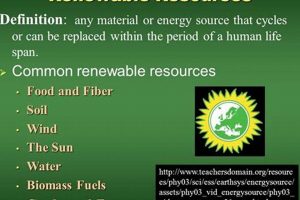
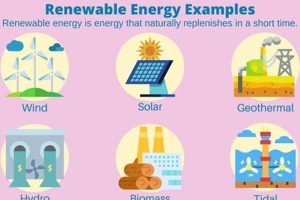
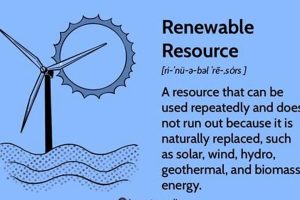
Renewable resources are naturally replenishing sources of energy that are sustainable because their consumption does not deplete their supply. Examples encompass solar power derived from sunlight, wind energy captured by turbines, geothermal energy sourced from the Earth’s internal heat, hydropower generated by flowing water, and biomass energy obtained from organic matter.
The deployment of these resources offers significant environmental advantages. They mitigate greenhouse gas emissions, diminishing the impact of climate change and improving air quality. Historically, societies have relied on renewable sources like wood and water, but recent technological advancements have greatly enhanced the efficiency and accessibility of modern renewable energy technologies. This shift towards sustainability is crucial for long-term energy security and ecological preservation.
The following points highlight key aspects of harnessing these enduring power sources, emphasizing their diverse potential and ongoing development. These encompass the scope of their impact, efficiency, and the exciting innovations driving their future.
Guidance on Renewable Resource Integration
The efficient and responsible integration of these resources requires careful planning and execution. The subsequent points offer pertinent guidance for maximizing their beneficial impact.
Tip 1: Assess Resource Availability: Conduct thorough site assessments to determine the potential of solar, wind, hydro, or geothermal resources. Accurate data is crucial for investment decisions.
Tip 2: Prioritize Energy Efficiency: Before investing in renewable energy generation, reduce energy consumption through efficiency measures in buildings, transportation, and industry.
Tip 3: Diversify Energy Portfolio: Integrate a mix of renewable sources to ensure energy security and mitigate the variability of intermittent sources such as solar and wind.
Tip 4: Implement Energy Storage Solutions: Combine renewable energy generation with energy storage technologies like batteries or pumped hydro to balance supply and demand.
Tip 5: Utilize Smart Grid Technologies: Implement smart grid technologies to optimize the distribution and management of renewable energy, improving grid stability and reliability.
Tip 6: Promote Community Engagement: Involve local communities in the planning and development of renewable energy projects to address concerns and foster support.
Tip 7: Establish Supportive Policies: Advocate for government policies that incentivize renewable energy development through tax credits, feed-in tariffs, and carbon pricing mechanisms.
These guidelines highlight the essential considerations for successful integration. Addressing these aspects promotes a transition towards a more sustainable energy future.
This guidance should assist in understanding the practical steps involved in realizing the benefits of these resources.
1. Sustainability

The principle of sustainability is intrinsically linked to the essence of renewable resources. Their defining characteristic is their ability to replenish naturally within a human lifespan, ensuring a continuous supply for future generations. This stands in stark contrast to finite fossil fuels, which deplete over time, leading to resource scarcity and environmental degradation. The embrace of sources like solar, wind, and hydro power directly supports a sustainable energy system, minimizing the extraction and combustion of non-renewable resources and their associated ecological consequences.
The implementation of sustainable practices within the renewable energy sector is exemplified by responsible land use in solar farms, minimizing habitat disruption, and the implementation of fish ladders in hydroelectric dams to mitigate impacts on aquatic ecosystems. Furthermore, advancements in wind turbine recycling and the development of closed-loop geothermal systems represent efforts to reduce the lifecycle environmental footprint of these technologies. These are designed to provide long-term energy solutions without compromising the environment.
In conclusion, the long-term viability of renewable energy hinges on its inherent sustainability. This understanding is critical to transitioning towards a resource-efficient and ecologically sound energy infrastructure. Continued research and development are essential to further enhance the sustainability of renewable energy technologies, ensuring their ongoing contribution to a cleaner and more resilient future.
2. Accessibility

Accessibility, in the context of renewable resources, refers to the extent to which these energy sources are readily available and usable by diverse populations, regardless of geographic location, economic status, or technical expertise. It is a critical factor influencing the widespread adoption and equitable distribution of the benefits associated with environmentally sustainable energy. Inequitable access can exacerbate existing socio-economic disparities, limiting opportunities for communities to participate in and benefit from the transition to a cleaner energy economy. For instance, remote rural areas, often lacking the infrastructure for grid connection, may find decentralized renewable energy systems, such as solar home systems or micro-grids, to be the most accessible and cost-effective solution to energy poverty.
The accessibility of renewable resources is directly affected by technological advancements and policy interventions. Decreasing costs of solar photovoltaic (PV) panels, driven by economies of scale and technological innovation, have significantly improved affordability for households and businesses. Similarly, streamlined permitting processes and financial incentives, such as tax credits and feed-in tariffs, can lower the upfront capital investment required for renewable energy projects, making them more accessible to small businesses and individual homeowners. Community solar projects, where multiple households or businesses share the output of a single solar installation, represent another approach to enhancing accessibility by overcoming financial and logistical barriers that may prevent individual adoption. The success of these initiatives requires addressing specific barriers, for example, the limited availability of skilled technicians for installation and maintenance, or the lack of access to financing in underserved communities.
In conclusion, improving the accessibility of renewable resources is paramount for achieving a just and sustainable energy transition. Removing economic, technical, and regulatory barriers is vital to ensuring that the benefits of clean energy are available to all segments of society. Focusing on promoting inclusive policies and deploying tailored solutions to meet the diverse needs of communities is essential to unlocking the full potential of sustainable resources. Failure to address equitable availability can lead to disproportionate benefits, hindering the progress toward a globally sustainable and socially equitable future.
3. Environmental Impact

The environmental consequences of energy production are a core consideration when evaluating resource options. The potential to mitigate detrimental effects is a primary driver in the shift towards renewable alternatives. The degree to which energy production affects air quality, water resources, and land use is a crucial differentiating factor between renewable and non-renewable sources.
- Greenhouse Gas Emissions
Renewable energy technologies, such as solar, wind, and geothermal, generate electricity with minimal or no greenhouse gas emissions during operation, unlike fossil fuel combustion. This reduction mitigates the effects of climate change and improves overall air quality. The implementation of such technologies directly addresses concerns about carbon footprints and related environmental degradation.
- Air and Water Pollution
Traditional power plants release pollutants into the air and water, including sulfur dioxide, nitrogen oxides, and mercury. Renewable sources, particularly solar and wind, substantially reduce these pollutants, leading to improved public health outcomes and decreased damage to ecosystems. The adoption of these cleaner energy sources minimizes the burden on natural resources.
- Land Use and Ecosystem Disruption
The development of any energy infrastructure inevitably requires land use. However, renewable energy facilities can minimize disruption through careful planning and innovative design. For example, offshore wind farms can co-exist with fishing activities, and solar farms can be integrated into agricultural landscapes, limiting the overall impact on ecosystems and biodiversity.
- Resource Depletion
Fossil fuels are finite resources that deplete over time, leading to environmental degradation through extraction and transportation. Renewable resources are self-replenishing and offer a sustainable alternative, reducing the pressure on natural resource reserves. This shift contributes to long-term resource security and environmental stewardship.
These factors collectively highlight the environmental benefits associated with renewable resource utilization. By prioritizing energy sources that minimize pollution, conserve resources, and mitigate climate change, a more sustainable and environmentally responsible energy future can be realized. Understanding these distinct environmental impacts is essential for informed decision-making in energy policy and investment.
4. Energy Security

Energy security, defined as the uninterrupted availability of energy sources at an affordable price, is intrinsically linked to renewable resources. Dependence on finite fossil fuels exposes nations to geopolitical volatility, price fluctuations, and potential supply disruptions. Diversifying the energy mix with domestically available renewable sources mitigates these risks, enhancing national energy independence. Solar, wind, hydro, and geothermal power, when harnessed effectively, provide a buffer against external shocks, strengthening a nation’s ability to meet its energy demands reliably. For instance, countries heavily reliant on imported natural gas are increasingly investing in renewable energy infrastructure to reduce their vulnerability to price spikes and supply chain vulnerabilities.
The integration of renewable resources into the energy grid creates a more resilient and distributed energy system. Unlike centralized fossil fuel power plants, renewable energy installations can be deployed across diverse geographic locations, reducing the impact of localized disruptions such as natural disasters or infrastructure failures. Smart grid technologies and energy storage solutions further enhance this resilience by optimizing the management and distribution of renewable energy, ensuring a stable and reliable power supply. Germany’s Energiewende, a national policy aimed at transitioning to a low-carbon economy, demonstrates the practical application of this principle by prioritizing renewable energy development to enhance energy security while reducing greenhouse gas emissions.
In summary, the relationship between energy security and renewable resources is characterized by mutual reinforcement. Renewable resources contribute to a more secure energy future by reducing reliance on imported fuels, diversifying energy sources, and promoting grid resilience. Addressing challenges related to intermittency and grid integration is crucial for maximizing the contribution of renewable energy to energy security. Continued investment in research, development, and supportive policies is essential for unlocking the full potential of renewable resources and strengthening global energy independence.
5. Technological Advancement

Technological advancement is a critical driver in the evolution and expansion of renewable resource utilization. Innovations across various domains have enhanced the efficiency, affordability, and accessibility of renewable energy technologies, playing a pivotal role in their widespread adoption and integration into global energy systems. This progress directly addresses key aspects of renewable energy deployment, influencing both economic and environmental outcomes.
- Improved Efficiency of Energy Conversion
Advancements in materials science and engineering have led to significant improvements in the efficiency of solar panels, wind turbines, and other renewable energy conversion technologies. For example, the development of perovskite solar cells and larger, more aerodynamically efficient wind turbine blades have increased energy output while reducing the physical footprint and cost per unit of energy generated. This translates to higher energy yields from renewable installations, making them more competitive with traditional energy sources.
- Enhanced Energy Storage Solutions
The intermittency of some renewable resources, such as solar and wind, necessitates effective energy storage solutions to ensure a consistent and reliable power supply. Technological advancements in battery technologies, pumped hydro storage, and compressed air energy storage have improved the capacity, efficiency, and lifespan of energy storage systems. This allows for the decoupling of energy generation from consumption, enabling a more stable and flexible grid powered by renewable sources.
- Smart Grid Technologies and Grid Integration
The integration of variable renewable energy sources into existing power grids requires sophisticated control and management systems. Smart grid technologies, including advanced sensors, communication networks, and control algorithms, enable real-time monitoring and optimization of grid operations. This allows for the seamless integration of renewable energy sources, ensuring grid stability and reliability while maximizing the utilization of clean energy.
- Reduced Manufacturing Costs and Economies of Scale
Technological innovation has driven down the manufacturing costs of renewable energy technologies, making them more affordable and accessible. Economies of scale, resulting from increased production volumes and standardized manufacturing processes, have further reduced costs. The declining costs of solar panels and wind turbines have made renewable energy increasingly competitive with fossil fuels, accelerating their deployment in both developed and developing countries.
In conclusion, technological advancement is a cornerstone of the renewable energy revolution. Continuous innovation across materials science, energy storage, grid management, and manufacturing processes is essential for unlocking the full potential of renewable resources. Further investments in research and development will drive further improvements in efficiency, affordability, and reliability, solidifying the role of renewable energy as a key pillar of a sustainable energy future.
6. Economic Viability

Economic viability is a fundamental consideration in the transition to renewable energy systems. The capacity of these resources to compete with established fossil fuel technologies in terms of cost, return on investment, and job creation is critical to their widespread adoption. Addressing economic challenges and demonstrating long-term financial benefits are essential for securing the necessary investments and support for sustainable energy infrastructure.
- Levelized Cost of Energy (LCOE)
LCOE is a measure of the total cost of an energy source over its lifetime divided by the total energy output. The declining LCOE of renewable energy technologies, particularly solar and wind, has made them increasingly competitive with traditional fossil fuels. For example, large-scale solar projects in sun-rich regions now often have LCOEs lower than those of coal or natural gas power plants. This economic advantage drives investment and accelerates the deployment of renewable energy, contributing to a more sustainable energy mix.
- Job Creation and Economic Growth
The renewable energy sector creates jobs in manufacturing, installation, maintenance, and project development. Studies have shown that investments in renewable energy generate more jobs per dollar invested compared to fossil fuels. For instance, the solar industry employs hundreds of thousands of workers globally, and the wind energy sector continues to expand, providing new opportunities for skilled labor. This job creation stimulates economic growth and supports local communities.
- Investment and Financing
The economic viability of renewable energy projects depends on access to capital and favorable financing terms. Government incentives, such as tax credits and feed-in tariffs, can reduce the upfront costs and improve the return on investment for renewable energy projects. Private sector investment, including venture capital and institutional funding, is also crucial for driving innovation and scaling up renewable energy technologies. Clear and consistent policy frameworks are essential for attracting investment and creating a stable market for renewable energy.
- Long-Term Energy Security and Price Stability
Renewable energy sources, once installed, have minimal fuel costs, reducing vulnerability to price fluctuations in global commodity markets. This provides long-term price stability and predictability for energy consumers. Investing in renewable energy infrastructure also enhances energy security by reducing reliance on imported fuels and promoting domestic energy production. This economic benefit is particularly important for countries with limited fossil fuel resources.
In conclusion, the economic viability of renewable resources is a multifaceted issue that encompasses cost competitiveness, job creation, investment opportunities, and long-term energy security. Continued technological advancements, supportive policies, and innovative financing mechanisms are crucial for enhancing the economic attractiveness of renewable energy and accelerating the transition to a sustainable energy future. These factors demonstrate the clear benefits and importance of renewable resources.
Frequently Asked Questions About Renewable Resources
The following questions address common inquiries concerning the attributes, implementation, and impact of renewable resources within the contemporary energy landscape.
Question 1: What constitutes a renewable resource, and how does it differ from a non-renewable resource?
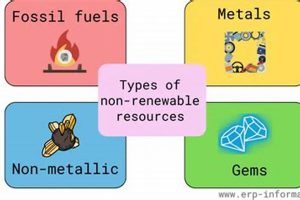
A renewable resource is defined as a naturally replenishing energy source, such as solar, wind, or hydro power. Its use does not deplete the resource over time. Conversely, a non-renewable resource, like fossil fuels, exists in finite quantities and is exhausted upon consumption.
Question 2: Are renewable energy sources perpetually available, irrespective of geographical location or climate conditions?
While renewable energy is generally abundant, its availability can vary. Solar energy is more effective in sunny regions, while wind energy is better suited for areas with consistent wind patterns. Geographical location and climatic conditions directly affect the potential yield of different renewable energy resources.
Question 3: What measures can be implemented to mitigate the variability of renewable energy generation, particularly with resources such as solar and wind?
Variability in renewable energy generation can be addressed through several strategies, including energy storage solutions (e.g., batteries), smart grid technologies that optimize energy distribution, and the diversification of renewable energy sources to ensure a more stable supply.
Question 4: What are the primary environmental impacts associated with the manufacturing and disposal of renewable energy technologies, such as solar panels and wind turbines?
The environmental impacts include resource extraction for manufacturing, energy consumption during production, and end-of-life disposal challenges. These impacts are generally less severe than those associated with fossil fuels but require ongoing efforts to minimize their environmental footprint through recycling and sustainable manufacturing practices.
Question 5: How can governments and individuals contribute to the increased adoption and integration of renewable resources into existing energy infrastructures?
Governments can implement supportive policies, such as tax incentives, feed-in tariffs, and renewable energy mandates. Individuals can reduce their energy consumption, invest in renewable energy systems, and support companies committed to sustainable practices. Both collective and individual actions are necessary to drive widespread adoption.
Question 6: What are the long-term economic benefits of transitioning to a renewable energy-based economy?
The long-term economic benefits include reduced reliance on volatile fossil fuel markets, job creation in the renewable energy sector, and decreased healthcare costs associated with air pollution. A renewable energy economy can also enhance energy security and foster innovation, contributing to sustainable economic growth.
Understanding these factors is critical for informed decision-making regarding renewable energy deployment. The ongoing development and refinement of these technologies are vital for realizing a sustainable energy future.
The subsequent section provides an overview of the future prospects and challenges associated with renewable resource adoption.
10 facts about renewable resources
This exploration has illuminated core tenets of renewable energy, emphasizing sustainability, accessibility, environmental impact, energy security, technological advancement, and economic viability. Each element plays a crucial role in the broader energy landscape, underscoring the need for informed analysis and strategic implementation.
Continued commitment to renewable energy development, coupled with supportive policy frameworks and technological innovation, will be essential for realizing a future powered by clean, sustainable, and secure energy sources. This transition demands proactive engagement and a clear understanding of the challenges and opportunities that lie ahead, shaping a trajectory toward a more resilient and environmentally conscious global energy system.
![Guide to What Energy Resources Are Renewable [+Future] | Renewable Energy Solutions for a Sustainable Future | Clean & Green Power](https://pplrenewableenergy.com/wp-content/uploads/2026/03/th-516-300x200.jpg "Guide to What Energy Resources Are Renewable [+Future] Renewable Energy Solutions for a Sustainable Future | Clean & Green Power")