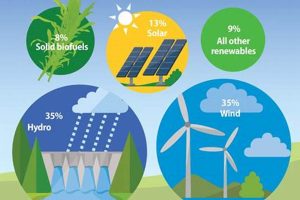
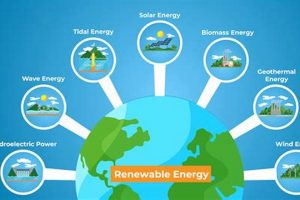
Water’s capacity to be replenished naturally is a fundamental characteristic that positions it as a sustainable power resource. Precipitation, including rainfall and snowfall, continuously refills bodies of water such as rivers, lakes, and reservoirs. This ongoing replenishment distinguishes it from finite resources like fossil fuels.
The constant cycling of water through evaporation, condensation, and precipitation, collectively known as the water cycle, ensures its perpetual availability. This cycle drives hydroelectric power generation, where the kinetic energy of flowing water is converted into electricity. Furthermore, tidal and wave energy technologies harness the mechanical power of ocean movements, contributing to energy production.
Understanding the mechanisms behind its renewability is crucial for developing sustainable energy strategies. Effective water management practices, coupled with technological advancements in hydroelectric and ocean energy technologies, maximize the potential of this resource. This ensures long-term energy security and minimizes reliance on non-renewable alternatives.
Harnessing the Potential
Maximizing the contribution of water to the energy mix requires strategic planning and technological innovation. The following tips outline key considerations for optimizing its use as a renewable resource.
Tip 1: Invest in Hydropower Infrastructure Modernization: Upgrading existing hydroelectric dams enhances efficiency and extends operational lifespan. Implementing advanced turbine designs and control systems optimizes energy generation.
Tip 2: Promote Small-Scale Hydroelectric Projects: Developing smaller hydropower facilities on suitable waterways minimizes environmental impact while providing distributed power generation capabilities. These projects can serve local communities and reduce transmission losses.
Tip 3: Explore Pumped Hydro Storage Solutions: Pumped hydro storage systems utilize surplus electricity to pump water uphill to a reservoir. Releasing the water generates electricity during periods of high demand. This technology facilitates grid stability and integrates intermittent renewable sources.
Tip 4: Support Research and Development in Wave and Tidal Energy: Investing in innovative technologies that harness the energy of ocean waves and tides diversifies the renewable energy portfolio. These resources offer predictable and consistent energy generation potential.
Tip 5: Implement Integrated Water Resource Management: Balancing energy production with other water uses, such as agriculture, domestic consumption, and ecosystem preservation, is crucial for sustainable development. Comprehensive water resource management frameworks ensure equitable access and minimize environmental impacts.
Tip 6: Prioritize Environmental Impact Assessments: Thorough environmental impact assessments are essential for identifying and mitigating potential ecological consequences of hydropower and ocean energy projects. This includes assessing impacts on aquatic habitats, fish migration, and water quality.
Tip 7: Foster Public-Private Partnerships: Collaborative initiatives between government agencies, private companies, and research institutions accelerate the development and deployment of water-based renewable energy technologies. These partnerships leverage expertise and resources to overcome technical and financial barriers.
These strategic recommendations, focusing on infrastructure, technological advancement, and sustainable resource management, provide a framework for responsible and effective utilization. By implementing these practices, the benefits of water’s renewable characteristics can be realized while minimizing potential environmental concerns.
Adopting these tips ensures its long-term contribution to a sustainable and secure energy future.
1. Continuous Replenishment

Continuous replenishment is a foundational element that directly addresses the question of why water qualifies as a sustainable energy source. This property differentiates water from finite resources like fossil fuels, establishing its potential for ongoing energy production.
- The Hydrologic Cycle as the Engine of Renewal
The hydrologic cycle, driven by solar energy, continuously moves water through evaporation, condensation, precipitation, and collection. This cyclical process ensures a perpetual supply of water is available, effectively replenishing sources used for hydropower generation. For example, rainfall replenishes reservoirs behind dams, maintaining the water level necessary for electricity production.
- Rate of Replenishment Versus Consumption
The rate at which water is replenished must exceed or equal the rate at which it is consumed for energy production to be truly sustainable. While the hydrologic cycle is ongoing, factors such as climate change, deforestation, and excessive water usage can disrupt the cycle’s efficiency. Therefore, responsible water management is crucial to ensure the continuous availability of water resources for energy and other needs.
- Geographic Variations in Replenishment Rates
The rate of water replenishment varies significantly across different geographic regions. Areas with high rainfall or snowmelt experience faster replenishment, while arid or semi-arid regions may face water scarcity challenges. Understanding these regional variations is essential for tailoring energy production strategies and minimizing potential water stress. For instance, regions with predictable rainfall patterns are better suited for relying on hydropower as a consistent energy source.
- Impact of Climate Change on Replenishment
Climate change can significantly alter the hydrologic cycle, leading to more frequent and intense droughts in some areas and increased flooding in others. These changes can disrupt the continuous replenishment of water resources, affecting the reliability of hydropower generation and other water-dependent energy technologies. Adaptation strategies, such as improved water storage infrastructure and drought-resistant water management practices, are necessary to mitigate these impacts.
In conclusion, continuous replenishment, driven by the natural water cycle, is a primary factor in water’s designation as a resource for power. However, its true sustainability depends on balancing consumption rates with replenishment rates and implementing responsible management practices that account for regional variations and potential impacts of climate change.
2. Hydrologic Cycle

The hydrologic cycle serves as the fundamental process underlying water’s status as a power resource. This cyclical system, driven by solar energy, encompasses evaporation, condensation, precipitation, and surface runoff. The perpetual movement and renewal of water through these stages ensures the continuous availability of this resource, directly addressing the question of why it is classified as renewable.
The operation of hydroelectric power plants exemplifies the practical significance of the hydrologic cycle. Precipitation, in the form of rain or snow, accumulates in reservoirs. The water held in these reservoirs then flows through turbines, generating electricity. Without the hydrologic cycle replenishing these reservoirs, hydroelectric power generation would be unsustainable. Similarly, the cycles influence on river flow dictates the potential for run-of-river hydroelectric systems. The consistent flow, a direct result of precipitation and runoff, enables continuous energy production.
Understanding the hydrologic cycles influence is crucial for sustainable water resource management. Alterations to land use, deforestation, and climate change can disrupt this cycle, leading to altered precipitation patterns and reduced water availability. By maintaining healthy ecosystems and implementing responsible water management practices, the integrity of the hydrologic cycle can be preserved. This, in turn, safeguards water’s capacity to function as a sustainable power option, ensuring its long-term availability for energy production and other essential uses.
3. Solar Energy Driven

Solar energy serves as the primary driving force behind the hydrologic cycle, which is central to understanding its renewability. Solar radiation initiates the evaporation process, propelling water into the atmosphere and sustaining the continuous cycling of water resources. Without solar energy, the cycle would cease, rendering water unsustainable as a continuous source.
- Evaporation as the Initiating Mechanism
Solar radiation provides the energy required for water to transition from liquid to vapor. This evaporation occurs from bodies of water, soil, and vegetation, transferring moisture into the atmosphere. The scale of evaporation is directly proportional to solar intensity, influencing the amount of water available for subsequent precipitation. Diminished solar radiation would reduce evaporation rates, impacting the overall water cycle and potentially limiting the amount of available for various uses, including electricity generation.
- Atmospheric Circulation and Precipitation
Solar energy also drives atmospheric circulation patterns, influencing the distribution of water vapor across the globe. Uneven heating of the Earth’s surface leads to pressure gradients, creating winds that transport moisture-laden air masses. When these air masses cool and condense, precipitation occurs, replenishing surface and groundwater resources. The spatial distribution of solar energy, therefore, dictates regional precipitation patterns, affecting water availability for renewable energy applications.
- Photosynthesis and Transpiration
Solar energy fuels photosynthesis in plants, a process that indirectly contributes to the hydrologic cycle through transpiration. Plants absorb water from the soil and release it into the atmosphere as vapor through transpiration. This process adds to the overall atmospheric moisture content, influencing precipitation patterns. Deforestation reduces transpiration rates, potentially affecting local and regional water cycles and impacting the sustainability of water resources.
- Glacial and Snowmelt Dynamics
Solar radiation plays a significant role in melting glaciers and snowpack, contributing to surface water runoff and replenishing rivers and streams. Snowmelt is a crucial water source for many regions, providing a reliable supply of water during the dry season. Climate change, driven by increased greenhouse gas concentrations, is accelerating glacial melt, altering snowmelt patterns, and impacting the long-term availability of water resources for renewable energy production.
These facets underscore the inextricable link between solar energy and the renewability of water. By driving the hydrologic cycle, influencing atmospheric circulation, and contributing to transpiration and snowmelt dynamics, solar energy ensures the continuous availability of water for various applications, including power generation. Understanding and mitigating the impacts of climate change on solar radiation and the water cycle is crucial for maintaining the sustainability of this resource.
4. Gravity's Role

Gravity is a fundamental force that directly contributes to the renewable nature of water. Its influence shapes the movement and distribution of water across the Earth’s surface, enabling various processes essential for power generation. Understanding gravity’s role elucidates key aspects of the water cycle and its implications for sustainable energy production.
- Precipitation and Downward Flow
Gravity is the driving force behind precipitation. Once water vapor condenses in the atmosphere, gravity pulls it back to the Earth’s surface as rain, snow, sleet, or hail. This downward flow replenishes surface water bodies, such as rivers, lakes, and reservoirs, which are crucial for hydroelectric power generation. Without gravity, precipitation would not occur, and these water sources would not be consistently replenished.
- Surface Runoff and River Systems
Gravity facilitates surface runoff, directing water flow from higher elevations to lower elevations. This process creates river systems, which are a primary source for hydropower. The consistent flow of water within these systems is a direct result of gravity pulling water downhill, enabling continuous energy generation. The steeper the gradient, the greater the potential energy that can be harnessed.
- Groundwater Recharge and Aquifer Systems
Gravity plays a role in groundwater recharge. As water infiltrates the soil, gravity pulls it downward, replenishing underground aquifers. These aquifers can serve as a reservoir for water storage, providing a consistent supply of water even during periods of low precipitation. The slow and steady flow of groundwater is also influenced by gravity, contributing to the overall stability of water resources.
- Hydroelectric Power Generation
Hydroelectric power plants leverage gravity to convert potential energy into electricity. Water stored in reservoirs at higher elevations is released, and gravity accelerates its flow through turbines. The kinetic energy of the water spins the turbines, generating electricity. The height difference between the reservoir and the turbine, known as the hydraulic head, directly influences the amount of energy that can be produced. The greater the head, the more energy can be generated due to gravity’s influence.
In conclusion, gravity is an essential component of the water cycle, ensuring the continuous movement and distribution of water resources. Its influence on precipitation, surface runoff, groundwater recharge, and hydroelectric power generation directly supports the renewable nature. Utilizing these insights, while managing factors such as water consumption and environmental impact, the role of gravity in sustainable power development can be enhanced.
5. Sustainable Management
Sustainable management is an integral aspect of maintaining waters status as a perpetually available power resource. While the hydrological cycle naturally replenishes water supplies, human actions significantly influence its long-term availability and suitability for energy production. Effective management strategies are essential to ensure that water resources are utilized responsibly, mitigating potential negative impacts on ecosystems and other water users.
- Balancing Water Use for Energy and Other Sectors
Sustainable management requires a holistic approach that considers the competing demands for water from various sectors, including energy, agriculture, domestic consumption, and industry. Prioritizing efficient water allocation strategies and minimizing water waste is crucial to ensuring that sufficient water remains available for power generation without compromising other essential water uses. For example, implementing water-efficient irrigation techniques in agriculture can reduce overall water demand, freeing up resources for hydropower production.
- Protecting Water Quality and Ecosystem Health
Maintaining water quality is paramount for the sustainable use of water. Pollution from industrial discharges, agricultural runoff, and sewage can degrade water quality, rendering it unsuitable for various uses, including power generation. Protecting water quality through pollution control measures and ecosystem restoration projects is essential for ensuring the long-term viability of water resources. Healthy aquatic ecosystems also play a crucial role in regulating water flow and maintaining water quality.
- Adapting to Climate Change Impacts
Climate change poses a significant threat to water resources, potentially altering precipitation patterns, increasing the frequency and intensity of droughts and floods, and accelerating glacial melt. Sustainable management practices must incorporate climate change adaptation strategies to mitigate these impacts and ensure the resilience of water supplies. This includes developing drought-resistant water management plans, investing in water storage infrastructure, and promoting water conservation measures.
- Promoting Stakeholder Engagement and Collaboration
Effective water management requires the active participation and collaboration of all stakeholders, including government agencies, private sector entities, local communities, and environmental organizations. Collaborative decision-making processes that consider the diverse perspectives and needs of all stakeholders are essential for developing sustainable water management policies and practices. Transparent communication and public education can also promote responsible water use and foster a sense of shared responsibility for protecting water resources.
The long-term sustainability of water as a power source hinges on the implementation of responsible management practices that balance competing water demands, protect water quality, adapt to climate change impacts, and promote stakeholder engagement. By prioritizing sustainable management, water resources can continue to contribute to energy production while safeguarding the environment and ensuring equitable access for all.
Frequently Asked Questions
The following section addresses common inquiries regarding water’s status as a sustainable energy resource, providing detailed explanations and clarifying potential misconceptions.
Question 1: What fundamentally defines water as a renewable resource when utilized for energy production?
Its classification stems from the continuous natural replenishment through the hydrologic cycle, a process driven by solar energy and gravity. This cycle ensures a perpetual supply, distinguishing it from finite resources such as fossil fuels.
Question 2: How does the hydrologic cycle directly contribute to water’s renewability?
The cycle involves evaporation, condensation, precipitation, and runoff, creating a continuous flow of water. This process replenishes rivers, lakes, and reservoirs used for hydroelectric power, guaranteeing a sustainable source of energy when managed responsibly.
Question 3: What role does solar energy play in ensuring water remains a sustainable power source?
Solar energy drives evaporation, the initial stage of the hydrologic cycle. This process lifts water into the atmosphere, setting the stage for precipitation and the subsequent replenishment of surface and groundwater resources.
Question 4: How does gravity factor into the equation of water’s renewability for energy generation?
Gravity pulls water back to Earth as precipitation and facilitates surface runoff, channeling water into rivers and reservoirs. Additionally, it drives the flow of water through turbines in hydroelectric plants, converting potential energy into electricity.
Question 5: Is water’s availability as a power resource guaranteed indefinitely, or are there potential limitations?
While the hydrologic cycle is ongoing, factors such as climate change, deforestation, and unsustainable water management practices can disrupt the cycle and reduce water availability. Responsible water resource management is crucial.
Question 6: What are some critical strategies for ensuring the sustainability of water use in energy production?
Key strategies include implementing efficient water allocation policies, protecting water quality, adapting to climate change impacts, and promoting collaboration among stakeholders to balance competing water demands.
Understanding these aspects of water’s renewable nature is vital for developing and implementing effective strategies for sustainable energy production and responsible resource management.
This concludes the frequently asked questions section. The following segments will address practical applications and potential challenges related to harnessing water for renewable energy.
Why is Water a Renewable Energy Source
The preceding exploration has elucidated why water is considered a renewable energy source, emphasizing the fundamental role of the hydrologic cycle, solar energy, and gravity. The continuous replenishment driven by these natural processes distinguishes water from depletable resources, positioning it as a sustainable option for power generation. However, the inherent renewability is contingent upon responsible management practices that address competing water demands, protect water quality, and mitigate the impacts of climate change.
Sustained viability requires a commitment to informed decision-making, technological innovation, and collaborative stewardship. Prioritizing these principles secures the long-term contribution of this vital resource to a diversified and sustainable energy future. Recognizing water as a renewable source necessitates a corresponding recognition of the responsibility to safeguard its availability and integrity for generations to come.