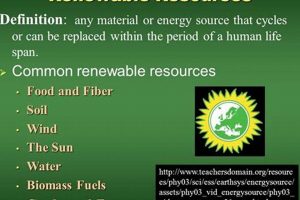
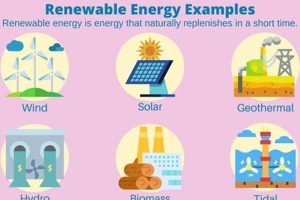
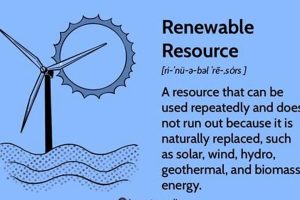
Sources of energy that replenish naturally on a human timescale, such as solar, wind, hydro, geothermal, and biomass, represent a sustainable alternative to finite fossil fuels. These resources derive from naturally recurring processes, constantly renewed by the environment. For instance, solar radiation, wind patterns, and water cycles are perpetually occurring phenomena harnessed to generate power.
The adoption of such resources is crucial for mitigating climate change and ensuring long-term energy security. Their utilization reduces greenhouse gas emissions, diminishes reliance on volatile global fuel markets, and fosters localized energy production. Historically, civilizations have depended on naturally replenishing resources like wind and water power for various purposes; however, technological advancements have significantly broadened the scope and efficiency of their application.
Understanding the diverse types, deployment methods, and economic considerations associated with these self-replenishing sources is essential for informed decision-making regarding energy infrastructure and policy. Analyzing their potential impact on environmental sustainability and global energy transition is vital for shaping a resilient and environmentally responsible future.
Harnessing Self-Replenishing Energy Sources
The following considerations are crucial for effectively leveraging sources of energy that renew themselves naturally over time. Implementing these tips can optimize investment and maximize the beneficial impact of such resources.
Tip 1: Diversify Energy Portfolio: Avoid over-reliance on a single source. Integrate various options such as solar, wind, and hydro power to buffer against resource variability and enhance energy security. For example, combining solar power generation with wind power can provide a more stable energy supply across different weather conditions.
Tip 2: Conduct Comprehensive Resource Assessments: Prior to investment, thoroughly evaluate the availability and consistency of each chosen source. This involves analyzing solar irradiance levels, wind speeds, water flow rates, and geothermal potential at the specific project location. Accurate data is critical for predicting energy output and optimizing system design.
Tip 3: Prioritize Energy Storage Solutions: Address the intermittent nature of certain sources by integrating energy storage technologies. Battery storage systems, pumped hydro storage, and thermal storage can mitigate fluctuations and ensure a continuous power supply. Consider the scale and type of storage that best complements the chosen source and the demand profile.
Tip 4: Embrace Smart Grid Technologies: Implement smart grid solutions to optimize energy distribution and consumption. Smart grids enable real-time monitoring, adaptive control, and enhanced communication between energy producers and consumers, maximizing efficiency and reducing waste. This facilitates the integration of distributed generation and demand response programs.
Tip 5: Promote Supportive Policy Frameworks: Advocate for government policies that incentivize the adoption of energy sources which renew themselves naturally. This includes feed-in tariffs, tax credits, renewable energy mandates, and streamlined permitting processes. A stable and predictable regulatory environment is essential for attracting investment and driving widespread deployment.
Tip 6: Invest in Ongoing Research and Development: Support continuous innovation in renewable energy technologies. This includes improvements in solar panel efficiency, wind turbine design, energy storage capacity, and grid integration techniques. Technological advancements are crucial for reducing costs and improving the performance of energy systems which renew themselves naturally over time.
These guidelines provide a framework for effectively integrating naturally replenishing energy sources into the energy landscape, fostering a more sustainable and secure future. By implementing these considerations, stakeholders can maximize the benefits of these resources and contribute to a cleaner energy economy.
Moving forward, a holistic approach that integrates technological innovation, strategic planning, and supportive policies will be paramount to realizing the full potential of self-replenishing energy sources in addressing global energy challenges.
1. Solar Irradiation

Solar irradiation, the electromagnetic radiation emitted by the sun, constitutes a primary energy source for numerous processes on Earth and forms a cornerstone of solar energy, a key category within naturally replenishing sources. This radiant energy drives photosynthesis, weather patterns, and ocean currents, while also providing a direct input for electricity generation via photovoltaic (PV) systems and solar thermal power plants. The intensity of solar irradiation varies geographically, seasonally, and diurnally, influencing the efficiency and productivity of solar energy technologies.
The effective utilization of solar irradiation requires a comprehensive understanding of its characteristics and availability. Solar resource assessment, involving detailed measurements and modeling, is crucial for determining the optimal location, orientation, and design of solar energy installations. For instance, regions with high solar irradiation levels, such as the southwestern United States and desert areas in the Middle East, exhibit significant potential for large-scale solar power generation. Solar farms in these locations convert sunlight into electricity, contributing to grid stabilization and reducing reliance on fossil fuels. The output of these farms, however, is dependent on atmospheric conditions and the time of day.
In conclusion, solar irradiation’s role as a readily available and perpetually renewed energy source makes it fundamental to the development of sustainable energy systems. Overcoming challenges related to intermittency through energy storage solutions and optimizing the efficiency of solar technologies will be critical for maximizing its contribution to a low-carbon energy future. A thorough grasp of solar irradiation’s nuances is therefore essential for effective implementation of naturally replenishing energy strategies, ensuring a more sustainable future.
2. Wind Kinetic
Wind kinetic energy, a naturally replenishing resource, represents the energy inherent in moving air masses. Its conversion into usable power through wind turbines is a critical element in the portfolio of which is renewable resources. The viability and efficiency of wind energy systems hinge on understanding and harnessing this kinetic force.
- Turbine Technology and Efficiency
Wind turbines convert the kinetic energy of wind into mechanical energy, subsequently transformed into electrical energy. Turbine design, blade aerodynamics, and generator technology directly impact the efficiency of this conversion. Larger turbines, strategically placed in areas with consistent high wind speeds, yield greater energy output, maximizing the capture of wind kinetic energy for electricity generation. For instance, offshore wind farms often employ larger turbines due to more consistent wind conditions.
- Geographical Wind Resource Assessment
The availability and consistency of wind resources vary significantly by geographic location. Wind resource assessment involves mapping and analyzing wind patterns, including average wind speeds, turbulence intensity, and prevailing wind directions. Areas with consistently high wind speeds, such as coastal regions, mountain passes, and open plains, are prime locations for wind energy development. Accurate resource assessment is crucial for determining the economic feasibility and energy output of wind projects, ensuring the efficient utilization of wind kinetic energy.
- Grid Integration Challenges
Integrating wind energy into existing power grids presents unique challenges due to the intermittent nature of wind resources. Wind power output fluctuates based on weather conditions, necessitating grid management strategies to maintain stability and reliability. Smart grid technologies, energy storage solutions, and geographically dispersed wind farms can mitigate these challenges, ensuring a consistent supply of electricity from wind kinetic energy. Balancing supply and demand is crucial for effective grid integration.
- Environmental Considerations
While wind energy offers a clean alternative to fossil fuels, it is not without environmental impacts. Wind turbines can pose risks to avian wildlife and affect local ecosystems. Careful site selection, turbine design, and mitigation strategies are essential to minimize these impacts. Environmental impact assessments and ongoing monitoring are crucial for ensuring the sustainable deployment of wind energy, balancing energy production with ecological preservation, to support strategies that identify which is renewable resources.
The successful implementation of wind energy projects depends on a comprehensive understanding of wind kinetic energy and its interactions with technology, geography, grid infrastructure, and the environment. By addressing these facets, it is possible to maximize the contribution of wind power to a sustainable energy future and fully leverage the potential of which is renewable resources in meeting global energy demands.
3. Hydro Potential

Hydro potential, representing the energy inherent in water resources, constitutes a significant component within the realm of which is renewable resources. Its effective utilization involves converting the potential and kinetic energy of water into electricity, contributing substantially to global energy production and playing a pivotal role in sustainable energy strategies. Harnessing hydro potential necessitates a comprehensive understanding of hydrological cycles, hydraulic engineering, and environmental considerations.
- Hydrological Cycle and Water Availability
The hydrological cycle, encompassing precipitation, evaporation, and runoff, dictates the availability of water for hydroelectric power generation. Variations in precipitation patterns, influenced by climate change, directly impact the reliability of hydro potential as an energy source. Regions with consistent and abundant rainfall or snowmelt exhibit greater potential for hydropower development. Efficient water resource management is crucial for ensuring the long-term sustainability of hydroelectric operations, maintaining a balance between energy production and environmental stewardship. For example, the seasonal melting of snowpack in mountainous regions provides a reliable water source for hydropower generation during the spring and summer months.
- Dam Infrastructure and Power Generation
Dam infrastructure, including dams, reservoirs, and penstocks, facilitates the conversion of hydro potential into electricity. The design and operation of dams significantly influence the efficiency of power generation and the environmental impact on river ecosystems. Dams impound water, creating a head that drives turbines and generators to produce electricity. Run-of-river hydroelectric plants, which utilize the natural flow of water without significant impoundment, offer a less disruptive alternative to conventional dam construction. Properly managed infrastructure maximizes electricity production while minimizing environmental consequences.
- Environmental Impacts and Mitigation Strategies
Hydropower development can have significant environmental impacts, including altered river flows, habitat fragmentation, and changes in water quality. Mitigation strategies, such as fish passages, minimum flow requirements, and reservoir management practices, are essential for minimizing these impacts. Careful site selection, comprehensive environmental impact assessments, and stakeholder engagement are crucial for ensuring the sustainable development of hydropower resources, supporting environmental stability alongside energy production.
- Economic Considerations and Energy Storage
Hydropower projects involve substantial upfront capital investments, but offer long-term operational benefits and relatively low operating costs. The economic viability of hydropower depends on factors such as water availability, construction costs, electricity prices, and environmental regulations. Pumped hydro storage, which uses surplus electricity to pump water uphill for later release, provides a valuable energy storage solution for integrating intermittent renewable energy sources into the grid, increasing both the reliability and economic attractiveness of hydro potential.
The multifaceted nature of hydro potential, encompassing hydrological processes, engineering infrastructure, environmental impacts, and economic considerations, underscores its significance as a renewable energy resource. Successfully harnessing hydro potential requires a holistic approach that balances energy production with environmental sustainability, ensuring its continued contribution to a cleaner and more reliable energy future. Further research and technological innovation will play a crucial role in maximizing the benefits of hydro potential within the broader context of which is renewable resources.
4. Geothermal Gradient
The geothermal gradient, the rate at which Earth’s temperature increases with depth, serves as a critical factor in determining the viability and efficiency of geothermal energy extraction. As a fundamental element of Earth’s internal heat, the geothermal gradient directly influences the accessibility and sustainability of this particular naturally replenishing resource. Locations with a higher geothermal gradient, indicating a faster temperature increase with depth, generally offer more favorable conditions for geothermal power generation. This enhanced heat flow reduces the drilling depth required to reach usable temperatures, thereby lowering project costs and increasing overall energy output. For instance, Iceland, situated on a volcanic hotspot, exhibits a significantly higher geothermal gradient compared to stable continental regions, enabling extensive geothermal power production for electricity generation and district heating. Thus, a pronounced geothermal gradient directly enhances the economic and operational benefits of geothermal energy, solidifying its role within the spectrum of naturally replenishing energy sources.
The practical applications of understanding the geothermal gradient extend beyond traditional geothermal power plants. Enhanced Geothermal Systems (EGS) leverage artificially created fractures in hot, dry rocks to access geothermal energy in regions with otherwise insufficient permeability. The effectiveness of EGS heavily relies on accurate measurements and modeling of the geothermal gradient to identify optimal drilling locations and predict heat extraction rates. Furthermore, shallow geothermal systems, utilizing ground-source heat pumps, capitalize on the relatively constant temperature of the Earth’s subsurface for heating and cooling buildings. The performance of these systems is directly influenced by the near-surface geothermal gradient, which determines the temperature differential between the ground and the ambient air. Thus, a precise understanding of the geothermal gradient is essential for optimizing the design and operation of a wide range of geothermal energy technologies, maximizing their contribution to sustainable energy solutions.
In summary, the geothermal gradient is a fundamental parameter governing the feasibility and effectiveness of geothermal energy as a naturally replenishing resource. Its magnitude directly impacts project economics, technological implementation, and overall energy output. Accurate assessment and modeling of the geothermal gradient are crucial for optimizing geothermal energy extraction and ensuring its sustainable contribution to a diversified and environmentally responsible energy portfolio. Overcoming challenges associated with characterizing the geothermal gradient in complex geological settings will be essential for unlocking the full potential of this valuable renewable energy source.
5. Biomass Carbon

Biomass carbon, representing the carbon content within organic matter derived from plants and animals, occupies a complex position within the context of which is renewable resources. Its categorization as a renewable resource hinges on sustainable management practices that ensure carbon neutrality and minimize environmental impact. Proper management balances carbon sequestration with carbon emissions.
- Carbon Neutrality and Sustainability
The purported renewability of biomass carbon relies on achieving carbon neutrality, wherein the carbon released during combustion or decomposition is offset by the carbon absorbed during the growth of new biomass. Sustainable forestry and agricultural practices are essential for ensuring this balance. For example, harvesting trees at a rate that matches or falls below the rate of new tree growth maintains carbon sequestration. However, unsustainable practices, such as deforestation or excessive land clearing, can result in net carbon emissions, undermining biomass’s renewable status.
- Types of Biomass Feedstocks
Biomass feedstocks encompass a wide range of organic materials, including wood, agricultural residues, energy crops, and organic waste. Each feedstock type possesses unique characteristics regarding carbon content, energy density, and environmental impact. For instance, energy crops, such as switchgrass and miscanthus, are specifically cultivated for energy production and can offer higher yields and lower environmental impacts compared to traditional crops. The choice of feedstock significantly influences the sustainability and carbon footprint of biomass energy systems.
- Conversion Technologies and Emissions
Biomass can be converted into various forms of energy, including heat, electricity, and biofuels, using a range of technologies such as combustion, gasification, and anaerobic digestion. The emissions associated with these conversion processes vary depending on the technology and feedstock used. Modern biomass power plants often employ advanced emission control technologies to reduce particulate matter, nitrogen oxides, and other pollutants. However, inefficient or outdated conversion processes can result in higher emissions, negating some of the environmental benefits of biomass energy.
- Land Use and Ecosystem Impacts
The widespread cultivation of biomass feedstocks can have significant land use and ecosystem impacts, including deforestation, habitat loss, and competition with food production. Sustainable biomass production requires careful land management practices that minimize these impacts and promote biodiversity. Integrated approaches, such as agroforestry and the utilization of marginal lands, can help mitigate land use conflicts and enhance the environmental sustainability of biomass energy systems. Balancing land use considerations with energy production goals is essential for ensuring the long-term viability of biomass as a renewable resource.
The integration of biomass carbon into a sustainable energy portfolio requires a comprehensive assessment of its carbon cycle, feedstock sources, conversion technologies, and land use implications. While biomass holds the potential to contribute to a low-carbon energy future, realizing this potential necessitates responsible management practices that prioritize carbon neutrality, environmental sustainability, and ecosystem integrity. A holistic approach is imperative for maximizing the benefits of biomass within the framework of which is renewable resources.
6. Tidal Movement

Tidal movement, the periodic rise and fall of sea levels caused by the gravitational forces of the moon and sun, represents a consistent and predictable source of energy directly relevant to which is renewable resources. Its predictable nature distinguishes it from other intermittent renewable sources, offering potential for stable and reliable power generation.
- Tidal Range and Energy Potential
Tidal range, the vertical difference between high and low tides, directly influences the amount of energy that can be harnessed. Locations with larger tidal ranges, such as the Bay of Fundy in Canada, possess greater potential for tidal power generation. Tidal barrages, which create a reservoir to store water during high tide and release it through turbines during low tide, capitalize on this difference in water level. Understanding tidal range variations is crucial for determining the economic viability of tidal energy projects.
- Tidal Stream Velocity and Turbine Technology
Tidal stream velocity, the speed of water currents during tidal flow, represents another key factor in harnessing tidal energy. Tidal stream turbines, similar to underwater wind turbines, convert the kinetic energy of tidal currents into electricity. Areas with strong tidal currents, such as narrow straits and channels, offer ideal locations for tidal stream turbine deployment. The design and placement of these turbines are crucial for maximizing energy capture while minimizing environmental impacts.
- Environmental Considerations and Mitigation
Harnessing tidal energy can have environmental consequences, including alterations to tidal flow patterns, habitat disturbance, and potential impacts on marine life. Tidal barrages can obstruct fish migration and alter sediment transport, while tidal stream turbines can pose risks to marine mammals and seabirds. Careful site selection, environmental impact assessments, and mitigation strategies are essential for minimizing these impacts and ensuring the sustainable development of tidal energy resources.
- Economic Feasibility and Grid Integration
Tidal energy projects involve significant upfront capital investments, but offer the potential for long-term operational benefits and relatively low operating costs. The economic feasibility of tidal energy depends on factors such as tidal range, tidal stream velocity, construction costs, and electricity prices. Integrating tidal energy into existing power grids presents unique challenges due to the cyclical nature of tidal flows. Energy storage solutions and grid management strategies are necessary to ensure a reliable and consistent supply of electricity from tidal resources.
The utilization of tidal movement as a renewable energy resource requires a thorough understanding of tidal dynamics, environmental considerations, and economic factors. While tidal energy offers the potential for predictable and sustainable power generation, responsible development practices are crucial for minimizing environmental impacts and ensuring its long-term viability within the framework of which is renewable resources.
Frequently Asked Questions
This section addresses common queries regarding renewable resources, clarifying their characteristics and implications for sustainable energy.
Question 1: What fundamentally distinguishes renewable resources from non-renewable ones?
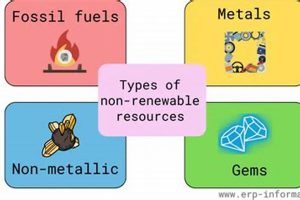
Renewable resources replenish naturally within a human lifespan. Non-renewable resources, like fossil fuels, exist in finite quantities and are depleted faster than they can be replenished.
Question 2: Are all renewable resources equally environmentally friendly?
No. While generally cleaner than fossil fuels, the environmental impact of various renewable resources varies. Large-scale hydropower, for example, can alter river ecosystems, while biomass energy may require significant land use.
Question 3: Can a nation entirely rely on renewable resources for its energy needs?
Transitioning to 100% reliance on renewable resources is technically feasible but presents challenges. Intermittency, storage requirements, and infrastructure investments require careful planning and technological advancements.
Question 4: What role does technological advancement play in expanding the use of renewable resources?
Technological innovations are crucial for improving the efficiency, reducing the costs, and enhancing the reliability of renewable energy technologies. Advancements in solar panels, wind turbines, and energy storage systems are essential for widespread adoption.
Question 5: How do governmental policies impact the development and deployment of renewable resources?
Governmental policies, such as tax incentives, renewable energy mandates, and carbon pricing, can significantly influence the economic viability and market penetration of renewable resources. Supportive policies create a favorable environment for investment and innovation.
Question 6: What are the primary limitations hindering the widespread adoption of renewable resources?
Key limitations include intermittency of some resources (solar and wind), geographic constraints, high upfront costs for certain technologies, and the need for significant grid infrastructure upgrades.
Renewable resources offer a pathway to a more sustainable energy future. Overcoming the associated challenges through innovation, strategic planning, and supportive policies is crucial for realizing their full potential.
The next section explores the future prospects and challenges facing renewable energy development.
Renewable Resources
This exposition has clarified the definition, significance, and diverse forms of energy resources that naturally replenish. Solar irradiation, wind kinetic, hydro potential, geothermal gradient, biomass carbon (when sustainably managed), and tidal movement all represent vital components of a sustainable energy future. The integration of these energy sources necessitates careful consideration of technological advancements, environmental impacts, economic feasibility, and supportive policy frameworks. A comprehensive understanding of these factors is paramount for effective implementation and long-term viability.
The sustained global demand for energy compels a decisive shift toward these renewable options. Addressing the challenges of intermittency, infrastructure development, and responsible resource management is not merely an option, but a fundamental requirement for mitigating climate change, ensuring energy security, and safeguarding the planet for future generations. The successful transition to an energy economy powered by renewable sources demands unwavering commitment, strategic investment, and a collective dedication to sustainable practices. The time for decisive action is now.
![Guide to What Energy Resources Are Renewable [+Future] | Renewable Energy Solutions for a Sustainable Future | Clean & Green Power](https://pplrenewableenergy.com/wp-content/uploads/2026/03/th-516-300x200.jpg "Guide to What Energy Resources Are Renewable [+Future] Renewable Energy Solutions for a Sustainable Future | Clean & Green Power")