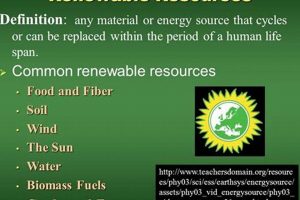
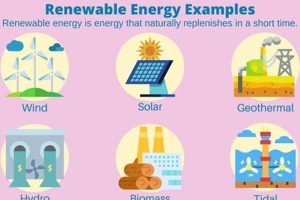
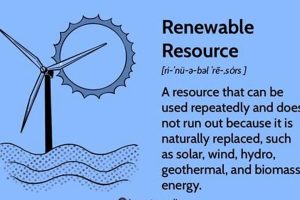
These sources of power are derived from natural processes that are replenished at a higher rate than they are consumed. This means that, unlike fossil fuels, their availability is not finite. Examples include solar radiation harnessed through photovoltaic cells or thermal systems, wind power captured by turbines, geothermal energy extracted from the Earth’s internal heat, hydropower derived from flowing water, and biomass energy produced from organic matter.
Utilization of these energy forms is crucial for mitigating climate change and reducing reliance on environmentally damaging fossil fuels. They offer numerous benefits, including decreased air and water pollution, enhanced energy security, and the creation of new jobs in the green energy sector. Historically, societies have relied on some forms of this energy, such as hydropower and biomass, for centuries, but recent technological advancements have significantly expanded the potential and efficiency of other sources.
The subsequent sections of this article will delve into the specific technologies associated with these power sources, explore their economic feasibility, examine their environmental impacts, and analyze the policies needed to promote their widespread adoption and integration into the global energy mix.
Practical Guidance for Maximizing the Potential of these Power Sources
The following guidelines aim to provide actionable insights into how best to leverage power derived from naturally replenishing sources, ensuring efficient utilization and long-term sustainability.
Tip 1: Conduct a Comprehensive Resource Assessment: Before investing in any infrastructure, thoroughly evaluate the availability and consistency of the resource in the specific location. For example, solar irradiance levels should be analyzed over multiple years to determine the optimal size and type of photovoltaic system.
Tip 2: Prioritize Energy Efficiency Measures: Reduce overall energy demand through improvements in building design, industrial processes, and transportation. Lowering consumption makes the transition to alternative power sources more manageable and cost-effective.
Tip 3: Implement Smart Grid Technologies: Enhance grid flexibility and reliability through the integration of smart meters, advanced sensors, and data analytics. This allows for better management of fluctuating energy output from sources like wind and solar.
Tip 4: Diversify Energy Portfolio: Relying on a single type of renewable energy source can create vulnerabilities. A balanced mix of solar, wind, hydro, and geothermal reduces risk and ensures a more stable supply.
Tip 5: Support Research and Development: Invest in advancements in energy storage technologies, materials science, and system integration. These innovations are crucial for improving the performance and affordability of alternative energy.
Tip 6: Establish Clear Regulatory Frameworks: Governments should create stable and predictable policies that incentivize investment in clean energy, streamline permitting processes, and establish clear standards for grid connection.
Tip 7: Promote Public Awareness and Education: Inform the public about the benefits of alternative energy and encourage adoption through incentives and educational programs. Addressing misinformation is critical for building support.
Implementing these suggestions will accelerate the transition towards cleaner energy systems, leading to significant reductions in greenhouse gas emissions and greater energy independence.
The concluding section of this article will synthesize the key findings and offer a forward-looking perspective on the future of energy production.
1. Sustainability

Sustainability forms a cornerstone of the definition. The core concept dictates that energy production should not deplete resources faster than their natural replenishment rate. Without this characteristic, a resource, regardless of its environmental impact, cannot be genuinely categorized within the scope of “renewable energy resources”. Sustainability ensures long-term viability, preventing the transition to an energy source that ultimately faces depletion akin to fossil fuels. For example, sustainable forestry practices are essential for biomass energy to be considered truly renewable; unchecked deforestation would undermine the sustainability of this resource, negating its intended benefits.
The link between sustainability and renewable energy extends beyond mere availability. It encompasses the broader environmental and social consequences of energy production. A sustainable resource extraction process minimizes ecological damage, protects biodiversity, and respects the needs of future generations. Conversely, even if a resource replenishes rapidly, unsustainable harvesting methods can lead to environmental degradation, rendering the practice ecologically unsound. Consider hydroelectric power; while water is a constantly renewing resource, the construction of large dams can disrupt ecosystems, displace communities, and alter riverine environments, thereby compromising the overall sustainability of the energy source.
In conclusion, sustainability is not merely an ancillary benefit, but an integral component of the definition. Its presence determines whether a resource genuinely qualifies as “renewable”. Therefore, assessing sustainability is essential when evaluating energy options. Addressing ecological footprint is critical for ensuring that the pursuit of alternative energy truly provides a long-term sustainable and environmentally sound solution.
2. Replenishment Rate

The defining characteristic distinguishing power from finite resources, such as fossil fuels, lies in its ability to naturally regenerate within a human timescale. This rate of renewal is pivotal. For a source to be appropriately categorized as within the scope of sustainable energy, its regeneration must outpace consumption. An imbalance where usage exceeds replenishment would invariably lead to depletion, mirroring the trajectory of non-replenishable commodities. Solar radiation serves as a quintessential illustration; the continuous flux of solar energy onto Earth guarantees a perpetually available energy stream, provided appropriate capture mechanisms are implemented. Similarly, wind patterns, driven by solar-induced temperature differentials, consistently circulate the atmosphere, offering a continual source of mechanical energy for turbines. Conversely, resources with negligibly slow renewal processes are excluded from this designation, irrespective of their other attributes.
The practical significance of understanding replenishment rate extends to resource management and technology deployment. Solar and wind, while continually replenished, exhibit intermittency due to diurnal and meteorological variations. Consequently, energy storage technologies or grid integration strategies are essential to ensure consistent power delivery. Hydropower, dependent on precipitation and river flow, requires careful watershed management to maintain adequate water levels for sustained electricity generation. Geothermal energy extraction must be meticulously monitored to prevent reservoir depletion and maintain long-term viability. Ignoring the inherent replenishment dynamics leads to operational inefficiencies, environmental harm, and ultimately, the erosion of the energy sources supposed sustainability.
In summary, an adequate replenishment rate is not merely a desirable attribute but a fundamental criterion for classifying any resource under the umbrella of sources for energy. Accurate assessment and responsible management of the replenishment rate are essential to ensure the lasting availability of energy, aligning its production with the principles of environmental preservation. Therefore, understanding replenishment rates is critical for making responsible energy decisions.
3. Natural Processes
The foundation of sustainable energy rests upon the continuous operation of naturally occurring phenomena. These resources inherently derive their power from ongoing cycles and systems that are self-sustaining. Without the continuous action of these processes, sources would be finite and, therefore, incompatible with the concept. Solar radiation, for instance, originates from nuclear fusion reactions within the sun, a continuous process that delivers a constant energy flux to Earth. Wind patterns are driven by differential heating of the Earth’s surface, a meteorological process that ensures the constant movement of air masses. Hydropower is predicated on the water cycle, encompassing evaporation, precipitation, and runoff, which continuously replenishes water reservoirs. Geothermal energy taps into the Earth’s internal heat, a consequence of radioactive decay and residual heat from planetary formation, a long-lasting though not indefinitely renewable process in the strictest sense. Biomass energy leverages the photosynthetic capabilities of plants, converting sunlight into chemical energy, thus closing the loop in a cycle of energy capture and release.
The reliance on the Earth’s continuous operation carries practical implications for energy resource management. The intermittent nature of solar and wind resources necessitates sophisticated grid management strategies, including energy storage solutions and geographically dispersed generation sites, to ensure continuous power supply. The efficiency of hydropower generation is directly influenced by watershed management practices that preserve water quality and regulate river flows. Geothermal power plants must be carefully sited to avoid depleting subsurface heat reservoirs and inducing seismic activity. Sustainable biomass production requires careful forest management practices and the use of agricultural residues to avoid deforestation and land degradation. Furthermore, it is also required to be consider about climate changes which impacts the process of nature.
In summary, natural processes are inextricably linked to the viability of sources of power. Their ongoing operation guarantees the long-term availability. Responsible stewardship of these processes through sustainable management practices is essential for maximizing the potential of energy sources. Failing to understand this connection will undermine the ability to harness these energy sources and, ultimately, jeopardize the transition to a sustainable energy future.
4. Environmental Benefits

The appeal of energy derived from naturally replenishing sources is substantially enhanced by the marked advantages offered to the environment, an aspect integral to a full appreciation of these resources.
- Reduced Greenhouse Gas Emissions
Conventional electricity generation relying on fossil fuels releases substantial quantities of carbon dioxide (CO2), methane (CH4), and nitrous oxide (N2O), all potent greenhouse gases. Utilizing renewable sources significantly diminishes these emissions, contributing to the mitigation of climate change. For example, solar, wind, and hydropower facilities produce electricity with near-zero direct greenhouse gas emissions during operation. This reduction is crucial in limiting global warming and its associated impacts, such as sea-level rise and extreme weather events.
- Diminished Air and Water Pollution
Burning fossil fuels results in the emission of particulate matter, sulfur dioxide (SO2), nitrogen oxides (NOx), and mercury, all of which degrade air and water quality. Renewable energy technologies generally produce far fewer pollutants. Wind and solar power generation, for instance, release virtually no air pollutants. Hydropower can impact water quality through dam construction and reservoir management, but these effects are often less severe than those from coal-fired power plants. The minimized pollution contributes to improved public health, reduced respiratory illnesses, and cleaner aquatic ecosystems.
- Decreased Water Consumption
Conventional power plants, particularly coal and nuclear facilities, require significant quantities of water for cooling processes. This water consumption can strain local water resources, especially in arid regions. Renewable energy technologies often have lower water requirements. Wind and solar photovoltaic systems require minimal water during operation. Geothermal power plants can utilize closed-loop systems that recycle water. Reducing water consumption helps conserve this vital resource, particularly in areas prone to drought or water scarcity.
- Land Use Considerations and Habitat Preservation
While renewable energy facilities require land for deployment, the environmental impact can be mitigated through careful planning and siting. Wind farms, for example, can coexist with agricultural operations. Solar installations can be placed on rooftops or brownfield sites. Hydropower dams can alter riverine habitats, but mitigation measures, such as fish ladders, can help minimize these effects. Sustainable biomass production requires responsible forest management practices. Thoughtful land use planning minimizes the environmental footprint of energy projects, contributing to biodiversity conservation and ecosystem protection.
The environmental advantages are not merely peripheral benefits; they are central to the overall value proposition. The adoption of technologies driven by naturally recurring sources allows for simultaneous addressing energy demands and safeguarding the planet’s natural resources. Considering Environmental Benefits are important in the evaluation of energy production options, facilitating informed decision-making that prioritizes both human well-being and ecological integrity.
5. Resource Diversity

The concept of resource diversity is intrinsically linked to the definition of energy stemming from sources with natural replenishment. A reliance on a single alternative power form introduces vulnerabilities analogous to those associated with fossil fuel dependence. Fluctuations in availability, geographical limitations, and technological constraints inherent to individual sources can compromise energy security if not mitigated by a diversified portfolio. For example, a region solely dependent on hydropower faces significant disruptions during prolonged droughts, while a location relying exclusively on solar power experiences diminished output during extended periods of cloud cover. Resource diversity serves as a risk mitigation strategy, ensuring a more stable and resilient energy supply. A well-diversified portfolio capitalizes on the strengths of various sources while minimizing their individual weaknesses.
Practical implementation of resource diversity involves integrating multiple sources, such as solar, wind, geothermal, and biomass, into a cohesive energy system. This integration necessitates advanced grid management technologies capable of accommodating the variable output characteristics of different generation methods. For example, combining solar photovoltaic systems with wind turbines and energy storage solutions enables a more consistent power supply, even during periods of low sunlight or wind. Furthermore, distributed generation strategies, where energy is produced locally from a variety of sources, enhance grid resilience and reduce transmission losses. Policies that incentivize the development of diverse facilities and promote grid modernization are essential for fostering resource diversification.
In conclusion, resource diversity is not merely a desirable attribute, but a critical component for robust and sustainable energy systems. By diversifying energy portfolios, regions can reduce their vulnerability to fluctuations in individual energy sources, enhance energy security, and improve overall grid reliability. Embracing resource diversity is pivotal for achieving a resilient and ecologically sound energy future, moving beyond reliance on singular energy sources and fostering a multi-faceted approach to satisfying energy demands.
6. Energy Security

The concept of energy security is fundamentally intertwined with reliance on naturally replenished power. Energy security encompasses a nation’s ability to access sufficient, affordable, and reliable energy supplies to meet its economic and social needs. Dependence on fossil fuels, often sourced from politically unstable regions, creates vulnerabilities to price volatility, supply disruptions, and geopolitical pressures. In contrast, embracing renewable energy sources enhances energy security by diversifying supply, reducing reliance on imported fuels, and fostering domestic energy production. The shift toward utilizing naturally recurring energy contributes directly to safeguarding against external shocks and bolstering national energy independence. Germany’s “Energiewende” policy, for example, aims to reduce reliance on imported fossil fuels by expanding domestic renewable energy production, thereby strengthening national energy security.
Investment in sustainable energy technologies fosters local job creation, stimulates economic growth, and promotes technological innovation within a nation’s borders. Solar panel manufacturing, wind turbine construction, and geothermal energy development create new industries and employment opportunities, lessening dependence on foreign expertise and bolstering domestic economies. Furthermore, the decentralized nature of many technologies, such as distributed solar photovoltaic systems, enhances grid resilience and reduces vulnerability to large-scale disruptions. Consider Denmark’s leading position in wind turbine technology; the country has not only secured a stable domestic energy supply but has also become a major exporter of wind energy technology, contributing significantly to its economy and enhancing its global competitiveness.
In summary, the adoption of naturally replenishing energy is not merely an environmental imperative; it is a strategic necessity for achieving long-term energy security. Diversifying energy sources, promoting domestic energy production, and fostering technological innovation strengthens national economies, reduces dependence on volatile global markets, and enhances resilience to geopolitical instability. The pursuit of environmentally sustainable power directly translates into greater energy independence and a more secure energy future. Prioritizing investment in these types of energy is essential for nations seeking to ensure stable and affordable access to the resources required for economic prosperity and social well-being.
Frequently Asked Questions
The following questions address common inquiries and clarify critical aspects of resources defined by natural replenishment.
Question 1: Are “renewable energy resources” truly inexhaustible?
While naturally replenishing, these resources are not necessarily inexhaustible in practice. Improper management and unsustainable extraction practices can degrade or deplete certain resources. Geothermal energy, for example, can be depleted if extraction rates exceed the rate of heat replenishment within the Earth’s crust.
Question 2: Does the definition of “renewable energy resources” include nuclear power?
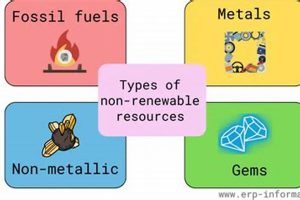
Nuclear power is generally not considered. Although nuclear fission utilizes uranium, a relatively abundant element, it is not replenished on a human timescale. Furthermore, nuclear waste disposal poses significant environmental challenges, making it incompatible with the sustainability principles underpinning.
Question 3: How does the intermittency of solar and wind power impact their designation as “renewable energy resources”?
The intermittent nature of solar and wind does not disqualify them. These fluctuations are inherent characteristics that require mitigation through energy storage solutions, grid management strategies, and geographic diversification of generation sites. The key lies in managing intermittency to ensure reliable power delivery.
Question 4: What role does energy storage play in maximizing the potential of “renewable energy resources”?
Energy storage is pivotal. Technologies such as batteries, pumped hydro storage, and compressed air energy storage enable the capture and storage of excess energy generated during peak production periods. This stored energy can then be released during periods of low production, ensuring a more consistent and reliable power supply.
Question 5: Are there any environmental drawbacks associated with the utilization of “renewable energy resources”?
While generally environmentally benign, these resources are not without potential impacts. Hydropower dams can alter river ecosystems, wind farms can pose a threat to avian wildlife, and biomass energy production can contribute to deforestation if not managed sustainably. Careful planning and mitigation measures are essential.
Question 6: How does government policy influence the development and deployment of “renewable energy resources”?
Government policies, such as tax incentives, feed-in tariffs, renewable energy standards, and carbon pricing mechanisms, play a crucial role. These policies incentivize investment in technologies, promote grid integration, and create stable market conditions that encourage the widespread adoption.
In summary, understanding nuances regarding management practices and integration strategies is crucial for successfully harnessing the benefits these energy resources offer.
The subsequent section will address future trends and emerging technologies shaping the landscape of naturally replenishing power production.
Conclusion
The preceding analysis has elucidated the fundamental characteristics defining the field of naturally replenished power. Emphasis has been placed on sustainability, replenishment rate, natural processes, environmental benefits, resource diversity, and energy security. A comprehensive understanding of these attributes is essential for informed decision-making regarding energy policy and technological investments. It is necessary to acknowledge the interplay between ecological preservation and energy needs, requiring a holistic evaluation of options.
The ongoing transition toward greater utilization of the power described within this article represents a pivotal shift in global energy strategy. Responsible implementation of this transition necessitates a continued commitment to research, development, and policy frameworks that support sustainable practices. The future stability and ecological integrity of global energy systems depend on widespread understanding and diligent application of the principles.
![Guide to What Energy Resources Are Renewable [+Future] | Renewable Energy Solutions for a Sustainable Future | Clean & Green Power](https://pplrenewableenergy.com/wp-content/uploads/2026/03/th-516-300x200.jpg "Guide to What Energy Resources Are Renewable [+Future] Renewable Energy Solutions for a Sustainable Future | Clean & Green Power")