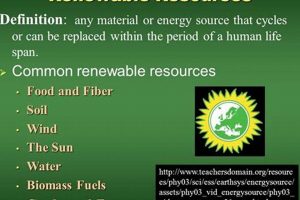
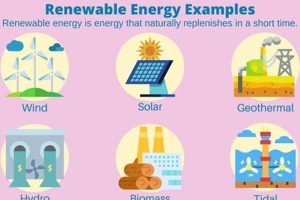
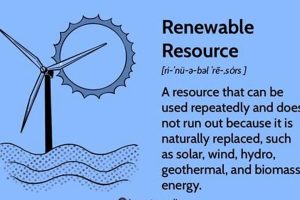
Naturally occurring resources that replenish at a rate comparable to or faster than their rate of consumption are considered sustainable. These resources are derived from the environment and can be continuously replenished, ensuring their availability for future generations. Sunlight, wind, water, geothermal heat, and biomass are prime examples of these self-replenishing sources.
The utilization of these resources presents numerous advantages. Dependence on finite fossil fuels diminishes, thereby mitigating greenhouse gas emissions and combating climate change. These sources are often locally available, enhancing energy independence and promoting economic development within communities. Furthermore, harnessing these resources fosters innovation and the creation of green jobs, contributing to a more sustainable and resilient economy. Historically, societies have relied on these resources, such as wood for fuel and water for irrigation; however, modern technologies now allow for the efficient and large-scale extraction of energy from these sustainable sources.
Subsequent sections will delve into specific categories, examining their potential, limitations, and the technologies employed to harness their energy effectively. This will encompass a discussion of solar power generation, wind energy conversion, hydroelectric power, geothermal energy extraction, and the sustainable utilization of biomass.
Harnessing Sustainable Resources Effectively
The effective utilization of replenishable natural resources requires careful planning, responsible implementation, and ongoing monitoring to maximize their benefits and minimize potential environmental impacts.
Tip 1: Prioritize Resource Assessment: A thorough assessment of the availability and potential of various sustainable resources within a specific region is crucial. This involves evaluating factors such as solar irradiance, wind speeds, water flow rates, geothermal gradients, and biomass availability to determine the most suitable energy sources.
Tip 2: Implement Diversified Energy Portfolios: Reliance on a single type of sustainable resource can create vulnerabilities. Diversifying energy portfolios by incorporating a mix of solar, wind, hydro, and geothermal sources enhances energy security and resilience to fluctuations in resource availability.
Tip 3: Invest in Energy Storage Solutions: The intermittent nature of solar and wind energy necessitates the deployment of energy storage solutions, such as batteries and pumped hydro storage, to ensure a consistent and reliable power supply. This helps to bridge the gap between energy generation and demand.
Tip 4: Adopt Smart Grid Technologies: Integrating sustainable resources into the grid requires the adoption of smart grid technologies that enable real-time monitoring, control, and optimization of energy flows. This improves grid stability and efficiency.
Tip 5: Promote Energy Conservation and Efficiency: Reducing energy consumption through energy conservation measures and efficiency improvements minimizes the demand for energy, thereby maximizing the impact of renewable sources. This can include measures such as improving building insulation, using energy-efficient appliances, and promoting public transportation.
Tip 6: Implement Sustainable Land Use Practices: The development of resource projects should be carefully planned to minimize environmental impacts, such as habitat destruction and water pollution. Sustainable land use practices, such as reforestation and wetland restoration, can help to mitigate these impacts.
Tip 7: Foster Community Engagement: Gaining community support for resource projects is essential for their successful implementation. Engaging with local communities, addressing their concerns, and providing them with economic benefits can help to build trust and ensure the long-term sustainability of these projects.
By adhering to these guidelines, individuals, communities, and governments can harness the power of replenishable natural resources to create a cleaner, more sustainable, and resilient energy future. These approaches are critical for long-term economic and environmental well-being.
The concluding section will summarize the key points discussed and highlight the broader implications for environmental stewardship and global sustainability.
1. Sustainability

The inherent link between sustainability and replenishable natural resources is fundamental to long-term environmental and economic stability. Sustainability, in this context, refers to the capacity to maintain ecological processes, biodiversity, and productivity over time. Replenishable natural resources are integral to achieving sustainability because their consumption does not lead to depletion, ensuring their availability for future generations. The utilization of fossil fuels, conversely, is inherently unsustainable due to their finite nature and the environmental consequences associated with their extraction and combustion.
The effective deployment of resources like solar, wind, and geothermal energy exemplifies the practical significance of this connection. Solar energy, derived from sunlight, is perpetually replenished, minimizing environmental impact and reducing reliance on finite resources. Similarly, wind energy, captured from air currents, presents a sustainable alternative to fossil fuel-based power generation. Geothermal energy, harnessed from the Earth’s internal heat, offers a consistent and reliable resource with a minimal carbon footprint. In contrast, deforestation practices that exceed the rate of forest regrowth undermine sustainability by depleting timber resources and disrupting ecosystems.
Ultimately, understanding the interconnectedness of sustainability and resources that are naturally self-replenishing is crucial for informed decision-making in energy policy, resource management, and economic planning. The challenge lies in scaling up the adoption of sustainable technologies, promoting responsible resource management practices, and fostering a global commitment to environmental stewardship. Failure to prioritize sustainability will inevitably lead to resource scarcity, environmental degradation, and long-term economic instability.
2. Replenishment Rate

The rate at which resources regenerate is a critical factor in determining their sustainability and overall utility. Understanding the replenishment rate of naturally self-replenishing resources is essential for effective resource management and ensuring their long-term availability. This rate dictates the extent to which these resources can be utilized without compromising their future supply.
- Solar Energy Influx
The replenishment rate of solar energy is essentially instantaneous from a human perspective. The continuous influx of solar radiation onto the Earth’s surface far exceeds current global energy consumption. This near-instantaneous replenishment allows for the constant harnessing of solar energy without depleting the source. The limiting factor is not the replenishment rate, but rather the technology and infrastructure required to capture and convert solar energy into usable forms.
- Wind Generation Dynamics
Wind, driven by solar heating and atmospheric pressure gradients, has a relatively fast replenishment rate. While wind patterns can vary regionally and seasonally, the fundamental atmospheric processes that generate wind are continuous. The sustainability of wind energy depends on proper turbine placement and management to minimize ecological impacts, but the replenishment rate of the wind itself is not a limiting factor in its widespread use.
- Hydrological Cycle Turnover
Water resources, crucial for hydroelectric power and various industrial and agricultural applications, are replenished through the hydrological cycle. The rate of this cycle, involving evaporation, precipitation, and runoff, varies significantly depending on geographic location and climate. While the overall water supply is finite, the hydrological cycle ensures continuous replenishment. However, factors like climate change, deforestation, and excessive water withdrawal can disrupt this cycle, leading to water scarcity and affecting the sustainability of water-dependent resources.
- Geothermal Heat Conduction
Geothermal energy, derived from the Earth’s internal heat, has a slower replenishment rate compared to solar or wind energy. While the Earth’s core generates immense heat, the rate at which this heat is conducted to the surface is relatively slow. Geothermal resources are generally considered sustainable on a human timescale, but it is important to manage extraction rates carefully to avoid depleting local geothermal reservoirs. Sustainable geothermal energy production involves monitoring reservoir pressures and temperatures to ensure a balance between extraction and natural heat recharge.
The variable replenishment rates underscore the need for diverse management strategies. Solar and wind power, with their rapid replenishment, offer immediate and expansive potential. Water resources require careful stewardship to maintain hydrological cycle integrity. Geothermal energy demands meticulous monitoring to prevent depletion of local reservoirs. The common thread is that understanding these rates is pivotal to maximizing the long-term benefit and sustainability of these natural resources.
3. Environmental Benefits

The integration of naturally replenishing resources into energy systems yields profound environmental benefits, driving the shift towards sustainable practices. These benefits encompass reduced pollution, minimized habitat disruption, and the mitigation of climate change impacts, underscoring the critical role of such resources in environmental stewardship.
- Reduced Greenhouse Gas Emissions
Replacing fossil fuels with resources such as solar, wind, and hydro power significantly diminishes greenhouse gas emissions. Fossil fuel combustion releases carbon dioxide, a primary driver of climate change. Using natural self-replenishing alternatives substantially lowers the carbon footprint of energy generation, contributing to global efforts to mitigate climate change.
- Decreased Air and Water Pollution
Conventional energy sources, like coal and natural gas, generate air pollutants such as sulfur dioxide and nitrogen oxides, contributing to respiratory problems and acid rain. Resource-based energy systems produce minimal or no air pollutants, enhancing air quality and reducing the incidence of related health issues. Similarly, water contamination from mining and fossil fuel extraction is avoided, preserving aquatic ecosystems and water resources.
- Minimized Habitat Disruption
Extraction and transportation of fossil fuels often involve extensive habitat disruption through activities such as mining, drilling, and pipeline construction. Resource projects can also have environmental impacts, such as wind turbine bird strikes or the alteration of river flows by hydroelectric dams. However, when planned and managed responsibly, resource facilities typically have a smaller physical footprint and less detrimental impact on biodiversity compared to fossil fuel operations.
- Conservation of Finite Resources
Reliance on fossil fuels depletes finite geological reserves, raising concerns about long-term resource availability and geopolitical stability. Embracing resources that regenerate naturally reduces pressure on these finite reserves, promoting resource conservation and ensuring a more secure and sustainable energy future. This conservation extends the lifespan of remaining fossil fuel reserves, potentially reserving them for applications where renewable alternatives are not yet viable.
The confluence of reduced emissions, decreased pollution, minimized habitat disruption, and conservation of finite resources demonstrates the comprehensive environmental advantages associated with these resources. Transitioning towards such sources represents a critical strategy for fostering a healthier planet and securing a sustainable future for generations to come.
4. Energy Security

Energy security, defined as the uninterrupted availability of energy sources at an affordable price, is intrinsically linked to the development and deployment of resources that replenish naturally. Dependence on finite fossil fuel reserves often exposes nations to price volatility, geopolitical instability, and supply disruptions. Transitioning to naturally regenerating resources offers a pathway toward enhanced energy independence and resilience.
- Diversification of Energy Sources
A diversified energy portfolio, incorporating solar, wind, hydro, and geothermal sources, reduces reliance on any single energy source. This diversification mitigates the risk associated with supply disruptions or price fluctuations in global fossil fuel markets. For example, countries heavily dependent on imported natural gas can enhance their energy security by investing in domestic wind and solar power generation.
- Reduced Geopolitical Vulnerability
Fossil fuel resources are geographically concentrated, leading to geopolitical tensions and potential conflicts over access and control. Resources that are naturally self-replenishing are more evenly distributed globally, reducing dependence on specific regions and diminishing geopolitical vulnerability. Investment in locally available resources fosters greater energy autonomy and reduces exposure to international political instability.
- Mitigation of Price Volatility
Fossil fuel prices are subject to significant volatility due to factors such as supply and demand imbalances, geopolitical events, and speculative trading. Resources that are naturally self-replenishing offer price stability, as their operational costs are largely independent of global commodity markets. The predictable cost structure of renewable energy projects enhances long-term energy affordability and reduces the financial risks associated with fluctuating fossil fuel prices.
- Decentralized Energy Generation
Resource technologies facilitate decentralized energy generation, empowering communities and individuals to produce their own power. Distributed solar photovoltaic (PV) systems, small-scale wind turbines, and micro-hydro installations enhance energy resilience by reducing dependence on centralized power grids. Decentralized energy systems improve energy access in remote areas and enhance overall grid stability by reducing transmission losses and congestion.
The correlation between resources that replenish naturally and energy security is undeniable. By embracing diverse sources, reducing geopolitical vulnerability, mitigating price volatility, and promoting decentralized energy generation, nations can bolster their energy security while simultaneously fostering environmental sustainability and economic development. The strategic deployment of these resources represents a vital step towards a more secure and resilient energy future.
5. Economic Viability

The economic viability of resources that replenish naturally is a critical determinant of their widespread adoption and contribution to global energy systems. Assessing the cost-effectiveness, investment requirements, and job creation potential of such resources is essential for informed decision-making by policymakers, investors, and consumers.
- Levelized Cost of Energy (LCOE)
LCOE represents the average cost of producing electricity over the lifetime of a power plant, considering all capital and operating expenses. The LCOE of resources such as solar and wind has declined dramatically in recent years, making them increasingly competitive with traditional fossil fuel-based power generation. For example, large-scale solar PV projects in sun-rich regions now often have an LCOE comparable to or lower than that of new coal-fired power plants. This declining LCOE is driving the expansion of renewable energy capacity worldwide.
- Upfront Capital Investment
Resource projects typically require significant upfront capital investment for infrastructure development, equipment procurement, and installation. While the initial capital costs can be substantial, these projects often have lower operating costs compared to fossil fuel plants, which require ongoing fuel purchases. Government incentives, tax credits, and innovative financing mechanisms play a crucial role in reducing the financial barriers to resource deployment. For instance, feed-in tariffs and renewable energy certificates can provide stable revenue streams for renewable energy projects, attracting private investment.
- Job Creation and Economic Development
The resource sector has the potential to create significant employment opportunities across various sectors, including manufacturing, installation, maintenance, and research and development. Investing in natural self-replenishing resources stimulates economic growth, particularly in rural areas where these resources are often abundant. For example, the establishment of wind turbine manufacturing facilities can create high-skilled jobs and boost local economies. Furthermore, resource projects can provide economic benefits to local communities through land lease payments, property taxes, and community benefit agreements.
- Grid Integration Costs
Integrating resource-based power into existing electricity grids can incur additional costs related to grid upgrades, transmission infrastructure, and energy storage. The intermittent nature of solar and wind energy necessitates investments in grid flexibility and energy storage solutions to ensure a reliable and stable power supply. Smart grid technologies, such as advanced metering infrastructure and demand response programs, can help to optimize grid operations and minimize integration costs. Proper planning and coordination between resource developers and grid operators are essential for cost-effective grid integration.
The facets of LCOE, upfront capital investment, job creation, and grid integration costs collectively shape the economic viability of resources that replenish naturally. While challenges remain, ongoing technological advancements, supportive government policies, and increasing investor interest are driving down costs and enhancing the economic competitiveness of these resources. These factors suggest a future where naturally self-replenishing resources play a central role in a sustainable and prosperous energy economy.
6. Technological Innovation
Technological innovation serves as a primary driver in expanding the feasibility and efficiency of harnessing naturally self-replenishing resources. The cost-effectiveness and scalability of solar, wind, geothermal, and hydroelectric power are fundamentally linked to advancements in materials science, engineering, and energy storage. Without continuous innovation, the widespread adoption of these resources would remain constrained by economic and logistical barriers.
Consider the evolution of solar photovoltaic (PV) technology. Early solar cells were expensive and inefficient, limiting their application to niche areas. However, ongoing research has led to the development of more efficient and affordable materials, such as thin-film solar cells and perovskite solar cells. Similarly, advancements in wind turbine design, including larger rotor diameters and more sophisticated control systems, have significantly increased the energy capture and reduced the cost per kilowatt-hour of wind power. In geothermal energy, enhanced geothermal systems (EGS) are being developed to access geothermal resources in areas with limited natural permeability, expanding the geographic potential for geothermal energy production. Developments in battery technology and pumped hydro storage are also crucial for addressing the intermittency challenges associated with solar and wind power, enabling greater grid stability and reliability. These advances directly impact the practical and economic deployment of these resources.
In summary, technological innovation is not merely an adjunct to the use of renewable natural resources; it is an integral component of their viability. Continued investment in research and development is essential to overcome existing limitations, reduce costs, and unlock the full potential of these resources for a sustainable energy future. Overcoming these challenges is vital for ensuring the long-term sustainability and scalability of renewable energy systems.
7. Resource Distribution

The geographical distribution of resources that are naturally self-replenishing exhibits considerable variability, significantly influencing their accessibility and potential utilization. This uneven distribution shapes energy policy, infrastructure development, and economic opportunities across different regions. An understanding of these distribution patterns is crucial for optimizing resource utilization and mitigating energy disparities.
Solar energy, while theoretically available globally, displays significant regional variations in irradiance. Deserts and equatorial regions typically receive substantially higher solar radiation levels than higher latitude areas, making them prime locations for large-scale solar power installations. Wind energy potential is also geographically dependent, with coastal regions, mountain passes, and open plains often exhibiting higher average wind speeds. Hydroelectric potential is determined by the presence of rivers with sufficient flow rates and suitable topography for dam construction, concentrating hydroelectric resources in mountainous regions and areas with abundant rainfall. Geothermal resources are typically located near tectonic plate boundaries or volcanic hotspots, limiting their availability to specific geological regions. The availability of biomass for bioenergy production is influenced by agricultural practices, forest cover, and land use patterns.
Effective resource management strategies must account for these uneven distribution patterns. This involves developing transmission infrastructure to transport energy from resource-rich areas to demand centers, implementing smart grid technologies to manage intermittent energy sources, and fostering international cooperation to facilitate the sharing of resources and technologies. Additionally, it is vital to consider the social and environmental impacts of resource development, ensuring that benefits are equitably distributed and that environmental degradation is minimized. Recognizing and addressing the challenges posed by the uneven distribution of resources that are naturally self-replenishing is fundamental for building a sustainable and equitable energy future.
Frequently Asked Questions
This section addresses common inquiries and misconceptions regarding the nature, utilization, and implications of resources that replenish naturally.
Question 1: What distinguishes naturally self-replenishing resources from other energy sources?
Resources that are naturally self-replenishing are characterized by their ability to regenerate within a human timescale. This contrasts with finite resources like fossil fuels, which are depleted upon extraction. Common examples include solar energy, wind energy, hydroelectric power, geothermal energy, and biomass.
Question 2: How reliable are resource-based energy sources given their intermittent nature?
The intermittency of some resources, such as solar and wind, can be addressed through several strategies. These include energy storage solutions (e.g., batteries, pumped hydro), grid integration technologies (e.g., smart grids), and geographic diversification of resource projects. These measures enhance the reliability and stability of resource-based energy systems.
Question 3: What are the primary environmental concerns associated with resource projects?
While resources are generally considered environmentally benign, certain concerns exist. These include habitat disruption from wind farms or hydroelectric dams, potential impacts on aquatic ecosystems from geothermal energy production, and land use considerations for biomass cultivation. Responsible planning and mitigation strategies are crucial to minimize these impacts.
Question 4: How do resources contribute to energy security?
Resources enhance energy security by diversifying energy sources, reducing dependence on imported fossil fuels, and mitigating price volatility. Geographically dispersed resource projects contribute to a more resilient energy system, less vulnerable to geopolitical disruptions.
Question 5: What are the key factors influencing the economic viability of resource projects?
Economic viability depends on factors such as the levelized cost of energy (LCOE), upfront capital investment, government incentives, and grid integration costs. Technological advancements and economies of scale are driving down costs, making resources increasingly competitive with traditional energy sources.
Question 6: How can individuals contribute to the adoption of resources?
Individuals can support the adoption of these resources through various actions, including investing in solar panels, purchasing energy-efficient appliances, supporting policies that promote resource development, and advocating for sustainable practices in their communities.
Resources offer a viable path to a more sustainable and secure energy future. Ongoing research, technological innovation, and supportive policies are essential for unlocking their full potential.
The next section will delve into the future prospects and challenges associated with the widespread adoption of resources.
Conclusion
This exploration has detailed the multifaceted nature of renewable natural resources, outlining their significance as sustainable alternatives to finite energy sources. The analysis has encompassed their definition, environmental and economic benefits, technological advancements, and distribution patterns. Understanding replenishment rates, addressing intermittency challenges, and mitigating environmental impacts are essential for responsible resource management.
The imperative to transition toward widespread adoption of renewable natural resources remains paramount. Continued research, policy support, and technological innovation are critical to realize a sustainable and secure energy future. The responsible and informed utilization of these resources represents a necessary commitment to global environmental stewardship and long-term economic stability.
![Guide to What Energy Resources Are Renewable [+Future] | Renewable Energy Solutions for a Sustainable Future | Clean & Green Power](https://pplrenewableenergy.com/wp-content/uploads/2026/03/th-516-300x200.jpg "Guide to What Energy Resources Are Renewable [+Future] Renewable Energy Solutions for a Sustainable Future | Clean & Green Power")