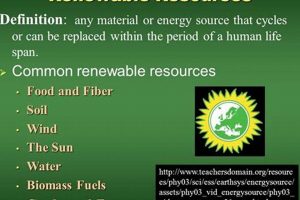
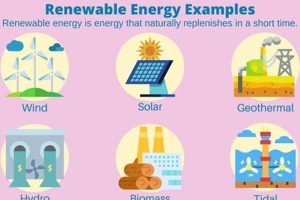
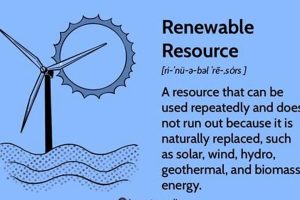
Methods of power generation relying on naturally replenishing sources such as sunlight, wind, geothermal heat, water, and biomass represent a significant shift away from finite fossil fuels. Examples include photovoltaic solar panels, wind turbines, hydroelectric dams, geothermal power plants, and facilities that convert organic matter into energy.
The adoption of these methods holds immense promise in mitigating climate change by reducing greenhouse gas emissions, improving air quality, and fostering energy independence. Historically, reliance on these approaches was limited by technological constraints and economic viability, but advancements have significantly improved efficiency and lowered costs, making them increasingly competitive.
The following sections will detail various types, current implementation strategies, associated challenges, and the ongoing research driving future innovations in sustainable energy solutions. This exploration encompasses both established and emerging approaches, providing a broad overview of the present landscape and potential future developments.
Strategic Implementation Guidance
The following guidance outlines crucial considerations for the effective integration and utilization of naturally replenishing energy sources. Successful adoption requires careful planning, technological understanding, and adherence to best practices.
Tip 1: Conduct a Comprehensive Resource Assessment: Before initiating any project, rigorously evaluate the available resource potential (solar irradiance, wind speed, geothermal gradient, etc.) at the specific location. Accurate data is essential for determining project feasibility and optimizing system design.
Tip 2: Prioritize Grid Integration Compatibility: Designs must incorporate advanced grid integration technologies to ensure stable and reliable electricity supply. Consider employing energy storage solutions to mitigate intermittency.
Tip 3: Embrace Life Cycle Cost Analysis: Evaluate projects based on total life cycle costs, encompassing initial investment, operational expenses, and decommissioning. This provides a more accurate economic comparison with conventional energy sources.
Tip 4: Foster Public-Private Partnerships: Collaborative ventures between government entities and private companies can leverage expertise and capital to accelerate project development and deployment.
Tip 5: Implement Robust Monitoring and Maintenance Programs: Regular inspection, maintenance, and performance monitoring are crucial for ensuring the long-term operational efficiency and reliability of installed systems.
Tip 6: Support Research and Development Initiatives: Invest in ongoing R&D to improve efficiency, reduce costs, and develop innovative applications. Technological advancements are essential for driving the continued expansion of the sector.
Tip 7: Adhere to Stringent Environmental Safeguards: Implement practices that minimize environmental impact during construction, operation, and decommissioning. This includes protecting biodiversity and mitigating potential habitat disruption.
Adhering to these tips will contribute to the successful and sustainable deployment of environmentally friendly energy generation, unlocking significant benefits for both the environment and the economy.
The following section will delve into the challenges and opportunities associated with widespread adoption.
1. Efficiency
Efficiency, in the context of sustainable power generation, refers to the ratio of energy output to energy input for any given system. Higher efficiency directly translates to greater power generation from the same quantity of natural resources, reducing the physical footprint and the resource consumption associated with generating electricity. For instance, the efficiency of photovoltaic cells determines how much of the incoming solar radiation is converted into usable electrical energy. Similarly, the efficiency of a wind turbine influences the amount of kinetic energy from the wind transformed into electricity. Improved efficiency levels result in a greater return on investment and enhance the economic viability of these technologies.
The operational lifespan and cost-effectiveness are inextricably linked to efficiency gains. Enhanced solar cell efficiencies necessitate fewer panels to generate a given amount of energy, consequently lowering installation costs, land use, and material requirements. Advanced wind turbine designs, incorporating aerodynamic enhancements, capture more wind energy, leading to increased power output and improved operational performance. Geothermal power plants benefit from technological advancements that enhance the extraction of geothermal heat, boosting overall power generation efficiency. This is also true for hydroelectric generators. Increasing the energy derived from biomass feedstocks improves the sustainability of this energy source.
Ultimately, continuous improvements in energy system efficiency are crucial for the widespread adoption and successful integration of sustainable power generation. Lowering the resource requirement through improved efficiency enables these technologies to compete effectively with conventional energy sources while minimizing environmental impact. Addressing the challenge of maintaining or increasing efficiency across various environmental conditions and operational scales remains a critical focus of ongoing research and development. Technological advancement will encourage new and novel technologies, for example, improving the use of geothermal resources and the optimization of the electricity produced by hydropower generators.
2. Storage

The intermittent nature of many environmentally friendly power sources, such as solar and wind, necessitates robust storage solutions to ensure a consistent and reliable electricity supply. Without effective storage, the power generated from these variable sources cannot be dispatched on demand, limiting their integration into existing power grids. The implementation of storage technologies mitigates the discrepancy between power supply and consumer demand, thereby enhancing grid stability and maximizing the utilization of generated energy.
Various storage technologies are employed to address the intermittency challenge, including battery storage systems, pumped hydroelectric storage, compressed air energy storage, and thermal energy storage. Battery storage, utilizing lithium-ion and other advanced chemistries, provides rapid response times and modular scalability, making it suitable for both grid-scale and distributed energy applications. Pumped hydroelectric storage, a more established technology, utilizes excess electricity to pump water uphill to a reservoir, releasing it through turbines when power is needed. Compressed air energy storage compresses air into underground caverns and releases it to drive turbines when demand arises. Thermal energy storage, often used in conjunction with concentrated solar power plants, stores thermal energy to generate electricity during periods of low solar irradiance. Each method offers distinct advantages and disadvantages regarding energy capacity, discharge duration, response time, and geographic suitability.
The integration of storage solutions with naturally replenishing energy sources is crucial for achieving a stable and decarbonized energy system. Overcoming the technological and economic barriers to widespread storage deployment, including the high upfront costs of some technologies and the need for further research into alternative storage materials, remains a key challenge. Continued advancements in energy storage technologies and supportive policies that incentivize their adoption are essential for unlocking the full potential of environmentally friendly energy generation.
3. Grid Integration

Effective grid integration is a critical prerequisite for maximizing the contribution of environmentally friendly energy sources to the overall electricity supply. The variable nature of solar and wind power, in particular, presents significant challenges to maintaining grid stability and reliability. Consequently, advanced technologies and sophisticated management strategies are required to seamlessly incorporate these intermittent sources into the existing electrical grid infrastructure.
The primary challenges stem from the fluctuating output of such facilities, which can lead to imbalances between electricity supply and demand. Without proper grid integration mechanisms, these fluctuations can cause voltage and frequency deviations, potentially resulting in grid instability or even blackouts. Solutions include smart grid technologies, such as advanced metering infrastructure (AMI) and supervisory control and data acquisition (SCADA) systems, which enable real-time monitoring and control of the grid. Additionally, energy storage solutions, such as batteries and pumped hydro, can help to smooth out the fluctuations and provide a more consistent power supply. An example of effective implementation is the integration of large-scale wind farms in Germany, which utilize advanced grid management systems and cross-border electricity trading to mitigate intermittency and ensure grid stability.
Successful grid integration is essential for unlocking the full potential of naturally replenishing energy sources and transitioning to a sustainable energy future. It requires a coordinated effort involving grid operators, energy providers, policymakers, and technology developers. Addressing the technical and regulatory barriers to grid integration is crucial for ensuring that these sources can reliably and cost-effectively contribute to the electricity supply, thereby reducing reliance on fossil fuels and mitigating climate change. Further development of smart grid technologies and the implementation of supportive policies are critical steps towards achieving a more resilient and sustainable energy system.
4. Cost Reduction

Cost reduction is a pivotal driver in the widespread adoption of environmentally friendly power generation. The initial high capital expenditure associated with many installations presents a significant barrier to entry. Decreasing these costs through technological innovation, economies of scale, and streamlined manufacturing processes is essential for these technologies to compete effectively with established, yet environmentally damaging, fossil fuel-based power plants. Declining costs not only improve economic feasibility but also incentivize greater investment and deployment, accelerating the transition to a more sustainable energy landscape. The impact of cost reduction is evident in the dramatic decrease in the price of solar photovoltaic panels over the past decade, leading to exponential growth in solar energy installations worldwide. Similarly, advancements in wind turbine technology and manufacturing have reduced the cost of wind energy, making it increasingly competitive in many regions.
Further cost reductions can be achieved through various strategies, including optimizing supply chains, standardizing components, and improving operational efficiency. Streamlining permitting processes and reducing regulatory burdens can also contribute to lower project development costs. Government subsidies, tax incentives, and carbon pricing mechanisms can provide additional financial support, further reducing the economic gap between these technologies and conventional energy sources. The effect of these strategies is evidenced by the increased investments in environmentally friendly energy projects spurred by government incentives and the increased development in efficient energy generation.
In summary, cost reduction is a fundamental element in the progression of environmentally friendly energy generation. Continuous efforts to lower the financial burden of these technologies are crucial for achieving widespread adoption, reducing carbon emissions, and creating a more sustainable energy future. Overcoming financial barriers will be the key to the use of these methods to provide a viable energy economy.
5. Policy Support

Governmental interventions play a crucial role in fostering the deployment and growth of environmentally friendly power sources. Policies can directly influence the economic viability, market access, and overall competitiveness of these resources relative to conventional energy sources. A stable and predictable policy environment is essential for attracting investment, stimulating innovation, and driving the transition toward a sustainable energy future.
- Feed-in Tariffs
Feed-in tariffs (FITs) guarantee a fixed price for electricity generated from eligible technologies, providing a stable revenue stream for producers. Germany’s Energiewende program, which initially relied heavily on FITs, demonstrated their effectiveness in rapidly increasing the share of power generated from the sun and wind. The predictable revenue stream encourages investment in these installations and contributes to long-term growth. These are now present in some areas of the United States.
- Tax Incentives and Credits
Tax credits and incentives reduce the initial capital costs associated with purchasing and installing systems. The U.S. Investment Tax Credit (ITC) for solar energy, for example, provides a percentage-based credit for the cost of solar equipment, significantly improving project economics and driving deployment. These initiatives lower the upfront investment required, making these technologies more accessible.
- Renewable Portfolio Standards
Renewable portfolio standards (RPS) mandate that a certain percentage of electricity sold by utilities come from eligible sources. These mandates create a guaranteed market for power, encouraging utilities to invest in and procure these systems. California’s RPS, one of the most ambitious in the United States, has been instrumental in driving the development of solar, wind, and geothermal generation within the state.
- Carbon Pricing Mechanisms
Carbon taxes and cap-and-trade systems impose a cost on carbon emissions, making fossil fuels less competitive and incentivizing the adoption of cleaner alternatives. The European Union Emissions Trading System (EU ETS) is an example of a cap-and-trade system that puts a price on carbon emissions, encouraging companies to invest in low-carbon technologies and operations. However, the effectiveness is still debated due to the constantly changing prices.
These examples highlight the diverse range of policy tools available to governments to support the development and deployment of environmentally friendly power. The effectiveness of these policies depends on careful design, consistent implementation, and adaptation to local circumstances. A combination of supportive policies, tailored to specific market conditions, is often the most effective approach to accelerating the transition to a sustainable energy future.
6. Environmental Impact

The deployment of environmentally friendly power sources, while offering a pathway toward mitigating climate change, is not without potential effects on the environment. A comprehensive assessment of these effects is essential to ensure that the transition to a cleaner energy system is genuinely sustainable and does not inadvertently create new environmental problems. These power sources can include solar, wind, hydroelectric, geothermal, and biomass. Examining these systems will allow for a conclusion based on the effects they have on the world.
Potential consequences vary across different types. Solar farms require significant land areas, potentially leading to habitat loss and alterations in land use patterns. Wind turbines can pose a risk to bird and bat populations, particularly during migration seasons. Hydroelectric dams can disrupt river ecosystems, alter water flow patterns, and impact fish populations. Geothermal energy extraction can release trace amounts of greenhouse gases, although far less than fossil fuels. The production and disposal of solar panels and wind turbine components also raise concerns about resource depletion and waste management. The creation and use of biomass as a fuel source also carries problems for environmental degradation. Some examples of these effects are shown in the areas discussed.
Addressing these environmental concerns requires careful planning, responsible siting practices, and continuous technological improvements. Environmental impact assessments should be conducted prior to project development to identify potential risks and mitigation strategies. Technologies and operational practices can be refined to minimize harm to wildlife and ecosystems. Promoting recycling and responsible disposal of equipment is crucial for minimizing waste. A holistic approach that considers the full life cycle of systems and their potential consequences is necessary to ensure the long-term sustainability of environmentally friendly power generation. These considerations should be examined for all methods of power generation to determine which is best for the planet.
Frequently Asked Questions
This section addresses common inquiries regarding sustainable energy. The responses provide objective, fact-based information to promote a deeper understanding of the topic.
Question 1: Are methods of power generation utilizing naturally replenishing sources truly sustainable, considering the resources required for manufacturing and disposal?
Sustainability is a relative concept. While these methods do require resources for manufacturing components and pose end-of-life disposal challenges, their overall environmental impact is significantly lower than that of fossil fuels due to the elimination of ongoing fuel extraction and combustion emissions.
Question 2: How does the intermittency of solar and wind power affect grid reliability?
Intermittency poses challenges to grid stability, necessitating the implementation of energy storage solutions and advanced grid management technologies to balance supply and demand.
Question 3: What are the primary economic barriers to the widespread adoption of sustainable power generation?
High upfront capital costs, coupled with the need for grid infrastructure upgrades and storage technologies, represent significant financial obstacles to widespread deployment.
Question 4: Do sustainable power sources have any negative environmental impacts?
Yes, these sources are not entirely without effect. Solar farms require land use, wind turbines can pose a risk to avian wildlife, and hydroelectric dams can disrupt aquatic ecosystems. Careful planning and mitigation strategies are essential to minimize these impacts.
Question 5: How effective are government policies in promoting the development and deployment of sustainable methods?
Government policies, such as feed-in tariffs, tax incentives, and renewable portfolio standards, can be highly effective in creating a favorable economic environment and driving investment in the sector.
Question 6: What role does research and development play in advancing the field of sustainable energy?
Ongoing research and development are crucial for improving efficiency, reducing costs, developing new technologies, and addressing the challenges associated with integrating these sources into the existing energy infrastructure.
In conclusion, while challenges remain, the benefits of moving towards sustainable energy outweigh the difficulties. Continuous investment in innovation and supportive policies will be essential for accelerating the transition.
The next section will summarize the main points discussed.
Conclusion
This exploration of renewable energy resources and technologies has highlighted their potential to transform the global energy landscape. Key aspects such as efficiency improvements, cost reductions, effective grid integration, and the development of robust storage solutions are crucial for widespread adoption. Supportive governmental policies and ongoing research and development efforts further accelerate progress in this sector.
The continued investment in, and responsible deployment of, renewable energy resources and technologies are essential to mitigating climate change and ensuring a sustainable energy future. Careful consideration of environmental impacts, coupled with proactive mitigation strategies, is paramount. The global transition to cleaner energy systems requires sustained commitment from governments, industries, and individuals to achieve long-term success.
![Guide to What Energy Resources Are Renewable [+Future] | Renewable Energy Solutions for a Sustainable Future | Clean & Green Power](https://pplrenewableenergy.com/wp-content/uploads/2026/03/th-516-300x200.jpg "Guide to What Energy Resources Are Renewable [+Future] Renewable Energy Solutions for a Sustainable Future | Clean & Green Power")