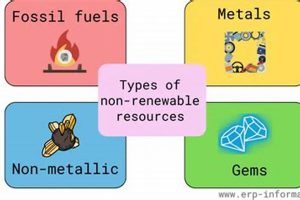
These are finite energy sources that cannot be replenished at the same rate at which they are consumed. This category encompasses fossil fuels such as coal, oil, and natural gas, formed over millions of years from decomposed organic matter. Nuclear fuels, like uranium, are also included due to their limited availability.
Their significance lies in their historical role as primary energy providers, fueling industrial revolutions and modern economies. They offer high energy density and established infrastructure for extraction, processing, and distribution. However, their extraction and use can have substantial environmental consequences, including greenhouse gas emissions, air and water pollution, and habitat disruption. Depletion of these resources is also a growing concern.
The following sections will delve into the specific types, their environmental impacts, and the ongoing efforts to transition towards more sustainable energy alternatives.
The efficient and responsible management of depletable energy commodities necessitates a comprehensive understanding of their characteristics and associated challenges. Diligence in resource allocation is vital.
Tip 1: Prioritize Energy Efficiency: Implement measures to minimize energy consumption across all sectors. This includes adopting energy-efficient technologies, optimizing industrial processes, and promoting conservation practices in residential and commercial buildings.
Tip 2: Diversify Energy Portfolio: Reduce reliance on a single, finite source by diversifying energy sources. Integrate renewable energy technologies alongside existing infrastructure to mitigate risks associated with supply disruptions or price volatility.
Tip 3: Invest in Carbon Capture and Storage: Support the development and deployment of technologies that capture carbon dioxide emissions from power plants and industrial facilities. Secure long-term geological storage is essential to prevent atmospheric release.
Tip 4: Strengthen Regulatory Frameworks: Establish robust regulatory frameworks that govern the extraction, processing, and utilization of depletable energy commodities. Ensure compliance with environmental standards and promote responsible resource management practices.
Tip 5: Promote Research and Development: Allocate resources to research and development of advanced technologies that can enhance energy efficiency, reduce emissions, and extend the lifespan of existing finite resources.
Tip 6: Encourage Public Awareness: Promote public awareness campaigns that educate individuals about the environmental and economic implications of depletable energy sources. Encourage informed decision-making regarding energy consumption and promote the adoption of sustainable alternatives.
Effective strategies necessitate a multifaceted approach that encompasses technological innovation, regulatory oversight, and public engagement. These are crucial to mitigating their limitations and fostering a more sustainable energy future.
The subsequent section will explore alternative energy solutions and their potential to address the challenges associated with the use of these resources.
1. Finite quantity

The defining characteristic of non-renewable energy sources is their finite quantity. This inherent limitation is a core component of the term, meaning that the Earth’s reserves are limited and will eventually be depleted with continued extraction and utilization. This finitude distinguishes them from renewable sources, which are naturally replenished within a human timescale. The formation processes for fossil fuels, such as coal and oil, require millions of years, rendering them non-renewable in practical terms. Real-world examples, such as the declining production rates of certain oil fields, demonstrate the practical significance of understanding this limitation. Recognition of this attribute is paramount for energy planning and resource management.
The finite quantity aspect directly impacts energy security and geopolitical stability. Nations heavily reliant on imported fossil fuels are vulnerable to supply disruptions and price volatility. Furthermore, competition for diminishing resources can exacerbate international tensions. The understanding of these resource constraints necessitates a shift toward diversified energy portfolios, incorporating renewable energy technologies and enhanced energy efficiency measures. For instance, countries are investing heavily in solar and wind power to reduce their dependence on fossil fuels and mitigate the risks associated with dwindling reserves. This awareness also drives innovation in extraction technologies, although such advancements do not alter the fundamental reality of finite reserves.
In conclusion, the finite nature of non-renewable energy resources is not merely a theoretical concept but a critical factor with profound economic, environmental, and strategic implications. Accurately assessing the remaining reserves, coupled with a commitment to sustainable energy practices, is crucial for ensuring long-term energy security and mitigating the adverse consequences associated with resource depletion. Ignoring this fundamental aspect of these sources would lead to unsustainable consumption patterns and heightened vulnerability to future energy crises.
2. Fossil fuel origin
The origin of fossil fuels is intrinsically linked to the very definition of non-renewable energy resources. This connection underscores the inherent time scales involved in their formation, solidifying their categorization as non-renewable.
- Organic Matter Transformation
Fossil fuels are derived from the remains of ancient organisms, primarily plants and algae, that lived millions of years ago. Over geological epochs, these organic materials underwent complex physical and chemical transformations under immense pressure and heat deep within the Earth’s crust. This process, known as fossilization, converts the original organic matter into coal, oil, and natural gas. The long time frames involved make it impossible to replenish these resources at rates comparable to human consumption.
- Carboniferous Period Significance
The Carboniferous Period, spanning from approximately 358.9 to 298.9 million years ago, was particularly significant for the formation of vast coal deposits. During this era, swampy forests thrived, accumulating large quantities of plant biomass. The subsequent burial and compression of this biomass over millions of years resulted in the extensive coal seams found today. This historical context emphasizes the finite and irreplaceable nature of this resource.
- Hydrocarbon Composition
Oil and natural gas are predominantly composed of hydrocarbons, which are organic compounds consisting of hydrogen and carbon atoms. These hydrocarbons are derived from the remains of marine organisms, such as plankton and algae, that accumulated on the ocean floor. Over time, these organic sediments were subjected to heat and pressure, transforming them into liquid and gaseous hydrocarbons. The unique molecular structures of these hydrocarbons determine their properties and suitability for various energy applications.
- Geological Constraints
The formation of fossil fuels is contingent upon specific geological conditions, including the presence of sedimentary basins, adequate source rocks, sufficient heat and pressure, and suitable migration pathways. These conditions are not uniformly distributed across the globe, resulting in concentrated deposits of fossil fuels in certain regions. The geological constraints further underscore the limited availability and non-renewable nature of these energy resources.
The fossil fuel origin of these energy sources, therefore, directly explains their status as non-renewable. The multi-million-year time scales associated with their formation contrast sharply with the rapid rates of consumption, rendering them finite resources in practical terms. Understanding this origin is essential for appreciating the environmental and economic implications of their use and for developing sustainable energy strategies for the future. Alternative energy sources not reliant on these processes will, consequently, be critical to energy supply.
3. Environmental impact

The environmental impact is a critical consideration inextricably linked to the utilization of finite energy sources. The extraction, processing, and combustion of these resources result in a range of environmental consequences that warrant careful assessment and mitigation strategies.
- Greenhouse Gas Emissions
The combustion of fossil fuels releases greenhouse gases, primarily carbon dioxide, into the atmosphere. These gases trap heat and contribute to global warming and climate change. Coal-fired power plants, for instance, are a significant source of carbon dioxide emissions, exacerbating the effects of climate change, such as rising sea levels and extreme weather events. The link to the keyword is clear: using sources that are not renewable introduces more carbon in the air than is naturally absorbed.
- Air and Water Pollution
The extraction and processing of finite energy sources can lead to air and water pollution. Coal mining, for example, can result in acid mine drainage, contaminating nearby water sources and harming aquatic life. Oil spills, such as the Deepwater Horizon disaster, can have devastating effects on marine ecosystems and coastal communities. These pollutants degrade air and water quality, posing risks to human health and the environment. Finite resources often require extensive transportation, which increases the chances of pollution events.
- Habitat Destruction
The extraction of finite energy sources often involves habitat destruction and land degradation. Mountaintop removal coal mining, for instance, obliterates entire ecosystems, leading to biodiversity loss and soil erosion. Oil and gas drilling can fragment habitats, disrupting wildlife migration patterns and reducing biodiversity. These impacts disrupt ecological balance and threaten the long-term sustainability of natural ecosystems. The need to extract finite resources often outweighs environmental protection in practical decision-making.
- Resource Depletion and Waste Generation
The use of finite energy resources inevitably leads to resource depletion and waste generation. As reserves are exhausted, the environmental costs associated with extraction become increasingly significant. Nuclear power, while not a fossil fuel, generates radioactive waste that requires long-term storage and poses potential environmental risks. Managing this waste safely and effectively is a complex and costly endeavor. The waste generated from these processes presents long-term challenges for environmental management and sustainability. The depletion itself is the ultimate consequence.
These environmental impacts underscore the urgent need to transition toward more sustainable energy alternatives. Renewable energy sources, such as solar, wind, and hydropower, offer a cleaner and more sustainable path forward. Mitigation strategies, such as carbon capture and storage, can help to reduce the environmental footprint of finite energy resources, but these strategies are not without their own challenges and limitations. A comprehensive approach, encompassing energy efficiency, renewable energy deployment, and responsible resource management, is essential for addressing the environmental challenges associated with finite energy resources.
4. Economic dependence
Economic dependence on finite energy sources constitutes a significant facet of their definition, shaping global economic structures and geopolitical relationships. This reliance arises from their historical dominance in powering industries, transportation, and electricity generation. The infrastructure developed over decades, and in some cases centuries, is heavily predicated on the availability and affordability of resources like coal, oil, and natural gas. As such, transitions away from these sources represent substantial economic shifts. Nations with abundant reserves often experience economic prosperity tied directly to extraction and export, creating a dependency that can be difficult to diversify away from. For example, the economies of many Middle Eastern nations are heavily reliant on oil revenues. Conversely, nations lacking domestic supplies are subject to import costs and price fluctuations, impacting their economic stability. Therefore, economic dependence is not merely a consequence of their use but a defining characteristic that influences resource management, energy policy, and international relations.
The practical significance of understanding this dependency extends to various domains. Businesses must factor in the potential for price volatility and supply disruptions when making long-term investment decisions. Governments must formulate energy policies that balance economic growth with environmental sustainability and energy security. Moreover, international cooperation becomes essential for ensuring equitable access to resources and mitigating the risks associated with geopolitical instability. The pursuit of alternative energy sources and energy efficiency measures is, in part, driven by the desire to reduce economic dependence on finite supplies. For instance, Germany’s Energiewende initiative aims to transition the country to a low-carbon economy, reducing its reliance on imported fossil fuels. Developing nations, in particular, face the challenge of balancing their energy needs with the economic realities of accessing and utilizing these resources. The cost of infrastructure to extract, refine, and transport fossil fuels can be prohibitive.
In conclusion, economic dependence is a defining characteristic intertwined with the utilization of finite energy sources. This dependency influences global economics, geopolitical relations, and national energy policies. Addressing this dependence requires a multifaceted approach that encompasses technological innovation, policy reforms, and international cooperation. The move toward diversified energy portfolios and sustainable energy practices is critical for mitigating the risks associated with finite resources and fostering long-term economic stability. Furthermore, understanding the nuances of this relationship is paramount for informed decision-making by businesses, governments, and individuals alike. Transitioning to sustainable energy is essential for long-term economic security.
5. Depletion timeline

The depletion timeline forms a critical component of what defines finite energy sources. It reflects the finite nature of these resources and influences decisions regarding energy policy, resource management, and the transition toward alternative energy systems. Because these resources are defined as non-replenishable at rates comparable to consumption, projecting their exhaustion is intrinsically important to the definition. Estimating the depletion timeline involves analyzing proven reserves, extraction rates, technological advancements, and consumption patterns. Different fossil fuels have varying projected timelines, with some estimates suggesting peak oil production has already occurred or is imminent, while coal reserves are expected to last longer. Variations in estimates exist depending on the methodology and data used, which complicates long-term planning. However, the understanding that these timelines are finite is crucial for driving investments in alternative energy technologies and promoting energy conservation efforts.
The practical significance of the depletion timeline extends to various sectors. Governments use these projections to formulate energy strategies, including incentivizing renewable energy development and diversifying energy portfolios. Industries consider the depletion timeline when making long-term investments in energy-intensive infrastructure. Consumers can factor this information into their decisions regarding energy consumption and the adoption of energy-efficient technologies. A real-world example of the impact of depletion timelines is the development of unconventional oil and gas resources, such as shale oil and gas. Although these resources have extended the overall timeline for fossil fuel availability, their extraction often comes with higher environmental costs. The knowledge of an impending depletion timeline fosters innovation and research into new energy sources, such as advanced nuclear technologies and enhanced geothermal systems, with an expanded commitment to solar and wind energy solutions.
In conclusion, the depletion timeline is an inseparable element in the definition of finite energy sources. It underscores the urgency of transitioning to more sustainable energy systems and highlights the economic and environmental implications of continued reliance on finite resources. While the exact timelines may vary, the fundamental understanding of resource depletion is essential for informed decision-making and responsible resource management. Addressing the challenges associated with finite energy resources requires a coordinated effort involving governments, industries, and individuals to accelerate the transition to a more sustainable energy future.
Frequently Asked Questions
This section addresses common inquiries and misconceptions regarding the definition and implications of non-renewable energy resources.
Question 1: Are all fossil fuels considered non-renewable energy resources?
Yes, all fossil fuels, including coal, oil, and natural gas, are classified as finite energy sources. These resources are derived from the fossilized remains of ancient organisms and require millions of years to form. Their rate of consumption far exceeds their natural replenishment rate, rendering them non-renewable on a human timescale.
Question 2: Is nuclear energy classified as a non-renewable energy resource?
Yes, nuclear energy, which relies on uranium as its primary fuel source, is considered a finite energy resource. Although uranium is abundant in the Earth’s crust, it is a finite resource that is not replenished on a human timescale. Nuclear fission consumes uranium, generating electricity. While breeder reactors can produce more fissile material, they have not been widely adopted due to safety and economic concerns.
Question 3: What distinguishes non-renewable from renewable energy resources?
The primary distinction lies in the rate of replenishment. Renewable energy resources, such as solar, wind, and hydropower, are naturally replenished on a human timescale. These resources are either continuously available or can be replenished within a relatively short period. Finite energy resources, on the other hand, cannot be replenished at a rate comparable to their consumption, making them finite and exhaustible.
Question 4: How does the depletion of finite energy sources impact future generations?
The depletion of these resources poses significant challenges for future generations. As reserves are exhausted, the cost of extraction increases, and the availability of these resources decreases. Future generations may face energy shortages and higher energy prices. Furthermore, the environmental impacts of finite energy resource extraction and use, such as climate change and pollution, will disproportionately affect future generations.
Question 5: What are the primary environmental concerns associated with the use of finite energy resources?
The environmental concerns include greenhouse gas emissions, air and water pollution, habitat destruction, and waste generation. The combustion of fossil fuels releases greenhouse gases, contributing to global warming and climate change. The extraction and processing of finite resources can lead to air and water pollution, harming human health and ecosystems. Habitat destruction and waste generation further exacerbate environmental degradation.
Question 6: What are the potential alternatives to finite energy resources?
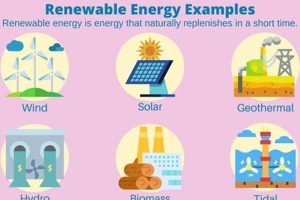
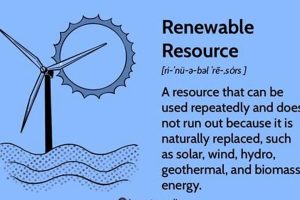
Potential alternatives include renewable energy sources, such as solar, wind, hydropower, geothermal, and biomass. These renewable resources offer a cleaner and more sustainable path forward. Energy efficiency measures, such as improving building insulation and adopting energy-efficient technologies, can also reduce reliance on finite energy resources. Advanced energy storage technologies, such as batteries and pumped hydro storage, can enhance the reliability and integration of renewable energy sources.
Understanding the nuances of finite energy sources is critical for informed energy policy and individual decision-making. Transitioning to sustainable alternatives mitigates environmental harm.
The subsequent sections will delve deeper into the specific types of finite energy sources and their respective attributes.
Understanding Finite Energy Resources
This exploration of the “non renewable energy resources definition” has highlighted their core characteristics: finite quantities, fossil fuel origins, environmental impacts, economic dependencies, and depletion timelines. These elements collectively define the challenges and imperatives associated with reliance on these resources. A comprehensive understanding of these resources is crucial for developing effective energy strategies.
Continued reliance on finite energy resources presents significant challenges to both ecological and economic stability. The imperative to transition toward sustainable energy sources is not merely an environmental consideration but a necessity for long-term global prosperity and security. A commitment to energy efficiency and renewable energy innovation is crucial for future generations.
![Guide to What Energy Resources Are Renewable [+Future] | Renewable Energy Solutions for a Sustainable Future | Clean & Green Power](https://pplrenewableenergy.com/wp-content/uploads/2026/03/th-516-300x200.jpg "Guide to What Energy Resources Are Renewable [+Future] Renewable Energy Solutions for a Sustainable Future | Clean & Green Power")