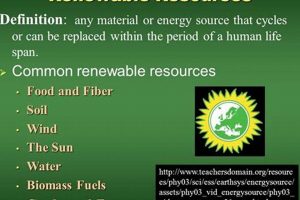
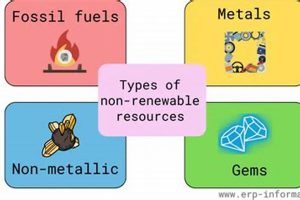
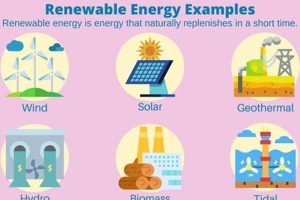
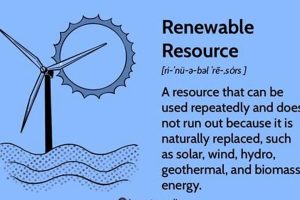
A category of energy sources naturally replenished on a human timescale characterizes environmentally conscious power generation. These sources contrast starkly with finite fossil fuels, offering a sustainable alternative for meeting global energy demands. Solar radiation, wind currents, geothermal heat, and water flow exemplify such resources, providing diverse avenues for electricity generation and heating.
The utilization of these inexhaustible power sources offers significant advantages. Reduced greenhouse gas emissions mitigate climate change, while diminished reliance on foreign fuel imports enhances national energy security. Historically, the cost of harnessing these resources has been a barrier, but technological advancements and increased production are steadily driving down expenses, making them increasingly competitive.
Subsequent sections will delve into the specific technologies used to capture and convert these forms of energy into usable power. Furthermore, the article will examine the economic and social implications of widespread adoption, exploring potential challenges and opportunities associated with transitioning to a sustainable energy future.
Optimizing the Implementation of Replenishable Energy Sources
The following guidelines aim to facilitate the effective integration and management of environmentally sustainable power generation methods within various contexts.
Tip 1: Conduct a Comprehensive Resource Assessment: Prior to project initiation, thoroughly evaluate the availability and suitability of local resources, such as solar irradiance, wind patterns, or geothermal potential. Precise data collection ensures informed decision-making regarding technology selection and project feasibility.
Tip 2: Prioritize Energy Efficiency Measures: Implement strategies to minimize energy consumption across all sectors. Reducing overall demand lessens the need for large-scale power generation, maximizing the impact of alternative sources.
Tip 3: Invest in Grid Modernization: Upgrade existing infrastructure to accommodate intermittent generation. Smart grids with advanced monitoring and control systems are essential for effectively managing fluctuating power supplies.
Tip 4: Establish Supportive Policy Frameworks: Governments should enact policies that incentivize investment, streamline permitting processes, and guarantee long-term market stability for alternative energy projects. Predictable regulations are vital for attracting private capital and fostering industry growth.
Tip 5: Promote Public Awareness and Education: Increase understanding of the benefits and limitations of naturally replenishing power sources. Informed communities are more likely to support their development and adoption.
Tip 6: Foster Technological Innovation: Continuously invest in research and development to improve the efficiency, reliability, and cost-effectiveness of alternative energy technologies. Breakthroughs in materials science, energy storage, and grid integration are crucial for long-term sustainability.
Tip 7: Encourage Decentralized Generation: Support distributed energy systems, such as rooftop solar or small-scale wind turbines, to enhance energy security and reduce transmission losses. Localized power generation promotes resilience and empowers communities.
Effective implementation of these practices will enhance the viability and contribution of such energy sources to a resilient, sustainable energy economy. A strategic and holistic approach maximizes positive environmental and economic outcomes.
The subsequent sections will explore specific case studies and analyze the ongoing developments in the field.
1. Replenishable

The characteristic of being replenishable forms the cornerstone of the entire concept of sustainable energy practices. It dictates the long-term viability and environmental impact of any energy source deemed as renewable. This attribute distinguishes these sources from finite fossil fuels and underscores their critical role in mitigating climate change and ensuring energy security.
- Continual Supply and Natural Cycles
Replenishability implies that the energy source is continuously restored through natural processes, such as solar irradiation, wind patterns, hydrological cycles, or geothermal activity. For example, solar radiation is a consistent energy source, continually supplied by the sun. Hydropower relies on the constant circulation of water through evaporation, precipitation, and runoff. This contrasts sharply with the extraction-based nature of fossil fuels, where resources are depleted with each use.
- Sustainable Yield and Resource Management
Achieving sustainable yield is crucial for maintaining replenishability. This means extracting energy at a rate that does not exceed the resource’s natural rate of replenishment. Overexploitation, such as excessive deforestation for biomass energy, can undermine the long-term sustainability of a renewable resource. Responsible management practices are therefore essential to prevent resource degradation and ensure continued availability.
- Environmental Impact Mitigation
The replenishable nature of these resources inherently reduces the environmental impact associated with energy generation. Because they rely on naturally recurring phenomena, these sources typically produce significantly lower greenhouse gas emissions and air pollutants compared to fossil fuels. However, it is essential to note that the production and deployment of renewable energy technologies themselves can have environmental consequences, which must be carefully managed and minimized.
- Energy Security and Independence
Reliance on naturally replenishing resources enhances national energy security and reduces dependence on foreign fuel imports. Countries with abundant domestic resources can leverage these to diversify their energy mix and insulate themselves from volatile global energy markets. This independence fosters economic stability and geopolitical autonomy.
In summary, the attribute of being replenishable is foundational to the meaning of these sources. It dictates their environmental benefits, contributes to energy security, and requires thoughtful management to ensure long-term sustainability. Properly understanding and utilizing this defining characteristic is crucial for effective energy planning and the development of a sustainable energy future.
2. Sustainable

Sustainability is an intrinsic element in defining the core significance of environmentally conscious power generation methods. Without the attribute of sustainability, an energy source, regardless of its ability to regenerate, cannot be accurately classified within this sphere. The connection between renewability and sustainability lies in ensuring long-term availability without causing irreversible damage to the environment. A resource that replenishes rapidly but releases significant pollutants or destroys ecosystems in the process fails to meet the criteria for genuine, environmentally conscious energy production. Deforestation to procure biomass for fuel, for example, showcases a replenishing resource utilized in a manner that undermines environmental stability.
The practical significance of this understanding extends to policy-making, investment strategies, and technological development. Policies aimed at promoting these forms of energy must prioritize sustainability alongside renewability, incorporating robust environmental safeguards and impact assessments. Investment decisions should favor technologies and projects that minimize environmental footprint across their entire life cycle, from resource extraction to waste disposal. Solar panel manufacturing, for instance, requires careful management of hazardous materials to ensure the resulting energy source remains genuinely sustainable. Furthermore, ongoing innovation in energy storage and grid infrastructure is critical to manage the intermittent nature of some naturally replenishing sources without relying on unsustainable backup systems. The pursuit of sustainability also encompasses social and economic dimensions, such as ensuring fair labor practices in the supply chain and equitable access to energy benefits for all communities.
In summary, sustainability functions as a crucial filter, ensuring that energy sources contribute to environmental protection and long-term well-being, rather than merely providing a temporary solution. While renewability addresses the supply side of the equation, sustainability addresses the impact of that supply on the environment, society, and the economy. Achieving a truly sustainable energy future requires a holistic approach, integrating environmental responsibility, economic viability, and social equity into all aspects of energy production and consumption.
3. Environmentally sound
The term “environmentally sound” possesses a direct and inextricable link to the broader concept. It represents a critical criterion that these sources must meet to truly warrant inclusion under this designation. An energy source, while renewable in the sense of being naturally replenished, fails to qualify if its utilization results in significant environmental degradation. This degradation can manifest in various forms, including air and water pollution, habitat destruction, or the depletion of other natural resources. Consequently, the “environmentally sound” attribute functions as a safeguard, ensuring that the pursuit of alternative power generation does not inadvertently exacerbate existing environmental problems or create new ones.
Consider, for example, large-scale hydroelectric projects. While harnessing the continuous flow of water, these projects often involve the construction of dams that flood vast areas of land, displacing communities and disrupting ecosystems. The decomposition of submerged vegetation releases greenhouse gases, and the altered flow patterns can negatively impact aquatic life. Similarly, the production of biofuels, while seemingly renewable, can lead to deforestation and the conversion of land used for food production, resulting in biodiversity loss and increased food prices. These examples illustrate that the mere fact of renewability is insufficient; a comprehensive assessment of the entire life cycle of an energy source is necessary to determine its true environmental impact. This assessment must consider not only the direct emissions and pollution associated with energy generation but also the indirect effects of resource extraction, manufacturing, transportation, and waste disposal.
In conclusion, the “environmentally sound” attribute provides a crucial lens through which to evaluate the true sustainability of alternative energy options. It necessitates a holistic approach that considers all potential environmental impacts, both direct and indirect, across the entire life cycle of an energy source. By prioritizing environmentally sound practices, it is possible to harness naturally replenishing resources in a manner that truly contributes to a sustainable and resilient energy future.
4. Diverse
The concept of diversity constitutes an indispensable element within the definition of such energy resources, reflecting the varied forms in which naturally replenished energy manifests. The significance of a diverse portfolio stems from its ability to mitigate risks associated with reliance on a single energy source. The availability of any individual resource may fluctuate due to seasonal variations, geographic limitations, or technological constraints. For instance, solar energy generation is dependent on sunlight, which varies geographically and temporally. Similarly, wind energy production is affected by wind patterns, which can be intermittent. A diverse mix incorporating solar, wind, geothermal, hydro, and biomass resources provides a more resilient and stable energy supply, reducing vulnerability to disruptions affecting any single source. Consider Germany, which has invested heavily in solar and wind but also maintains biomass and hydropower capacity, thereby diversifying its energy mix and enhancing its energy security.
Furthermore, a varied portfolio allows for optimization of energy generation based on local conditions and resource availability. Different regions possess varying endowments of energy resources. Coastal areas are well-suited for wind energy, while regions with high solar irradiance are ideal for solar energy generation. Geothermal resources are concentrated in specific geological areas. By developing a mix tailored to local conditions, regions can maximize energy production efficiency and minimize transmission losses. The Western United States, for example, leverages a combination of solar, wind, and geothermal resources, capitalizing on the region’s unique geological and climatic advantages. This approach not only enhances energy independence but also stimulates local economies through the creation of jobs in the energy sector. Investment in diverse technologies also spurs innovation and competition, driving down costs and improving the efficiency of alternative energy generation.
In summary, diversity is a cornerstone of any sustainable energy strategy, mitigating risks, optimizing resource utilization, and fostering technological innovation. It is not merely a matter of expanding the number of available energy sources but of strategically integrating a mix of technologies that complement each other, enhance resilience, and maximize environmental and economic benefits. Neglecting this element can lead to vulnerabilities and missed opportunities in the transition toward a more sustainable energy future.
5. Accessible
The term “accessible” underscores the importance of widespread availability and ease of utilization in defining sustainable power generation methods. While a resource may be naturally replenishing and environmentally benign, its contribution to a sustainable energy future is limited if it remains unattainable due to technological, economic, or infrastructural barriers.
- Technological Readiness and Deployment
The existence of mature, readily deployable technologies is critical for accessibility. Solar panels, wind turbines, and geothermal power plants represent technologies that have reached a level of technological readiness allowing for widespread application. However, emerging technologies such as advanced energy storage systems and enhanced geothermal systems still face deployment challenges related to cost, efficiency, and reliability. Their accessibility hinges on continued research, development, and demonstration efforts to overcome these limitations.
- Economic Viability and Affordability
The economic viability of an energy source determines its affordability for both consumers and investors. Resources that require substantial upfront investments or result in high operating costs may be inaccessible to individuals and communities with limited financial resources. Government subsidies, tax incentives, and innovative financing mechanisms can play a vital role in enhancing economic accessibility by lowering the initial investment burden and ensuring competitive pricing. The declining cost of solar photovoltaic (PV) systems, for instance, has significantly improved their affordability, making them increasingly accessible to homeowners and businesses.
- Infrastructural Readiness and Grid Integration
The presence of adequate infrastructure is essential for connecting alternative energy sources to the electricity grid and delivering power to end-users. This infrastructure includes transmission lines, distribution networks, and smart grid technologies capable of managing intermittent power flows. Insufficient grid capacity or inadequate integration technologies can hinder the accessibility of resources, particularly in remote or underserved areas. Investments in grid modernization and distributed energy systems are crucial for ensuring that these resources can be effectively integrated into the existing energy infrastructure.
- Policy and Regulatory Frameworks
Supportive policies and clear regulatory frameworks can significantly enhance the accessibility by reducing bureaucratic hurdles, providing market certainty, and incentivizing investment. Streamlined permitting processes, feed-in tariffs, and renewable energy standards create a conducive environment for private sector participation and accelerate the deployment of these technologies. Conversely, complex regulations or unclear policy signals can deter investment and limit the accessibility by creating uncertainty and increasing project risks.
In conclusion, the concept of accessibility is multifaceted, encompassing technological readiness, economic viability, infrastructural preparedness, and supportive policies. Ensuring that alternative energy options are accessible to all requires a concerted effort to overcome these barriers and create an enabling environment for widespread adoption. By improving accessibility, the potential of these sources to contribute to a sustainable energy future can be fully realized.
6. Long-term

The “long-term” perspective is not merely an adjunct to the definition of environmentally conscious power generation; it is an intrinsic and indispensable component. It emphasizes a commitment to energy strategies that provide sustained benefits over extended periods, transcending short-term gains. This perspective directly contrasts with the finite nature of fossil fuels and the environmental consequences associated with their extraction and combustion. Failing to incorporate this element into energy planning results in solutions that are, at best, temporary and, at worst, exacerbate long-term environmental and economic vulnerabilities. For example, transitioning to wind power necessitates considering the life cycle of turbines, responsible decommissioning processes, and the minimization of habitat disruption, ensuring the benefits extend far into the future.
Consider the implications of ignoring the “long-term” aspect. Short-sighted energy policies might prioritize immediate economic benefits from fossil fuel exploitation, leading to accelerated climate change, resource depletion, and increased healthcare costs associated with air pollution. These consequences impose significant burdens on future generations. Alternatively, a long-term oriented approach would incorporate comprehensive cost-benefit analyses that account for environmental externalities, long-term resource availability, and the potential for technological innovation. Such an approach might favor investments in solar energy despite higher initial costs, recognizing the long-term benefits of reduced emissions, fuel independence, and technological advancements that will further reduce costs over time. The development of robust energy storage solutions, for instance, addresses the intermittency challenges associated with solar and wind power, paving the way for a more reliable and sustainable long-term energy system.
In summary, the “long-term” element compels a fundamental shift in how energy systems are conceived and managed. It necessitates a focus on intergenerational equity, environmental stewardship, and the development of resilient energy infrastructure. By prioritizing long-term sustainability, societies can mitigate climate change, enhance energy security, and foster economic prosperity for present and future generations. The practical significance lies in adopting policies, investments, and technologies that are not only economically viable today but also environmentally sound and socially equitable for the long term. The absence of this perspective renders any energy strategy incomplete and ultimately unsustainable.
Frequently Asked Questions
The following questions and answers address common inquiries regarding the nature, benefits, and challenges associated with harnessing naturally replenished power sources.
Question 1: Are all alternative energy sources truly sustainable?
Not necessarily. While a resource may be naturally replenishing, the manner in which it is utilized can undermine its sustainability. Practices such as deforestation for biomass or habitat destruction during hydroelectric dam construction negate the long-term environmental benefits.
Question 2: How does energy storage relate to harnessing naturally replenished power sources?
Many alternative energy sources, such as solar and wind, are intermittent. Energy storage solutions, such as batteries and pumped hydro storage, are crucial for ensuring a reliable electricity supply when these sources are not actively generating power.
Question 3: Can naturally replenished power sources completely replace fossil fuels?
While a complete transition is the ultimate goal, significant challenges remain. These include the intermittency of some sources, the need for substantial infrastructure investment, and the development of cost-effective energy storage technologies. A diverse portfolio is crucial.
Question 4: What is the role of government policy in promoting naturally replenished power sources?
Government policies, such as subsidies, tax incentives, and regulatory frameworks, play a vital role in incentivizing investment, reducing market barriers, and ensuring a level playing field for renewable energy technologies.
Question 5: Are there environmental impacts associated with the manufacturing of alternative energy technologies?
Yes. The production of solar panels, wind turbines, and batteries involves the use of materials and energy, and can generate waste and pollution. Minimizing these impacts through responsible manufacturing practices is essential.
Question 6: How do naturally replenished power sources contribute to energy security?
By reducing reliance on imported fossil fuels, these power sources enhance national energy security and insulate countries from volatile global energy markets, fostering greater economic stability.
In summary, environmentally conscious power generation offers significant benefits, but a responsible and comprehensive approach is necessary to maximize its potential and minimize its drawbacks.
The subsequent sections will explore specific case studies and analyze the ongoing developments in the field.
Concluding Remarks on the Definition of Environmentally Conscious Power Generation
This article has comprehensively explored the defining characteristics of environmentally conscious power generation, elucidating its fundamental attributes. The analysis underscored that the meaning extends beyond simple replenishability, encompassing sustainability, environmental soundness, diversity, accessibility, and a long-term perspective. Each element is essential for ensuring that energy strategies contribute to a resilient and equitable future.
The imperative for a global transition toward environmentally conscious power generation is undeniable. A continued commitment to innovation, responsible resource management, and informed policy-making remains critical to unlock the full potential and secure a sustainable energy future for generations to come. Only through the rigorous and holistic application of this definition can the promise of environmentally conscious power generation be fully realized.
![Guide to What Energy Resources Are Renewable [+Future] | Renewable Energy Solutions for a Sustainable Future | Clean & Green Power](https://pplrenewableenergy.com/wp-content/uploads/2026/03/th-516-300x200.jpg "Guide to What Energy Resources Are Renewable [+Future] Renewable Energy Solutions for a Sustainable Future | Clean & Green Power")