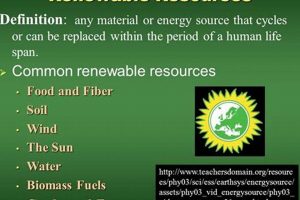
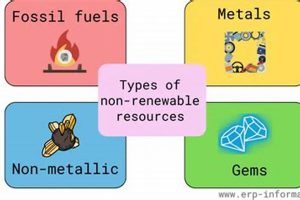
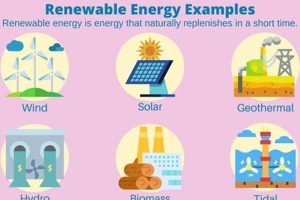
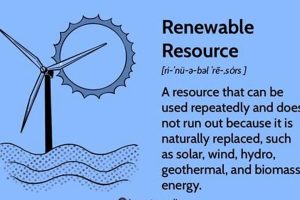
A naturally replenishing resource is one that is replenished at a rate comparable to or faster than its rate of consumption. These resources originate from sources that are essentially inexhaustible on a human timescale. Examples include solar radiation, wind, geothermal heat, and biomass that is sustainably managed.
The significance of utilizing these continually replenished resources stems from their reduced environmental impact compared to finite resources. Their employment mitigates the depletion of the Earth’s reserves and can diminish pollution associated with extraction, processing, and combustion. Historically, reliance on continually replenished sources was common before the widespread availability of fossil fuels, and a return to their prominence is viewed as crucial for a sustainable energy future.
Understanding the characteristics and applications of such resources is paramount in addressing global energy demands and fostering environmentally responsible practices. The following sections will delve into specific types, their technologies, and their role in a transition towards a cleaner energy economy.
Strategies for Effective Use of Replenishable Resources
This section presents practical strategies for maximizing the benefits and minimizing the drawbacks associated with the utilization of resources that are naturally replenished.
Tip 1: Prioritize Diversification: Employ a portfolio approach, integrating multiple types of such energy resources (solar, wind, hydro, geothermal) to enhance reliability and reduce dependence on any single source, mitigating intermittency challenges.
Tip 2: Invest in Energy Storage: Implement advanced energy storage solutions, such as battery systems or pumped hydro storage, to capture excess energy produced during periods of high generation and release it during periods of low generation, ensuring a consistent energy supply.
Tip 3: Support Grid Modernization: Advocate for and participate in grid modernization efforts to enhance the grid’s capacity to integrate distributed generation from these sources. Smart grids, equipped with advanced sensors and controls, are essential for efficient management.
Tip 4: Promote Energy Efficiency: Couple the deployment of replenishing energy technologies with aggressive energy efficiency measures across all sectors (residential, commercial, industrial) to reduce overall energy demand, thereby lowering the scale of such infrastructure required.
Tip 5: Encourage Policy Support: Engage in advocacy for supportive government policies, including feed-in tariffs, tax incentives, and renewable portfolio standards, to create a stable and predictable market environment that fosters investment and innovation.
Tip 6: Focus on Sustainable Biomass Management: If utilizing biomass, ensure it is sourced from sustainably managed forests or agricultural residues, preventing deforestation, soil degradation, and competition with food production.
Tip 7: Consider Lifecycle Assessments: Conduct thorough lifecycle assessments of different such resource technologies to evaluate their environmental impact across their entire value chain, from manufacturing to decommissioning, identifying areas for improvement.
Adopting these strategies enhances energy security, reduces environmental impact, and fosters a transition to a more sustainable energy system. The effective integration of these resources requires a holistic approach encompassing technological innovation, policy support, and responsible management practices.
The following sections will explore specific examples of successful implementations and discuss future trends in this evolving field.
1. Replenishment Rate

The defining characteristic of a naturally replenishing resource is its rate of replenishment. This rate must equal or exceed the rate at which the resource is consumed to maintain its classification as continually renewed. Failure to meet this condition negates the resource’s renewability, ultimately leading to depletion. For instance, solar energy, with its continuous influx of radiation, demonstrates an inherently high replenishment rate. Conversely, geothermal energy, while derived from the Earth’s internal heat, possesses a varying replenishment rate depending on the specific location and extraction method. If geothermal energy is extracted at a rate exceeding its natural recharge, the heat source can be exhausted over time, negating its continually renewed status.
The assessment of replenishment rate requires careful consideration of the specific resource and its context. Biomass, for example, relies on photosynthetic processes to convert solar energy into organic matter. While trees can be harvested for energy, their replenishment hinges on sustainable forestry practices. Deforestation or unsustainable harvesting practices can significantly reduce the replenishment rate, rendering biomass a non-renewable resource. Similarly, hydroelectric power, dependent on consistent water cycles, can be affected by climate change-induced droughts, decreasing its replenishment rate and overall viability as a renewable source. The practical significance of understanding replenishment rate lies in ensuring the long-term availability of energy resources and preventing unintended environmental consequences.
In conclusion, the replenishment rate serves as a fundamental criterion for categorizing energy sources as naturally replenishing. It dictates the sustainability of their utilization and necessitates responsible management practices. Accurate assessment and careful monitoring of replenishment rates are crucial for ensuring the long-term viability and environmental integrity of energy systems relying on naturally replenishing resources. Disregard for this crucial factor compromises the very definition of these sustainable energy sources.
2. Source Sustainability

Source sustainability is intrinsically linked to the definition of naturally replenishing resources. A resource can only be accurately classified as naturally replenishing if its source exhibits long-term viability and is not depleted through extraction or utilization. The cause-and-effect relationship is clear: unsustainable sourcing practices directly undermine the renewability of the resource. For instance, while biomass is often cited as a naturally replenishing resource, unsustainable logging practices leading to deforestation compromise the source, rendering the biomass supply non-renewable. This exemplifies that the apparent renewability of a resource is contingent on the sustainable management of its origin.
The importance of source sustainability as a component of defining naturally replenishing resources is underscored by practical examples. Consider geothermal energy. While the Earth’s internal heat is a vast reservoir, localized extraction rates exceeding the rate of heat replenishment can deplete specific geothermal reservoirs. Similarly, the viability of hydroelectric power depends on consistent water cycles and sustainable watershed management. Damming rivers without considering ecological impacts can disrupt downstream ecosystems, impacting water availability and undermining the long-term sustainability of the power source. Therefore, considering source sustainability is essential when assessing the renewability and environmental impact of any resource.
In summary, source sustainability is not merely a desirable attribute but a foundational requirement for a resource to genuinely qualify as naturally replenishing. Understanding this connection necessitates a holistic approach that considers the environmental and ecological factors influencing the availability and integrity of the resource origin. Failure to account for source sustainability leads to a misclassification of resources, undermining efforts to transition to a truly sustainable energy future and perpetuating environmentally harmful practices.
3. Environmental Impact

Environmental impact is a critical determinant in evaluating whether a resource genuinely aligns with the definition of naturally replenishing. The overall environmental consequence of harvesting, processing, and utilizing a resource plays a pivotal role in assessing its sustainable nature. A resource that necessitates extensive environmental damage during extraction or usage may not qualify as a truly replenishing option, irrespective of its natural reoccurrence.
- Greenhouse Gas Emissions
The emissions profile associated with a resources lifecycle significantly influences its environmental suitability. Resources such as solar, wind, and hydropower typically exhibit lower greenhouse gas emissions compared to fossil fuels. However, the manufacturing processes for solar panels and wind turbines, as well as the construction of hydroelectric dams, involve some level of emissions. A comprehensive lifecycle assessment is essential to accurately gauge the net greenhouse gas contribution. Improper land use for biofuel production, for example, can offset any emission benefits.
- Habitat Disruption
The degree to which the extraction or utilization of a resource disrupts natural habitats is a major consideration. While wind farms provide a low-carbon energy source, they can pose a threat to bird and bat populations if not sited and managed carefully. Hydroelectric dams alter river ecosystems, potentially impacting fish migration and riparian habitats. Siting and management of naturally replenished energy projects are therefore critical factors in minimizing habitat disruption.
- Water Usage
The water intensity of a resource’s utilization must be evaluated. Certain geothermal power plants can consume significant quantities of water for cooling, especially in arid regions. Hydropower, while not typically consumptive, can alter river flow patterns and impact downstream water availability. Careful water management strategies are required to mitigate potential negative impacts on water resources.
- Waste Generation
The generation of waste products during the manufacture, operation, or decommissioning of renewable technologies is an important environmental consideration. Solar panel production, for instance, can generate hazardous waste materials. Responsible recycling programs and proper waste disposal protocols are essential to minimize the environmental footprint of renewable energy technologies.
In conclusion, the environmental impact assessment is an intrinsic part of defining naturally replenishing resources. The consideration of greenhouse gas emissions, habitat disruption, water usage, and waste generation enables a comprehensive evaluation. Understanding and minimizing these impacts is crucial to ensuring that the pursuit of naturally replenishing energy sources genuinely contributes to a sustainable future.
4. Energy Security
Energy security, defined as the uninterrupted availability of energy sources at an affordable price, is intrinsically linked to the utilization and deployment of resources that meet the definition of naturally replenishing. Reliance on diverse, geographically distributed, and domestically available energy sources bolsters a nation’s energy independence and mitigates vulnerabilities to geopolitical instability and supply chain disruptions.
- Diversification of Energy Sources
A core tenet of energy security is diversification. Over-reliance on a single energy source, especially if imported, introduces significant risk. Naturally replenishing resources offer opportunities to diversify the energy mix, lessening dependence on volatile global commodity markets and reducing the potential impact of supply disruptions. For example, a country investing in solar, wind, and geothermal energy reduces its reliance on imported fossil fuels, enhancing its energy independence. Germany’s Energiewende, though complex, aims to diversify its energy supply by prioritizing naturally replenished resources.
- Reduced Geopolitical Risk
Fossil fuels are often concentrated in specific regions, leading to geopolitical tensions and potential conflicts. The geographically dispersed nature of resources meeting the definition of naturally replenished reduces this geopolitical risk. Solar, wind, and geothermal resources are available in varying degrees across many regions, allowing nations to harness domestic resources and lessen dependence on politically unstable suppliers. This localized energy production fosters greater self-sufficiency and strengthens national security. The United States, for instance, has significantly increased its domestic energy production through renewable sources, reducing its reliance on foreign oil.
- Mitigation of Price Volatility
Fossil fuel prices are subject to significant volatility due to factors such as geopolitical events, supply disruptions, and speculative trading. Resources meeting the definition of naturally replenished, once the initial infrastructure investment is made, offer more predictable and stable energy costs. The fuel source (sun, wind, geothermal heat) is essentially free, reducing exposure to fluctuating commodity prices. Long-term power purchase agreements for renewable energy projects provide price certainty, benefiting both consumers and utilities. Denmark’s strong focus on wind energy has provided more stable electricity prices compared to countries heavily reliant on imported natural gas.
- Enhanced Grid Resilience
Distributed generation, often associated with resources meeting the definition of naturally replenished, enhances grid resilience. Centralized power plants are vulnerable to large-scale outages. Distributed renewable energy systems, such as rooftop solar panels, can provide backup power during grid failures and improve the overall reliability of the electricity supply. Microgrids powered by renewable energy sources can operate independently during emergencies, ensuring critical services are maintained. Puerto Rico’s experience with Hurricane Maria highlighted the vulnerability of a centralized grid and the potential for distributed renewable energy systems to enhance resilience.
These facets illustrate the strong synergy between energy security and the utilization of resources that meet the definition of naturally replenishing. By diversifying energy sources, reducing geopolitical risk, mitigating price volatility, and enhancing grid resilience, these resources contribute significantly to a more secure and sustainable energy future.
5. Economic Viability

Economic viability is a crucial factor when evaluating any energy resource, including those classified as naturally replenishing. An energy source may technically meet the definition of naturally replenishing, yet its widespread adoption is contingent on its ability to compete economically with traditional energy sources like fossil fuels. The cost of energy generation, transmission, and storage must be competitive, and the resource should offer a reasonable return on investment for stakeholders. The increasing competitiveness of renewable energy technologies illustrates the practical importance of economic viability. For example, the declining cost of solar photovoltaic (PV) panels has made solar energy a viable alternative to conventional electricity generation in many regions, driving its widespread adoption. Conversely, some geothermal projects face high upfront capital costs, hindering their economic feasibility despite the renewable nature of the resource. Without economic viability, the potential of naturally replenishing resources to contribute to a sustainable energy future remains limited.
Government policies and incentives play a significant role in enhancing the economic viability of resources meeting the definition of naturally replenishing. Subsidies, tax credits, and feed-in tariffs can help level the playing field by offsetting the higher initial capital costs often associated with renewable energy projects. Carbon pricing mechanisms, such as carbon taxes or cap-and-trade systems, can further enhance the economic competitiveness of renewable energy by internalizing the external costs of fossil fuel combustion. Furthermore, technological advancements continually drive down the cost of renewable energy technologies. Innovations in solar panel efficiency, wind turbine design, and energy storage systems improve performance and reduce costs, making renewable energy more economically attractive. The offshore wind industry, for example, has significantly reduced costs through technological advancements and economies of scale, making it a viable option for many coastal regions.
In conclusion, economic viability is not merely a desirable attribute but a fundamental requirement for the widespread deployment of resources meeting the definition of naturally replenishing. While a resource may possess the characteristic of renewability, its ability to compete economically with conventional energy sources ultimately determines its practical impact. Government policies, technological innovation, and market dynamics all play crucial roles in enhancing the economic viability of renewable energy, driving its adoption and contributing to a more sustainable and secure energy future. The ongoing effort to make naturally replenishing resources economically competitive is essential for achieving a true transition towards cleaner energy systems.
6. Technological Advancements
Technological advancements are inextricably linked to the evolving definition and practical application of naturally replenishing resources. Progress in technology directly influences the efficiency, cost-effectiveness, and accessibility of harnessing these resources, thereby determining their feasibility as viable energy alternatives. The effect of these advancements is a continuous expansion of what can be considered a practically usable naturally replenishing resource. For instance, early solar cell technology was inefficient and expensive, limiting solar energy’s applicability. However, continuous innovation in materials science and manufacturing processes has drastically improved solar cell efficiency and reduced costs, making solar power a competitive energy source in many regions.
The importance of technological advancements as a component of defining naturally replenishing resources lies in their ability to overcome inherent limitations. Wind energy, for example, is intermittent and geographically dependent. However, advancements in wind turbine design, such as taller towers and larger rotor diameters, allow for increased energy capture in lower wind speed areas. Furthermore, developments in energy storage technologies, such as advanced batteries and pumped hydro storage, mitigate the intermittency challenge, making wind energy a more reliable power source. Smart grid technologies also play a crucial role, enabling the efficient integration of variable renewable energy sources into the electricity grid. These examples underscore that technological innovation is not simply an enhancement but an essential driver in expanding the scope and practicality of resources meeting the definition of naturally replenishing.
In summary, technological advancements are a defining force in shaping the accessibility and economic viability of naturally replenishing resources. Continuous innovation in energy generation, storage, and grid integration is crucial for overcoming inherent limitations and ensuring these resources can contribute significantly to a sustainable energy future. Challenges remain in further reducing costs, improving efficiency, and addressing environmental impacts associated with the manufacturing and disposal of renewable energy technologies. However, ongoing technological progress offers the potential to transform the energy landscape and facilitate a transition to a cleaner and more secure energy future based on naturally replenished sources.
7. Policy Frameworks

Policy frameworks are instrumental in shaping the development, deployment, and integration of resources that meet the definition of naturally replenishing. The creation and implementation of targeted policies can either accelerate or impede the transition to a sustainable energy system based on these resources. A comprehensive and well-designed policy landscape is essential for fostering investor confidence, incentivizing innovation, and ensuring equitable access to clean energy technologies.
- Feed-in Tariffs (FITs)
Feed-in tariffs are a policy mechanism designed to support naturally replenishing energy sources by guaranteeing a fixed price for electricity generated from these sources. FITs offer long-term contracts that provide revenue certainty for project developers, incentivizing investment in renewable energy projects. For instance, Germany’s early FIT program was instrumental in driving the rapid expansion of solar photovoltaic (PV) capacity. The guaranteed price encourages the development of resources meeting the definition of naturally replenishing, even when their costs are initially higher than conventional sources. However, poorly designed FITs can lead to over-subsidization and market distortions.
- Renewable Portfolio Standards (RPS)
Renewable Portfolio Standards mandate that a certain percentage of electricity supplied by utilities must come from naturally replenishing sources. RPS policies create a demand for renewable energy certificates (RECs), which utilities can purchase to meet their compliance obligations. These standards establish a market for renewable energy, driving investment and innovation. California’s RPS program, for example, has significantly increased the state’s reliance on renewable energy. The effectiveness of RPS policies depends on the level of the target, the flexibility provided to utilities, and the enforcement mechanisms in place. Strong RPS policies can drive substantial growth in the utilization of resources that meet the definition of naturally replenishing.
- Tax Incentives and Subsidies
Tax incentives and direct subsidies reduce the upfront capital costs and operational expenses associated with developing naturally replenishing energy projects. Investment tax credits (ITCs) and production tax credits (PTCs) lower the financial barriers to entry for renewable energy developers. These incentives can stimulate investment in research and development, manufacturing, and deployment of renewable energy technologies. The U.S. federal government has utilized ITCs and PTCs to support the growth of wind and solar energy. Tax incentives and subsidies can be effective in accelerating the adoption of resources meeting the definition of naturally replenishing, but their long-term sustainability and cost-effectiveness should be carefully evaluated.
- Carbon Pricing Mechanisms
Carbon pricing mechanisms, such as carbon taxes and cap-and-trade systems, internalize the external costs of fossil fuel combustion, making resources that meet the definition of naturally replenishing more economically competitive. A carbon tax places a direct price on carbon emissions, incentivizing businesses and consumers to reduce their carbon footprint. Cap-and-trade systems establish a limit on overall emissions and allow companies to trade emission allowances. These policies create a market signal that favors low-carbon energy sources. The European Union Emissions Trading System (EU ETS) is an example of a cap-and-trade system. Carbon pricing mechanisms can create a more level playing field for resources that meet the definition of naturally replenishing, driving their adoption and reducing reliance on fossil fuels.
These facets underscore the critical role of policy frameworks in shaping the landscape for resources that meet the definition of naturally replenishing. Effective policies can drive innovation, reduce costs, and accelerate the transition to a sustainable energy system. However, poorly designed or implemented policies can create market distortions, hinder progress, and undermine the long-term viability of renewable energy. Therefore, careful consideration of policy design, implementation, and evaluation is essential for maximizing the benefits of naturally replenishing resources and achieving a sustainable energy future.
Frequently Asked Questions about Naturally Replenishing Resources
This section addresses common inquiries and clarifies prevalent misconceptions regarding resources that meet the definition of naturally replenishing.
Question 1: What precisely distinguishes a naturally replenishing resource from a non-replenishing one?
A naturally replenishing resource is defined by its replenishment rate, which must equal or exceed its consumption rate. Non-replenishing resources, conversely, are finite and depleted upon use, lacking a comparable rate of natural replenishment.
Question 2: Are all resources marketed as “naturally replenishing” truly sustainable in practice?
No. The designation of a resource as naturally replenishing requires verification of sustainable sourcing and management practices. Unsustainable practices, such as deforestation for biomass or excessive water usage in geothermal, can undermine the resource’s renewability.
Question 3: Is the economic cost of naturally replenishing energy technologies always higher than that of fossil fuels?
Historically, this was often the case, but technological advancements and economies of scale have significantly reduced the cost of many resources meeting the definition of naturally replenishing. Solar and wind energy, in particular, are now competitive with fossil fuels in many regions.
Question 4: How does the intermittency of solar and wind energy impact grid reliability?
The inherent variability of solar and wind energy presents challenges to grid stability. Energy storage solutions, smart grid technologies, and geographical diversification are crucial for mitigating intermittency and ensuring a reliable electricity supply.
Question 5: What role do government policies play in promoting the adoption of resources meeting the definition of naturally replenishing?
Government policies, such as feed-in tariffs, renewable portfolio standards, and tax incentives, create a supportive market environment that incentivizes investment in resources meeting the definition of naturally replenishing and accelerates their deployment.
Question 6: How do environmental impacts associated with the manufacturing and disposal of renewable energy technologies compare to those of fossil fuels?
While the environmental impacts associated with fossil fuels, encompassing extraction, combustion, and waste disposal, are generally more severe, the manufacturing and disposal of renewable energy technologies also carry environmental burdens. Lifecycle assessments are essential to comprehensively evaluate and minimize these impacts.
In conclusion, understanding the complexities and nuances associated with resources meeting the definition of naturally replenishing is essential for making informed decisions and promoting a truly sustainable energy future.
The following section will explore future trends and emerging technologies in the field of renewable energy.
Define Renewable Resource
This exploration of “define renewable resource” has underscored the multifaceted nature of this concept. The term encompasses not only the inherent renewability of a source but also critical considerations of sustainability, economic viability, technological feasibility, and supportive policy frameworks. Each aspect is interconnected, requiring a holistic understanding to ensure that the utilization of a so-called renewable source genuinely contributes to a sustainable energy future. A simplistic interpretation risks misclassifying unsustainable practices as environmentally sound, thereby undermining global efforts toward decarbonization and resource conservation.
Moving forward, a more rigorous and nuanced application of the definition is imperative. This necessitates continuous monitoring of resource replenishment rates, proactive management of environmental impacts, and sustained investment in innovative technologies. Furthermore, robust policy mechanisms are essential to incentivize responsible resource utilization and foster a level playing field within the energy market. Ultimately, the commitment to upholding the true essence of “define renewable resource” is a commitment to securing a resilient and ecologically sound future for generations to come.
![Guide to What Energy Resources Are Renewable [+Future] | Renewable Energy Solutions for a Sustainable Future | Clean & Green Power](https://pplrenewableenergy.com/wp-content/uploads/2026/03/th-516-300x200.jpg "Guide to What Energy Resources Are Renewable [+Future] Renewable Energy Solutions for a Sustainable Future | Clean & Green Power")