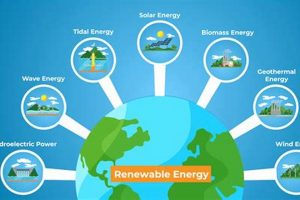
Globally, a portion of power generation is derived from sources that are naturally replenished, such as solar, wind, hydro, geothermal, and biomass. This fraction represents the degree to which societies are transitioning away from finite resources. For instance, if calculations show that 20% of the world’s energy supply originates from these sources, it signifies that one-fifth of global energy needs are met sustainably.
The significance of this proportion lies in its impact on environmental sustainability and energy security. Increasing this fraction reduces reliance on fossil fuels, thereby mitigating greenhouse gas emissions and combating climate change. Furthermore, diversifying energy sources strengthens energy independence, safeguarding nations from volatile global markets and geopolitical instability. Historically, this segment of the energy mix has been relatively small but has witnessed substantial growth in recent decades due to technological advancements and increased environmental awareness.
Understanding the current level, its trajectory, and the factors influencing its growth are essential for shaping future energy policies and investment decisions. The subsequent sections will delve into current data, trends, regional variations, and challenges associated with expanding these energy technologies.
Understanding Renewable Energy Contribution
Examining the fraction of global power derived from renewable sources necessitates a multi-faceted approach, incorporating data analysis, policy evaluation, and technological assessment to understand current trends and future prospects.
Tip 1: Analyze Global Energy Statistics. Consult reputable sources like the International Energy Agency (IEA), the U.S. Energy Information Administration (EIA), and the Intergovernmental Panel on Climate Change (IPCC) for precise figures. These organizations provide comprehensive data on energy production and consumption by source, enabling accurate determination of the percentage contributed by renewables.
Tip 2: Differentiate Between Energy and Electricity. It is critical to distinguish between total energy consumption and electricity generation. Renewables contribute a larger percentage to electricity generation than to overall energy consumption, which includes transportation and heating. A comprehensive analysis requires separate consideration of these sectors.
Tip 3: Evaluate Regional Variations. The percentage varies significantly across regions. Europe and Latin America often exhibit higher proportions due to supportive policies and abundant renewable resources, while other regions may lag behind due to infrastructure limitations or reliance on fossil fuels. Regional analyses offer a nuanced understanding of the global average.
Tip 4: Monitor Technological Advancements. Technological innovation in renewable energy technologies, such as solar photovoltaics, wind turbines, and energy storage, directly influences their competitiveness and adoption rates. Tracking these advancements helps project future growth and contribution.
Tip 5: Assess Policy Impacts. Government policies, including subsidies, tax incentives, and renewable energy mandates, play a crucial role in driving deployment. Evaluating the effectiveness of these policies provides insight into their contribution to expanding the renewable energy sector.
Tip 6: Consider Embedded Energy. A comprehensive assessment must include the energy required to manufacture, transport, and install renewable energy systems. This life cycle analysis provides a more accurate representation of the net contribution of renewables.
Tip 7: Account for Intermittency. The intermittent nature of some renewable sources, such as solar and wind, poses challenges for grid stability. Understanding how grid management strategies and energy storage solutions address this intermittency is crucial for evaluating the reliability and overall impact of renewables.
In summation, understanding the percentage requires a thorough investigation of data sources, technological progress, policy impacts, and regional variations. This analysis will allow for more effective strategies to increase the contribution of renewable sources to the global energy mix and foster a sustainable energy future.
The following sections will further explore specific renewable energy technologies and their respective contributions to the global energy landscape.
1. Current Percentage

The “current percentage” directly quantifies “what percent of the world’s energy comes from renewable sources,” serving as a key performance indicator for the global energy transition. A higher percentage signifies greater reliance on renewable sources and decreased dependence on fossil fuels, directly affecting carbon emissions and environmental sustainability. For example, if current data indicates that renewable sources account for 28% of global energy, this figure directly translates to the extent to which energy demand is being met by sustainable means. This percentage is not merely a statistic; it is an actionable metric that informs policy decisions, investment strategies, and technological development.
The “current percentage” acts as a benchmark against which progress is measured and targets are set. Governments and international organizations use this metric to evaluate the effectiveness of renewable energy policies and to adjust strategies as needed. Consider the European Union’s renewable energy targets; their progress toward those targets is directly assessed by tracking the current percentage of renewable energy within the EU’s energy mix. Furthermore, investors rely on this indicator to identify opportunities in the renewable energy sector, allocate capital to promising projects, and assess the risk and return profiles of various renewable energy technologies. The fluctuations in the “current percentage” reflect the dynamic interplay between policy interventions, technological advancements, and market forces.
In conclusion, the “current percentage” provides essential insights into the degree to which renewable sources contribute to the global energy supply. Its monitoring and analysis are critical for guiding the energy transition, informing policy decisions, and driving investments in sustainable energy solutions. While challenges remain in accelerating the adoption of renewable energy, the “current percentage” serves as a vital tool for measuring progress and charting a course towards a more sustainable energy future.
2. Electricity vs. Total

The proportion of energy derived from renewable sources varies significantly when considering electricity generation versus total energy consumption. Renewable sources often constitute a larger fraction of electricity production than they do of overall energy use, a disparity primarily attributable to the persistent dominance of fossil fuels in sectors like transportation and heavy industry. For example, a nation might report that 40% of its electricity is generated from renewable sources, while the total energy from these sources only accounts for 15%, considering the energy consumed by vehicles and manufacturing processes. This difference is crucial when assessing the overall progress toward a renewable energy transition.
The focus on electricity is driven by several factors: relative ease of integration of renewable sources into power grids, technological maturity of renewable electricity generation (e.g., wind turbines, solar photovoltaic), and policy incentives often targeting the electricity sector. Many countries have implemented renewable portfolio standards specifically for electricity providers. In contrast, decarbonizing sectors like transportation and industrial heating poses more complex challenges, requiring technological breakthroughs in areas such as electric vehicles, sustainable aviation fuels, and high-temperature industrial processes powered by renewables. The rate of progress in these sectors significantly influences the proportion of total energy derived from renewable sources.
Understanding this distinction is essential for devising effective strategies for a comprehensive energy transition. While increasing the share of renewable electricity is a positive step, it is equally important to address the dependence on fossil fuels in other sectors. Overcoming these challenges requires a multifaceted approach that includes technological innovation, policy support, and infrastructure development to ensure that “what percent of the world’s energy comes from renewable sources” increases across all energy consumption categories, not just electricity.
3. Regional Variations
The proportion of global energy derived from renewable sources exhibits significant geographic diversity. These “Regional Variations” reflect differing resource endowments, policy frameworks, economic conditions, and technological infrastructure, all of which collectively determine “what percent of the world’s energy comes from renewable sources” in a particular area.
- Resource Availability
Geographic location dictates access to renewable resources. Regions with abundant solar irradiance, such as the Middle East and North Africa, possess a comparative advantage in solar energy production. Similarly, areas with strong and consistent wind patterns, like the North Sea region, are well-suited for wind power generation. Countries with significant hydropower potential, often located near large rivers or mountainous terrain, can leverage this resource for electricity generation. The availability of these resources directly impacts the feasibility and cost-effectiveness of renewable energy projects in different regions, influencing their contribution to the overall energy mix.
- Policy and Regulatory Frameworks
Government policies exert a substantial influence on the adoption of renewable energy. Regions with supportive policies, such as feed-in tariffs, renewable portfolio standards, and carbon pricing mechanisms, tend to have a higher percentage of energy from renewable sources. For example, the European Union’s Renewable Energy Directive has spurred significant growth in renewable energy across its member states. Conversely, regions with less supportive or non-existent policies may face barriers to renewable energy development, resulting in a lower proportion of renewable sources in their energy mix. Policy consistency and long-term commitments are critical for attracting investment and fostering sustainable growth in the renewable energy sector.
- Economic Development and Investment Capacity
The level of economic development and the availability of capital investment are key determinants of renewable energy deployment. Developed economies often possess the financial resources and technological expertise necessary to invest in large-scale renewable energy projects. Developing countries, on the other hand, may face financial constraints and technical limitations that hinder their ability to adopt renewable energy technologies. International financial assistance and technology transfer can play a crucial role in bridging this gap and promoting renewable energy development in less developed regions. Public-private partnerships can also leverage private sector investment to accelerate the transition to renewable energy.
- Technological Infrastructure and Grid Capacity
The existing technological infrastructure and grid capacity also affect the feasibility of integrating renewable energy sources. Regions with well-developed electricity grids are better equipped to handle the intermittent nature of some renewable energy sources, such as solar and wind power. Upgrading and modernizing grid infrastructure is essential for accommodating increasing amounts of renewable energy and ensuring a reliable electricity supply. Furthermore, the availability of energy storage solutions, such as batteries and pumped hydro storage, can help to mitigate the intermittency challenge and improve the stability of the electricity grid. The level of technological sophistication and infrastructure readiness directly influences the ability of a region to integrate and utilize renewable energy sources effectively.
In conclusion, regional variations in resource availability, policy frameworks, economic conditions, and technological infrastructure lead to significant disparities in the proportion of global energy derived from renewable sources. Addressing these regional differences requires tailored strategies that consider the specific circumstances of each region, promoting international collaboration, and fostering technological innovation to accelerate the transition to a more sustainable energy future. These differences are crucial to consider when analyzing “what percent of the world’s energy comes from renewable sources” at a global scale.
4. Growth Trajectory

The ‘Growth Trajectory’ of renewable energy directly dictates the evolving percentage of global energy derived from these sources. It represents the path of expansion, adoption, and integration of renewables within the global energy mix, inherently influencing “what percent of the world’s energy comes from renewable sources” at any given point in time. Understanding this trajectory is crucial for projecting future energy landscapes and evaluating the effectiveness of current sustainability efforts.
- Policy Influence on Expansion Rate
Governmental policies serve as critical catalysts for the growth of renewable energy. Incentives such as feed-in tariffs, tax credits, and renewable portfolio standards directly impact the economic viability and attractiveness of renewable energy projects. For instance, countries with strong carbon pricing mechanisms often see accelerated growth in renewable energy investments. These policy decisions dictate the rate at which renewable energy capacity expands, directly influencing the upward trajectory of the percentage of energy derived from renewable sources globally. Conversely, policy uncertainty or a lack of consistent support can stifle growth, leading to a slower increase in renewables’ share of the energy mix.
- Technological Advancements and Cost Reduction
Innovation in renewable energy technologies is a key driver of their increasing competitiveness and adoption. Advancements in solar photovoltaic efficiency, wind turbine design, and energy storage solutions have led to significant cost reductions in recent years. The declining cost of renewable energy makes it increasingly competitive with fossil fuels, accelerating its deployment. For example, the levelized cost of electricity (LCOE) for solar and wind has decreased dramatically, making them economically viable options in many regions. This technological progress is essential for ensuring that the growth trajectory of renewable energy continues upward, contributing to a larger percentage of global energy coming from these sources.
- Infrastructure Development and Grid Integration
The expansion of renewable energy necessitates significant investments in infrastructure to support its integration into existing energy systems. Upgrading transmission lines, developing smart grids, and deploying energy storage solutions are crucial for ensuring the reliable delivery of renewable energy to consumers. Inadequate infrastructure can limit the ability to integrate variable renewable sources, such as solar and wind, hindering their growth. Regions with robust grid infrastructure and advanced grid management technologies are better positioned to accommodate increasing amounts of renewable energy, leading to a faster growth trajectory. These infrastructure developments are integral to increasing the percentage of global energy supplied by renewable sources.
The interplay between policy interventions, technological innovation, and infrastructure development collectively shapes the growth trajectory of renewable energy and directly impacts “what percent of the world’s energy comes from renewable sources.” Consistent progress across these fronts is essential for achieving a sustainable energy transition and significantly increasing the contribution of renewables to the global energy mix in the years to come.
5. Policy Impact

Government policies exert a demonstrable influence on the proportion of global energy derived from renewable sources. This “Policy Impact” forms a critical component in determining “what percent of the world’s energy comes from renewable sources,” acting as both a catalyst and a constraint. Effective policies incentivize investment, promote technological innovation, and create stable market conditions conducive to the growth of renewable energy technologies. Conversely, the absence of supportive policies, or the presence of policies that favor fossil fuels, can significantly impede the deployment of renewables. For example, the implementation of feed-in tariffs in Germany played a pivotal role in the early adoption of solar photovoltaic technology, driving down costs and stimulating industry growth. This, in turn, increased the percentage of electricity generated from renewable sources within the German energy mix.
The specific instruments employed by governments vary widely, each with its own impact on the renewable energy landscape. Renewable portfolio standards (RPS), which mandate that a certain percentage of electricity be generated from renewable sources, create a guaranteed market for renewable energy producers. Tax incentives, such as investment tax credits and production tax credits, lower the upfront costs and improve the financial viability of renewable energy projects. Carbon pricing mechanisms, such as carbon taxes and cap-and-trade systems, make fossil fuels more expensive, thereby increasing the competitiveness of renewable energy. The effectiveness of these policies depends on their design, implementation, and enforcement. For instance, a poorly designed RPS with loopholes and waivers may fail to drive significant investment in renewable energy. Similarly, a carbon tax that is too low may have little impact on consumer behavior and energy choices. The long-term stability and predictability of policies are also critical for attracting investment in renewable energy projects, which often have high upfront costs and long payback periods.
Ultimately, the impact of policies on “what percent of the world’s energy comes from renewable sources” is undeniable. Supportive policies can accelerate the transition to a cleaner energy system, while the lack of such policies can hinder progress. Policymakers must carefully consider the design, implementation, and enforcement of renewable energy policies to maximize their effectiveness and ensure a sustainable energy future. Successfully navigating the complexities of policy design requires a comprehensive understanding of the interactions between policy instruments, market dynamics, and technological innovation.
6. Technology Advancement

Technological advancement constitutes a primary driver in the expansion of renewable energy’s contribution to the global energy supply. Innovations across various renewable energy technologies directly impact the efficiency, cost-effectiveness, and scalability of these sources, thereby dictating “what percent of the world’s energy comes from renewable sources.” Efficiency improvements in solar photovoltaic (PV) cells, for instance, enable greater electricity generation from a given surface area, reducing land use requirements and lowering the per-unit cost of energy. Similarly, advancements in wind turbine design, such as larger rotor diameters and taller tower heights, capture more wind energy, increasing the output and reducing the cost of wind power. These technological progressions directly translate into a greater proportion of the global energy mix being supplied by renewable sources, enhancing their competitiveness against traditional fossil fuels.
The role of technological advancement extends beyond energy generation to encompass energy storage and grid integration. Energy storage technologies, such as lithium-ion batteries and pumped hydro storage, address the intermittency challenges associated with variable renewable energy sources like solar and wind. Advanced grid management systems, including smart grids and demand response programs, improve the reliability and stability of electricity grids with high penetrations of renewable energy. These technological solutions are essential for integrating a larger share of renewable energy into the grid and ensuring a consistent and reliable electricity supply. Without these supporting technologies, the integration of renewable energy would be significantly limited, impeding their ability to contribute substantially to the global energy mix. For instance, the development of high-voltage direct current (HVDC) transmission lines has enabled the long-distance transmission of renewable energy from remote areas to urban centers, expanding the geographical reach and potential of renewable energy projects.
In conclusion, technological advancement is inextricably linked to the growth and deployment of renewable energy technologies, influencing “what percent of the world’s energy comes from renewable sources”. Ongoing innovation in energy generation, storage, and grid integration is crucial for achieving a sustainable energy transition and reducing global reliance on fossil fuels. Continued investment in research and development, coupled with supportive policy frameworks, is essential for unlocking the full potential of renewable energy technologies and maximizing their contribution to the global energy supply. The practical significance of this understanding lies in directing resources and efforts towards the most promising technological pathways for accelerating the adoption of renewable energy and achieving a cleaner, more sustainable energy future.
7. Investment Flows

Investment flows represent the financial resources allocated to the development, deployment, and maintenance of renewable energy technologies. These flows are intrinsically linked to the expansion of the renewable energy sector and, consequently, directly influence “what percent of the world’s energy comes from renewable sources.” The magnitude and direction of these investments serve as a key indicator of the global commitment to transitioning towards a cleaner energy system.
- Public Sector Investments
Government funding, including grants, subsidies, and tax incentives, plays a crucial role in de-risking renewable energy projects and attracting private capital. Public sector investments often target early-stage research and development, infrastructure development (e.g., grid modernization), and deployment of nascent technologies. For example, the U.S. Department of Energy’s loan guarantee program has supported large-scale solar and wind projects, demonstrating the viability of these technologies and encouraging further private investment. These public investments directly enhance the competitiveness of renewable energy and increase their share in the overall energy mix.
- Private Sector Investments
Private capital, including venture capital, private equity, and corporate investments, is essential for scaling up renewable energy technologies and deploying them on a commercial basis. Private sector investments typically target established renewable energy technologies with proven track records, such as solar PV and wind power. Institutional investors, such as pension funds and insurance companies, are increasingly allocating capital to renewable energy projects as part of their environmental, social, and governance (ESG) investment strategies. For instance, large investment firms are actively investing in offshore wind farms and utility-scale solar projects, demonstrating the growing confidence in the economic viability of renewable energy. This infusion of private capital accelerates the deployment of renewable energy and directly contributes to a higher percentage of global energy coming from these sources.
- International Financial Institutions
International financial institutions (IFIs), such as the World Bank and the European Investment Bank, play a critical role in financing renewable energy projects in developing countries. IFIs provide concessional loans, grants, and technical assistance to support renewable energy development in regions with limited access to capital. These investments often focus on expanding access to electricity in rural areas through off-grid renewable energy solutions, such as solar home systems and mini-grids. For example, the World Bank has supported numerous renewable energy projects in Sub-Saharan Africa, helping to increase the percentage of electricity generated from renewable sources and improve energy access for millions of people. These investments are crucial for addressing energy poverty and promoting sustainable development in developing countries.
- Impact Investing
Impact investing focuses on generating both financial returns and positive social and environmental impact. Impact investors are increasingly allocating capital to renewable energy projects that address climate change, improve air quality, and create jobs in underserved communities. These investments often target innovative business models and technologies that have the potential to transform the energy sector. For instance, impact investors are supporting companies that develop energy storage solutions, electric vehicle charging infrastructure, and community solar projects. By prioritizing both financial and social returns, impact investing can help to accelerate the transition to a cleaner and more equitable energy system. These types of investment can have a profound and direct impact on the overall global energy mix.
The combined effect of these investment flows, from both public and private sources, determines the rate at which renewable energy capacity is deployed globally. Regions with robust investment climates and supportive policy frameworks tend to attract greater capital flows, resulting in a faster expansion of their renewable energy sectors and a higher percentage of energy derived from renewable sources. Understanding the dynamics of investment flows is therefore essential for projecting future trends in renewable energy deployment and for designing effective policies to accelerate the transition to a sustainable energy future.
Frequently Asked Questions
This section addresses common inquiries surrounding the proportion of global energy derived from renewable sources, providing clarity and addressing potential misconceptions.
Question 1: What is the approximate current percentage of global energy derived from renewable sources?
Recent estimates indicate that renewable sources constitute a significant, but not yet dominant, fraction of the world’s energy supply. The exact percentage fluctuates based on data collection methodologies and the inclusion of specific energy sources. Current figures typically fall within the range of 25% to 30% of total global energy consumption, a figure encompassing electricity, heating, and transportation.
Question 2: Is the percentage of renewable energy consistent across different energy sectors (e.g., electricity, heating, transportation)?
No. Renewable energy’s contribution varies substantially across sectors. The electricity sector generally exhibits the highest penetration of renewables due to the mature technologies and established infrastructure for wind, solar, and hydro power. Heating and transportation sectors lag behind, primarily due to the continued reliance on fossil fuels and the challenges associated with electrifying these sectors or adopting alternative renewable fuels.
Question 3: How are different renewable energy sources (solar, wind, hydro, etc.) contributing to the overall percentage?
The contribution of each renewable energy source varies depending on regional resource availability, technological maturity, and policy support. Hydropower has historically been the largest contributor, but wind and solar power are experiencing rapid growth and are projected to become increasingly dominant in the future. Biomass, geothermal, and other renewable sources contribute a smaller, but still significant, portion to the overall percentage.
Question 4: Why is it important to track the percentage of global energy derived from renewable sources?
Tracking this percentage is crucial for assessing progress towards global climate goals and energy security objectives. It serves as a key performance indicator for the energy transition, enabling policymakers and stakeholders to evaluate the effectiveness of renewable energy policies and investments. It also provides a basis for setting targets, monitoring progress, and adjusting strategies as needed.
Question 5: What are the main barriers preventing a faster increase in the percentage of global energy from renewable sources?
Several barriers impede the accelerated adoption of renewable energy. These include high upfront costs, intermittency challenges associated with variable renewable sources, inadequate grid infrastructure, policy uncertainty, and competition from subsidized fossil fuels. Overcoming these barriers requires concerted efforts to promote technological innovation, strengthen policy frameworks, and mobilize financial resources.
Question 6: How can individuals and organizations contribute to increasing the global percentage of energy from renewable sources?
Individuals can reduce their energy consumption, choose renewable energy providers, and invest in energy-efficient appliances. Organizations can implement renewable energy projects, advocate for supportive policies, and invest in research and development. Collective action at all levels is essential for accelerating the transition to a sustainable energy future.
In summary, understanding the current percentage of global energy derived from renewable sources, along with its sectoral variations and influencing factors, is essential for informed decision-making and effective action towards a sustainable energy future.
The next section will delve into the future outlook for renewable energy adoption and the potential pathways to achieving a fully decarbonized energy system.
Conclusion
The preceding analysis has underscored the multifaceted nature of determining what percent of the world’s energy comes from renewable sources. The current proportion, while demonstrably growing, remains a minority share of the global energy mix, significantly trailing the consumption rates of fossil fuels across various sectors. Regional disparities, policy effectiveness, technological advancements, and investment strategies all coalesce to influence the pace and extent of renewable energy adoption. A nuanced understanding of these factors is crucial for accurate assessment and strategic planning.
Achieving a sustainable energy future necessitates a sustained and amplified commitment to renewable energy development and deployment. Recognizing the critical role that these sources play in mitigating climate change and ensuring energy security, continued focus must be directed towards innovative technologies, robust policy frameworks, and strategic investment allocations. The future global energy landscape hinges on the collective and decisive actions taken to accelerate the integration of renewable resources, driving the percentage toward a majority stake and securing a more environmentally responsible and economically resilient world energy system.


![Basics: What is an Energy Source? [Explained] | Renewable Energy Solutions for a Sustainable Future | Clean & Green Power](https://pplrenewableenergy.com/wp-content/uploads/2026/03/th-100-300x200.jpg "Basics: What is an Energy Source? [Explained] Renewable Energy Solutions for a Sustainable Future | Clean & Green Power")