Harnessing heat from the Earth’s interior for power generation and heating applications represents a significant energy strategy. This subterranean heat, a result of the planet’s formation and radioactive decay within its core, can be accessed through various methods, including geothermal power plants and direct-use applications. These applications include heating buildings, greenhouses, and even aquaculture facilities.
The utilization of this resource offers numerous advantages. It provides a consistent and reliable energy supply, independent of weather conditions. Unlike solar or wind power, the Earth’s internal heat is constantly available. Historically, civilizations have utilized geothermal resources for bathing and heating, but modern technologies have expanded its application to large-scale electricity production. Its lower carbon footprint compared to fossil fuels contributes to mitigating climate change.
The following sections will delve into the mechanisms of accessing subterranean heat, assess its long-term sustainability, and examine the environmental considerations associated with its use, providing a detailed overview of its role in a sustainable energy future.
Geothermal Energy Utilization
Effective implementation of geothermal resources requires careful planning and execution. The following tips provide guidance on optimizing the benefits of this energy source.
Tip 1: Site Selection: Prioritize locations with high geothermal gradients and accessible hydrothermal resources. Geological surveys and temperature gradient measurements are crucial for determining the viability of a potential site. For example, areas near volcanic activity or tectonic plate boundaries often exhibit higher geothermal potential.
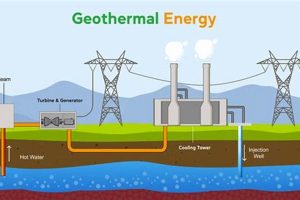
Tip 2: Technology Matching: Select the appropriate geothermal technology based on resource temperature and energy demand. High-temperature resources are suitable for electricity generation via steam turbines, while lower-temperature resources are better suited for direct-use applications such as district heating or agricultural processes.
Tip 3: Resource Management: Implement strategies for sustainable resource extraction to prevent reservoir depletion. Monitoring well pressure and temperature, coupled with injection strategies, are essential for maintaining long-term productivity.
Tip 4: Environmental Mitigation: Address potential environmental impacts such as land disturbance, air emissions (e.g., hydrogen sulfide), and water usage. Closed-loop systems can minimize water consumption and reduce the risk of groundwater contamination.
Tip 5: Regulatory Compliance: Adhere to all applicable environmental regulations and permitting requirements. Compliance ensures responsible development and avoids potential legal or financial penalties.
Tip 6: Community Engagement: Engage with local communities to address concerns and ensure project acceptance. Open communication and transparent project planning can foster positive relationships and minimize opposition.
Tip 7: Financial Planning: Secure adequate funding through a combination of public and private investment. Geothermal projects often require significant upfront capital, but the long-term operational costs are typically lower than fossil fuel-based alternatives.
These strategies promote responsible and efficient use. By focusing on site selection, appropriate technology, and environmental considerations, the potential of this resource can be maximized.
Subsequent discussions will explore specific case studies and technological advancements further.
1. Earth's Internal Heat

Earth’s internal heat is the fundamental driver behind geothermal energy’s potential as a sustainable resource. This heat, originating from primordial heat left over from the planet’s formation and ongoing radioactive decay in the mantle and core, continuously flows outwards. This consistent outward flux distinguishes it from depletable fossil fuels. Without this continuous supply of heat from within the Earth, geothermal energy extraction would be unsustainable over relevant timescales.
The accessibility of this thermal energy varies geographically. Regions with high geothermal gradients, often associated with volcanic activity or tectonic plate boundaries, allow for easier and more efficient extraction. For example, Iceland’s abundant geothermal resources, due to its location on the Mid-Atlantic Ridge, provide a significant portion of the nation’s electricity and heating needs. The practical significance lies in harnessing this naturally replenishing heat source to reduce reliance on carbon-intensive energy sources, thereby mitigating climate change.
In conclusion, Earth’s internal heat is the underlying and essential component of geothermal energy. Its continuous replenishment, coupled with responsible extraction and management practices, solidifies the classification of geothermal as a renewable energy source. While regional variations in accessibility and technological advancements continue to shape its utilization, its fundamental connection to the planet’s internal heat ensures its long-term viability as a clean energy alternative.
2. Sustainable Extraction Rates
The classification of subterranean thermal energy as a renewable source hinges critically on maintaining sustainable extraction rates. This parameter refers to the rate at which heat or fluid is withdrawn from a subterranean reservoir without depleting the resource over a defined timeframe. When extraction surpasses the natural recharge rate of the reservoir, the system will eventually cool or dry up, negating its long-term sustainability. Therefore, careful management of extraction rates is paramount to ensuring the continued viability and classification of this resource as renewable.
The Reykjavik Energy geothermal system in Iceland exemplifies the importance of sustainable extraction. Through meticulous monitoring of reservoir pressure, temperature, and fluid levels, extraction rates are carefully adjusted to match the natural recharge. Conversely, the initial operations at the Geysers geothermal field in California experienced unsustainable practices, resulting in a decline in steam production. Corrective measures, including wastewater injection, were implemented to replenish the reservoir and restore sustainable output. This underscores the practical implications of balancing energy production with resource conservation to prevent depletion.
In conclusion, the link between sustainable extraction rates and the designation of Earth’s internal heat as a renewable source is undeniable. Achieving sustainable extraction requires robust monitoring programs, adaptive management strategies, and a deep understanding of reservoir dynamics. By prioritizing long-term resource health over short-term energy gains, the renewable status of Earth’s internal heat can be preserved, contributing to a more sustainable energy future. The challenges lie in accurately assessing recharge rates and implementing effective management strategies that balance energy demand with long-term resource availability, ensuring the sustained availability for future generations.
3. Reservoir Recharge Capacity

Reservoir recharge capacity plays a pivotal role in determining the long-term viability and renewable designation of subterranean heat resources. It represents the ability of a reservoir to replenish its heat and fluid content naturally or through managed intervention, ensuring the sustained availability of thermal energy for extraction. Understanding and managing this capacity are crucial for classifying subterranean heat as a renewable resource.
- Natural Replenishment Mechanisms
Natural recharge involves processes such as the conduction of heat from surrounding rock formations, the influx of groundwater heated by deeper thermal sources, and the convective circulation of fluids within the reservoir. The rate of these processes determines the reservoir’s inherent ability to recover after energy extraction. For instance, in high-permeability hydrothermal systems, groundwater infiltration can significantly contribute to recharge, while in hot dry rock systems, conductive heat transfer from the surrounding rock is the primary replenishment mechanism. If extraction rates exceed natural replenishment, the reservoir’s temperature and pressure will decline, diminishing its energy potential and impacting its renewable classification.
- Impact of Injection Strategies
Injection strategies, such as injecting treated wastewater or surface water into the reservoir, can artificially augment recharge capacity. This practice helps maintain reservoir pressure, sustains fluid levels, and can enhance heat transfer from the surrounding rock. The success of injection depends on several factors, including water compatibility with the reservoir rock, injection rate, and well placement. For example, at the Geysers geothermal field, injection of treated wastewater has proven essential for sustaining steam production. However, improper injection can lead to issues such as induced seismicity or reduced permeability due to mineral precipitation, requiring careful monitoring and management.
- Geological Characteristics
The geological characteristics of a reservoir profoundly influence its recharge capacity. Factors such as rock permeability, porosity, fracture density, and thermal conductivity govern the rate at which fluids can flow into the reservoir and heat can be transferred from the surrounding rocks. High permeability and porosity facilitate rapid fluid infiltration and heat convection, enhancing recharge. For example, volcanic rock formations often exhibit high permeability due to fracturing, making them ideal for sustaining geothermal production. Understanding the geological properties of a reservoir is crucial for accurately assessing its recharge potential and designing effective management strategies.
- Long-Term Sustainability Implications
The ability to maintain a balance between extraction and recharge is fundamental for the long-term sustainability. If extraction consistently outpaces recharge, the resource will eventually deplete, negating its renewable status. Sustainable management requires continuous monitoring of reservoir conditions, adaptive extraction strategies, and, if necessary, the implementation of artificial recharge techniques. Sites like Larderello in Italy exemplify the long-term challenges and the importance of sustained research and development in reservoir management to ensure continued productivity. Ensuring long term management guarantees the source as renewable for future extraction.
The multifaceted interplay between natural processes, geological conditions, and human intervention determines the reservoir recharge capacity, a key determinant of whether subterranean heat can be accurately classified as renewable. Effective management of this capacity, through informed extraction practices and sustainable injection strategies, ensures the long-term availability of Earth’s thermal resources, underpinning their classification as a source of clean and renewable energy. The challenge lies in maintaining this equilibrium in the face of increasing energy demands and the complexities of subterranean geological systems.
4. Environmental Impact Mitigation
The classification of subterranean heat as a renewable resource is intrinsically linked to effective environmental impact mitigation. While the extraction of thermal energy offers a lower carbon footprint compared to fossil fuels, it is not without potential environmental consequences. Mitigating these impacts is crucial for ensuring the long-term sustainability and acceptance of this energy source. Neglecting environmental considerations undermines the resource’s claim to renewability, as irreversible ecological damage compromises its future viability. Several key areas demand careful attention, including land disturbance, air emissions, water usage, and induced seismicity. Addressing each of these potential impacts minimizes the overall environmental footprint, reinforcing the renewable status of this source.
Consider the case of the Svartsengi geothermal plant in Iceland. While providing a significant portion of Iceland’s electricity and heating, the plant faces challenges related to wastewater disposal. Reinjection of geothermal fluids is employed to mitigate water pollution and maintain reservoir pressure. However, this reinjection can, in some cases, trigger minor seismic events. Rigorous monitoring and adaptive management strategies are therefore essential to minimize this risk. The practical significance lies in balancing the benefits of clean energy production with the need to protect local ecosystems and communities. Employing closed-loop systems, advanced emission control technologies, and careful site selection minimizes the detrimental effects on the environment. Furthermore, stringent regulatory oversight and adherence to best practices are paramount for ensuring responsible resource development.
In summary, the effectiveness of strategies employed to mitigate environmental impacts directly influences the evaluation of subterranean heat as a truly renewable energy source. Mitigation efforts are vital for minimizing ecological disruption, preserving the resource’s long-term viability, and upholding its classification as a sustainable energy solution. The challenge lies in continuously improving mitigation technologies, implementing comprehensive monitoring programs, and fostering a culture of environmental responsibility within the geothermal industry. By prioritizing environmental protection, the full potential of geothermal energy as a renewable resource can be realized without compromising the health of the planet.
5. Long-Term Resource Management
Effective long-term resource management is essential for maintaining the classification of subterranean heat as a renewable energy source. Sustainability hinges not only on the inherent properties of the resource but also on the strategies employed to ensure its availability for future generations. The following outlines critical facets of long-term resource management in the context of subterranean heat and its renewable status.
- Reservoir Monitoring and Modeling
Continuous monitoring of reservoir conditions, including temperature, pressure, fluid levels, and chemical composition, is fundamental. This data informs the development of sophisticated reservoir models that predict long-term performance under various extraction scenarios. For example, monitoring data from the Larderello geothermal field in Italy has been used for decades to refine reservoir models and optimize production strategies. Accurate models enable informed decision-making regarding extraction rates, injection strategies, and the overall management of the resource, ensuring its sustained productivity.
- Adaptive Management Strategies
Long-term resource management requires adaptive strategies that respond to changing reservoir conditions and new scientific understanding. This involves adjusting extraction rates, optimizing well placement, and implementing enhanced recovery techniques as needed. The Geysers geothermal field in California provides a clear illustration; early unsustainable extraction practices led to declining steam production, necessitating the implementation of wastewater injection to replenish the reservoir and restore output. Adaptive management ensures that the resource is utilized in a manner that promotes long-term sustainability.
- Injection and Reinjection Techniques
Injection of treated wastewater or surface water into geothermal reservoirs is a key strategy for maintaining reservoir pressure, sustaining fluid levels, and enhancing heat recovery. Careful selection of injection fluids and monitoring of injection well performance are crucial to prevent scaling, corrosion, and induced seismicity. The success of reinjection programs, such as those implemented at the Svartsengi plant in Iceland, demonstrates the potential to significantly extend the lifespan and enhance the sustainability of subterranean heat resources.
- Regulatory Framework and Oversight
A robust regulatory framework and effective oversight are essential for promoting responsible resource management and preventing overexploitation. Regulations should address issues such as permitting requirements, environmental impact assessments, monitoring protocols, and enforcement mechanisms. The regulatory structure in New Zealand, for example, provides a comprehensive framework for managing geothermal resources, ensuring sustainable development and minimizing environmental impacts. Clear and consistently enforced regulations are critical for safeguarding the long-term viability and renewable status.
These facets are intrinsically linked to ensuring long-term supply. By employing meticulous monitoring, adaptive strategies, strategic fluid injection, and a robust regulatory framework, the resource can be effectively maintained as a renewable source. This multi-faceted approach highlights the complex relationship between human intervention and natural resource preservation, underpinning the argument for geothermal energy’s position in a sustainable energy future.
Frequently Asked Questions
The following addresses common inquiries regarding the categorization of Earth’s internal heat as a renewable energy resource.
Question 1: Is geothermal energy truly inexhaustible?
While the Earth’s internal heat is vast, it is not entirely inexhaustible at specific extraction sites. Sustainable practices are crucial to ensure long-term viability.
Question 2: What is the primary factor determining the renewability of geothermal resources?
The balance between the rate of heat extraction and the natural or artificial recharge of the reservoir is the determining factor. Extraction rates must not exceed the replenishment rate to maintain sustainability.
Question 3: Can improper geothermal energy development lead to resource depletion?
Yes, unsustainable extraction practices, such as extracting fluids faster than the recharge rate, can lead to reservoir cooling, pressure decline, and ultimately, resource depletion.
Question 4: How do injection wells contribute to the sustainability of geothermal energy?
Injection wells replenish reservoir fluids, maintain pressure, and enhance heat recovery, thereby extending the lifespan and improving the sustainability of extraction sites.
Question 5: What environmental concerns are associated with terrestrial thermal energy?
Potential environmental impacts include land disturbance, air emissions (e.g., hydrogen sulfide), water usage, and, in some cases, induced seismicity. These concerns necessitate careful mitigation strategies.
Question 6: What role do regulatory frameworks play in ensuring the renewable status of this energy source?
Robust regulatory frameworks, including permitting requirements, monitoring protocols, and enforcement mechanisms, are essential for promoting responsible resource management and preventing overexploitation, safeguarding its renewable status.
In summary, while the Earth’s internal heat presents a substantial energy resource, its classification as renewable is contingent upon sustainable extraction practices, responsible environmental stewardship, and effective long-term resource management.
The subsequent section will delve into the future prospects and emerging technologies in geothermal energy utilization.
Geothermal Energy
This examination has detailed the multifaceted nature of geothermal energy and its classification. The inherent sustainability hinges upon responsible management practices, emphasizing the delicate balance between extraction and replenishment. Mitigation of environmental impacts remains paramount, directly influencing the viability and acceptance of geothermal as a sustainable energy solution. The Earth’s continuous internal heat, combined with strategic resource management, underpins the argument for geothermal’s renewable designation.
Future advancements in technology and comprehensive regulatory frameworks will be critical in maximizing the potential of subterranean thermal energy. Continued investment in research, development, and deployment of responsible geothermal practices is essential to secure a sustainable energy future. Prioritizing long-term resource health, environmental stewardship, and community engagement will ultimately determine the contribution of Earth’s internal heat to a diversified and reliable energy portfolio.