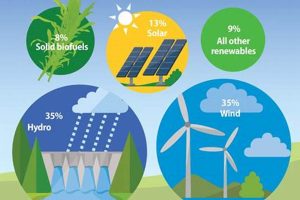
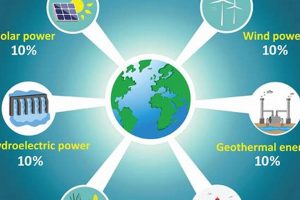
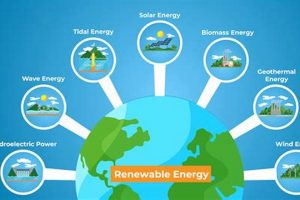
A resource capable of being replenished by natural ecological cycles or sound management practices within a human lifespan is considered sustainable. Power derived from such resources inherently replaces reliance on depletable reserves like fossil fuels. Solar radiation, wind, flowing water, geothermal heat, and biomass represent typical examples. Exploiting these natural phenomena allows for continuous energy generation, provided that the rate of consumption does not exceed the rate of natural regeneration.
Adopting these sustainable practices offers several significant advantages. Reducing greenhouse gas emissions, mitigating climate change, enhancing energy security, and diversifying energy supplies constitute key benefits. Historically, societies have utilized rudimentary forms of such resources, such as windmills and watermills. Modern technological advancements have facilitated more efficient and widespread utilization, driving down costs and improving reliability. The transition away from finite stocks supports environmental preservation and long-term economic stability.
The following sections will delve into the specifics of various types of sustainable power generation. This analysis will include assessments of their technological maturity, environmental impacts, and economic viability. Consideration will be given to the challenges and opportunities associated with integrating these options into existing energy infrastructures. Further discussion will address policy frameworks and technological advancements needed to accelerate their deployment.
Practical Guidance for Understanding Sustainable Power
This section presents essential insights for navigating the complexities of sustainable power, focusing on key aspects and considerations relevant to both individual comprehension and broader societal implementation.
Tip 1: Distinguish Between Renewable and Sustainable: While frequently used interchangeably, these terms possess nuanced differences. A resource may be renewable but not necessarily sustainable if its extraction or utilization causes significant environmental damage or depletes other critical resources.
Tip 2: Understand Lifecycle Assessments: Evaluate the complete environmental impact of power generation, including manufacturing, transportation, operation, and decommissioning. This comprehensive approach reveals the true sustainability of various resources.
Tip 3: Consider Geographic Appropriateness: The viability of specific resources varies considerably based on location. Solar resources are optimal in regions with high solar irradiance, whereas wind resources require consistent wind patterns. Analyze the specific regional context before advocating for a particular technology.
Tip 4: Acknowledge Intermittency Challenges: Many sustainable power sources, such as solar and wind, exhibit intermittent output. Addressing this requires energy storage solutions, grid modernization, and demand response strategies.
Tip 5: Evaluate Energy Storage Solutions: Energy storage technologies are crucial for reliable sustainable energy integration. Batteries, pumped hydro storage, and thermal energy storage offer different advantages and disadvantages depending on the application.
Tip 6: Research Government Incentives and Policies: Governments worldwide offer various incentives, such as tax credits and feed-in tariffs, to promote adoption. Understanding these policies is crucial for evaluating the economic feasibility of projects.
Tip 7: Follow Technological Advancements: The field of sustainable power is rapidly evolving. Staying informed about the latest technological breakthroughs, such as improved solar panel efficiency and enhanced energy storage capacity, is essential.
These insights provide a foundational understanding for engaging with the multifaceted aspects of sustainable power. A comprehensive perspective enables informed decision-making and promotes effective strategies for transitioning towards a more sustainable energy future.
The subsequent sections will explore specific sustainable power technologies in greater detail, building upon this foundational understanding.
1. Replenishment Rate

The replenishment rate fundamentally defines the sustainability of an energy resource. A high replenishment rate, where the resource is renewed quickly through natural processes, directly correlates with the classification of the energy as sustainable. Conversely, resources with negligible or extremely slow replenishment rates, such as fossil fuels, are deemed unsustainable due to their finite nature and eventual depletion. The rate must equal or exceed the rate of consumption to ensure long-term availability. For instance, solar energy possesses a near-instantaneous replenishment rate, being continuously supplied by the sun. Wind energy’s rate is determined by atmospheric conditions and is consistently replenished by solar heating and planetary rotation. Biomass replenishment depends on plant growth rates, which are sustainable if harvesting is balanced with regrowth.
The relationship between replenishment rate and consumption directly influences the environmental impact. If consumption consistently exceeds replenishment, the resource becomes degraded, impacting ecosystems and jeopardizing future availability. Over-harvesting forests for biomass can lead to deforestation and soil erosion, negating the intended sustainability. Similarly, extracting geothermal energy at rates exceeding the natural replenishment of underground heat reservoirs can cause temperature declines and reduced power output. Careful management and technological innovation are required to align consumption and replenishment rates. This includes strategies like optimized forest management, enhanced geothermal systems, and efficient solar cell design. These efforts seek to minimize environmental impacts and maximize the longevity of energy resources.
Understanding the replenishment rate is therefore paramount for sustainable energy resource management. It informs policy decisions regarding resource allocation, technological investment, and consumption patterns. A clear grasp of this fundamental concept allows for the development of effective strategies that guarantee energy security while safeguarding the environment. The ongoing challenge involves accurately assessing replenishment rates, especially in complex systems like geothermal reservoirs and biomass production, and implementing practices that maintain a sustainable equilibrium between resource availability and human consumption, ultimately supporting the principles of sustainability.
2. Natural Processes

Natural processes are intrinsic to the very nature of resources that continuously renew and replenish themselves, forming the cornerstone of sustainable power. These processes ensure that the resources are available for energy generation without depletion, provided they are managed responsibly. Understanding these processes is fundamental to appreciating the long-term viability and environmental benefits of such resources.
- Solar Radiation Replenishment
The Sun, driven by nuclear fusion, continuously emits electromagnetic radiation. This energy arrives at the Earth, providing a perpetual source for solar power generation. The Earth’s atmosphere plays a role in regulating this radiation, but the fundamental process remains consistent, ensuring a predictable and renewable supply of energy. Without this continuous radiation from the sun, solar power would be nonexistent.
- Wind Formation Dynamics
Differential heating of the Earth’s surface by solar radiation creates temperature gradients, driving atmospheric pressure differences. These pressure differences give rise to wind patterns. Wind turbines convert the kinetic energy of the wind into electricity. The consistent replenishment of wind energy, driven by the interplay of solar heating and planetary rotation, forms the basis of wind power as a viable sustainable source.
- Hydrological Cycle
Evaporation, precipitation, and runoff constitute the hydrological cycle, a closed system where water is continuously recycled. Hydropower relies on the potential energy of water stored in reservoirs or flowing in rivers. The consistent operation of the hydrological cycle, driven primarily by solar energy, ensures the continual availability of water for power generation, making hydropower a sustainable energy resource.
- Geothermal Heat Flux
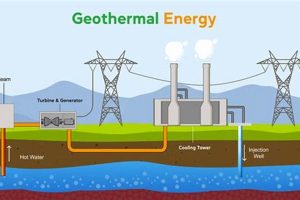
The Earth’s internal heat, a result of primordial heat from planetary formation and radioactive decay within the Earth’s core, creates a geothermal gradient. Geothermal power plants harness this heat, converting it into electricity or using it directly for heating purposes. While not strictly renewable in the same timescale as solar or wind, the vast reservoir of thermal energy within the Earth provides a relatively constant and sustainable source of heat for energy production, provided extraction rates are managed effectively.
The aforementioned natural processes demonstrate the inherent sustainability of various energy resources. These processes provide the continuous renewal that allows for long-term energy generation without depleting the resource base. The efficacy and sustainability of any energy source depend on understanding and respecting these underlying natural processes, ensuring that resource exploitation does not disrupt the balance of these natural systems and preserves their functionality for future generations.
3. Finite Lifespan Comparison

The concept of finite lifespan comparison is central to differentiating sustainable and unsustainable energy sources. Its examination highlights the fundamental limitation of resources with exhaustible reserves, contrasting starkly with the virtually inexhaustible nature of resources that are continuously replenished.
- Depletion Rates
Fossil fuels, such as coal, oil, and natural gas, possess fixed quantities. Extraction and consumption continuously deplete these reserves. The rate of depletion directly impacts the projected availability of these fuels. Conversely, sustainable resources, like solar and wind, are replenished at rates that vastly exceed human consumption, making their depletion, for practical purposes, inconsequential.
- Resource Regeneration
Fossil fuels require millions of years to form through geological processes. The time required for regeneration is significantly longer than the rate of consumption. Sustainable resources, on the other hand, regenerate through natural processes that occur within human timescales. Sunlight, wind, and flowing water are continually available, independent of human action.
- Long-Term Energy Security
Reliance on resources with finite lifespans inevitably leads to energy insecurity as reserves dwindle and extraction becomes more challenging and costly. Conversely, transitioning to sources with virtually limitless lifespans enhances energy security, providing a reliable and predictable energy supply for future generations.
- Environmental Impact Mitigation
The extraction and combustion of finite resources result in significant environmental impacts, including greenhouse gas emissions, habitat destruction, and pollution. Sustainable resources, by virtue of their natural replenishment, generally have far lower environmental impacts, contributing to climate change mitigation and ecological preservation.
These comparisons underscore the fundamental advantages of reliance on sources that have very long or virtually indefinite lifespans. Shifting from the extraction and consumption of resources with limited lifespans to sources ensures long-term energy availability while minimizing environmental degradation. This comparison forms a critical foundation for informed energy policy decisions.
4. Environmental Impact

The environmental impact serves as an intrinsic element in evaluating any renewable source energy definition. True sustainability demands that energy production not only derive from replenishable sources but also minimize ecological disruption throughout its lifecycle. The connection between the two concepts lies in a cause-and-effect relationship: energy generation methods impact the environment; the extent of that impact informs the classification of whether the source aligns with the principles of sustainable practice. For instance, a hydroelectric dam, while utilizing a replenishing water resource, can significantly alter river ecosystems and displace communities. The negative consequences on aquatic life, sediment transport, and land use challenge its unqualified designation as inherently environmentally positive.
The importance of minimizing environmental impact within renewable source energy definition stems from the necessity to preserve ecological integrity and ensure long-term resource availability. Wind farms, though cleaner than fossil fuel plants, can pose threats to bird and bat populations. Solar panel manufacturing involves the use of certain materials with their own environmental concerns. Biomass, if not sustainably sourced, can contribute to deforestation and soil degradation. Therefore, a full lifecycle assessment, considering manufacturing, operation, and decommissioning, becomes essential when evaluating the true environmental footprint of power. This assessment includes carbon footprint, water use, land use, and impacts on biodiversity.
In conclusion, the environmental implications are essential for effective power policies. By carefully assessing and mitigating impacts throughout their entire lifecycle, we can ensure that sustainable energy contributes to a healthier planet. The challenge lies in continual innovation to minimize impacts, coupled with rigorous monitoring and responsible resource management, thereby ensuring a balanced and sustainable approach to energy that respects the environment and promotes long-term ecological health.
5. Long-Term Availability

Long-term availability is a critical determinant of any resource’s classification within a renewable source energy definition. A resource, irrespective of its purported environmental benefits, cannot be considered sustainably viable unless its supply can be guaranteed for the foreseeable future. The connection stems from the fundamental premise that an energy system must be able to provide power reliably and consistently over extended periods without risking resource depletion or system collapse. Failure to meet this criterion renders the resource non-sustainable, regardless of its other advantageous characteristics. For instance, if a source such as a geothermal power plant draws energy at a rate faster than the geothermal reservoir can replenish, its operational lifespan is limited, thereby disqualifying it from being fully recognized as part of a sustainable energy infrastructure.
The importance of long-term availability to the renewable source energy definition is rooted in ensuring energy security and economic stability. A consistent and predictable energy supply allows societies to plan infrastructure development, support economic growth, and avoid the volatility associated with finite resources. Power derived from solar radiation, wind, and flowing water, where the underlying phenomena are governed by consistent natural cycles, showcases this principle. Sunlight is an almost limitless energy source, so its availability in most locations for solar panel energy production is fairly constant and reliable. Wind patterns, driven by global weather systems, similarly, offer a renewable source of power. In contrast, a reliance on a resource with a finite supply chain creates uncertainty and vulnerability. For example, some types of biomass production are deemed unsustainable if managed poorly, and if overused, can be more harmful than finite sources of energy.
In summary, guaranteeing long-term availability is essential for defining and implementing truly sustainable power systems. This principle requires a comprehensive assessment of resource replenishment rates, extraction practices, and potential environmental impacts. By prioritizing resources with virtually inexhaustible supplies and implementing responsible management strategies, it is possible to build an energy system that supports long-term economic prosperity and ecological integrity. The ongoing challenge lies in developing advanced technologies and policies that can effectively harness and manage natural processes to achieve and maintain long-term resource availability.
Frequently Asked Questions Regarding the Definition of Sustainable Power
The following provides answers to common questions concerning the classification and characterization of resources considered within the realm of sustainable energy.
Question 1: What distinguishes an energy source as ‘renewable’ versus ‘sustainable’?
The term ‘renewable’ describes resources replenished naturally, such as solar and wind. ‘Sustainable’ encompasses renewability but also considers environmental impact, resource management, and long-term availability. A source can be renewable without being truly sustainable.
Question 2: How does the concept of ‘replenishment rate’ factor into defining resources?
The replenishment rate represents the speed at which a resource regenerates. A sustainable resource must replenish at a rate equal to or exceeding the rate of consumption, ensuring long-term availability.
Question 3: Why is the comparison of finite lifespan important when considering resources?
Comparison highlights the limitation of non-renewable resources and the long-term availability of sustainable options. This contrast informs policy decisions promoting energy security and ecological preservation.
Question 4: What is the significance of ‘environmental impact’ in the consideration?
Minimizing environmental impact is paramount. Resources must be evaluated for their impact on ecosystems, climate, and resource use throughout their lifecycle, not just during energy production.
Question 5: Why is ‘long-term availability’ a non-negotiable factor in the definition?
Long-term availability ensures energy security, economic stability, and consistent supply. A resource cannot be considered sustainably viable if its supply cannot be guaranteed into the future.
Question 6: Can a resource be deemed unsustainable despite being widely considered ‘green’?
Yes. Unsustainable practices within the lifecycle of a resource, such as environmental degradation, may disqualify it as truly sustainable, irrespective of its ‘green’ reputation. Thorough assessment is required.
These answers provide clarity on the multifaceted nature of the criteria. A thorough understanding of these factors is crucial for effective energy planning and sustainable resource management.
The subsequent article sections will delve into specific examples and case studies to illustrate these principles in practice.
Renewable Source Energy Definition
The exploration has clarified that a resource classification hinges on multiple criteria beyond mere replenishment. Replenishment rate, environmental impact, resource lifespan comparison, and long-term availability are each crucial. The evaluation requires a lifecycle approach, comprehensively accounting for ecological consequences throughout the energy production process. An assessment must recognize trade-offs and consider the broader systemic implications of adopting a specific resource.
The pursuit of sustainable power demands rigorous analysis and informed decision-making. Continued research, technological advancements, and stringent regulatory frameworks are necessary to ensure that choices support both energy needs and environmental stewardship. The collective responsibility to advance these goals is critical for securing a sustainable energy future.