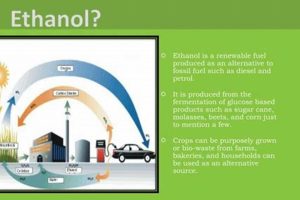
Biofuels are derived from recently living organic matter, commonly plants or agricultural waste. This distinguishes them from fossil fuels, which originate from ancient, long-decayed organic materials. A common example is ethanol, produced from the fermentation of sugars found in crops like corn or sugarcane, and biodiesel, made from vegetable oils, animal fats, or recycled greases.
The significance of fuels derived from biomass lies in their potential to reduce reliance on finite fossil fuel reserves and mitigate greenhouse gas emissions. Unlike fossil fuels, which release carbon sequestered over millions of years, biofuels can be part of a closed-loop carbon cycle. The plants used to create these fuels absorb carbon dioxide from the atmosphere during their growth. When the resultant fuel is burned, the carbon released is theoretically equivalent to the amount initially absorbed, resulting in a near-neutral carbon footprint, provided the energy used to cultivate, process, and transport the biofuel is also sustainably sourced. This characteristic has spurred interest in the development and utilization of these fuels as a way to promote energy independence and reduce environmental impact. The increased utilization can lead to reduced greenhouse gas emissions, diversification of energy resources, and create economic opportunities in rural areas through agricultural development.
To understand the sustainability benefits of these fuels requires an examination of their production cycle, including land use considerations, water consumption, and the overall energy balance. Further investigation into advanced biofuel technologies, which utilize non-food crops and waste materials, reveals a potential path towards even greater environmental and economic viability.
Understanding the Sustainable Nature of Biofuels
Optimizing the environmental benefits of fuels derived from biomass requires a comprehensive understanding of their lifecycle and responsible implementation strategies.
Tip 1: Focus on Sustainable Feedstock Sourcing: Prioritize biofuels derived from sustainably managed sources, such as non-food crops, agricultural residues, or dedicated energy crops grown on marginal lands. Avoid feedstocks that compete with food production or contribute to deforestation.
Tip 2: Optimize Conversion Processes: Implement efficient conversion technologies that minimize energy input and waste generation during biofuel production. Invest in research and development of advanced conversion methods like cellulosic ethanol production and algae-based biofuel technologies.
Tip 3: Promote Lifecycle Assessment: Conduct thorough lifecycle assessments (LCAs) of biofuel production pathways to evaluate their environmental impacts across the entire value chain, including feedstock cultivation, transportation, conversion, and combustion. LCAs help identify potential hotspots and opportunities for improvement.
Tip 4: Ensure Responsible Land Management: Implement land management practices that protect biodiversity, soil health, and water resources in areas used for biofuel feedstock production. Avoid converting natural habitats into agricultural land for biofuel crops.
Tip 5: Support Policy Frameworks: Advocate for policy frameworks that promote sustainable biofuel production and consumption, including incentives for advanced biofuels, carbon pricing mechanisms, and sustainability standards.
Tip 6: Improve Infrastructure and Distribution: Develop infrastructure and distribution networks to support the widespread adoption of biofuels. This includes upgrading existing fuel infrastructure to handle higher blends of biofuels and investing in new biofuel production facilities.
Tip 7: Promote Technological Innovation: Encourage continuous technological innovation in biofuel production to improve efficiency, reduce costs, and minimize environmental impacts. Support research and development of new biofuel feedstocks, conversion technologies, and utilization pathways.
Implementing these guidelines enhances the sustainability and net-positive impact of using fuels from renewable organic sources, maximizing the environmental and economic advantages.
The responsible and informed development of biofuels offers a pathway towards a more sustainable energy future.
1. Carbon Cycle Integration

The integration of biofuels within the carbon cycle constitutes a foundational element of their classification as sources of renewable energy. Unlike fossil fuels, which introduce carbon that has been sequestered for millions of years into the atmosphere, biofuels theoretically operate within a closed or near-closed carbon loop. The process begins with the photosynthetic absorption of atmospheric carbon dioxide (CO2) by plants during their growth phase. These plants, which serve as the feedstock for biofuel production, incorporate this carbon into their biomass. Subsequently, when the resultant biofuel is combusted to generate energy, the carbon that was initially absorbed from the atmosphere is released. This inherent cycling mechanism distinguishes biofuels, in principle, from fossil fuels and underpins their classification as renewable resources. For instance, consider corn ethanol production: the corn plant absorbs CO2 as it grows, and this CO2 is released when the ethanol derived from the corn is burned in an engine.
The importance of carbon cycle integration lies in its potential to mitigate the net increase of atmospheric CO2 concentrations, a primary driver of climate change. However, a complete understanding requires accounting for the entire lifecycle of biofuel production. Factors such as the energy inputs required for feedstock cultivation, harvesting, transportation, and conversion processes must be considered. If these processes rely heavily on fossil fuels, the carbon footprint of the biofuel can be significantly increased, potentially diminishing its net environmental benefits. Furthermore, indirect land use changes (ILUC), where biofuel production displaces food crops and leads to deforestation to compensate, can release significant amounts of stored carbon, negating the initial carbon sequestration benefits. Therefore, the sustainability of biofuels is contingent upon optimizing the carbon cycle integration by employing efficient and renewable energy sources throughout the production chain and minimizing the potential for ILUC effects. Sustainable practices include utilizing no-till farming techniques, employing renewable energy for processing plants, and promoting biofuel production on degraded lands that are unsuitable for food crops.
In conclusion, the integration of biofuels into the carbon cycle is a crucial factor in determining their renewability, but it is not the sole determinant of their overall sustainability. The extent to which biofuels can contribute to mitigating climate change depends on a holistic approach that considers the entire lifecycle carbon footprint, including land use impacts and energy inputs. Addressing the challenges associated with efficient and sustainable production practices is paramount to realizing the full potential of biofuels as a truly renewable energy source. Ongoing research and technological advancements are essential to further refine biofuel production processes and enhance their carbon cycle integration, ensuring they contribute positively to a lower-carbon future.
2. Biomass Regeneration

Biomass regeneration is intrinsically linked to the renewable status of biofuels, as it addresses the fundamental requirement of replenishing the source material used in their production. Unlike fossil fuels, which are finite resources extracted from geological reserves accumulated over millions of years, biomass can be renewed relatively quickly through agricultural practices or natural regrowth. The ability to regenerate biomass ensures a continuous supply of feedstock for biofuel production, thus enabling the sustained generation of energy. For example, sugarcane, a common feedstock for ethanol production, can be harvested annually, with new plants readily sprouting from the cut stalks, allowing for continual harvesting seasons. Similarly, fast-growing trees, such as willow or poplar, cultivated for woody biomass production, can be harvested on short rotation cycles, ensuring a consistent supply for biofuel conversion.
The importance of biomass regeneration extends beyond mere supply availability; it directly impacts the environmental sustainability of biofuels. Sustainable biomass regeneration practices, such as crop rotation, no-till farming, and integrated pest management, can enhance soil health, reduce erosion, and minimize the need for synthetic fertilizers and pesticides. These practices not only improve the productivity of biomass crops but also reduce the environmental footprint associated with their cultivation. Furthermore, the utilization of marginal lands, unsuitable for conventional agriculture, for dedicated energy crop production can avoid competition with food crops and prevent deforestation, thus enhancing the overall sustainability of biofuel production. For instance, switchgrass, a native prairie grass, can be grown on marginal lands with minimal inputs, providing a sustainable feedstock for cellulosic ethanol production. This contributes significantly to the perception and realization of the source as renewable since the material is actively and repeatedly replaced.
In conclusion, biomass regeneration is a critical component of why biofuels are considered renewable sources of energy. Its capacity to provide a continuous and sustainable supply of feedstock, coupled with environmentally sound agricultural practices, ensures the long-term viability of biofuel production. Addressing challenges associated with efficient biomass regeneration, such as optimizing crop yields, minimizing land use impacts, and promoting sustainable agricultural practices, is essential for realizing the full potential of biofuels as a renewable energy source. Future research and development efforts should focus on enhancing biomass regeneration techniques and promoting the adoption of sustainable agricultural practices to ensure the continued renewability and environmental sustainability of biofuel production.
3. Reduced Fossil Dependence

The capacity to lessen reliance on fossil fuels forms a critical justification for classifying biofuels as renewable energy sources. Diminishing dependence on finite fossil reserves promotes energy security and mitigates the environmental consequences associated with their extraction, processing, and combustion. Biofuels offer a domestically producible alternative, diversifying energy portfolios and buffering nations from volatile global fossil fuel markets.
- Diversification of Energy Sources
Fossil fuels currently dominate the global energy landscape; biofuels diversify energy sources by providing alternatives for transportation, heating, and power generation. This diversification minimizes the risks associated with geopolitical instability and resource depletion inherent in relying on a limited number of fossil fuel-producing nations. For example, Brazil’s widespread adoption of ethanol derived from sugarcane has significantly reduced its dependence on imported oil, bolstering its energy independence.
- Mitigation of Greenhouse Gas Emissions
The combustion of fossil fuels is a primary contributor to greenhouse gas emissions, driving climate change. Biofuels, particularly those produced from sustainable feedstocks and utilizing efficient conversion technologies, offer the potential to reduce net greenhouse gas emissions compared to their fossil fuel counterparts. The reduced reliance on fossil fuels lowers the overall carbon footprint of the energy sector. For instance, biodiesel produced from recycled cooking oil can significantly reduce carbon emissions compared to petroleum diesel, contributing to climate change mitigation efforts.
- Enhanced Energy Security
Reduced dependence on fossil fuels enhances energy security by decreasing a nation’s vulnerability to supply disruptions, price volatility, and geopolitical instability associated with fossil fuel markets. Biofuels, produced domestically from locally available resources, strengthen energy independence and resilience. The United States, for example, has invested heavily in corn ethanol production to reduce its reliance on imported oil and enhance its energy security.
- Economic Development in Rural Areas
Biofuel production can stimulate economic development in rural areas by creating new agricultural and industrial jobs, supporting local economies, and increasing farm incomes. The cultivation of biofuel feedstocks and the operation of biofuel production facilities provide economic opportunities in regions often reliant on traditional agriculture. The growth of the biofuel industry has led to increased farm incomes and job creation in rural communities across the Midwest in the United States, contributing to local economic development.
The multifaceted benefits derived from decreased fossil fuel consumption strengthen the argument for biofuels as renewable energy sources. Diversifying energy portfolios, mitigating greenhouse gas emissions, enhancing energy security, and stimulating economic development collectively underscore the potential of biofuels to contribute to a more sustainable and resilient energy future. The continued development and deployment of sustainable biofuel technologies are crucial for realizing these benefits and transitioning away from a fossil fuel-dominated energy system.
4. Waste Stream Utilization
The utilization of waste streams in biofuel production represents a significant factor in why these fuels are considered a renewable energy source. This approach diverts materials that would otherwise become environmental burdens, converting them into valuable energy resources, thereby enhancing the overall sustainability profile of biofuels.
- Reduced Land Use Pressure
Employing waste streams as biofuel feedstock alleviates pressure on land resources. Dedicated energy crops often compete with food production or require deforestation, whereas waste streams, by definition, are byproducts of existing processes. For instance, using agricultural residues like corn stover or wheat straw for cellulosic ethanol production reduces the need to cultivate additional land solely for biofuel feedstock. This reduces competition for arable land and lessens the environmental impact associated with land conversion.
- Environmental Remediation
Biofuel production from waste streams can contribute to environmental remediation by utilizing materials that pose pollution risks. For example, waste cooking oil, if improperly disposed of, can clog sewage systems and contaminate water sources. Converting this oil into biodiesel not only produces a renewable fuel but also prevents environmental damage. Similarly, utilizing municipal solid waste for biofuel production can reduce landfill volumes and methane emissions, a potent greenhouse gas.
- Enhanced Resource Efficiency
Integrating waste stream utilization into biofuel production enhances resource efficiency by maximizing the value derived from existing resources. Instead of simply disposing of waste materials, they are repurposed to generate energy, effectively closing the loop and reducing the demand for virgin resources. For instance, using livestock manure for biogas production generates renewable energy and simultaneously reduces the environmental impact of manure management, improving air and water quality.
- Cost Reduction
The use of waste streams as feedstock can potentially reduce the overall cost of biofuel production. Waste materials are often available at lower costs compared to dedicated energy crops, as they represent a byproduct rather than a primary input. This can improve the economic competitiveness of biofuels and facilitate their wider adoption. For example, some industrial processes generate organic waste streams that can be readily converted into biofuels with minimal processing costs, making them an economically attractive feedstock option.
In conclusion, the integration of waste streams into biofuel production pathways significantly contributes to their classification as renewable energy sources. By reducing land use pressure, promoting environmental remediation, enhancing resource efficiency, and potentially lowering costs, waste stream utilization improves the overall sustainability and economic viability of biofuels, aligning with the principles of a circular economy and promoting a more sustainable energy future.
5. Sustainable Land Management

Sustainable land management is inextricably linked to the renewability of biofuels. The practices employed in cultivating biofuel feedstocks significantly determine the long-term viability and environmental impact of these energy sources. Irresponsible land use can negate the potential benefits of biofuels, whereas sustainable approaches can enhance their renewability and contribute to broader environmental goals.
- Preventing Deforestation and Habitat Loss
Deforestation to create land for biofuel feedstock cultivation releases significant amounts of stored carbon and destroys vital ecosystems. Sustainable land management prioritizes avoiding deforestation by utilizing existing agricultural land, marginal lands, or brownfield sites for biofuel feedstock production. An example is the cultivation of dedicated energy crops, such as switchgrass, on degraded lands unsuitable for food production. This approach minimizes habitat loss and maintains biodiversity while providing a sustainable source of biomass. Failing to prevent deforestation can nullify the carbon reduction benefits of biofuels and undermine their renewability.
- Maintaining Soil Health and Fertility
Unsustainable agricultural practices, such as monoculture farming and excessive tillage, can deplete soil nutrients, increase erosion, and reduce soil fertility. Sustainable land management emphasizes practices that maintain and improve soil health, such as crop rotation, no-till farming, and the use of cover crops. These techniques enhance soil organic matter, improve water retention, and reduce the need for synthetic fertilizers, promoting long-term productivity and reducing environmental impacts. For instance, rotating corn with soybeans, a nitrogen-fixing crop, can replenish soil nutrients and reduce the need for nitrogen fertilizers. Healthy soils are essential for sustained biomass production and the long-term renewability of biofuels.
- Conserving Water Resources
Water scarcity is an increasing concern in many regions, and the cultivation of biofuel feedstocks can place significant demands on water resources. Sustainable land management prioritizes water conservation through practices such as efficient irrigation techniques, rainwater harvesting, and the selection of drought-tolerant crops. For example, drip irrigation systems deliver water directly to plant roots, minimizing water loss through evaporation. Similarly, cultivating drought-tolerant crops, such as sorghum, can reduce the reliance on irrigation in water-scarce regions. Responsible water management is crucial for ensuring the long-term sustainability and renewability of biofuel production.
- Minimizing Fertilizer and Pesticide Use
The excessive use of synthetic fertilizers and pesticides can have detrimental environmental impacts, including water pollution, soil degradation, and biodiversity loss. Sustainable land management emphasizes minimizing the use of these inputs through practices such as integrated pest management (IPM), the use of organic fertilizers, and the selection of pest-resistant crop varieties. IPM strategies rely on natural pest control methods and targeted pesticide applications only when necessary. Similarly, using organic fertilizers, such as compost and manure, can improve soil health and reduce the need for synthetic fertilizers. Minimizing reliance on chemical inputs reduces environmental impacts and promotes the long-term sustainability of biofuel feedstock production.
- Promoting Biodiversity
Monoculture farming for biofuel feedstock production can reduce biodiversity and create ecological imbalances. Sustainable land management incorporates strategies to promote biodiversity, such as planting hedgerows, creating wildlife corridors, and preserving natural habitats within agricultural landscapes. Hedgerows provide habitat for beneficial insects and pollinators, enhancing crop pollination and reducing the need for pesticides. Preserving natural habitats, such as wetlands and forests, within agricultural landscapes supports biodiversity and provides ecosystem services. Promoting biodiversity enhances the resilience of agricultural systems and contributes to the overall sustainability of biofuel production.
In summary, sustainable land management is fundamental to ensuring that biofuels are truly renewable energy sources. By preventing deforestation, maintaining soil health, conserving water resources, minimizing chemical inputs, and promoting biodiversity, sustainable land management practices safeguard the environmental integrity of biofuel production and contribute to a more sustainable and resilient energy future. The degree to which biofuel production integrates these sustainable practices directly influences its viability as a renewable resource.
Frequently Asked Questions
This section addresses common inquiries regarding the renewability of biofuels, providing detailed explanations to clarify misconceptions and enhance understanding of the topic.
Question 1: What fundamentally distinguishes biofuels from fossil fuels in terms of renewability?
The primary distinction lies in the source material. Biofuels are derived from recently living organic matter (biomass), such as plants and agricultural waste, which can be replenished relatively quickly. Fossil fuels, conversely, originate from ancient organic matter that has been fossilized over millions of years, representing a finite resource.
Question 2: How does the carbon cycle influence the renewability assessment of biofuels?
Biofuels engage in a near-closed carbon cycle, where carbon dioxide absorbed by plants during growth is released during combustion. Ideally, this creates a carbon-neutral scenario. Fossil fuels, however, release carbon that has been sequestered for millennia, contributing to a net increase in atmospheric carbon dioxide levels.
Question 3: Does the potential for competition with food crops affect the designation of biofuels as renewable?
Concerns about competition with food crops are valid. Sustainable biofuel production minimizes this competition by utilizing non-food crops, agricultural residues, or marginal lands unsuitable for food production. When biofuel production displaces food crops, it can raise ethical and environmental concerns, impacting its perceived renewability.
Question 4: How significant is land use change in determining the sustainability and renewability of biofuels?
Land use change is a critical factor. Deforestation or conversion of natural habitats to cultivate biofuel feedstocks negates the benefits of reduced fossil fuel reliance. Sustainable biofuel production avoids such land conversion, ensuring that the overall impact on the environment remains positive.
Question 5: What role do advanced biofuel technologies play in enhancing the renewability of biofuels?
Advanced biofuel technologies, such as those utilizing cellulosic materials or algae, significantly enhance renewability. They broaden the range of available feedstocks, reduce reliance on arable land, and often demonstrate improved energy balances compared to conventional biofuels.
Question 6: How does the energy input required for biofuel production impact its overall renewability?
The energy balance, or the ratio of energy output to energy input, is a crucial consideration. If the energy required to cultivate, process, and transport biofuel feedstocks is excessively high, the renewability benefits can be diminished. Sustainable biofuel production prioritizes minimizing energy inputs and utilizing renewable energy sources throughout the production chain.
In summary, biofuels are renewable because their source material is capable of being replenished and because they can be part of a closed-loop carbon cycle. However, their overall sustainability and renewability depend on factors such as feedstock selection, land management practices, and energy input considerations.
The subsequent section will delve into the long-term implications and future prospects of biofuels.
Understanding Biofuel’s Renewable Nature
This exploration has illuminated the rationale behind classifying biofuels as renewable energy sources. The cyclical carbon dynamics, regenerative biomass capacity, potential for reduced fossil dependence, valuable waste stream utilization, and sustainable land management practices collectively contribute to their designation. The inherent capacity for renewal distinguishes them from finite fossil reserves, offering a pathway toward energy diversification and reduced reliance on depleting resources.
Continued research, technological advancements, and policy frameworks prioritizing sustainability are imperative to fully realize the potential of biofuels. The responsible development and implementation of these energy sources are crucial for mitigating environmental impacts and fostering a more sustainable energy future.