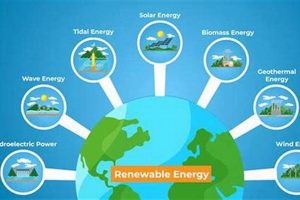
Harnessing power from naturally replenishing processes offers a sustainable alternative to finite fossil fuels. These resources are characterized by their ability to be replenished within a human lifetime, mitigating depletion concerns. Examples include solar radiation, wind currents, geothermal heat, and flowing water.
Adopting these methods reduces dependence on fossil fuels, lowers greenhouse gas emissions, and enhances energy security. Historically, reliance on sustainable resources was limited by technological constraints; however, advancements have significantly improved efficiency and reduced costs, making them increasingly viable.
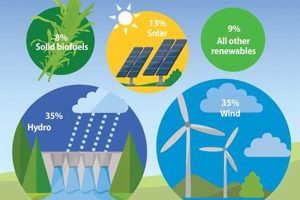
The following sections detail specific types of sustainable power generation, explaining their operational mechanisms, applications, and overall contribution to a cleaner energy future. This includes in-depth coverage of solar, wind, hydroelectric, geothermal, biomass, ocean thermal energy conversion, and hydrogen energy.
Guidance on Sustainable Power Generation
Effective utilization of resources derived from naturally replenishing processes necessitates careful planning and implementation. The following tips provide guidance on maximizing the potential of these methods for energy production.
Tip 1: Conduct a Feasibility Assessment: Prior to investing in any sustainable energy system, a thorough feasibility study is crucial. This assessment should evaluate resource availability, geographical constraints, and potential environmental impacts.
Tip 2: Prioritize Energy Efficiency: Reducing energy consumption through efficient appliances, insulation, and smart building design minimizes the required capacity of sustainable energy systems, lowering initial costs and operational demands.
Tip 3: Diversify Energy Sources: Reliance on a single type of sustainable resource can be vulnerable to fluctuations in weather patterns or seasonal changes. Diversifying with a combination of solar, wind, and geothermal can enhance reliability.
Tip 4: Utilize Energy Storage Solutions: Integrating energy storage technologies, such as batteries or pumped hydro storage, allows for the capture of excess energy generated during peak production times and its release during periods of high demand or low resource availability.
Tip 5: Leverage Government Incentives and Policies: Many governments offer tax credits, rebates, and other financial incentives to encourage the adoption of sustainable energy systems. Researching and utilizing these programs can significantly reduce project costs.
Tip 6: Monitor Performance and Maintenance: Regular monitoring of system performance and proactive maintenance are essential for optimizing energy output and extending the lifespan of equipment. Implement a maintenance schedule based on manufacturer recommendations.
Tip 7: Stay Informed on Technological Advancements: The sustainable energy sector is rapidly evolving. Staying abreast of new technologies and best practices ensures that systems remain efficient and competitive.
By implementing these guidelines, individuals, businesses, and communities can effectively harness the potential of resources derived from naturally replenishing processes, contributing to a more sustainable energy future.
The subsequent sections delve into the specific applications and considerations for optimizing the use of different sustainable power generation systems.
1. Solar Photovoltaics

Solar photovoltaics (PV) represent a cornerstone within the context of sustainable energy. These technologies directly convert sunlight into electricity through the photovoltaic effect, offering a clean and reliable power source. As a component of resource derived from naturally replenishing processes, PV systems significantly contribute to reducing dependence on fossil fuels and mitigating greenhouse gas emissions. The correlation is direct: increased deployment of PV technology leads to a greater share of electricity generation from sustainable sources, thus aligning with the goals of a sustainable energy future.
The practical significance of understanding solar PV lies in its widespread applicability. Residential rooftops, commercial buildings, and utility-scale solar farms all benefit from this technology. For instance, large-scale solar farms in the deserts of California are capable of powering hundreds of thousands of homes, demonstrating the potential to replace traditional power plants. Smaller, distributed PV systems empower individuals and businesses to generate their own electricity, reducing reliance on centralized grids and enhancing energy independence. Innovations such as bifacial solar panels and floating solar farms are further expanding the applications and efficiency of PV technology.
However, challenges remain. Intermittency due to weather conditions and the need for energy storage solutions are key considerations. Moreover, the manufacturing of solar panels involves specific environmental considerations, including resource extraction and end-of-life recycling. Addressing these challenges through technological advancements and responsible practices is crucial for maximizing the sustainability of solar PV and its overall contribution to a resource-derived from naturally replenishing processes-powered future.
2. Wind Turbine Systems

Wind Turbine Systems, integral to the set of sustainable power generation, harness the kinetic energy of wind to generate electricity. Their importance lies in providing a non-polluting energy source, significantly reducing reliance on fossil fuels and associated environmental impacts.
- Operational Mechanics and Types
Wind turbines convert wind energy into mechanical energy via rotating blades, which in turn drives a generator to produce electricity. Horizontal-axis wind turbines (HAWTs) are the most common type, while vertical-axis wind turbines (VAWTs) are used in specific applications due to their ability to capture wind from any direction. The operational mechanics are designed to maximize energy capture while minimizing noise and environmental impact. For example, modern wind farms often incorporate advanced blade designs and control systems to optimize performance under varying wind conditions.
- Location and Environmental Impact
Optimal placement is critical for the efficiency of wind turbine systems. Locations with consistent and strong wind patterns, such as coastal areas, plains, and mountaintops, are preferred. While wind energy is clean, the construction and operation of wind farms can have environmental impacts, including habitat disruption, bird and bat mortality, and visual pollution. Mitigation strategies include careful site selection, bird deterrent systems, and minimizing noise pollution.
- Integration with Electrical Grids
Wind energy must be seamlessly integrated into existing electrical grids to effectively supply power. This requires sophisticated grid management systems to handle the intermittent nature of wind power. Energy storage solutions, such as batteries or pumped hydro storage, are also essential for ensuring a reliable power supply. The integration of wind energy into electrical grids can reduce the need for conventional power plants, leading to lower emissions and improved air quality.
- Economic Considerations and Policy Support
The economic viability of wind turbine systems depends on factors such as the cost of construction, operation, and maintenance, as well as the price of electricity. Government policies, such as tax incentives, subsidies, and renewable energy mandates, play a crucial role in promoting wind energy development. For example, many countries offer tax credits for wind energy projects, making them more competitive with fossil fuel-based power generation.
The various facets of wind turbine systemsfrom their operational mechanics and environmental impacts to their integration with electrical grids and economic viabilityunderscore their significance as a key component of sustainable power generation. Their continued development and deployment are essential for achieving a cleaner and more sustainable energy future. The ongoing advancements in wind energy technology promise further improvements in efficiency, reliability, and cost-effectiveness.
3. Hydroelectric Dams

Hydroelectric dams harness the potential energy of stored water to generate electricity, firmly establishing them as a major contributor. This method relies on the gravitational force of water flowing through turbines, converting it into mechanical energy, which is subsequently transformed into electrical energy. As one of the oldest and most established means of sustainable power production, these installations have played a significant role in meeting global energy demands, particularly in regions with abundant water resources. Their consistent and controllable power output often serves as a reliable base load, complementing intermittent resources such as solar and wind. The relationship is evident: hydroelectric power stations directly utilize naturally replenished water cycles, minimizing carbon emissions during operation, therefore aligning with the definition.
The practical significance of hydroelectric dams is multifaceted. Large-scale installations, such as the Three Gorges Dam in China, can provide power to millions of homes and businesses, contributing significantly to regional and national energy grids. Smaller, run-of-river hydroelectric projects can power local communities with minimal environmental impact. Beyond electricity generation, these structures often serve multiple purposes, including flood control, irrigation, and water supply. For example, the Hoover Dam in the United States not only generates power but also regulates water flow in the Colorado River, supporting agriculture and urban development in arid regions. Understanding these diverse benefits is crucial for assessing the overall value and sustainability of hydroelectric projects. However, the construction and operation of hydroelectric dams also involve potential environmental and social consequences, including habitat alteration, fish migration barriers, and displacement of communities. Careful planning, environmental impact assessments, and mitigation strategies are necessary to minimize these adverse effects.
In summary, hydroelectric dams represent a significant, albeit complex, element. Their ability to provide a reliable and sustainable energy source is undeniable, but the environmental and social considerations cannot be overlooked. The ongoing challenge lies in balancing energy production with ecological preservation and community well-being. Future advancements in hydroelectric technology, such as fish-friendly turbines and improved reservoir management, hold promise for enhancing the sustainability and acceptance of this resource as a cornerstone of a sustainable energy future.
4. Geothermal Plants

Geothermal plants leverage the Earth’s internal heat as a resource, positioning them as a noteworthy contributor. This sustainable source harnesses thermal energy from the Earth’s core, mantle, and crust, offering a consistent and reliable energy supply independent of weather conditions or diurnal cycles. The correlation between this technology and the phrase ‘what are the 7 renewable energy sources’ lies in its direct utilization of naturally replenishing subterranean heat, thereby minimizing reliance on fossil fuels and mitigating greenhouse gas emissions.
- Operational Mechanics and Types
Geothermal plants extract heat from the Earth’s subsurface using various methods, including dry steam, flash steam, and binary cycle systems. Dry steam plants directly use steam from geothermal reservoirs to turn turbines, while flash steam plants convert high-pressure hot water into steam. Binary cycle plants pass hot water through a heat exchanger to vaporize a secondary fluid, which then drives the turbines. Examples include The Geysers in California, a complex of geothermal plants that collectively generate enough electricity to power a city. The implications for “what are the 7 renewable energy sources” are significant, as the versatility of these systems allows for energy extraction from diverse geological environments.
- Geographical Distribution and Potential
The geographical distribution of geothermal plants is largely determined by tectonic activity and the presence of geothermal reservoirs near the surface. Regions such as Iceland, Italy, the Philippines, and the western United States have significant geothermal resources. The potential for geothermal energy expansion is substantial, particularly with advancements in enhanced geothermal systems (EGS), which can access heat from deeper and more widespread sources. These improvements are pivotal for the discussion “what are the 7 renewable energy sources” because increased accessibility broadens the potential deployment of sustainable power, impacting global energy mixes.
- Environmental Considerations and Sustainability
While geothermal plants are sustainable, they also pose specific environmental challenges, including the release of greenhouse gases (such as carbon dioxide and hydrogen sulfide) and the potential for induced seismicity. However, emissions are generally much lower than those from fossil fuel power plants. Sustainable practices, such as reinjection of geothermal fluids, can minimize environmental impacts and prolong the lifespan of geothermal reservoirs. These considerations are integral to the subject “what are the 7 renewable energy sources” because they emphasize the importance of responsible management to ensure long-term sustainability and minimize unintended consequences.
- Economic Viability and Technological Advancements
The economic viability of geothermal plants depends on factors such as resource availability, drilling costs, and the price of electricity. Technological advancements, such as enhanced drilling techniques, improved heat exchangers, and advanced monitoring systems, are continually reducing costs and improving efficiency. Government policies, such as tax incentives and renewable energy mandates, also play a crucial role in promoting geothermal energy development. The intersection of these factors directly influences “what are the 7 renewable energy sources,” as economic competitiveness drives further adoption and technological improvements, solidifying the position of geothermal energy as a cost-effective and sustainable power option.
In conclusion, geothermal plants represent a consistent and sustainable energy source, contributing significantly. The diversity of operational methods, geographical distribution, environmental considerations, and economic factors underscore its importance. Ongoing advancements in technology and responsible management practices are essential for maximizing its contribution to a cleaner and more sustainable energy future. This also emphasizes the relevance of “what are the 7 renewable energy sources” in the context of developing global sustainability initiatives.
5. Biomass Combustion

Biomass combustion, the process of burning organic matter to generate heat and electricity, holds a complex position. As part of the enumerated options for a sustainable energy portfolio, its classification hinges on the renewability of the source material and the sustainability of its management. Feedstocks such as sustainably harvested wood, agricultural residues, and dedicated energy crops can be considered carbon neutral if the carbon dioxide released during combustion is offset by the carbon dioxide absorbed during the plant’s growth. However, if biomass is harvested unsustainably, such as through deforestation, it can contribute to net carbon emissions and environmental degradation.
The practical application of biomass combustion varies significantly. In some regions, dedicated biomass power plants provide a reliable source of electricity. In others, biomass is co-fired with coal in existing power plants to reduce greenhouse gas emissions. Examples include the Drax power station in the United Kingdom, which has converted several units from coal to biomass, and numerous combined heat and power (CHP) plants that utilize biomass to generate both electricity and thermal energy for district heating. Understanding the source and management practices of biomass is crucial for accurately assessing its contribution and avoiding potentially detrimental environmental effects. The net impact on carbon emissions, air quality, and land use must be carefully evaluated to ensure genuine sustainability.
In conclusion, biomass combustion’s role as a sustainable energy source is contingent on responsible sourcing and efficient combustion technologies. While it offers the potential to reduce reliance on fossil fuels, it also carries the risk of environmental harm if not managed correctly. Its integration within sustainable power strategies demands a thorough evaluation of its entire life cycle, from cultivation or harvesting to combustion and waste management, to ensure its contribution to a truly cleaner energy future. This also underlines the importance of the phrase and its implications in the global transition to sustainable energy economies.
6. Ocean Energy Technologies

Ocean Energy Technologies constitute a critical yet often overlooked subset, aligning with the definition by harnessing the immense power of marine environments to generate electricity. These technologies tap into the oceans dynamic forces, offering diverse methods of conversion, and contribute to the portfolio.
- Wave Energy Conversion
Wave energy converters capture the kinetic energy of ocean waves, transforming it into electricity. Devices like oscillating water columns, point absorbers, and overtopping devices exemplify the variety of approaches. An oscillating water column, for instance, uses wave action to compress air, driving a turbine. Wave energy’s intermittency poses a challenge, but its high energy density offers significant potential, integrating it into the category.
- Tidal Energy Exploitation
Tidal energy systems harness the predictable rise and fall of tides, using turbines to convert tidal currents into electricity. Tidal barrages, like the Rance Tidal Power Station in France, create a dam-like structure to capture water during high tide and release it through turbines during low tide. Tidal stream generators, analogous to underwater wind turbines, are submerged in strong tidal currents. Tidal energy provides a consistent and predictable energy source, enhancing diversification.
- Ocean Thermal Energy Conversion (OTEC)
Ocean Thermal Energy Conversion (OTEC) leverages the temperature difference between warm surface water and cold deep ocean water to drive a heat engine, generating electricity. Closed-cycle OTEC systems use a working fluid with a low boiling point, while open-cycle systems utilize seawater as the working fluid. Although OTEC technology faces efficiency challenges and high initial costs, it offers a continuous and renewable energy source in tropical regions, furthering this definition.
- Salinity Gradient Power
Salinity gradient power, also known as osmotic power, harnesses the energy released when freshwater and saltwater mix. Pressure-retarded osmosis (PRO) and reverse electrodialysis (RED) are two primary methods. PRO uses a semi-permeable membrane to allow water to flow from freshwater to saltwater, creating pressure to drive a turbine. While still in the early stages of development, salinity gradient power holds promise as a sustainable energy source, especially in areas where rivers meet the sea, supporting diverse strategies.
These multifaceted technologies underscore the significance of ocean energy in the context. Each method presents unique advantages and challenges, requiring careful consideration of environmental impacts, economic viability, and technological readiness. The integration of ocean energy systems into the global energy mix depends on continued innovation, policy support, and sustainable deployment practices, reinforcing the importance of diversification and the definition.
Frequently Asked Questions Regarding Renewable Energy Sources
This section addresses common inquiries and clarifies misconceptions surrounding this set of sustainable power generation methods.
Question 1: What constitutes as a sustainable energy resource?
A resource that is naturally replenished on a human timescale, such as solar, wind, hydro, geothermal, biomass, ocean, and hydrogen, is considered as part of the enumerated methods.
Question 2: How do these sources compare to fossil fuels in terms of environmental impact?
Generally, these sources have a significantly lower environmental impact than fossil fuels, producing minimal or no greenhouse gas emissions during operation. However, lifecycle impacts, including manufacturing and disposal, require consideration.
Question 3: Is the deployment of these technologies geographically limited?
While certain technologies, such as geothermal and tidal energy, are geographically constrained, solar and wind power have broad applicability. Technological advancements are expanding the geographic viability of other sustainable resources.
Question 4: What are the primary challenges hindering widespread adoption of these enumerated resources?
Intermittency, energy storage costs, infrastructure limitations, and upfront capital investments are key challenges to widespread adoption. Policy support and technological advancements are crucial for overcoming these barriers.
Question 5: Are these generation methods cost-competitive with conventional power sources?
In many regions, solar and wind power are now cost-competitive with fossil fuels, and costs continue to decline. Government incentives and carbon pricing mechanisms can further enhance competitiveness. However, some technologies, such as ocean thermal energy conversion, require further cost reductions to become economically viable.
Question 6: How do these resources contribute to energy security and independence?
By diversifying energy sources and reducing reliance on imported fossil fuels, these methods can enhance energy security and independence, promoting greater stability and resilience in national energy systems.
In summary, understanding both the potential and the limitations of this suite of sustainable power options is critical for informed decision-making and effective strategies. Continued research, technological innovation, and supportive policies are essential for realizing their full potential and achieving a cleaner, more sustainable energy future.
The following sections offer conclusive insights and future outlook regarding the discussed topics.
Conclusion
This exploration of the seven enumerated sustainable energy sourcessolar, wind, hydroelectric, geothermal, biomass, ocean thermal, and hydrogenunderscores their diverse potential and inherent complexities. Each offers a unique pathway to reducing reliance on fossil fuels, yet their effective integration into the global energy mix necessitates careful consideration of technological feasibility, environmental impact, economic viability, and societal acceptance. From the established presence of hydroelectric dams to the nascent development of ocean thermal energy conversion, each resource demands tailored strategies for optimization and sustainable deployment.
The ongoing transition towards cleaner energy systems hinges upon continued research, innovation, and policy support. Addressing challenges such as intermittency, storage limitations, and infrastructure constraints is paramount. The global community must prioritize collaborative efforts to accelerate the adoption of these resources, fostering a resilient and sustainable energy future for generations to come. The responsibility for informed decision-making rests with governments, industries, and individuals alike, ensuring that the pursuit of renewable energy aligns with principles of environmental stewardship and social equity.