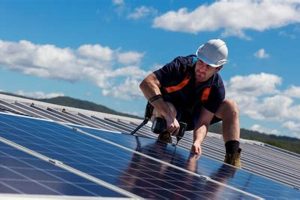
Photovoltaic systems, a key element in sustainable power generation, convert sunlight directly into electricity using semiconductor materials. These systems offer a clean and sustainable alternative to traditional fossil fuel-based power plants, providing a means to harness the sun’s abundant energy resource. Their modular nature allows for installation on rooftops, in open fields, and even integrated into building materials.
The significance of this technology lies in its potential to reduce carbon emissions, mitigate climate change, and enhance energy security. Historically, their development has progressed from relatively low-efficiency prototypes to highly efficient and cost-effective commercial products. The decreasing cost of materials and advancements in manufacturing processes have made this form of energy increasingly competitive with conventional sources, driving widespread adoption globally. Further, the decentralized nature of power generation they enable can improve grid resilience and reduce transmission losses.
This discussion will now delve into the various types of photovoltaic technologies, their efficiencies, the factors influencing their performance, and the economic considerations surrounding their deployment. Furthermore, the environmental impact, including lifecycle assessments and disposal considerations, will be examined. Finally, the future trends and innovations shaping the landscape of this crucial energy source will be addressed.
Practical Guidance
The following guidelines address key aspects of leveraging photovoltaic technology effectively, focusing on performance optimization and cost-effectiveness.
Tip 1: Conduct a Thorough Site Assessment: Prior to installation, evaluate solar irradiance, shading patterns, roof orientation, and structural integrity. Accurate data ensures optimal panel placement and performance.
Tip 2: Select Appropriate Panel Technology: Consider monocrystalline, polycrystalline, or thin-film options based on energy needs, space limitations, and budget. Monocrystalline panels generally offer higher efficiency but at a higher cost.
Tip 3: Employ Professional Installation Services: Certified installers guarantee adherence to safety standards, proper wiring, and optimal system configuration, maximizing energy production and minimizing long-term maintenance costs.
Tip 4: Implement Regular System Monitoring: Utilize monitoring systems to track energy output, identify performance issues, and detect potential faults early, preventing significant energy loss and extending system lifespan.
Tip 5: Ensure Adequate Ventilation: Provide sufficient airflow around panels to prevent overheating, which can reduce efficiency and shorten lifespan. Proper ventilation is particularly critical in hot climates.
Tip 6: Explore Available Incentives and Rebates: Research local, state, and federal programs that offer financial incentives for renewable energy adoption, reducing upfront costs and improving the return on investment.
Tip 7: Prioritize Battery Storage Solutions: Consider incorporating battery storage to capture excess energy generated during peak sunlight hours, enabling usage during periods of low irradiance or power outages, enhancing energy independence.
By adhering to these guidelines, individuals and organizations can maximize the benefits of photovoltaic energy systems, contributing to a sustainable energy future.
The subsequent sections will explore the environmental and economic implications of photovoltaic technology adoption on a broader scale.
1. Efficiency Improvement

The advancement of photovoltaic technology is intrinsically linked to the optimization of energy conversion efficiency. Enhancing the capacity of photovoltaic devices to transform solar radiation into usable electricity is paramount to maximizing their impact on global energy production and mitigating dependence on fossil fuels. Increases in efficiency translate directly to greater energy output for a given area of installed panels, reducing land use and infrastructure requirements.
- Cell Material Development
The selection and refinement of semiconductor materials are foundational to efficiency gains. Single-crystalline silicon cells, while mature, are continually being optimized through doping and surface treatment techniques. Thin-film technologies, such as cadmium telluride (CdTe) and copper indium gallium selenide (CIGS), offer potential cost advantages, but typically exhibit lower efficiencies than crystalline silicon. Emerging materials, including perovskites, hold the promise of surpassing silicon-based cell efficiencies, but face challenges regarding stability and scalability.
- Light Trapping Techniques
Maximizing light absorption within photovoltaic cells is crucial. Techniques like surface texturing, anti-reflective coatings, and the incorporation of plasmonic nanoparticles are employed to reduce reflection and increase the path length of photons within the semiconductor material. This results in a higher probability of electron-hole pair generation, boosting the overall efficiency of the device.
- Multi-Junction Cell Architecture
Multi-junction cells, typically used in concentrated photovoltaic (CPV) systems, utilize multiple layers of different semiconductor materials, each optimized to absorb a different portion of the solar spectrum. By dividing the solar spectrum in this manner, a greater percentage of the incident light is converted into electricity, resulting in significantly higher efficiencies compared to single-junction cells. However, the complexity and cost of manufacturing multi-junction cells limit their widespread adoption in conventional applications.
- Advanced Manufacturing Processes
Precision manufacturing techniques play a vital role in maximizing cell performance. Control over material purity, layer thickness, and interface quality directly affects carrier recombination rates and overall efficiency. Advanced techniques such as atomic layer deposition (ALD) and sophisticated etching processes are used to create high-quality cells with minimized defects, leading to enhanced performance and durability.
These facets of efficiency improvement, from fundamental material science to advanced manufacturing processes, represent ongoing areas of research and development within the photovoltaic industry. Further advancements in these areas will continue to drive down the cost of photovoltaic electricity and enhance its competitiveness as a sustainable energy source, reinforcing the role of photovoltaic devices in achieving a decarbonized energy future.
2. Grid Integration

Effective grid integration is a critical factor determining the overall success and widespread adoption of photovoltaic energy systems. The ability to seamlessly integrate photovoltaic-generated electricity into existing power grids is essential for ensuring a stable, reliable, and sustainable energy supply. Without robust grid integration strategies, the inherent intermittency of solar energy can pose significant challenges to grid stability and power quality.
- Advanced Inverter Technology
Inverters play a pivotal role in grid integration by converting the direct current (DC) electricity produced by photovoltaic panels into alternating current (AC) suitable for grid distribution. Advanced inverters are equipped with functionalities such as reactive power control, voltage regulation, and frequency support, which help to stabilize the grid and mitigate the impact of fluctuating solar generation. For instance, smart inverters can dynamically adjust their output to compensate for voltage sags or frequency deviations, contributing to overall grid resilience.
- Smart Grid Infrastructure
The development of smart grid infrastructure is essential for accommodating the increasing penetration of photovoltaic energy. Smart grids incorporate advanced metering infrastructure (AMI), communication networks, and control systems that enable real-time monitoring and management of electricity flow. This allows grid operators to optimize the integration of distributed solar generation, manage grid congestion, and respond effectively to fluctuations in supply and demand. An example of this is the use of sophisticated forecasting algorithms to predict solar energy production and adjust grid operations accordingly.
- Energy Storage Systems
Energy storage systems, such as batteries, play a critical role in mitigating the intermittency of photovoltaic generation and enhancing grid stability. By storing excess solar energy during periods of high irradiance, batteries can provide a buffer against fluctuations in supply and demand. This enables a more consistent and reliable power supply, reducing the reliance on traditional fossil fuel-based power plants. A real-world example is the use of large-scale battery storage systems to smooth out the variability of solar energy output and provide grid services such as frequency regulation.
- Grid Code Compliance
Compliance with grid codes and standards is essential for ensuring the safe and reliable integration of photovoltaic energy into the power grid. Grid codes specify the technical requirements that photovoltaic systems must meet in order to connect to the grid, including requirements for voltage and frequency regulation, power quality, and protection. Adherence to these codes helps to prevent disturbances to the grid and ensures that photovoltaic systems operate in a manner that is compatible with existing infrastructure. For example, grid codes may require photovoltaic systems to disconnect from the grid in the event of a fault, preventing the spread of disturbances.
These multifaceted aspects of grid integration are crucial for maximizing the benefits of photovoltaic energy systems. By implementing advanced inverter technology, deploying smart grid infrastructure, incorporating energy storage systems, and adhering to grid code compliance, the power grid can effectively accommodate the increasing penetration of photovoltaic energy, contributing to a more sustainable and reliable energy future. As photovoltaic technology continues to evolve, ongoing research and development efforts are essential to address the challenges associated with grid integration and unlock the full potential of this renewable energy source.
3. Material Advancements

The operational effectiveness and economic viability of photovoltaic systems are directly influenced by material advancements. The core photovoltaic effect relies on semiconductor materials, and improvements in these materials translate to higher energy conversion efficiencies, longer operational lifespans, and reduced manufacturing costs. For example, the transition from amorphous silicon to monocrystalline silicon significantly boosted panel efficiency, albeit at a higher initial cost. Currently, research into perovskite materials aims to offer a similar performance boost but with potentially lower production expenses. These materials exhibit unique properties that allow for more efficient light absorption and electron transport, key components in maximizing energy yield from the sun’s radiation.
The impact of material advancements extends beyond efficiency. Durability and stability are crucial for long-term performance in diverse environmental conditions. Encapsulation materials, such as advanced polymers, protect the sensitive semiconductor layers from moisture, UV radiation, and physical damage, thereby extending the lifespan of the panels. Furthermore, transparent conductive oxides (TCOs) play a vital role in collecting and transporting generated electricity within the panel structure; advancements in TCOs focus on enhancing conductivity while maintaining high transparency, minimizing energy losses. These improvements collectively contribute to lowering the levelized cost of energy (LCOE), making photovoltaic energy increasingly competitive with conventional energy sources.
In conclusion, ongoing material advancements represent a fundamental driver in the evolution and widespread adoption of photovoltaic technology. The development of novel materials with enhanced performance characteristics, coupled with improved manufacturing techniques, is essential for addressing the challenges of energy security and climate change. While challenges such as material stability and scalability remain, the continued investment in materials research promises to unlock the full potential of photovoltaic systems as a reliable and cost-effective source of renewable energy. The focus remains on materials that can enhance efficiency, durability, and scalability while minimizing environmental impact.
4. Cost Reduction

Diminishing expenses associated with photovoltaic systems are a crucial driver for their increased adoption and contribution to the global energy mix. The initial high capital expenditure historically associated with these installations has presented a barrier to widespread implementation. Reductions in cost directly influence the competitiveness of photovoltaic energy relative to traditional fossil fuel-based generation, making it a more economically viable option for both residential and commercial consumers. These reductions stem from improvements across the value chain, including raw material extraction, manufacturing processes, installation techniques, and operation and maintenance strategies. For example, the automation of manufacturing processes has significantly reduced labor costs, leading to lower panel prices.
Further contributing to cost reduction are advancements in materials science and engineering. The development of thinner silicon wafers, the use of less expensive semiconductor materials, and improvements in cell design all contribute to lowering the overall cost per watt of installed capacity. Economies of scale, driven by increasing demand and larger manufacturing facilities, also play a significant role. Government subsidies, tax incentives, and feed-in tariffs can further reduce the economic burden on consumers and accelerate the deployment of photovoltaic systems. A practical application of this is seen in large-scale solar farms where cost reductions enable long-term power purchase agreements at rates competitive with or lower than conventional power plants.
Sustained efforts in cost reduction are essential for realizing the full potential of photovoltaic energy. While significant progress has been made, further innovation and investment are needed to overcome remaining barriers and ensure long-term economic sustainability. Challenges remain in reducing the cost of energy storage, improving the efficiency of less expensive cell technologies, and minimizing the environmental impact of manufacturing processes. Overcoming these hurdles will solidify the position of photovoltaic systems as a cornerstone of a decarbonized energy future, benefiting both the economy and the environment.
5. Energy Storage

The intermittency of solar irradiance presents a fundamental challenge to the consistent and reliable delivery of power generated by photovoltaic systems. Energy storage technologies directly address this issue by decoupling energy production from energy consumption. During periods of high solar irradiance, excess electricity generated by photovoltaic arrays can be stored for later use. This stored energy can then be dispatched during periods of low irradiance or peak demand, providing a more stable and predictable power supply. Without energy storage, the value of photovoltaic-generated electricity is diminished due to its fluctuating nature. Examples of energy storage technologies include lithium-ion batteries, flow batteries, and pumped hydro storage.
The integration of energy storage systems with photovoltaic arrays enhances grid stability and reduces the need for conventional power plants to provide backup power. In residential applications, battery storage systems allow homeowners to utilize self-generated solar electricity even when the sun is not shining, reducing their reliance on the grid. In commercial and industrial settings, energy storage can provide peak shaving capabilities, reducing demand charges and improving energy efficiency. Utility-scale energy storage projects coupled with photovoltaic power plants can provide grid services such as frequency regulation and voltage support, further enhancing the reliability of the power grid. For example, several large-scale solar farms have integrated battery storage systems to provide dispatchable power during evening hours.
The pairing of energy storage and photovoltaic systems is essential for achieving a fully decarbonized energy future. While the costs of both technologies have declined significantly in recent years, further reductions are needed to make them economically competitive in all applications. Challenges remain in improving the energy density, cycle life, and safety of energy storage technologies. The development of advanced energy storage technologies and innovative grid management strategies will be critical for maximizing the benefits of photovoltaic energy and creating a more resilient and sustainable energy system. Ultimately, the successful integration of energy storage with photovoltaic systems will be pivotal in reducing greenhouse gas emissions and mitigating the impacts of climate change.
Frequently Asked Questions About Renewable Energy Solar Panels
The following questions and answers address common inquiries regarding the technology, implementation, and impact of harnessing solar energy through photovoltaic systems.
Question 1: What is the typical lifespan of a photovoltaic panel?
The operational lifespan generally ranges from 25 to 30 years. Performance degradation occurs over time, typically resulting in a power output reduction of approximately 0.5% per year.
Question 2: How does cloud cover affect the performance of renewable energy solar panels?
Cloud cover reduces the amount of sunlight reaching the panels, thereby decreasing electricity generation. However, photovoltaic systems still produce some power under cloudy conditions, albeit at a reduced rate. Diffuse sunlight can still be converted to energy.
Question 3: Are photovoltaic panels recyclable?
Recycling processes for photovoltaic panels are developing. Certain components, such as glass, aluminum, and silicon, can be recovered and reused. However, the economic viability of recycling currently varies by panel type and location.
Question 4: What maintenance is required for renewable energy solar panel systems?
Minimal maintenance is typically required. Periodic cleaning to remove dirt and debris can improve performance. Regular inspections of electrical connections and mounting hardware are also recommended to ensure system integrity.
Question 5: How do temperature fluctuations impact renewable energy solar panel efficiency?
Increased temperatures generally decrease panel efficiency. Most photovoltaic panels have a negative temperature coefficient, indicating a reduction in power output as temperature rises. Proper ventilation can mitigate this effect.
Question 6: What is the levelized cost of energy (LCOE) for renewable energy solar panel systems?
The LCOE varies depending on factors such as location, system size, financing costs, and government incentives. Technological advancements and economies of scale have significantly reduced the LCOE, making photovoltaic energy increasingly competitive with traditional sources.
Photovoltaic technology represents a viable and increasingly cost-effective solution for sustainable energy generation. Understanding the operational characteristics and long-term performance aspects is crucial for informed decision-making.
The following sections will delve into the environmental considerations and policy frameworks surrounding the widespread adoption of photovoltaic energy.
Conclusion
This exploration has illuminated the multifaceted nature of photovoltaic systems, encompassing their operational principles, technological advancements, and economic implications. The continued refinement of cell efficiencies, the integration of advanced grid technologies, and the relentless pursuit of cost reductions have collectively positioned “renewable energy solar panels” as a central pillar in the global transition towards sustainable energy. The analysis has further underscored the critical role of energy storage solutions in mitigating the inherent intermittency of solar power, thereby ensuring grid stability and reliability.
The imperative for widespread adoption of “renewable energy solar panels” extends beyond mere economic considerations. The urgency of addressing climate change demands a rapid and decisive shift away from fossil fuel dependence. Investment in photovoltaic technologies, coupled with supportive policy frameworks, represents a tangible commitment to a cleaner, more secure energy future. The legacy of current energy decisions will profoundly impact generations to come, making the responsible deployment of “renewable energy solar panels” not merely an option, but a fundamental obligation.