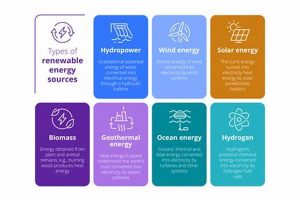
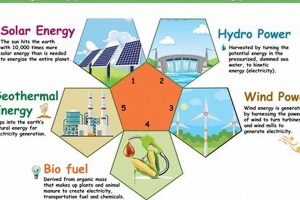
Sources of energy that are naturally replenished at a rate comparable to their consumption are considered sustainable. Solar energy, harnessed from sunlight, is a prime illustration. Wind power, generated by the movement of air masses, represents another instance. Geothermal energy, deriving from the Earth’s internal heat, further exemplifies this category. These sources stand in contrast to finite reserves that diminish with use.
The utilization of these sustainable options offers numerous advantages. They contribute to a reduction in greenhouse gas emissions, mitigating climate change. They enhance energy security by decreasing dependence on imported fuels. Furthermore, the development and deployment of these technologies can stimulate economic growth through job creation and innovation. Historically, reliance on these energy types was common before the widespread use of fossil fuels, and a resurgence in their adoption is observed globally.
The main body of this article will delve into specific types of these sustainable energy options, exploring their mechanisms, applications, and associated challenges. It will also consider the economic and policy factors influencing their adoption, along with their potential to contribute to a more sustainable energy future.
Strategies for Maximizing the Use of Replenishable Energy Sources
The following are actionable strategies to promote the effective integration and utilization of power generated from sources that renew naturally.
Tip 1: Implement Government Incentives. Governments should establish financial incentives, such as tax credits and subsidies, to encourage investment in renewable energy projects. Such measures can reduce the initial capital costs and improve the financial viability of these endeavors.
Tip 2: Invest in Research and Development. Ongoing research and development is crucial for improving the efficiency and reducing the cost of renewable energy technologies. Funding should be allocated to explore innovative solutions, such as advanced solar cells, improved wind turbine designs, and efficient energy storage systems.
Tip 3: Develop Grid Infrastructure. A robust and modern grid infrastructure is essential for integrating intermittent renewable energy sources, such as solar and wind, into the electricity supply. Investments in grid modernization, including smart grids and enhanced transmission lines, are vital.
Tip 4: Promote Public Awareness and Education. Raising public awareness about the benefits of renewable energy is crucial for fostering support and driving adoption. Educational campaigns can inform consumers about the environmental and economic advantages, encouraging them to choose renewable energy options.
Tip 5: Establish Clear Regulatory Frameworks. A clear and consistent regulatory framework is essential for attracting investment in renewable energy projects. Streamlined permitting processes and long-term policy certainty provide confidence for developers and investors.
Tip 6: Encourage Energy Storage Solutions. Addressing the intermittency challenge requires deploying energy storage solutions, such as batteries and pumped hydro storage. Incentives and policies should support the development and deployment of these technologies.
Tip 7: Support Community-Based Projects. Local projects can play a significant role in expanding access to renewable energy. Supporting community-owned projects can foster local economic development and enhance energy independence.
Adhering to these strategies will enhance the deployment of replenishable energy sources, creating a more sustainable and resilient energy future.
The subsequent sections will examine specific applications and future developments within this area.
1. Sunlight availability
Sunlight availability serves as a foundational element in the context of sustainable energy derived from solar resources. Its variability directly impacts the efficiency and reliability of solar energy systems, necessitating careful consideration in their design and deployment. The assessment of insolation levels, duration of sunlight hours, and atmospheric conditions are crucial to optimizing energy harvesting.
- Geographical Latitude and Solar Angle
The angle at which sunlight strikes the Earth’s surface varies with latitude and time of year, influencing the intensity of solar radiation received. Regions closer to the equator generally experience higher insolation levels, whereas polar regions receive less direct sunlight. The tilt of solar panels must be adjusted to maximize sunlight capture throughout the year, especially in regions with significant seasonal variations.
- Atmospheric Conditions and Cloud Cover
Atmospheric conditions, including cloud cover, aerosols, and pollutants, can significantly reduce the amount of sunlight reaching the Earth’s surface. Cloud cover is a primary factor affecting solar energy production, causing intermittent reductions in output. The presence of aerosols and pollutants can further scatter and absorb sunlight, diminishing its intensity.
- Seasonal Variation and Day Length
Seasonal variations in day length and solar angle directly impact the total amount of solar energy available throughout the year. During winter months, shorter days and lower solar angles result in reduced energy production. Solar energy systems must be designed to account for these seasonal fluctuations, potentially requiring energy storage solutions to ensure a consistent power supply.
- Technological Limitations and Efficiency
The efficiency of solar panels in converting sunlight into electricity is limited by current technology. Even under optimal sunlight conditions, a significant portion of solar energy is lost due to factors such as reflection, heat dissipation, and the inherent limitations of semiconductor materials. Ongoing research aims to improve solar panel efficiency and reduce these losses.
The interplay of these facets determines the efficacy of solar energy as a viable energy alternative. Understanding and mitigating the challenges posed by limited sunlight availability, through strategic placement, advanced technologies, and efficient grid management, is essential for unlocking the full potential of solar energy as a sustainable resource.
2. Wind consistency

Consistent wind patterns are a critical factor in determining the viability and efficiency of wind power, a prominent illustration of a replenishable energy source. The predictability and strength of wind directly impact the amount of electricity generated, influencing the overall effectiveness of wind energy as a sustainable alternative to fossil fuels.
- Geographical Location and Terrain
The geographical location of a wind farm plays a significant role in wind consistency. Coastal regions, mountainous areas, and open plains often experience more consistent wind patterns than inland areas with varied topography. Terrain features can channel and amplify wind currents, making certain locations more suitable for wind energy production. For instance, the Texas Gulf Coast and the Great Plains of the United States are known for their consistent wind resources, supporting substantial wind energy development.
- Atmospheric Pressure Gradients
Differences in atmospheric pressure create wind as air flows from high-pressure to low-pressure areas. Consistent pressure gradients, often associated with specific weather patterns, contribute to stable wind conditions. Areas with persistent high and low-pressure systems, such as those near the jet stream, tend to exhibit more reliable wind resources. Monitoring and predicting these pressure systems are crucial for optimizing wind energy production.
- Seasonal Variations and Climate Patterns
Wind consistency can vary seasonally due to changes in climate patterns. Some regions experience stronger winds during specific seasons, such as winter or spring, while others have more consistent wind throughout the year. Understanding these seasonal variations is essential for planning and managing wind energy production. For example, the monsoon season in certain parts of Asia brings strong and predictable winds, suitable for wind energy generation.
- Technology and Turbine Design
Advanced turbine designs can enhance the efficiency of wind energy production, even in areas with less consistent wind. Modern turbines are equipped with sensors and control systems that adjust blade pitch and yaw to optimize energy capture under varying wind conditions. Additionally, the development of taller towers allows turbines to access stronger and more consistent winds at higher altitudes.
The consistent presence of wind energy is a cornerstone of this particular sustainable source. Factors such as geography, weather phenomena, seasonal fluctuations, and technological advancements all shape its reliability. Successful deployment of wind energy demands thorough evaluation and proper handling of these determinants.
3. Geothermal accessibility

Geothermal accessibility defines the extent to which subterranean heat resources can be economically and technically harnessed for energy production. As a defining characteristic of a replenishable energy source, it dictates the feasibility and scalability of tapping into the Earth’s internal heat.
- Geological Formations and Geothermal Gradient
The composition and structure of subsurface geology play a crucial role in determining the ease of geothermal access. High geothermal gradients, where temperature increases rapidly with depth, are favorable. Permeable rock formations, such as fractured granite or porous sedimentary layers, facilitate the circulation of water heated by the Earth’s core. Locations along tectonic plate boundaries, characterized by volcanic activity and hydrothermal systems, often provide the most accessible geothermal resources. The Geysers in California, a region with extensive steam fields, exemplifies an area where geological conditions enable efficient geothermal energy extraction.
- Depth and Drilling Technology
The depth at which usable geothermal resources are located directly impacts the cost and complexity of accessing them. While shallow geothermal resources, suitable for direct-use applications like heating, are relatively easy to access, deep geothermal reservoirs require advanced drilling technologies. Enhanced Geothermal Systems (EGS) aim to create artificial reservoirs in hot, dry rock formations, but these projects necessitate deep drilling and hydraulic fracturing, which pose technical and environmental challenges. The Soultz-sous-Forts project in France represents an attempt to develop EGS technology, but the project has faced difficulties in maintaining reservoir permeability and minimizing induced seismicity.
- Hydrothermal Systems and Water Availability
The presence of hydrothermal systems, where water is heated by subsurface heat and circulated through permeable rocks, significantly enhances the accessibility of geothermal resources. These systems provide a readily available heat transfer medium, allowing for the extraction of steam or hot water. Water availability is crucial for sustaining geothermal operations, particularly in arid or semi-arid regions. Sustainable water management practices are essential to prevent reservoir depletion and ensure the long-term viability of geothermal projects. The Olkaria geothermal field in Kenya, which relies on a hydrothermal system for electricity generation, illustrates the importance of water availability in geothermal energy production.
- Economic Viability and Infrastructure
The economic feasibility of geothermal projects depends on a variety of factors, including resource temperature, flow rate, drilling costs, and electricity prices. The presence of existing infrastructure, such as power transmission lines and roads, can significantly reduce development costs. Government incentives and regulatory policies can also influence the economic viability of geothermal projects. The Reykjanes Peninsula in Iceland, with its abundant geothermal resources and supportive regulatory environment, exemplifies a region where geothermal energy is economically competitive with other energy sources.
These factors determine the economic and practical feasibility of utilizing the Earth’s internal heat. The combination of favorable geology, accessible water resources, advanced drilling techniques, and appropriate economic incentives determines where this particular replenishable energy source can be developed effectively. Overcoming these challenges is critical for expanding the contribution of geothermal energy to a sustainable energy mix.
4. Biomass sustainability

The long-term viability of biomass as a replenishable energy source hinges upon the concept of biomass sustainability. It dictates the extent to which biomass resources can be utilized without compromising their future availability or causing adverse environmental impacts. Unsustainable biomass practices undermine the renewable nature of this resource, transforming a potentially valuable asset into an environmental liability. The link between these practices and their effect on overall renewable characteristics are significant.
The use of biomass for energy must be managed to prevent deforestation, soil degradation, and biodiversity loss. Sustainable forestry practices, such as selective harvesting and reforestation, are essential for ensuring the continued availability of wood-based biomass. Agricultural residues, such as corn stover and wheat straw, can provide a supplementary source of biomass, but their removal must be carefully managed to maintain soil fertility and prevent erosion. The production of dedicated energy crops, such as switchgrass and miscanthus, holds promise for increasing biomass supply, but these crops must be grown in an environmentally responsible manner, avoiding the conversion of natural habitats and minimizing fertilizer and pesticide use. An example of good management is seen in Scandinavian countries with sustainable forests.
Biomass can only serve as a part of renewable options if its sourcing and processing adhere to sustainability principles. Addressing the challenges associated with biomass sustainability is crucial for realizing its full potential as a sustainable energy source and for mitigating its potential negative impacts. A focus on responsible biomass management, coupled with technological advancements in biomass conversion, is essential for ensuring that biomass contributes to a cleaner and more sustainable energy future.
5. Hydropower impact

The ramifications of hydropower development, while offering a sustainable energy option, necessitate careful evaluation within the framework of sustainable resources. The design, construction, and operation of hydroelectric facilities exert multifaceted influences on surrounding environments and communities, potentially challenging the purported benefits.
- River Ecosystem Alterations
Hydropower dams fundamentally alter river ecosystems by disrupting natural flow regimes, sediment transport, and fish migration patterns. Impoundments behind dams inundate upstream habitats, while downstream reaches experience reduced flows and altered water temperatures. Fish populations, particularly migratory species like salmon, face significant challenges in navigating dams, leading to population declines. The Glen Canyon Dam on the Colorado River exemplifies this issue, where regulated flows have negatively impacted downstream riparian habitats and native fish species.
- Sediment Deposition and Erosion
Dams trap sediment that would normally be transported downstream, leading to sediment deposition in reservoirs and erosion in downstream channels. Sediment deposition reduces reservoir storage capacity and can negatively impact water quality. Downstream erosion can destabilize riverbanks, damage infrastructure, and alter aquatic habitats. The Aswan High Dam on the Nile River illustrates the consequences of sediment trapping, with significant erosion occurring along the Nile Delta coast due to reduced sediment supply.
- Greenhouse Gas Emissions
While hydropower is generally considered a low-carbon energy source, reservoirs can emit greenhouse gases, particularly methane, from the decomposition of organic matter. Inundated vegetation and soils release methane as they decompose in anaerobic conditions, contributing to global warming. The amount of methane emitted varies depending on reservoir characteristics, such as water depth, temperature, and nutrient levels. Tropical reservoirs, in particular, tend to have higher methane emissions. Studies of reservoirs in the Amazon basin have documented significant methane releases, highlighting the potential for hydropower to contribute to greenhouse gas emissions.
- Social and Economic Displacement
The construction of hydropower dams often requires the displacement of communities and the inundation of agricultural lands and cultural sites. Resettlement processes can be disruptive and lead to social and economic hardship for affected populations. Loss of access to traditional livelihoods, such as fishing and agriculture, can have long-lasting impacts on community well-being. The Three Gorges Dam in China provides a prominent example of large-scale displacement, with over 1.2 million people relocated to make way for the reservoir.
These considerations underscore the critical need for a holistic approach to hydropower development, balancing the benefits of renewable energy generation with the potential for environmental and social harm. Sustainable hydropower practices, including environmental flow management, fish passage facilities, and reservoir methane mitigation, are essential for minimizing the adverse consequences of this energy source and ensuring its contribution to a truly sustainable energy future.
6. Tidal predictability

The consistent and reliable nature of tidal movements establishes tidal energy as a predictable form of renewable resource. This reliability offers a distinct advantage over other renewable options like solar and wind, which are subject to greater fluctuations due to weather patterns. The capacity to accurately forecast tidal patterns is central to the effective deployment and integration of tidal energy technologies.
- Astronomical Forcing and Tidal Cycles
Tidal cycles are primarily driven by the gravitational forces exerted by the Moon and the Sun, resulting in predictable patterns of high and low tides. These astronomical forces allow for the calculation of tidal ranges and timing with high accuracy decades into the future. For example, the semi-diurnal tidal cycle, characterized by two high tides and two low tides per day, is a well-understood phenomenon that enables precise planning for tidal energy extraction. The Bay of Fundy in Canada, known for its extreme tidal range, illustrates the predictability of tidal cycles, allowing for consistent energy generation forecasts.
- Geographical Influences and Amplification Effects
The shape and configuration of coastlines and ocean basins can amplify tidal ranges, leading to significant differences in tidal energy potential across different locations. Narrow channels, bays, and estuaries often experience enhanced tidal currents, making them ideal sites for tidal energy installations. For instance, the Pentland Firth in Scotland, a narrow strait between the mainland and the Orkney Islands, benefits from amplified tidal currents, supporting multiple tidal energy projects. Detailed bathymetric surveys and hydrodynamic modeling are essential for accurately assessing the tidal energy potential of specific locations.
- Tidal Prediction Models and Forecasting Accuracy
Advanced tidal prediction models, based on astronomical data, historical tidal records, and hydrodynamic simulations, enable accurate forecasting of tidal heights and currents. These models account for factors such as lunar phases, solar declination, and local bathymetry to provide detailed tidal predictions. Accurate forecasting is crucial for optimizing the operation of tidal energy devices and integrating tidal energy into the electricity grid. Organizations like the National Oceanographic and Atmospheric Administration (NOAA) provide publicly available tidal predictions, supporting navigation and coastal management as well as tidal energy development.
- Intermittency Mitigation and Energy Storage Solutions
While tidal energy is highly predictable, it is also intermittent, with energy generation varying throughout the tidal cycle. Energy storage solutions, such as batteries or pumped hydro storage, can help to mitigate this intermittency and ensure a consistent power supply. Integrating tidal energy with other renewable energy sources, such as wind or solar, can also enhance grid stability and reliability. For example, a combination of tidal energy and offshore wind power can provide a more stable and predictable energy output than either source alone. Smart grid technologies and advanced control systems are essential for managing the variability of tidal energy and optimizing its integration into the electricity grid.
The inherent predictability of tidal movements provides a significant advantage for tidal energy in contributing to sustainable practices. Accurate predictions facilitate the design and deployment of appropriate facilities, optimizing energy extraction and promoting the integration of this replenishable energy source into the existing energy infrastructure.
Frequently Asked Questions About Sustainable Energy Options
This section addresses common inquiries regarding energy sources that are naturally replenished, clarifying their characteristics and practical applications.
Question 1: What fundamentally distinguishes a replenishable energy source from a finite resource?
Renewable options are naturally replenished on a human timescale, ensuring long-term availability, while finite sources are depleted upon usage.
Question 2: How does sunlight availability impact the efficiency of solar energy systems?
The amount of sunlight directly correlates with the energy output of solar panels. Geographical location, weather patterns, and seasonal changes are significant factors. Maximizing exposure is essential for optimizing energy capture.
Question 3: In what ways does the consistency of wind patterns influence wind energy production?
Consistent and predictable wind patterns are crucial for efficient and reliable wind energy generation. Locations with steady airflow, such as coastal areas and mountain passes, are preferable for wind farms.
Question 4: What geological factors determine the accessibility of geothermal energy?
Geothermal accessibility depends on subsurface geological conditions, including geothermal gradients, rock permeability, and the presence of hydrothermal systems. Regions with high geothermal activity are most suitable for geothermal energy extraction.
Question 5: What measures are necessary to ensure the sustainability of biomass as an energy source?
Sustainable biomass management practices, such as responsible forestry and the use of agricultural residues, are crucial for avoiding deforestation and maintaining soil fertility. Dedicated energy crops must be grown in an environmentally responsible manner.
Question 6: How do hydropower dams affect river ecosystems, and what can be done to mitigate these impacts?
Hydropower dams can alter river ecosystems, disrupting natural flow regimes and fish migration patterns. Mitigation measures include environmental flow management and the construction of fish passage facilities. Careful planning and operation are essential for minimizing ecological damage.
Understanding these facets is crucial for making informed decisions about the development and deployment of these sources.
The following section provides a glossary of key terms related to sustainable energy.
Conclusion
The preceding discussion has elucidated several facets concerning energy derived from naturally replenishing origins. Examining sunlight availability, wind consistency, geothermal accessibility, biomass sustainability, hydropower impact, and tidal predictability allows for a comprehensive understanding of this concept. Each aspect carries distinct implications for the viability and scalability of its corresponding technology. Consideration of these factors is paramount to responsible development and deployment.
A global transition toward sustainable energy systems necessitates thorough evaluation of these renewable options. Further research, technological advancement, and informed policy-making remain crucial for realizing the full potential of these sources in mitigating climate change and ensuring long-term energy security. The commitment to pursuing these alternative options is an investment in a sustainable future.