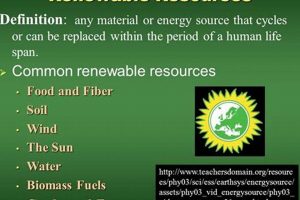
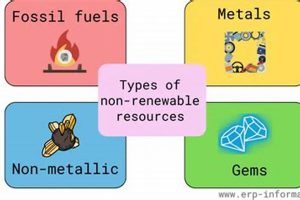
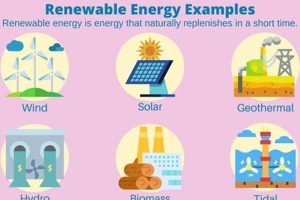
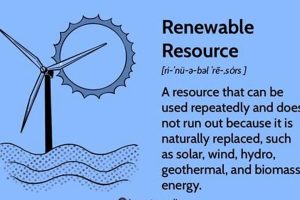
A resource is considered capable of replenishment by natural processes within a human timescale. These resources are naturally replenished, either through reproduction of living organisms or other recurring natural processes. Examples include solar energy, wind power, geothermal energy, and biomass.
Utilization of these resources offers several advantages. Reliance on them reduces dependence on finite supplies, mitigating long-term depletion concerns. Furthermore, their utilization often results in lower environmental impact compared to conventional energy sources, minimizing pollution and greenhouse gas emissions. Historically, societies have depended on them, such as wood for fuel and wind for sailing, but modern technology allows for more efficient and widespread application.
The following sections will delve deeper into specific types, exploring their technological applications, economic viability, and contribution to a sustainable energy future. Understanding the characteristics and potential of each type is crucial for informed decision-making regarding energy policy and investment.
Optimizing the Use of Resources that Replenish Naturally
Strategic management of resources that replenish naturally is crucial for sustainable development and long-term energy security. The following tips offer guidance on maximizing their benefits while minimizing potential drawbacks.
Tip 1: Prioritize Resource Diversification: Avoid over-reliance on a single source. A diversified portfolio across solar, wind, hydro, and geothermal energy enhances resilience against fluctuations in availability and technological advancements.
Tip 2: Invest in Energy Storage Technologies: The intermittent nature of some naturally replenishing sources, such as solar and wind, necessitates robust energy storage solutions. Battery storage, pumped hydro, and other technologies are essential for grid stability.
Tip 3: Support Research and Development: Continuous investment in research and development is vital for improving the efficiency and reducing the cost of technologies. This includes exploring new materials, advanced grid management systems, and innovative storage solutions.
Tip 4: Implement Supportive Policy Frameworks: Governments should enact policies that incentivize investment in infrastructure and deployment. This includes feed-in tariffs, tax credits, and streamlined permitting processes.
Tip 5: Promote Public Awareness and Education: Educating the public about the benefits and limitations is crucial for fostering acceptance and support. Transparent communication about the costs and benefits of different options is essential.
Tip 6: Conduct Thorough Environmental Impact Assessments: While generally considered environmentally friendly, their development can still have environmental consequences. Thorough assessments are necessary to minimize disruption to ecosystems and biodiversity.
Tip 7: Encourage Community Engagement: Involving local communities in planning and implementation fosters a sense of ownership and ensures that projects align with local needs and priorities. This can mitigate potential conflicts and maximize benefits for local populations.
Implementing these tips facilitates a more sustainable and reliable energy future, minimizing environmental impact while maximizing the long-term benefits for society.
The concluding sections will further explore the challenges and opportunities associated with integrating these energy sources into the global energy system, paving the way for a cleaner and more sustainable future.
1. Naturally Replenishing

The term “naturally replenishing” forms the bedrock definition. This quality refers to the ability of certain resources to regenerate or renew themselves within a timeframe relevant to human needs and utilization. The connection is causal: “naturally replenishing” is the core mechanism through which the resource fits the definition. Without this characteristic, a resource, irrespective of other qualities, cannot be classified as such. The absence of this replenishment capacity dictates finite availability, leading to eventual depletion with continued extraction or consumption.
Consider solar energy as an example. Solar radiation is a perpetual energy source due to ongoing nuclear fusion within the sun. Similarly, wind energy relies on atmospheric circulation patterns driven by solar heating and the Earth’s rotation. Biomass, another example, relies on photosynthesis, a naturally occurring process by which plants convert sunlight into chemical energy. These examples demonstrate that the sustained availability of the resource is intrinsically linked to the underlying natural processes that drive its replenishment. The “naturally replenishing” aspect is not merely a characteristic but an indispensable component.
Understanding the relationship between the nature of resources that replenish naturally is important for energy policy, investment strategies, and environmental conservation efforts. Recognizing that sustained availability depends on maintaining the integrity of the underlying ecosystems and natural processes informs sustainable management practices. This awareness promotes the development of technologies and policies that harness these resources in a manner that minimizes environmental impact and ensures long-term availability for future generations. Challenges include managing the intermittency of some supplies and mitigating localized environmental impacts, but these can be addressed through careful planning and technological innovation.
2. Sustainable Yield

Sustainable yield defines the rate at which a resource can be harvested or utilized without depleting its capacity to regenerate. For a resource to be correctly classified as replenishable, its utilization must adhere to the principles of sustainable yield. This concept represents a critical link, establishing a cause-and-effect relationship: adherence to sustainable yield practices ensures the resource remains replenishable; conversely, exceeding the sustainable yield threshold jeopardizes its replenishable status. The sustainable yield principle is not merely a desirable practice but a defining attribute.
Consider forestry as a pertinent example. A forest can be considered a replenishable source of timber if trees are harvested at a rate that allows for regrowth and reforestation to maintain the forest’s overall biomass and ecological function. Harvesting timber at a rate exceeding the forest’s capacity for regeneration degrades the forest ecosystem, leading to deforestation and loss of biodiversity. Similarly, in fisheries management, adhering to sustainable yield means setting catch limits that allow fish populations to replenish themselves through natural reproduction. Overfishing leads to population decline, ecosystem imbalance, and economic hardship for communities dependent on fishing. Hydroelectric power generation must also consider sustainable yield. Diverting excessive amounts of water from a river system can disrupt downstream ecosystems, impair water quality, and reduce the river’s capacity to generate electricity sustainably.
In conclusion, sustainable yield is an indispensable component of the term that describes naturally replenishable resources. Understanding and implementing sustainable yield practices is essential for ensuring the long-term availability of these resources, safeguarding ecosystems, and fostering sustainable development. Challenges in implementing sustainable yield principles often arise from conflicting economic interests, inadequate monitoring and enforcement, and uncertainty about the long-term impacts of resource utilization. Addressing these challenges requires integrated management approaches, robust scientific data, and effective governance structures to balance economic development with environmental sustainability.
3. Reduced Depletion
Reduced depletion constitutes a primary benefit derived from the utilization of resources capable of natural replenishment. This characteristic directly influences long-term sustainability and the mitigation of environmental concerns associated with finite supplies. Its presence or absence decisively impacts the assessment and utility of any resource.
- Lower Extraction Rates
Their employment lessens the necessity for aggressive extraction from finite reserves. This, in turn, decreases the environmental disruption linked to activities such as mining, drilling, and quarrying. For example, widespread adoption of solar energy significantly curtails the demand for fossil fuels, thereby minimizing habitat destruction and pollution associated with coal mining.
- Extended Resource Lifespan
By relying on sources that naturally regenerate, the lifespan of exhaustible resources is effectively extended. This ensures availability for future generations and mitigates the risk of resource scarcity. The shift towards wind power, for instance, reduces the strain on natural gas reserves, which can then be utilized for applications where directly replenishable alternatives are less viable.
- Decreased Waste Generation
Many technologies associated with their utilization produce less waste compared to conventional energy systems. This lowers the environmental burden associated with waste disposal and reduces the potential for pollution. Geothermal energy, when properly managed, generates minimal waste compared to the byproducts of nuclear power generation.
- Mitigation of Scarcity Concerns
As global demand for energy and materials continues to rise, their use mitigates concerns about resource scarcity and price volatility. This enhances energy security and promotes economic stability. Reliance on biomass, if managed sustainably, provides a reliable source of energy and materials that is less susceptible to global market fluctuations.
These elements coalesce to emphasize the significance of reduced depletion in the context of resources capable of natural replenishment. Through diminished extraction rates, extended resource lifespans, decreased waste generation, and mitigated scarcity concerns, they offer a pathway towards a more sustainable and resilient resource economy. These traits are integral to the classification of a resource that is naturally renewed, defining its place in a sustainable system.
4. Lower Impact
The attribute of “lower impact” represents a critical factor in the evaluation of resources capable of natural replenishment, highlighting their environmental and ecological advantages over finite sources. This facet is directly correlated with sustainability and the reduction of ecological harm.
- Reduced Greenhouse Gas Emissions
The utilization of resources that replenish naturally often results in significantly lower greenhouse gas emissions compared to fossil fuels. Solar, wind, and hydroelectric power generation, for example, produce minimal to no direct carbon dioxide emissions during operation, thereby mitigating climate change and its associated effects. This stands in stark contrast to coal-fired power plants, which are major contributors to atmospheric carbon dioxide.
- Minimized Air and Water Pollution
Many technologies employed to harness replenishable sources generate less air and water pollution than conventional energy systems. Wind turbines, for instance, produce clean electricity without releasing harmful pollutants into the atmosphere or water bodies. This contributes to improved air and water quality, benefiting human health and ecosystems.
- Decreased Land Disturbance
The extraction and processing of fossil fuels often require extensive land disturbance, leading to habitat destruction and ecosystem degradation. Their employment, on the other hand, can minimize land use and reduce the impact on biodiversity. For example, rooftop solar panels utilize existing structures, avoiding the need to clear natural habitats for energy generation.
- Diminished Waste Generation
Many processes associated with resources that are naturally renewed produce less waste than conventional energy systems. This reduces the environmental burden associated with waste disposal and minimizes the potential for pollution. Geothermal energy, for example, generates minimal waste compared to the radioactive waste produced by nuclear power plants.
These elements emphasize the importance of “lower impact” within the framework of understanding naturally replenished resources. Through reduced greenhouse gas emissions, minimized air and water pollution, decreased land disturbance, and diminished waste generation, these resources offer a pathway towards a more environmentally sustainable future, distinguishing them favorably from depletable alternatives.
5. Future Availability
Future availability is a defining characteristic of resources capable of natural replenishment, differentiating them from finite sources that are subject to eventual depletion. The expectation of continued accessibility underpins their value in long-term planning and sustainable development. This aspect is not merely a desirable attribute but a fundamental requirement.
- Regeneration Rate Synchronization
The capacity for continued use relies on a balance between consumption and regeneration. If utilization exceeds the natural renewal rate, the resource, despite its classification, faces potential exhaustion. Sustainable forestry, where timber harvesting is synchronized with tree regrowth, exemplifies this principle. Conversely, unsustainable deforestation practices undermine the forest’s ability to regenerate, jeopardizing its future availability as a timber source.
- Environmental Stewardship Implications
Ensuring future availability necessitates proactive environmental stewardship. Protection of ecosystems is crucial to maintaining the natural processes that drive replenishment. For example, preserving wetland ecosystems safeguards the water cycle, thereby maintaining the availability of water resources. Degradation of these ecosystems compromises their ability to provide essential resources for future use.
- Technological Advancement Effects
Technological advancements play a crucial role in enhancing access and utilization without compromising future availability. More efficient solar panels, for example, increase energy capture from sunlight, reducing the reliance on other sources and extending the lifespan of available energy. Conversely, inefficient technologies may lead to increased resource consumption and accelerate depletion.
- Policy and Regulatory Influence
Policy frameworks and regulatory measures significantly impact future availability. Government policies that promote sustainable practices and conservation efforts can safeguard these resources. For instance, implementing fishing quotas and marine protected areas can help maintain fish stocks for future generations. Conversely, lax regulations can lead to overexploitation and endanger the long-term viability of the resource.
These elements collectively illustrate the interconnectedness of resource management, environmental conservation, and technological innovation in securing continued availability. Comprehending and addressing these facets are imperative for realizing the full potential and long-term sustainability of naturally replenished resources, thereby fostering a resilient and environmentally conscious future.
Frequently Asked Questions
The following section addresses common queries regarding resources that replenish naturally, offering insights into their characteristics, applications, and limitations.
Question 1: Are resources that replenish naturally inherently sustainable?
While generally considered more sustainable than finite counterparts, sustainable management practices are critical. Overexploitation, even of a resource that replenishes naturally, can lead to depletion or ecological damage.
Question 2: Does the term “renewable” imply zero environmental impact?
No. All energy sources, including those that replenish naturally, have some environmental impact. Construction, operation, and disposal of infrastructure can affect ecosystems and biodiversity. Environmental impact assessments are necessary to minimize disruption.
Question 3: What are the primary limitations associated with using resources that replenish naturally?
Intermittency is a major challenge. Solar and wind energy, for instance, are dependent on weather conditions, requiring energy storage solutions or grid management strategies to ensure a reliable power supply. Geographic limitations also affect the feasibility of utilizing some resources.
Question 4: How does technological advancement impact the utilization of resources that replenish naturally?
Technological advancements play a crucial role in improving efficiency, reducing costs, and enhancing the reliability of the application of these resources. Innovation in energy storage, grid management, and resource extraction techniques can expand their potential contribution to global energy needs.
Question 5: Are resources that replenish naturally economically competitive with fossil fuels?
The economic competitiveness of these resources varies depending on factors such as location, technology, and government policies. As technology improves and fossil fuel prices fluctuate, many of them are becoming increasingly cost-competitive, especially when considering the long-term environmental and health costs associated with fossil fuels.
Question 6: What role do government policies play in promoting the utilization of resources that replenish naturally?
Government policies, such as feed-in tariffs, tax credits, and renewable energy mandates, are instrumental in incentivizing investment and deployment. Supportive policies create a favorable market environment, accelerating the transition towards a more sustainable energy system.
In summary, understanding the nuances of these resources, including their potential and limitations, is crucial for effective resource management and informed decision-making.
The following sections will delve into specific examples and explore their respective contributions to a sustainable future.
Understanding What Does a Renewable Resource Mean
This exploration of what does a renewable resource mean has illuminated its core attributes: natural replenishment, sustainable yield, reduced depletion, lower environmental impact, and future availability. These characteristics are not merely descriptive but define the utility and long-term viability of these resources in a sustainable economy.
The responsible and informed application of these resources is paramount. Continued research, technological development, and supportive policies are essential to maximize their benefits and mitigate potential drawbacks, securing a more sustainable and resilient future for generations to come. The emphasis must be on informed action and strategic planning to ensure their effective integration into the global resource portfolio.
![Guide to What Energy Resources Are Renewable [+Future] | Renewable Energy Solutions for a Sustainable Future | Clean & Green Power](https://pplrenewableenergy.com/wp-content/uploads/2026/03/th-516-300x200.jpg "Guide to What Energy Resources Are Renewable [+Future] Renewable Energy Solutions for a Sustainable Future | Clean & Green Power")