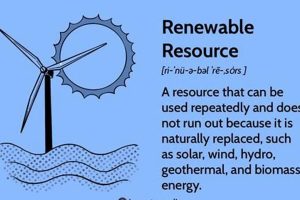
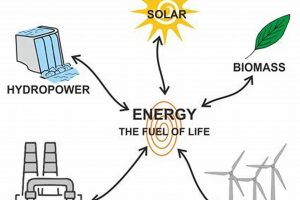
Renewable energy constitutes power derived from naturally replenishing resources. These sources, unlike fossil fuels, are theoretically inexhaustible and contribute minimally to environmental pollution when properly managed. Examples include solar, wind, hydro, geothermal, and biomass energies, each harnessing distinct natural processes for electricity generation, heating, or transportation.
The significance of renewable energy lies in its potential to mitigate climate change, enhance energy security, and stimulate economic growth. Utilizing these resources reduces reliance on finite fossil fuels, thereby decreasing greenhouse gas emissions and promoting a more sustainable energy future. Furthermore, developing and deploying renewable energy technologies can create new jobs and industries.
This article will delve into the specifics of various renewable energy options, examining their operational principles, advantages, limitations, and current applications worldwide. Consideration will be given to both established and emerging technologies, offering a broad overview of the renewable energy landscape.
Maximizing the Potential of Renewable Energy
Optimizing the adoption and efficiency of power generated from naturally replenishing resources requires a multifaceted approach. Strategic implementation, technological advancement, and policy support are crucial for realizing the full benefits of these energy solutions.
Tip 1: Prioritize Grid Modernization: Integrating variable sources like solar and wind requires a robust and flexible electricity grid. Investments in smart grid technologies, energy storage solutions, and transmission infrastructure are essential to accommodate fluctuating energy supply.
Tip 2: Diversify the Energy Mix: Reliance on a single energy source, even a renewable one, can create vulnerabilities. A diversified portfolio incorporating various forms, such as solar, wind, hydro, and geothermal, enhances energy security and resilience.
Tip 3: Encourage Distributed Generation: Promoting decentralized power generation, such as rooftop solar panels or small-scale wind turbines, empowers consumers and reduces transmission losses. Net metering policies and streamlined permitting processes can facilitate distributed generation.
Tip 4: Invest in Research and Development: Continuous innovation is vital to improving the efficiency, reliability, and affordability of renewable energy technologies. Targeted research grants and partnerships between academia and industry can drive technological advancements.
Tip 5: Establish Supportive Policy Frameworks: Clear and consistent policies, including renewable energy standards, tax incentives, and carbon pricing mechanisms, create a stable investment environment and encourage the deployment of renewable energy projects.
Tip 6: Promote Energy Efficiency: Reducing overall energy consumption minimizes the demand for new power generation, regardless of the source. Energy efficiency measures in buildings, transportation, and industry can significantly lower energy costs and greenhouse gas emissions.
Tip 7: Foster Public Awareness and Education: Educating the public about the benefits and opportunities associated with renewable energy fosters greater acceptance and support for these technologies. Public awareness campaigns and educational programs can dispel misconceptions and encourage informed decision-making.
By focusing on grid modernization, diversification, distributed generation, research and development, policy support, energy efficiency, and public education, society can unlock the full potential of renewable energy. These strategies are essential for building a sustainable and resilient energy future.
The subsequent sections of this article will delve deeper into specific implementation challenges and explore emerging technologies that hold promise for further advancing the renewable energy transition.
1. Resource Availability

Resource availability functions as a primary determinant in the feasibility and scalability of different renewable energy technologies. The geographical distribution and intensity of renewable resources, such as solar irradiance, wind speed, geothermal gradients, and biomass feedstock, directly influence the potential energy output and economic viability of corresponding renewable energy projects. Disparities in resource endowment across regions necessitate tailored energy strategies, favoring renewable sources best suited to local conditions.
The impact of resource availability is evident across various renewable energy sectors. Solar energy deployment is concentrated in regions with high solar irradiance, such as the southwestern United States and the Middle East. Wind energy projects are typically located in areas with consistent and strong wind patterns, exemplified by the wind farms in the Great Plains of North America and coastal regions of Europe. Geothermal energy utilization is confined to areas with accessible geothermal reservoirs, like Iceland and parts of the western United States. Biomass energy potential is linked to agricultural and forestry practices, with significant resources in regions with abundant biomass feedstock. This spatial dependence underscores the importance of comprehensive resource assessments for informed energy planning and investment decisions.
Understanding the connection between resource availability and renewable energy sources is critical for optimizing energy infrastructure development and achieving sustainable energy goals. Accurate resource mapping, forecasting, and modeling are essential for identifying suitable locations for renewable energy projects and for predicting their long-term performance. While technological advancements can enhance the efficiency of energy conversion, the underlying resource potential remains a fundamental constraint. Therefore, strategic energy planning must consider the spatial distribution and temporal variability of renewable resources to ensure effective and sustainable energy utilization.
2. Technological Maturity

Technological maturity significantly influences the widespread adoption and economic viability of renewable energy sources. The stage of development impacts efficiency, reliability, cost-effectiveness, and scalability, directly affecting their competitiveness with conventional energy technologies. Understanding the technological maturity of each source is essential for informed investment and policy decisions.
- Efficiency and Performance
More mature technologies, such as conventional hydropower and certain solar photovoltaic systems, exhibit higher efficiency and predictable performance. This reliability reduces operational risks and improves energy output. In contrast, emerging technologies like advanced geothermal systems or wave energy converters may demonstrate lower efficiencies and require further research to enhance performance.
- Cost Competitiveness
Technological maturity correlates directly with cost reduction. Established renewable technologies, like wind power and solar PV, have experienced significant cost declines due to economies of scale and technological advancements, making them increasingly competitive with fossil fuels. Less mature technologies often face higher upfront costs and require further innovation to achieve cost parity.
- Supply Chain and Manufacturing
Mature technologies benefit from established supply chains and manufacturing infrastructure, ensuring the availability of components and reducing production costs. For example, the solar PV industry has a well-developed global supply chain. Emerging technologies may face supply chain bottlenecks and require investment in manufacturing capacity to support widespread deployment.
- Integration and Grid Compatibility
The level of technological maturity influences the ease of integration into existing electricity grids. Mature technologies like wind and solar have established integration strategies, including grid management techniques and forecasting tools. Newer technologies may present integration challenges due to their variable output or unique operational characteristics, necessitating further development of grid infrastructure and control systems.
In summary, technological maturity shapes the deployment trajectory of renewable energy sources. Mature technologies offer established performance and cost profiles, while emerging technologies hold the potential for future advancements but require continued investment and development to reach their full potential. A balanced approach, supporting both mature and emerging technologies, is essential for accelerating the transition to a sustainable energy system.
3. Economic Viability

Economic viability serves as a pivotal determinant in the deployment and integration of renewable energy sources. The financial attractiveness of these technologies, relative to conventional alternatives, significantly influences investment decisions, policy support, and overall market penetration.
- Levelized Cost of Energy (LCOE)
The Levelized Cost of Energy (LCOE) is a primary metric for assessing the economic competitiveness of different energy sources. It calculates the present value of the total cost of building and operating a power plant over its lifetime, divided by the total energy produced over that period. Lower LCOE values indicate greater economic viability. For instance, wind and solar PV have experienced significant LCOE reductions in recent years, making them increasingly competitive with fossil fuel-based power generation. However, the LCOE varies greatly depending on factors such as location, resource availability, and financing costs.
- Capital Costs and Operating Expenses
The economic viability of renewable energy sources is strongly influenced by capital costs and operating expenses. Renewable energy projects often have high upfront capital costs associated with equipment, construction, and interconnection. Conversely, operating expenses are typically lower due to minimal fuel costs. For example, hydroelectric dams have substantial initial construction costs but require relatively low operating expenses. In contrast, biomass power plants may have lower capital costs but incur ongoing expenses for fuel procurement and handling.
- Policy Incentives and Subsidies
Government policies play a crucial role in enhancing the economic viability of renewable energy. Incentives such as tax credits, feed-in tariffs, and renewable energy certificates can significantly improve the financial returns of renewable energy projects. These policies help to level the playing field by offsetting the higher upfront costs or lower revenue streams of renewable technologies. For example, solar investment tax credits have spurred rapid growth in the solar industry, while feed-in tariffs have encouraged the deployment of wind power in Europe.
- External Costs and Environmental Valuation
Economic viability assessments often fail to fully account for the external costs associated with conventional energy sources, such as air pollution, greenhouse gas emissions, and public health impacts. Assigning economic value to these environmental externalities can improve the competitiveness of renewable energy sources. Carbon pricing mechanisms, such as carbon taxes or cap-and-trade systems, can internalize these costs, making renewable energy more economically attractive. For instance, a carbon tax would increase the cost of fossil fuels, thereby improving the relative economic position of low-carbon renewable alternatives.
The interplay of LCOE, capital and operating costs, policy incentives, and environmental valuation collectively shapes the economic viability of various renewable energy sources. Factors like technological advancements, economies of scale, and supportive policies are essential for ensuring that renewable technologies can compete effectively in the energy market, driving the transition to a more sustainable energy future.
4. Environmental Impact

The utilization of renewable energy sources is often presented as an environmentally benign alternative to fossil fuels; however, a comprehensive assessment necessitates acknowledging potential environmental consequences associated with each type. While generally exhibiting lower emissions of greenhouse gases and air pollutants compared to fossil fuels, renewable energy technologies can exert localized environmental impacts that warrant careful consideration and mitigation strategies. These impacts vary significantly depending on the specific energy source, project scale, and geographic location. Examples include land use changes associated with large-scale solar farms, habitat disruption from wind turbine development, altered aquatic ecosystems from hydroelectric dams, and potential air and water pollution from biomass combustion.
The importance of environmental impact assessment as an integral component of renewable energy development cannot be overstated. Thorough environmental studies, conducted prior to project implementation, can identify potential risks and inform mitigation measures to minimize adverse effects. For instance, strategic site selection for wind farms can reduce impacts on bird and bat populations. Incorporating fish ladders and minimum flow requirements in hydroelectric projects can help maintain aquatic biodiversity. Employing sustainable harvesting practices and advanced combustion technologies can minimize the environmental footprint of biomass energy. The practical significance of this understanding lies in the ability to develop and deploy renewable energy solutions in a responsible and sustainable manner, maximizing the benefits while minimizing potential harm to the environment.
In conclusion, while renewable energy sources offer substantial environmental advantages over fossil fuels, it is essential to acknowledge and address potential environmental impacts associated with their deployment. A holistic approach, incorporating rigorous environmental assessments, responsible site selection, and effective mitigation strategies, is critical for ensuring the long-term sustainability and environmental integrity of renewable energy systems. Continuous research and technological advancements aimed at minimizing the environmental footprint of renewable energy technologies are crucial for realizing their full potential as a clean and sustainable energy solution.
5. Grid Integration

Grid integration encompasses the technological and operational processes required to incorporate electricity generated from diverse sources into the existing power grid. Its importance is amplified with the increasing prevalence of renewable energy sources, which often exhibit variability and intermittency unlike traditional baseload power plants. Effective grid integration is essential to maintain grid stability, reliability, and overall system efficiency.
- Intermittency Management
Renewable sources such as solar and wind power are inherently intermittent, posing challenges to grid stability. Effective integration necessitates sophisticated forecasting tools to predict energy output, as well as flexible resources to compensate for fluctuations. Examples include advanced battery storage systems, pumped hydro storage, and demand response programs that adjust electricity consumption based on grid conditions. Failing to address intermittency can lead to voltage fluctuations, frequency deviations, and potential blackouts.
- Grid Modernization
The existing power grid infrastructure was primarily designed for unidirectional power flow from large, centralized generation sources. Integrating distributed renewable energy sources, such as rooftop solar panels, requires grid modernization. This involves upgrading transmission and distribution lines, deploying smart grid technologies for real-time monitoring and control, and implementing advanced metering infrastructure (AMI) to enable two-way communication between the grid and consumers. Without modernization, the grid may struggle to handle the increased complexity and variability of renewable energy inputs.
- Ancillary Services
Traditional power plants provide essential ancillary services to maintain grid stability, such as frequency regulation, voltage control, and reactive power support. As renewable energy penetration increases, these services must be provided by renewable sources or other grid resources. Technologies like synchronous condensers, fast-response inverters, and advanced control algorithms are crucial for enabling renewable energy sources to provide these ancillary services reliably. The lack of adequate ancillary services can compromise grid stability and increase the risk of outages.
- Transmission Capacity and Location
Renewable energy resources are often located in remote areas with limited transmission infrastructure. For instance, large-scale wind farms are frequently situated in rural regions with high wind speeds, while solar farms may be built in deserts with abundant sunlight. Expanding transmission capacity to these resource-rich areas is essential for transporting the generated electricity to demand centers. This requires significant investments in new transmission lines, substations, and other grid infrastructure. Inadequate transmission capacity can constrain the development and utilization of renewable energy resources.
Successfully integrating power from diverse renewable energy sources into the grid relies on addressing intermittency, modernizing grid infrastructure, ensuring adequate ancillary services, and expanding transmission capacity. These considerations are crucial for realizing the full potential of renewable energy and transitioning to a sustainable energy system. Failure to adequately address these aspects of grid integration will significantly hinder the effective utilization of various types of renewable energy sources and jeopardize grid stability.
Frequently Asked Questions Regarding Renewable Energy Sources
This section addresses common inquiries concerning the nature, implementation, and impact of renewable energy technologies. The aim is to provide clear, concise answers based on current scientific understanding and industry best practices.
Question 1: What constitutes a renewable energy source?
A renewable energy source is defined as a naturally replenishing energy resource. These resources are theoretically inexhaustible and are replenished at a rate comparable to or faster than their rate of consumption. Common examples include solar, wind, hydro, geothermal, and biomass energy.
Question 2: How does the intermittent nature of some renewable energy sources affect grid reliability?
The intermittent nature of sources such as solar and wind necessitates sophisticated grid management strategies. These strategies include advanced forecasting tools, energy storage solutions, and flexible generation resources to balance supply and demand. Grid modernization and enhanced interconnection capabilities are also critical for maintaining reliability.
Question 3: Are renewable energy sources truly environmentally benign?
While generally exhibiting lower emissions compared to fossil fuels, renewable energy sources are not entirely without environmental impact. Land use changes, habitat disruption, and potential water resource impacts are considerations that must be addressed through careful planning and mitigation measures. Life cycle assessments are crucial for evaluating the overall environmental footprint.
Question 4: What is the role of government policy in promoting renewable energy adoption?
Government policies play a significant role in accelerating the adoption of renewable energy technologies. These policies may include tax incentives, renewable energy standards, feed-in tariffs, and carbon pricing mechanisms. Such measures can level the playing field, reduce financial barriers, and create a stable investment environment.
Question 5: How does energy storage enhance the value of renewable energy systems?
Energy storage technologies, such as batteries and pumped hydro, enhance the value of renewable energy systems by addressing the intermittency challenge. Storage enables the decoupling of energy supply and demand, allowing excess energy generated during peak production periods to be stored for later use, thereby improving grid stability and reliability.
Question 6: What factors influence the economic viability of renewable energy projects?
Economic viability is influenced by factors such as capital costs, operating expenses, resource availability, policy incentives, and the levelized cost of energy (LCOE). Technological advancements, economies of scale, and supportive policies can improve the economic competitiveness of renewable energy technologies.
In summary, the successful implementation of power derived from naturally replenishing resources requires a multifaceted approach that considers technical, economic, environmental, and policy aspects. Addressing these factors is essential for realizing the full potential of renewable energy and transitioning to a sustainable energy future.
The following sections will explore specific renewable energy technologies in greater detail, providing an overview of their operational principles, applications, and future prospects.
Conclusion
This examination of various types of renewable energy sources has highlighted the diverse technological landscape available for transitioning to a sustainable energy future. Consideration of resource availability, technological maturity, economic viability, environmental impact, and grid integration is paramount for effective deployment. Understanding these facets enables informed decision-making and optimized resource allocation.
Continued research, strategic policy implementation, and sustained investment are essential to unlock the full potential of power derived from naturally replenishing resources. The future energy landscape hinges on the collective commitment to embrace these technologies, fostering a more resilient and environmentally responsible energy system for generations to come.