



Compressed Natural Gas (CNG) is natural gas that has been compressed to less than 1% of its volume at standard atmospheric pressure. Primarily composed of methane, its use is often promoted as... Read more »
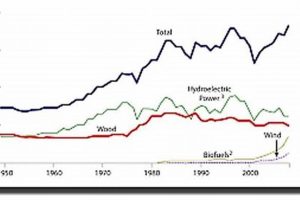
Identifying the energy generation method with the lowest overall demand involves analyzing global energy consumption data across various categories. This includes resources like solar, wind, hydroelectric, nuclear, natural gas, coal, and less... Read more »


Resources classified as finite and unable to replenish at a rate that keeps pace with consumption are termed non-renewable energy sources. Fossil fuels, such as coal, petroleum, and natural gas, exemplify this... Read more »
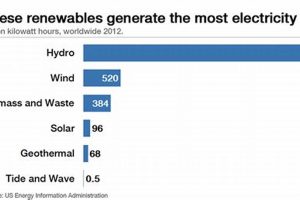
Hydroelectric power, derived from the energy of moving water, currently constitutes the largest share of global renewable electricity generation. This method harnesses the potential and kinetic energy of water, typically through dams... Read more »
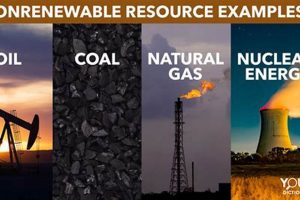
Coal is categorized as a nonrenewable energy source because its formation takes millions of years. Organic matter, primarily plants, accumulates in swamps and bogs. Over time, this matter is buried under layers... Read more »
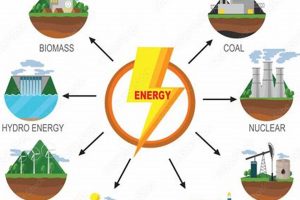
The classification of a resource as either renewable or non-renewable hinges on its rate of replenishment relative to its rate of consumption. Resources that naturally replenish within a human lifespan are generally... Read more »
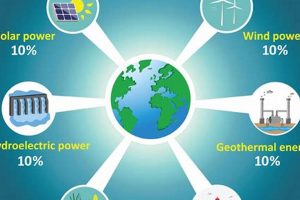
Optimal sustainable power generation involves considering various factors, including environmental impact, cost-effectiveness, reliability, and scalability. For instance, while solar power excels in sunny regions, geothermal energy might be more suitable in volcanically... Read more »
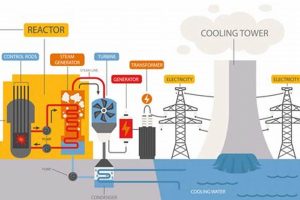
The concept of a sustainable and inexhaustible power supply is central to contemporary energy discussions. The prevailing understanding is that resources replenished at a rate equal to or exceeding their consumption are... Read more »
An energy resource is considered inexhaustible if it replenishes naturally on a human timescale. These resources derive from continuously available environmental phenomena. Solar radiation, wind, flowing water, geothermal heat, and biomass exemplify... Read more »
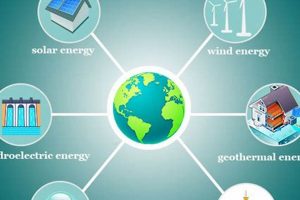
A naturally replenished resource whose rate of consumption does not exceed its rate of regeneration, effectively ensuring its availability for future generations. Examples include solar radiation, wind, geothermal heat, and hydropower. Harnessing... Read more »