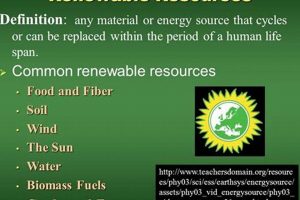
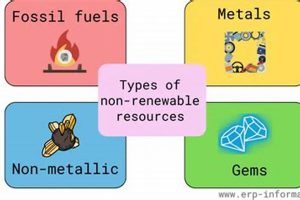
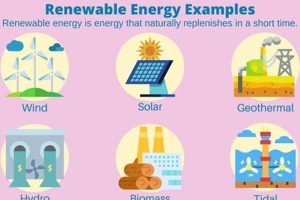
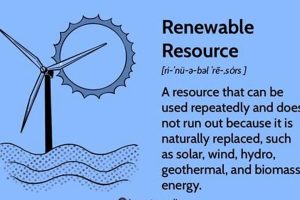
Energy and materials utilized by society originate from two primary categories: those that replenish naturally within a human lifespan, and those that exist in finite quantities, diminishing with extraction. The former includes resources like solar radiation, wind, and biomass, constantly renewed through natural processes. The latter encompasses fossil fuels (coal, oil, and natural gas) and minerals, formed over geological timescales and present in limited reserves.
Understanding the distinction between these resource types is crucial for sustainable development. Reliance on continuously replenished sources reduces environmental impact, mitigates resource depletion, and enhances long-term energy security. Conversely, dependence on finite reserves leads to eventual scarcity, price volatility, and potential environmental degradation associated with extraction and combustion. Historically, societies have transitioned between resource bases, driven by technological advancements and the availability of specific materials. The current focus on renewable energy reflects a growing awareness of the limitations associated with depletable reserves.
This article will further explore the specific characteristics of each resource category, examining their extraction methods, environmental impacts, and contribution to the global energy mix. Furthermore, it will delve into the technological advancements and policy initiatives designed to promote the sustainable utilization of all available resources, balancing economic needs with environmental stewardship.
Understanding Resource Classification
Proper comprehension of resource classification is fundamental for informed decision-making across various sectors, from individual consumption habits to national energy strategies. Applying this understanding can lead to more sustainable practices and a more secure future.
Tip 1: Evaluate Energy Consumption Sources: Analyze the origin of consumed energy. Prioritize electricity providers that utilize renewable sources such as solar, wind, or hydropower. This reduces reliance on fossil fuels and their associated environmental consequences.
Tip 2: Promote Energy Efficiency: Implement energy-efficient technologies and practices in homes and businesses. This reduces overall energy demand, minimizing the extraction of both renewable and non-renewable resources. Examples include using LED lighting, insulating buildings, and adopting smart thermostats.
Tip 3: Support Sustainable Transportation: Opt for transportation methods with lower environmental impact. Consider public transportation, cycling, walking, or electric vehicles. This reduces the demand for petroleum-based fuels and promotes cleaner air quality.
Tip 4: Advocate for Renewable Energy Policies: Support policies that incentivize the development and deployment of renewable energy technologies. This includes advocating for government subsidies, tax incentives, and regulations that favor renewable energy sources.
Tip 5: Invest in Renewable Energy Infrastructure: Support investments in renewable energy infrastructure, such as solar farms, wind farms, and hydroelectric dams. These investments create jobs, stimulate economic growth, and reduce reliance on finite resources.
Tip 6: Reduce Material Consumption: Practice mindful consumption to minimize the demand for materials that require resource extraction. Prioritize durable goods, repair existing items, and reduce waste through recycling and composting.
Tip 7: Understand the Lifecycle of Products: Consider the entire lifecycle of products, from resource extraction to disposal. Choose products with sustainable sourcing, minimal packaging, and end-of-life recycling options.
By incorporating these considerations into daily life and professional practices, individuals and organizations can actively contribute to a more sustainable and resource-efficient future. A nuanced awareness allows informed choices that benefit both the environment and long-term economic stability.
The following sections will expand upon these considerations, examining specific challenges and opportunities associated with transitioning to a more sustainable resource management paradigm.
1. Sustainability

Sustainability, in the context of resource management, is intrinsically linked to the defining characteristics of renewable and non-renewable resource categories. The longevity of human activities is contingent upon the responsible utilization of natural resources, ensuring their availability for future generations. Renewable resources, by their nature, offer a pathway to sustainable practices when managed effectively. Solar energy, wind power, and sustainably managed forests represent instances where resource extraction occurs within the bounds of natural replenishment, minimizing depletion and maintaining long-term viability. The mismanagement of renewable resources, such as overfishing or deforestation exceeding regrowth rates, compromises their sustainability and transforms them into effectively finite assets. This emphasizes the importance of responsible resource governance and ecological awareness.
Conversely, non-renewable resources, such as fossil fuels and minerals, present inherent challenges to sustainability due to their finite nature and the often significant environmental consequences associated with their extraction and processing. The combustion of fossil fuels contributes to climate change and air pollution, while mining operations can disrupt ecosystems and contaminate water sources. While these resources play a crucial role in current energy systems and industrial processes, their utilization necessitates strategies to mitigate their environmental impact and transition towards more sustainable alternatives. This includes investing in renewable energy technologies, improving energy efficiency, and developing circular economy models that reduce waste and maximize resource utilization. The strategic importance of transitioning to a circular economy can be exemplified by the adoption of improved recycling technologies that extract valuable metals from electronics, reducing the reliance on newly-mined ore.
In summation, the concept of sustainability provides a crucial framework for evaluating the impact and longevity of resource utilization strategies. While renewable resources offer inherent advantages in terms of long-term availability, effective management is essential to maintain their sustainable yield. Non-renewable resources, due to their finite nature, require careful management, technological innovation, and a strategic transition towards renewable alternatives to ensure environmental protection and resource security. Successfully integrating sustainability principles into resource management policies is essential for navigating the complex challenges of the 21st century and ensuring the well-being of current and future generations.
2. Depletion
Depletion, referring to the reduction in the quantity of a resource, directly correlates with the fundamental differentiation between renewable and non-renewable resources. The consumption rate of non-renewable resources demonstrably exceeds their natural formation rate, leading to a finite supply. Examples include the extraction of crude oil and the mining of metal ores. Continuous consumption without viable substitutes inevitably results in exhaustion, impacting future availability and potentially escalating economic and geopolitical tensions.
Renewable resources, conversely, possess the capacity to replenish within a human lifespan, mitigating the risk of depletion under sustainable management practices. However, even renewable resources are susceptible to depletion if extraction rates surpass their regeneration rates. Deforestation, overfishing, and overuse of freshwater aquifers exemplify instances where seemingly renewable resources face depletion due to unsustainable human activities. This underscores the significance of effective resource management strategies that prioritize conservation and responsible utilization.
The awareness of depletion rates is critical for formulating policies that encourage responsible resource consumption, incentivize the development of alternative resources, and promote technological innovation aimed at maximizing resource efficiency. Understanding this relationship allows for a more informed approach to long-term sustainability planning, influencing decisions ranging from individual consumption habits to national energy and environmental policies. Effectively addressing resource depletion requires a multi-faceted approach, involving technological advancements, economic incentives, regulatory frameworks, and behavioral changes.
3. Replenishment Rates

Replenishment rates serve as a defining characteristic in differentiating between renewable and non-renewable resources. These rates indicate the speed at which a resource is restored through natural processes. For renewable resources, the replenishment rate is comparatively rapid, often occurring within a human lifespan or even more quickly. Solar energy, for instance, is constantly replenished by the sun; wind energy is continuously generated by atmospheric conditions; and forests can regenerate through natural growth or reforestation efforts. The rate of replenishment, if managed sustainably, allows for continuous use without diminishing the resource base.
Non-renewable resources, in stark contrast, possess replenishment rates that extend over geological timescales, often millions of years. Fossil fuels, such as coal, oil, and natural gas, originate from the decomposed remains of ancient organic matter subjected to intense pressure and heat over extended periods. Minerals, similarly, are formed through slow geological processes. The negligible replenishment rate of these resources means that any extraction permanently reduces the total available stock. For example, the extraction of one barrel of crude oil represents a permanent loss to the global reserve, with no possibility of replenishment within a relevant timeframe. This disparity in replenishment rates underscores the finite nature of non-renewable resources and the long-term implications of their consumption.
The understanding of replenishment rates holds significant practical importance for resource management and policy decisions. Accurately assessing these rates enables informed strategies for sustainable resource utilization, including the development of renewable energy technologies, the implementation of conservation measures, and the exploration of alternative materials. Furthermore, it informs the economic evaluation of resource extraction and consumption, influencing pricing mechanisms and investment decisions. Failing to consider replenishment rates leads to unsustainable practices, resource depletion, and potentially irreversible environmental damage. Therefore, incorporating replenishment rate analysis into resource management frameworks is crucial for securing long-term resource availability and environmental sustainability.
4. Environmental Impact
The environmental impact directly correlates with the classification of resources as either renewable or non-renewable. The extraction, processing, and utilization of non-renewable resources are often associated with substantial environmental consequences. Fossil fuel combustion releases greenhouse gases, contributing to climate change and ocean acidification. Mining operations can lead to habitat destruction, soil erosion, and water contamination. The production of nuclear energy, while not emitting greenhouse gases during operation, poses risks related to radioactive waste disposal and the potential for accidents. These consequences are often significant and long-lasting, impacting ecosystems and human populations.
Renewable resources, in contrast, generally have a lower environmental impact. Solar energy production is relatively clean, with minimal emissions during operation, although the manufacturing of solar panels can involve the use of certain materials and energy. Wind energy production has a small footprint, but it can pose a threat to bird and bat populations. Hydropower dams can alter river ecosystems and displace local communities. Biomass energy, if sustainably sourced, can be carbon neutral, but deforestation for fuel or large-scale biofuel production can have negative consequences. It is critical to assess the full lifecycle environmental impact of renewable resources to ensure sustainability.
Understanding the connection between environmental impact and resource classification is essential for informed decision-making regarding energy policy, resource management, and sustainable development. Evaluating the environmental costs and benefits of different resource options, considering factors such as greenhouse gas emissions, water usage, land use, and waste generation, is necessary for achieving long-term ecological and economic well-being. Emphasizing the use of renewable resources and promoting efficient resource management can mitigate the negative environmental impacts associated with energy production and consumption. This requires interdisciplinary collaboration, technological innovation, and policy frameworks that incentivize sustainable practices.
5. Economic Implications
The economic implications of resource utilization are profoundly shaped by the distinction between renewable and non-renewable sources. This distinction influences market dynamics, investment strategies, and the overall stability of national economies. The finite nature and geographic concentration of non-renewable resources create unique economic challenges and opportunities, while the scalability and sustainability potential of renewable resources offer a contrasting set of considerations.
- Price Volatility and Resource Scarcity
Non-renewable resources, particularly fossil fuels, are susceptible to significant price fluctuations driven by supply disruptions, geopolitical instability, and shifts in global demand. Resource scarcity, as reserves diminish, exerts upward pressure on prices, potentially leading to economic instability for nations heavily reliant on these resources. For example, oil price shocks have historically triggered recessions and inflationary pressures, demonstrating the vulnerability associated with dependence on non-renewable energy sources.
- Capital Investment and Technological Innovation
The development of renewable energy infrastructure typically requires substantial upfront capital investment. Solar farms, wind farms, and hydroelectric power plants necessitate significant financial commitments before generating revenue. However, these investments can stimulate technological innovation, drive down long-term costs, and create new industries. The economic benefits of these innovations extend beyond the energy sector, fostering economic growth in related fields such as manufacturing, engineering, and research.
- Job Creation and Regional Economic Development
The renewable energy sector has the potential to create significant employment opportunities, particularly in manufacturing, installation, and maintenance. Renewable energy projects can stimulate economic development in rural areas and regions with abundant renewable resources, such as solar irradiance or wind capacity. This diversification of economic activity can reduce reliance on traditional industries and create more resilient local economies. Government policies supporting renewable energy development can further enhance these positive economic impacts.
- Energy Security and Trade Balances
Reliance on imported non-renewable resources exposes nations to geopolitical risks and potential supply disruptions, impacting energy security. Investing in domestic renewable energy sources can reduce dependence on foreign imports, improve trade balances, and enhance energy independence. This strengthens national economic sovereignty and reduces vulnerability to external economic shocks. The development of indigenous renewable resources can also lead to export opportunities, generating revenue and further bolstering national economies.
In conclusion, the economic implications of resource utilization are critically dependent on the characteristics of renewable and non-renewable resources. While non-renewable resources offer short-term economic advantages, their finite nature and associated environmental costs pose long-term economic risks. Investing in renewable energy technologies and promoting sustainable resource management practices can foster economic growth, enhance energy security, and mitigate the negative economic consequences of resource depletion and environmental degradation. A strategic transition towards a diversified and sustainable energy portfolio is essential for achieving long-term economic stability and prosperity.
6. Resource Management
The effectiveness of resource management is intrinsically linked to a clear understanding of the fundamental difference between renewable and non-renewable resources. Resource management strategies must account for the distinct characteristics of each category to ensure sustainability and long-term availability. Mismanagement of renewable resources can lead to depletion, while the unsustainable exploitation of non-renewable resources can result in environmental degradation and resource scarcity. Therefore, the definition of these resources directly informs and dictates the appropriate management approaches.
Effective resource management integrates a multi-faceted approach that addresses both the supply and demand sides. For renewable resources, this includes implementing sustainable harvesting practices, protecting ecosystems, and investing in research and development to improve resource yields. Sustainable forestry practices, for example, ensure that timber harvesting does not exceed the forest’s natural regeneration rate, maintaining a continuous supply of wood products while preserving biodiversity. For non-renewable resources, management strategies focus on maximizing resource efficiency, promoting recycling and reuse, and developing alternative technologies. The implementation of carbon capture and storage technologies, while not eliminating fossil fuel consumption, aims to mitigate the environmental impact by preventing greenhouse gas emissions from entering the atmosphere. These examples illustrate that the specific strategies depend on the resource category.
Ultimately, resource management serves as a critical bridge between the definitions of renewable and non-renewable resources and the practical application of sustainable practices. It requires a thorough understanding of resource dynamics, environmental impacts, and economic considerations. Addressing the challenges associated with resource management requires interdisciplinary collaboration among scientists, policymakers, and industry stakeholders. A comprehensive and adaptive approach is essential for securing long-term resource availability, environmental protection, and economic stability.
Frequently Asked Questions
The following questions address common inquiries and misconceptions concerning the fundamental division between replenishable and finite resources, providing concise and authoritative answers.
Question 1: What precisely distinguishes a renewable resource from a non-renewable one?
A renewable resource replenishes naturally within a human lifespan through ongoing natural processes, like solar radiation or forest regrowth. Conversely, a non-renewable resource exists in a finite quantity; its formation requires geological timescales, making replenishment practically impossible within a human timeframe.
Question 2: Can a resource traditionally considered renewable become non-renewable?
Yes. If a renewable resource is exploited at a rate exceeding its natural replenishment rate, it effectively becomes non-renewable. Overfishing, deforestation without reforestation, and the excessive draw-down of aquifers exemplify this transition.
Question 3: Are all renewable energy sources equally environmentally benign?
No. While generally having a lower environmental impact than non-renewable sources, renewable energy technologies can still have adverse effects. Hydropower dams can disrupt aquatic ecosystems, wind turbines can pose a threat to avian wildlife, and biomass energy can contribute to deforestation if unsustainably sourced.
Question 4: What are the primary environmental consequences associated with the extraction and use of non-renewable resources?
The extraction and use of non-renewable resources can result in a range of environmental consequences, including greenhouse gas emissions, habitat destruction, soil erosion, water contamination, and air pollution. The combustion of fossil fuels is a major contributor to climate change and air quality degradation.
Question 5: Is transitioning to renewable energy a financially viable strategy?
The financial viability of transitioning to renewable energy is becoming increasingly evident as technology advances and costs decline. While initial capital investments may be substantial, the long-term operational costs are generally lower than those associated with non-renewable sources. Furthermore, government policies and incentives are accelerating the adoption of renewable energy technologies.
Question 6: What role does resource management play in ensuring sustainable resource utilization?
Resource management is crucial for achieving sustainable resource utilization. Effective resource management strategies involve monitoring resource stocks, regulating extraction rates, promoting conservation, investing in technological innovation, and fostering responsible consumption patterns. These strategies aim to balance economic needs with environmental protection.
These answers emphasize the critical importance of understanding resource categorization for effective environmental stewardship and long-term sustainability planning.
The following section will provide an outlook to future trends and challenges in sustainable resource management.
Conclusion
The exploration of renewable and non renewable resources definition reveals a fundamental dichotomy that underpins global energy and material economies. The defining characteristics of each category replenishment rate, environmental impact, and economic implications necessitate distinct management approaches. A comprehensive understanding of this distinction is crucial for formulating sustainable resource utilization strategies and mitigating the risks associated with resource depletion and environmental degradation. Effective resource management requires a multi-faceted approach, encompassing technological innovation, policy interventions, and responsible consumption patterns.
The long-term sustainability of human civilization depends on a strategic transition towards a diversified and resilient resource portfolio, prioritizing renewable sources and maximizing the efficiency of non-renewable resource utilization. Addressing the challenges inherent in this transition requires sustained commitment from governments, industries, and individuals, fostering a collective responsibility towards securing a resource-secure and environmentally sustainable future.
![Guide to What Energy Resources Are Renewable [+Future] | Renewable Energy Solutions for a Sustainable Future | Clean & Green Power](https://pplrenewableenergy.com/wp-content/uploads/2026/03/th-516-300x200.jpg "Guide to What Energy Resources Are Renewable [+Future] Renewable Energy Solutions for a Sustainable Future | Clean & Green Power")