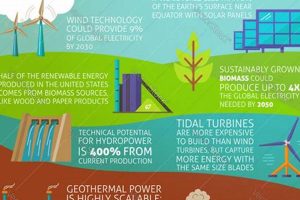
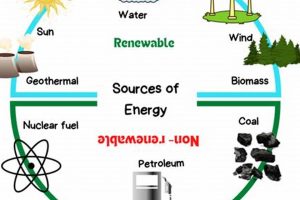
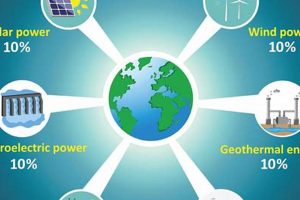
The leading contributor to global renewable power generation is hydroelectricity. This method harnesses the energy of moving water, typically through dams, to turn turbines and generate electricity. Existing infrastructure and established technology have made it a cornerstone of renewable energy portfolios worldwide.
Its significance lies in providing a reliable and large-scale source of clean energy, reducing dependence on fossil fuels and mitigating greenhouse gas emissions. Historically, water power has been utilized for centuries, evolving from simple water wheels to modern, large-scale hydroelectric dams. The long lifespan of these facilities provides a stable base for renewable energy production, though environmental and social considerations remain important factors in their development and operation.
While hydroelectric power currently holds the dominant position, other renewable sources such as solar and wind energy are experiencing rapid growth and technological advancements. These sources are gaining prominence and contributing increasingly to the global energy mix, positioning them as vital components of a sustainable energy future.
Strategies for Maximizing Renewable Energy Investment
Understanding the dynamics of renewable energy is crucial for effective investment and policy development. This section outlines key strategies for optimizing the contribution of various sources to a sustainable energy future.
Tip 1: Diversify Renewable Energy Portfolio: Investing solely in one technology, even the most prevalent, carries risk. A diversified approach, encompassing solar, wind, geothermal, and biomass, enhances resilience and reduces vulnerability to technological obsolescence or resource limitations.
Tip 2: Prioritize Grid Modernization: Integrating large-scale renewable generation necessitates upgrading existing grid infrastructure. Smart grids, capable of accommodating intermittent power sources and facilitating bidirectional energy flow, are essential for reliable electricity delivery.
Tip 3: Support Research and Development: Continuous innovation is paramount for enhancing the efficiency and reducing the costs of all renewable energy technologies. Targeted investment in research accelerates progress and unlocks new potential.
Tip 4: Implement Supportive Policy Frameworks: Governments play a critical role in fostering renewable energy adoption. Clear and consistent policies, including feed-in tariffs, tax incentives, and carbon pricing mechanisms, provide certainty and encourage investment.
Tip 5: Address Environmental and Social Impacts: While renewable energy offers significant environmental benefits, potential impacts, such as land use and habitat disruption, must be carefully considered. Sustainable development practices minimize negative consequences and ensure community engagement.
Tip 6: Focus on Energy Storage Solutions: The intermittent nature of some renewable sources requires effective energy storage solutions. Investing in battery technology, pumped hydro storage, and other innovative approaches ensures a reliable energy supply, regardless of weather conditions.
The implementation of these strategies facilitates a transition towards a resilient and sustainable energy system, leveraging the diverse potential of renewable resources to meet global energy demands.
These recommendations serve as a foundation for further exploration of specific renewable energy technologies and their integration into regional and national energy plans.
1. Hydroelectricity's Capacity

Hydroelectricity’s capacity is a primary determinant of its status as the leading renewable energy source. The total installed hydroelectric capacity worldwide significantly exceeds that of other renewable technologies, establishing it as a cornerstone of global renewable energy portfolios.
- Total Installed Capacity
Hydroelectric facilities worldwide possess a substantial cumulative installed capacity, measured in gigawatts (GW). This capacity reflects the potential power generation capability of all operational hydroelectric plants, exceeding the combined installed capacity of other renewable sources like solar and wind in many regions. For instance, countries with significant mountainous regions and large rivers, such as China, Canada, and Brazil, exhibit high installed hydroelectric capacity, contributing substantially to their national energy mix.
- Scale of Individual Projects
Hydroelectric power projects often involve large-scale infrastructure developments, including dams and reservoirs, which facilitate significant energy generation. The sheer size and capacity of these projects, exemplified by mega-dams like the Three Gorges Dam and the Itaipu Dam, enable the continuous provision of substantial amounts of electricity. These projects demonstrate the ability of hydroelectricity to deliver baseload power, contributing to grid stability and energy security.
- Baseload Power Provision
Unlike intermittent renewable sources, hydroelectricity can often provide a consistent and reliable baseload power supply. Reservoir-based hydroelectric facilities can regulate water flow to match electricity demand, ensuring a stable power output. This reliability makes hydroelectricity a valuable resource for meeting energy needs, particularly in areas with limited access to other reliable power sources.
- Energy Storage Capabilities
Hydroelectric facilities can also function as energy storage systems through pumped hydro storage. During periods of low demand, excess electricity is used to pump water from a lower reservoir to an upper reservoir. When demand increases, the stored water is released to generate electricity. This capability enhances grid flexibility and integrates well with other intermittent renewable sources, improving overall energy system efficiency.
The combined impact of total installed capacity, the scale of individual projects, the provision of baseload power, and energy storage capabilities underscores hydroelectricity’s position as the most substantial contributor to renewable energy production globally. While other renewable sources are rapidly expanding, the existing capacity and reliability of hydroelectric power maintain its preeminence in the current energy landscape.
2. Established Infrastructure
The status of hydroelectricity as the dominant renewable energy source is inextricably linked to its established infrastructure. The existence of numerous large-scale dams, reservoirs, and power generation facilities, many dating back decades, provides a substantial advantage over newer renewable technologies. These established facilities represent significant capital investments made over time, contributing to a high level of operational reliability and substantial energy production. The presence of pre-existing infrastructure lowers the barrier to entry for expanding hydroelectric generation capacity, as opposed to developing entirely new energy infrastructure for alternative renewable sources.
Real-world examples illustrate the importance of established infrastructure. The Hoover Dam in the United States, completed in 1936, continues to generate substantial electricity, serving as a reliable power source for the region. Similarly, older hydroelectric plants in Europe and Asia demonstrate the enduring value of well-maintained infrastructure. These facilities have proven their ability to withstand the test of time, providing a stable base for energy production that new and emerging technologies are still striving to replicate on a similar scale. The operational experience and accumulated knowledge gained from these established facilities also contribute to efficient management and maintenance practices, ensuring long-term performance.
Understanding the role of established infrastructure is crucial for informed decision-making regarding energy policy and investment. While newer renewable technologies offer considerable potential for growth and innovation, the existing infrastructure of hydroelectric power provides a critical foundation for current renewable energy production. Challenges remain in addressing environmental concerns related to dams and reservoirs, but the established infrastructure presents a significant advantage in terms of energy output, reliability, and overall contribution to the global renewable energy mix. This pre-existing infrastructure forms a considerable portion of what allows it to hold its leading position as the biggest renewable energy source.
3. Global Implementation

The widespread adoption of a particular energy source is a significant determinant of its overall contribution to the global renewable energy landscape. Assessing global implementation necessitates considering factors such as geographic distribution, the scale of projects, and the maturity of associated technologies.
- Geographic Distribution of Hydroelectric Facilities
Hydroelectric power facilities are operational across numerous countries and continents, reflecting a broad geographic distribution. The presence of suitable river systems and topography facilitates the construction of hydroelectric plants in diverse regions, from mountainous areas in Asia and South America to major river basins in North America and Europe. This wide distribution ensures that hydroelectric power contributes to the energy mix of many nations, enhancing global energy security.
- Scale of Hydroelectric Projects in Developing and Developed Nations
Hydroelectric projects exist on varying scales, catering to diverse energy needs in both developing and developed nations. Large-scale dams provide substantial energy output to support industrialized economies, while smaller-scale run-of-river projects offer sustainable energy solutions for rural communities in developing countries. This scalability enables the application of hydroelectric technology across a wide range of contexts, further contributing to its global impact.
- Integration with Existing Energy Infrastructure
The integration of hydroelectric facilities with existing energy infrastructure is a critical aspect of its global implementation. Many regions have incorporated hydroelectric power into their grids for decades, facilitating reliable power transmission and distribution. This integration allows hydroelectric power to serve as a baseload energy source, supplementing intermittent renewable sources and enhancing grid stability.
- Technological Maturity and Standardization
Hydroelectric technology has reached a high level of maturity and standardization, facilitating efficient operation and maintenance of facilities worldwide. Established engineering practices and standardized equipment designs streamline project development and reduce operational risks. This technological maturity enhances the attractiveness of hydroelectric power as a reliable and cost-effective renewable energy option for many nations.
The extensive geographic distribution, varying scales of projects, integration with existing infrastructure, and technological maturity collectively underscore the significance of global implementation in establishing hydroelectric power as the predominant renewable energy source. While other renewable sources are gaining traction, the established global presence of hydroelectric power positions it as a key player in the world’s transition to sustainable energy.
4. Energy Output Consistency

Energy output consistency is a critical factor in evaluating the viability and reliability of various renewable energy sources. The ability of a power source to provide a stable and predictable energy supply directly impacts its effectiveness in meeting energy demands and maintaining grid stability. In the context of identifying the leading renewable energy source, consistency plays a pivotal role.
- Predictable Generation Schedules
Hydroelectric power plants, particularly those with large reservoirs, often exhibit predictable generation schedules. Water flow can be managed to align with energy demand patterns, allowing operators to adjust power output based on anticipated needs. This level of control contrasts with the variability associated with sources like wind and solar, which are subject to weather conditions. For example, during peak demand hours, hydroelectric facilities can increase generation to meet consumer needs, offering a degree of flexibility not readily available from other renewables.
- Baseload Power Provision
Hydroelectricity is capable of providing baseload power, which refers to a continuous and reliable supply of electricity to meet the minimum level of demand. This contrasts with intermittent sources, which can only generate electricity when conditions are favorable. The consistent baseload capacity of hydroelectric facilities is a key advantage, ensuring a stable energy supply that supports the overall grid infrastructure. For instance, large hydroelectric dams can operate around the clock, supplying energy regardless of weather conditions or time of day.
- Storage Capabilities via Reservoirs
Reservoirs associated with hydroelectric facilities act as natural storage systems, enabling operators to store water and release it to generate electricity when needed. This storage capability allows hydroelectric plants to buffer against fluctuations in demand and maintain a consistent power output. In comparison, other renewable sources often require separate energy storage solutions, such as batteries or pumped hydro storage, to achieve similar levels of reliability. The Hoover Dam, for example, stores vast amounts of water in Lake Mead, providing a readily available source for electricity generation.
- Reduced Dependence on External Factors
While hydroelectric power is dependent on water availability, it is generally less susceptible to short-term weather variations than wind and solar. Snowmelt and rainfall provide a consistent supply of water to reservoirs, allowing hydroelectric plants to maintain a more stable power output. This reduced dependence on external factors contributes to the reliability of hydroelectricity as an energy source. For instance, regions with consistent precipitation patterns can rely on hydroelectric power to provide a stable energy supply, even during periods of drought.
The predictable generation schedules, baseload power provision, storage capabilities via reservoirs, and reduced dependence on external factors collectively contribute to the energy output consistency of hydroelectricity. This consistency is a key reason why hydroelectric power remains the leading renewable energy source in terms of global energy production.
5. Technological Maturity

The established position of hydroelectric power as the foremost renewable energy source is significantly influenced by its technological maturity. The underlying principles and operational methods of hydroelectric generation have been refined over more than a century, resulting in reliable, efficient, and scalable systems. This prolonged development period has fostered a deep understanding of the technology’s limitations and potential, leading to incremental improvements that enhance performance and longevity. A direct consequence of this maturity is the widespread adoption and integration of hydroelectric power into global energy grids.
The maturity of hydroelectric technology is evidenced by the standardization of components, the refinement of dam construction techniques, and the optimization of turbine designs. Standardized components enable efficient maintenance and repairs, reducing downtime and operational costs. Advanced dam construction methods ensure structural integrity and minimize environmental impacts. Efficient turbine designs maximize energy conversion from water flow, improving overall plant efficiency. Examples like the Grand Coulee Dam in the United States, a project initiated in the 1930s and continually upgraded, demonstrate the benefits of long-term investment and refinement in hydroelectric technology. These advancements collectively contribute to the robustness and cost-effectiveness of hydroelectric power, making it a viable option for diverse geographic locations and energy needs.
In summary, technological maturity is a key determinant in hydroelectric power’s dominance as the leading renewable energy source. The accumulated knowledge, standardized practices, and continuous refinements have resulted in reliable and efficient systems that are well-integrated into global energy infrastructure. While emerging renewable technologies are rapidly evolving, the technological maturity of hydroelectric power provides a stable and dependable foundation for meeting current and future energy demands, reinforcing its role in the sustainable energy landscape.
Frequently Asked Questions
The following section addresses common inquiries regarding the dominant contributor to global renewable energy production, providing factual and context-driven answers.
Question 1: Why is hydroelectricity considered the largest renewable energy source?
Hydroelectricity possesses a substantial installed capacity globally, surpassing other renewable technologies. Its long operational history and established infrastructure, including numerous large-scale dams and power generation facilities, contribute to its current status as the leading renewable energy source.
Question 2: How does hydroelectric energy output compare to that of solar and wind?
While solar and wind energy are rapidly expanding, hydroelectric facilities often provide a more consistent and predictable energy output. Reservoir-based hydroelectric plants can regulate water flow to match electricity demand, ensuring a stable power supply that is less susceptible to weather variations.
Question 3: What are the primary advantages of hydroelectric power over other renewable sources?
Hydroelectricity benefits from its established infrastructure, mature technology, and the ability to provide baseload power. Large reservoirs also offer energy storage capabilities, enabling hydroelectric facilities to buffer against fluctuations in demand and maintain a consistent power output. Additionally, the technology is generally less reliant on external factors compared to wind and solar.
Question 4: Are there any limitations associated with hydroelectric power generation?
Hydroelectric facilities can have significant environmental impacts, including alterations to river ecosystems, displacement of communities, and the release of greenhouse gases from reservoirs in certain climates. Careful consideration of these impacts is essential for sustainable development of hydroelectric resources.
Question 5: How does the scale of hydroelectric projects affect their environmental footprint?
Large-scale hydroelectric projects, such as mega-dams, often have more significant environmental and social impacts than smaller, run-of-river projects. Smaller projects can offer more sustainable energy solutions for rural communities while minimizing ecological disruption.
Question 6: What is the role of technological advancements in enhancing hydroelectric power generation?
Technological advancements continue to improve the efficiency and sustainability of hydroelectric facilities. Upgrades to turbine designs, dam construction methods, and monitoring systems enhance energy conversion, reduce environmental impacts, and extend the operational lifespan of existing plants.
Hydroelectricity’s dominance as the primary renewable energy source is attributable to a combination of factors, including its high installed capacity, established infrastructure, energy output consistency, and technological maturity. Understanding these factors is crucial for informed decision-making regarding energy policy and investment.
Considerations for future investment strategies involving renewable energy sources necessitate an understanding of the intricacies of hydroelectricity’s role in the energy landscape.
The Prevailing Renewable Energy Source
This exploration has clarified that hydroelectricity currently represents the most significant renewable energy source globally. This determination is based on factors including installed capacity, technological maturity, established infrastructure, energy output consistency, and the degree of global implementation. While other renewable energy technologies are rapidly developing and gaining prominence, hydroelectric power maintains a leading role due to its unique combination of scalability and reliability.
Acknowledging the current dominance of hydroelectricity is essential for informed energy policy and strategic investment. Further research and development in all renewable energy sectors, alongside responsible and sustainable hydroelectric project management, remain crucial for achieving a diversified and resilient global energy future. A continued focus on innovation and careful consideration of environmental and social impacts are necessary to optimize the role of all renewable sources in meeting growing energy demands.