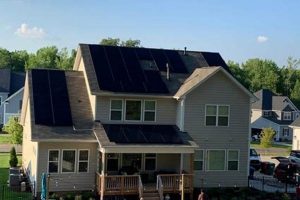
Electricity generation within the North Carolina metropolitan area, utilizing photovoltaic technology, is a growing sector. This localized power production contributes to the energy landscape of the region, offering an alternative to traditional sources.
Adoption of these systems yields multiple advantages, including reduced reliance on fossil fuels, potential cost savings for consumers through net metering programs, and a decrease in the overall carbon footprint of the community. Historically, government incentives and increasing environmental awareness have fueled its expansion.
The subsequent sections will delve into specific aspects such as installation processes, financial considerations, environmental impacts, and relevant policy frameworks that govern this energy production method within the region.
Tips Regarding Photovoltaic Systems in the Metropolitan Area
The following points provide guidance for individuals considering photovoltaic technology adoption in the specified geographic region, focusing on maximizing efficiency and long-term value.
Tip 1: Evaluate Energy Needs Thoroughly: Conduct a comprehensive assessment of current and projected electricity consumption. This ensures the installed system capacity aligns with actual demand, avoiding over- or under-sizing.
Tip 2: Assess Site Suitability Critically: Analyze shading patterns, roof orientation, and structural integrity. Optimal solar irradiance exposure is crucial for maximum energy generation, necessitating unobstructed sunlight throughout the day.
Tip 3: Research Installer Credentials Diligently: Verify installer certifications, licenses, and insurance coverage. Prioritize companies with established experience and positive customer reviews within the local market.
Tip 4: Compare Equipment Warranties Extensively: Examine the warranty terms for panels, inverters, and installation workmanship. Longer warranties offer enhanced protection against potential equipment failures or performance degradation.
Tip 5: Understand Net Metering Agreements Completely: Familiarize yourself with the local utility’s net metering policies and procedures. Proper understanding of these agreements ensures accurate credit for excess energy sent back to the grid.
Tip 6: Explore Available Incentives Proactively: Investigate federal, state, and local tax credits, rebates, and grants. These incentives can significantly reduce the initial investment cost of a photovoltaic system.
Tip 7: Monitor System Performance Regularly: Implement a system for tracking energy production and consumption. Regular monitoring helps identify potential issues early, ensuring optimal performance over time.
Adhering to these guidelines will enhance the likelihood of a successful and financially advantageous photovoltaic installation. Proper planning and execution are essential for realizing the full benefits of this energy technology.
The article will now proceed to discuss the financial implications of adopting photovoltaic systems in more detail.
1. Local irradiance assessment

Local irradiance assessment constitutes a fundamental component in the effective deployment of photovoltaic energy systems. The intensity of solar radiation incident upon a specific geographical area directly influences the energy output of the installed system. Insufficient irradiance levels compromise energy generation capabilities, reducing the return on investment for consumers adopting this technology. For instance, areas characterized by frequent cloud cover or significant shading from surrounding structures will experience lower irradiance, necessitating larger, more expensive systems to achieve comparable energy production to sites with unobstructed sunlight.
Accurate irradiance data facilitates informed decision-making during the system design phase. Solar installers utilize sophisticated tools and databases to model potential energy yields based on historical weather patterns and site-specific conditions. These models factor in variables such as latitude, longitude, average cloud cover, and the angle of incidence of sunlight on the photovoltaic panels. Without a comprehensive irradiance assessment, system sizing becomes speculative, potentially leading to suboptimal performance and financial losses for the end-user.
In summary, local irradiance assessment is not merely a preliminary step but an indispensable prerequisite for successful photovoltaic system implementation. Its influence on energy output, system design, and financial viability underscores its importance within the broader context of solar energy adoption. Ignoring this aspect invites significant risk and undermines the potential benefits associated with this renewable energy source.
2. Incentive program availability

The presence and structure of financial incentives significantly influence the adoption rate and economic feasibility of photovoltaic energy systems within the Charlotte metropolitan area. These programs aim to reduce the initial capital investment required for solar installations, thereby making the technology more accessible to a wider range of consumers and businesses.
- Federal Tax Credits
The federal Investment Tax Credit (ITC) offers a substantial reduction in the taxable income for individuals and businesses investing in solar energy. This credit, typically a percentage of the total system cost, directly lowers the upfront expense, improving the return on investment and shortening the payback period. For instance, a system costing $20,000 may qualify for a $6,000 federal tax credit, substantially reducing the net investment.
- State Rebates and Grants
In addition to federal incentives, North Carolina may offer state-level rebates or grants to further incentivize solar adoption. These programs provide direct cash rebates or grants based on system size or energy output, supplementing federal tax credits and enhancing the financial attractiveness of photovoltaic installations. The specifics of these programs can vary significantly, influencing the overall cost-effectiveness of a system. For example, a state rebate of $0.50 per watt could reduce the system cost by several thousand dollars.
- Local Utility Programs
Local utility companies often implement their own incentive programs to encourage renewable energy adoption within their service territories. These programs may take the form of upfront rebates, performance-based incentives tied to energy production, or net metering policies that offer credits for excess energy sent back to the grid. These initiatives directly impact the financial viability of solar installations by reducing upfront costs and providing ongoing revenue streams. An example is a utility offering a $1,000 rebate for systems exceeding a certain kilowatt capacity.
- Property Tax Exemptions
Some jurisdictions offer property tax exemptions for the added value contributed by solar panel installations. By exempting the incremental property value resulting from the solar system, these exemptions reduce the ongoing cost of ownership and improve the long-term financial benefits of investing in photovoltaic technology. This ensures that homeowners and businesses are not penalized with higher property taxes for investing in renewable energy assets.
The combined effect of federal, state, and local incentives can substantially reduce the net cost of photovoltaic systems, making them a more attractive investment for both residential and commercial consumers. Understanding and leveraging these programs is critical for maximizing the financial benefits associated with solar energy adoption in the Charlotte metropolitan area. Changes to these programs can significantly impact the solar market and the feasibility of individual projects.
3. Qualified installer selection

Selection of a qualified installer directly impacts the performance and longevity of photovoltaic systems within the Charlotte solar market. Improper installation negates potential energy savings and introduces safety risks. A competent installer possesses the requisite certifications, licensing, and experience specific to the regions building codes and electrical standards. The cause-and-effect relationship is straightforward: skilled installation practices lead to efficient energy generation and a lower risk of system failures, while unskilled work compromises system integrity and financial returns. For example, improperly sealed roof penetrations during panel mounting can lead to water damage, necessitating costly repairs. Similarly, incorrect wiring can cause electrical hazards and reduce system efficiency.
The Charlotte area presents unique installation challenges, including varying roof types and architectural styles. A qualified installer understands these nuances and adapts installation techniques accordingly. Further, familiarity with local permitting processes and net metering regulations streamlines project completion. An example of practical significance is demonstrated when an installer ensures proper grounding techniques, mitigating the risk of electrical surges caused by lightning strikes common to the region. Another case is the appropriate selection of racking systems that withstand specific wind loads mandated by local building codes. Without such expertise, the photovoltaic investment faces increased risk of premature degradation or failure.
In summary, the choice of installer represents a critical decision point for those investing in photovoltaic technology in the Charlotte area. Competent installation not only ensures optimal system performance and safety but also protects the long-term financial viability of the investment. Neglecting this aspect undermines the potential benefits of solar energy adoption and exposes consumers to unnecessary risks and expenses.
4. Net metering agreements

Within the Charlotte solar landscape, net metering agreements represent a crucial policy mechanism that significantly impacts the financial viability of distributed solar energy systems. These agreements establish the terms under which utility companies compensate solar customers for excess electricity generated and fed back into the grid.
- Credit Calculation Methodology
Net metering agreements stipulate how excess solar energy is valued for credit purposes. This can range from full retail rate compensation, where solar customers receive the same rate for excess energy as they pay for electricity consumed from the grid, to avoided cost rates, which compensate at a lower wholesale rate reflecting the utility’s cost of generation. The methodology employed directly affects the financial return on investment for solar systems within the Charlotte area. For example, full retail rate net metering enhances the profitability of solar installations by maximizing the value of exported electricity, whereas avoided cost rates may reduce economic incentives.
- Interconnection Standards and Requirements
Interconnection standards define the technical specifications and safety requirements that solar systems must meet to connect to the grid. These standards, governed by utility companies and regulatory bodies, ensure grid stability and prevent potential hazards. Compliance with interconnection standards may require specific equipment, inspections, and fees, which can impact the overall cost and complexity of solar projects in Charlotte. Strict standards may increase upfront expenses but guarantee safe and reliable grid operation.
- Agreement Length and Termination Clauses
The duration of net metering agreements and the conditions under which they can be terminated influence the long-term certainty of solar investments. Lengthier agreements provide greater financial security, as solar customers can rely on consistent compensation rates for a defined period. Termination clauses outlining permissible reasons for agreement cancellation protect solar customers from abrupt policy changes. For instance, grandfathering provisions prevent retroactive changes to net metering rates for existing solar installations, fostering investor confidence.
- Excess Generation Handling
Net metering agreements address how excess solar generation is handled at the end of a billing cycle or contract term. Options may include rolling over credits to the next billing cycle, providing a payment for accumulated credits, or forfeiting excess generation. The handling of excess generation impacts the financial incentives for oversizing solar systems. For example, allowing credit rollovers encourages solar customers to generate more energy than they consume, while forfeiture provisions disincentivize system oversizing.
The interplay between these facets of net metering agreements profoundly affects the economic feasibility and attractiveness of solar investments in the Charlotte area. Understanding the specific terms and conditions outlined in these agreements is crucial for both solar installers and consumers to make informed decisions and maximize the benefits of distributed solar energy.
5. System performance monitoring

Within the context of photovoltaic deployments in the Charlotte region, system performance monitoring emerges as a critical factor in ensuring long-term operational efficiency and maximizing return on investment. Real-time tracking of energy production, system health, and potential anomalies provides valuable insights into overall performance. A direct correlation exists between diligent monitoring practices and the ability to proactively address system degradation or component failures. Without consistent oversight, subtle performance declines may go unnoticed, leading to significant cumulative energy losses over time. Consider a residential system where a single string of panels experiences shading due to tree growth; without monitoring, the resulting reduction in energy production could persist for months, diminishing the system’s overall yield by a substantial margin. The practical significance lies in mitigating financial losses and ensuring that photovoltaic installations in Charlotte achieve their projected performance benchmarks.
Effective system monitoring facilitates informed decision-making regarding maintenance and repairs. Data-driven diagnostics enable installers and system owners to pinpoint the source of performance issues, such as inverter malfunctions, panel defects, or wiring problems. In a commercial setting, performance monitoring allows for the comparative analysis of multiple photovoltaic arrays, identifying underperforming sections and enabling targeted maintenance interventions. Remote monitoring capabilities are particularly valuable, allowing system owners to track performance from any location and receive alerts in the event of significant deviations from expected output. Furthermore, the data collected through system monitoring can be used to optimize system parameters, such as panel tilt angles or inverter settings, to maximize energy production throughout the year. For instance, seasonal adjustments can be implemented to account for variations in solar irradiance, leading to a noticeable increase in energy capture.
In conclusion, system performance monitoring represents an indispensable component of photovoltaic installations in Charlotte. It transforms raw energy production data into actionable intelligence, empowering system owners to proactively manage their assets and ensure optimal performance. While the initial investment in monitoring equipment and services may represent an additional cost, the long-term benefits including increased energy production, reduced maintenance expenses, and extended system lifespan far outweigh the initial expenditure. Addressing the challenge of data interpretation through user-friendly monitoring platforms and expert analytical services is crucial for maximizing the value derived from system performance monitoring and fostering the continued adoption of solar energy in the region.
6. Financial return calculations

The financial return calculations associated with photovoltaic systems in the Charlotte region are fundamental to assessing the economic viability of solar energy investments. These calculations provide a quantitative framework for evaluating the projected benefits against the upfront and ongoing costs.
- Net Present Value (NPV) Analysis
NPV analysis discounts future cash flows back to their present value, accounting for the time value of money. In the context of Charlotte solar, it compares the present value of expected energy savings and incentive payments to the initial system cost. A positive NPV indicates that the investment is expected to generate more value than it costs, rendering it financially attractive. For example, a system with a high initial cost but substantial long-term savings and incentive benefits may still yield a positive NPV, justifying the investment. This metric is crucial for determining the overall profitability of a solar installation.
- Internal Rate of Return (IRR) Assessment
The IRR represents the discount rate at which the NPV of an investment equals zero. For Charlotte solar projects, the IRR signifies the rate of return generated by the system over its lifespan. A higher IRR suggests a more profitable investment, indicating that the system generates a greater return relative to its cost. For instance, an IRR of 15% implies that the investment is expected to yield a 15% annual return. This metric assists in comparing the profitability of solar projects to alternative investment options.
- Simple Payback Period Determination
The simple payback period estimates the time required for the cumulative energy savings and incentive payments to equal the initial system cost. For Charlotte solar installations, it provides a straightforward measure of how quickly the investment will “pay for itself.” A shorter payback period indicates a more rapid return on investment, making the system more attractive. However, simple payback does not account for the time value of money or potential system degradation over time. A system with a five-year payback period would recover its initial cost within five years based on annual savings and credits.
- Levelized Cost of Energy (LCOE) Calculation
LCOE calculates the per-kilowatt-hour cost of energy generated by the solar system over its lifetime. For Charlotte solar, it considers all costs associated with the system, including installation, maintenance, and financing, and divides them by the total energy produced over the system’s expected lifespan. A lower LCOE indicates that the solar energy is more cost-competitive with traditional sources of electricity. For example, if the LCOE for a solar system is $0.08/kWh, it means that each kilowatt-hour of energy generated by the system costs $0.08 to produce. This metric enables comparison of the cost-effectiveness of solar energy with other energy sources.
These financial return calculations are essential for evaluating the economic benefits of embracing solar technology in Charlotte. By considering these metrics, investors and consumers can assess the potential savings, profitability, and long-term value of their solar energy investments, guiding decision-making and accelerating the adoption of sustainable energy solutions.
Frequently Asked Questions
This section addresses common inquiries regarding photovoltaic systems within the Charlotte metropolitan area, providing clarity on key aspects of solar energy adoption.
Question 1: What is the typical energy output of a residential solar system in Charlotte?
Energy output varies based on system size, panel orientation, shading conditions, and weather patterns. A typical 5kW system, optimally positioned, can generate approximately 6,000-7,000 kWh annually.
Question 2: How long does it take to install a photovoltaic system?
Installation time depends on system complexity and permitting requirements. Generally, a residential installation takes 1-3 days, excluding the time required for permitting and interconnection.
Question 3: What maintenance is required for solar panels?
Minimal maintenance is typically required. Periodic visual inspections for debris accumulation or damage are recommended. Occasional cleaning may be necessary in dusty or polluted environments.
Question 4: What happens during a power outage with a grid-tied solar system?
Grid-tied systems typically shut down during a power outage to prevent backfeeding electricity onto the grid, which could endanger utility workers. Battery backup systems can provide power during outages.
Question 5: What is the lifespan of solar panels?
Most solar panels have a performance warranty of 25-30 years, guaranteeing a certain percentage of original power output. Panel degradation occurs gradually over time.
Question 6: How does net metering work with the local utility?
Net metering allows solar customers to receive credit for excess energy fed back into the grid. The utility typically credits the customer’s account at the retail rate for the excess electricity.
Understanding these fundamentals helps clarify the practical considerations associated with investing in photovoltaic technology.
The following section will explore case studies of successful photovoltaic implementations in the Charlotte region.
Charlotte Solar
This discourse has traversed the critical dimensions of photovoltaic energy adoption within the Charlotte region, encompassing system performance, financial incentives, installer qualifications, net metering arrangements, monitoring protocols, and economic return assessments. The synthesis of these elements underscores the multi-faceted nature of successful solar implementations.
As the demand for sustainable energy solutions intensifies, a comprehensive understanding of these factors remains paramount. Informed decision-making, coupled with proactive engagement with policy frameworks, will be crucial in maximizing the benefits of this energy technology and fostering a more resilient and environmentally conscious energy landscape within the area. The ongoing evolution of photovoltaic technology and regulatory environments warrants continued vigilance and adaptation to optimize investment outcomes and promote the widespread adoption of this renewable energy source.

![Understanding What is Solar Renewable Energy Credit? [Guide] | Renewable Energy Solutions for a Sustainable Future | Clean & Green Power](https://pplrenewableenergy.com/wp-content/uploads/2026/04/th-19-300x200.jpg "Understanding What is Solar Renewable Energy Credit? [Guide] Renewable Energy Solutions for a Sustainable Future | Clean & Green Power")