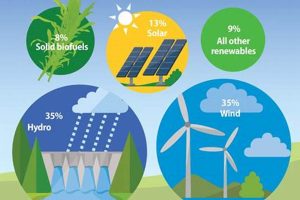
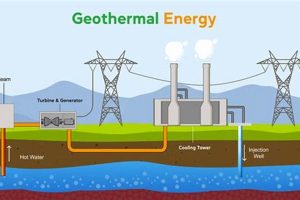
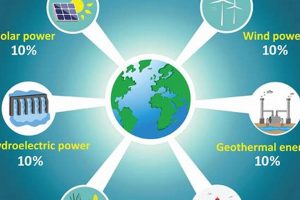
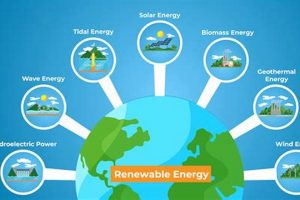
The categorization of a fuel as either renewable or non-renewable hinges on its rate of replenishment. Renewable resources are those that can be replenished at a rate comparable to their consumption, typically through natural processes within a human lifespan. Sunlight, wind, and biomass are examples of energy sources that fall into this category due to their continuous availability or relatively rapid regeneration.
The formation of some combustible geological deposits occurs over geological timescales, spanning millions of years. They are derived from the decomposition of organic matter under specific conditions of pressure and temperature deep within the Earth’s crust. Due to the exceedingly slow rate at which these deposits accumulate, the current consumption significantly outpaces their natural replenishment. This imbalance leads to their classification as finite resources.
Considering these differing formation rates and availability, a critical examination of specific fuel origins is necessary to determine its appropriate classification. This classification has significant implications for energy policy, environmental sustainability, and resource management strategies.
Accurate categorization of energy sources is essential for informed decision-making regarding energy policy, investment, and environmental stewardship. Understanding the origin and renewability characteristics of different fuel sources allows for the development of sustainable energy strategies.
Tip 1: Distinguish Between Formation Time Scales: Pay close attention to the time required for a resource to form. Resources that require millions of years to develop are generally considered non-renewable, regardless of their organic origin.
Tip 2: Assess Replenishment Rate vs. Consumption Rate: Evaluate whether the rate at which a resource is replenished naturally keeps pace with the rate at which it is being consumed. If consumption significantly exceeds replenishment, the resource is likely non-renewable.
Tip 3: Consider the Role of Technology: While technology can enhance the extraction or utilization of a resource, it does not inherently change its renewability. Focus on the fundamental source of the energy and its natural regeneration cycle.
Tip 4: Analyze Life Cycle Impacts: Understand that even if a resource has some renewability aspects, the entire life cycle (extraction, processing, combustion) needs to be considered to assess its overall environmental impact.
Tip 5: Advocate for Transparency in Labeling: Support clear and accurate labeling of energy sources to promote informed consumer choices and responsible energy consumption. Misleading labels can undermine efforts to transition to a sustainable energy future.
Tip 6: Support Research and Development: Promote investment in research and development of truly renewable energy sources and technologies to reduce reliance on finite resources.
By understanding the principles of renewability and critically evaluating the characteristics of various energy sources, stakeholders can contribute to the development of a sustainable and secure energy future.
The accurate classification of energy sources is only the first step towards a comprehensive energy strategy. Further analysis is needed to address the economic, social, and environmental implications of various energy choices.
1. Fossil Fuel

The term “fossil fuel” is central to understanding the debate around whether certain geological deposits are renewable. Fossil fuels, by definition, originate from the fossilized remains of organic matter subjected to immense pressure and heat over millions of years. This origin directly impacts their classification in terms of renewability.
- Origin from Ancient Biomass
Fossil fuels are derived from the remains of prehistoric plants and animals. The decomposition of this organic matter over geological timescales results in the formation of deposits rich in hydrocarbons. This process requires specific environmental conditions and vast amounts of time. Since these conditions are not readily replicable within a human lifespan, fossil fuels are considered non-renewable.
- Extremely Slow Formation Rate
The transformation of organic matter into usable energy resources such as oil, coal, and the specified geological deposit requires millions of years. This exceedingly slow rate of formation stands in stark contrast to the rate at which these resources are currently consumed. The disparity between formation and consumption is a key factor in classifying fossil fuels as non-renewable.
- Finite Resource Availability
Due to the slow formation rate, the quantity of fossil fuels available is inherently limited. While technological advancements may allow for the discovery and extraction of new reserves, the total amount of fossil fuel resources remains finite. This finite nature necessitates careful management and consideration of alternative, renewable energy sources.
- Carbon Cycle Disruption
The combustion of fossil fuels releases carbon dioxide into the atmosphere, disrupting the natural carbon cycle. This release of stored carbon contributes to climate change and other environmental problems. In contrast, renewable energy sources, such as solar and wind power, typically have a much lower carbon footprint, making them more sustainable alternatives.
The facets of fossil fuel origin, formation rate, availability, and environmental impact underscore why fossil fuels are not considered renewable. The immense timescales involved in their formation and the finite nature of their reserves necessitate a transition towards renewable energy sources to ensure a sustainable energy future.
2. Finite Resource

The classification of certain geological deposit as a finite resource directly informs its categorization concerning renewability. A finite resource is defined by its limited quantity and inability to be replenished at a rate comparable to its consumption. The formation of this geological deposit requires millions of years under specific geological conditions. Current extraction and utilization rates far exceed the natural regeneration processes. This imbalance is a primary reason why this geological deposit is not considered renewable.
The implications of its finite nature are significant. Reliance on a finite resource necessitates strategic resource management and exploration of alternative energy sources. Continued depletion without adequate alternatives can lead to resource scarcity, economic instability, and geopolitical challenges. Real-world examples, such as fluctuations in energy prices due to supply disruptions, underscore the practical significance of understanding the finite nature of this resource. Furthermore, recognizing it as finite drives innovation in renewable energy technologies and promotes policies that encourage energy efficiency and conservation.
In summary, the characteristic of being a finite resource is a key determinant in classifying it as non-renewable. This understanding is essential for responsible energy planning and the transition towards sustainable energy solutions. The challenge lies in balancing current energy needs with the long-term imperative of conserving finite resources and mitigating environmental impact.
3. Slow Formation

The exceedingly slow geological processes involved in the formation of some geological deposits are a central factor in determining its classification as a non-renewable energy source. The timeframe for its creation extends over millions of years, starkly contrasting with the rate at which it is extracted and consumed.
- Geological Time Scales
The formation of some geological deposits necessitates specific conditions of pressure, temperature, and organic matter accumulation over geological epochs. This protracted process implies that the rate of natural replenishment is negligible within a human lifespan. For instance, the conversion of organic sediments into energy-rich geological layers occurs at an infinitesimally slow pace, rendering it impractical to consider this fuel as a renewable resource.
- Contrast with Consumption Rate
The rate at which humans extract and consume energy from these geological deposits is exponentially faster than the rate at which it is naturally formed. This disparity between supply and demand creates a fundamental imbalance. The resource is depleted at a pace far exceeding its ability to regenerate, leading to its categorization as a finite and non-renewable resource.
- Implications for Sustainability
The slow formation process has profound implications for sustainability. Reliance on a resource with such a slow regeneration rate necessitates careful resource management and the development of alternative energy sources. Ignoring this inherent limitation can lead to resource depletion, environmental degradation, and economic instability.
- Comparison with Renewable Resources
Unlike resources like solar, wind, and biomass, which are replenished on human timescales, its geological deposit formation is fundamentally different. Renewable resources are continuously available or can be regenerated within a relatively short period, making them sustainable alternatives to slow-forming resources. This distinction highlights the importance of transitioning towards renewable energy sources to ensure long-term energy security and environmental stewardship.
The slow formation underscores the importance of responsible energy consumption and the urgent need to develop and implement sustainable energy solutions. Recognizing the temporal limitations of this geological deposit formation is crucial for informed decision-making regarding energy policy and environmental protection.
4. Combustion Emissions

The environmental impact associated with the combustion of certain geological deposits plays a significant role in the discussion of its classification as a renewable energy source. The release of byproducts during combustion, notably greenhouse gases and other pollutants, influences considerations of sustainability and long-term viability.
- Greenhouse Gas Emissions
Combustion releases carbon dioxide (CO2), a primary greenhouse gas, into the atmosphere. The accumulation of CO2 contributes to global warming and climate change. While some geological deposits may produce less CO2 per unit of energy compared to other fossil fuels, the overall volume of emissions remains substantial, particularly as global energy demand increases. This significant carbon footprint is inconsistent with the criteria for renewable energy sources, which ideally have minimal or zero net greenhouse gas emissions.
- Air Pollutant Release
In addition to CO2, combustion can release other air pollutants, including nitrogen oxides (NOx), sulfur dioxide (SO2), and particulate matter (PM). These pollutants contribute to smog, acid rain, and respiratory problems. The presence of these pollutants undermines the notion of a clean and sustainable energy source, contrasting sharply with the characteristics of renewable options like solar and wind, which produce negligible air pollutants during operation.
- Life Cycle Emissions Analysis
A comprehensive evaluation of its impact must consider the entire life cycle, including extraction, processing, transportation, and combustion. Each stage contributes to overall emissions. Methane leakage during extraction and transportation, for example, is a potent greenhouse gas and can offset some of the purported benefits of lower CO2 emissions during combustion. A life cycle assessment provides a more accurate picture of the environmental cost, further reinforcing its classification as a non-renewable energy source with significant environmental consequences.
- Carbon Capture and Storage (CCS)
While technologies like Carbon Capture and Storage (CCS) aim to mitigate emissions from combustion, they are not yet widely deployed or economically viable. CCS technologies also require energy to operate, potentially reducing the overall efficiency of power generation. Even with CCS, the fundamental issue of its depletion remains, differentiating it from truly renewable sources that do not rely on finite reserves.
The multifaceted impact of its combustion emissions, encompassing greenhouse gases, air pollutants, and life cycle considerations, directly contradicts the criteria for a renewable energy source. While technological advancements may offer partial mitigation strategies, the underlying environmental burden associated with combustion sustains its classification as a non-renewable fuel with significant environmental consequences.
5. Depletable Supply
The characteristic of a depletable supply is a defining element in the assessment of whether a specific geological deposit constitutes a renewable energy source. This characteristic signifies that the resource is finite and subject to depletion over time due to extraction exceeding the rate of natural replenishment. This aspect directly impacts its classification.
- Finite Reserves
Its presence in the Earth’s crust is constrained to specific geological formations. The total volume available is a finite quantity. Exploration efforts may discover new reserves, but the overall stock remains limited. The implication of this finite nature is that continued extraction will inevitably lead to a reduction in available supply, thereby affecting long-term energy security. This contrasts with renewable sources, which are continuously replenished.
- Extraction Rates vs. Formation Rates
The rate at which it is extracted for energy production far surpasses the rate at which natural geological processes generate new deposits. The disparity results in a net decrease in the available resource. As demand for energy increases, the rate of extraction intensifies, further exacerbating the depletion. This unsustainable extraction pattern highlights a key difference from renewable resources, where replenishment occurs at a rate comparable to or exceeding consumption.
- Economic Implications of Depletion
As reserves dwindle, the cost of extraction tends to increase. The economic principle of supply and demand dictates that scarcity drives up prices. Furthermore, the need to access more remote or challenging deposits necessitates advanced and often more expensive technologies. These economic consequences underscore the need for diversification of energy sources and a transition towards renewable alternatives to mitigate the risks associated with relying on a depleting resource.
- Geopolitical Considerations
Concentrations of remaining reserves in specific geographic locations can create geopolitical dependencies. Nations with limited domestic resources may become reliant on imports from countries with abundant supplies. These dependencies can create vulnerabilities to supply disruptions, price volatility, and political leverage. Transitioning to renewable energy sources can reduce these dependencies and enhance energy independence.
The finite and depletable nature of its supply is a fundamental argument against classifying it as a renewable energy source. The economic, environmental, and geopolitical implications of depletion necessitate a shift towards sustainable energy practices and the development of renewable alternatives to ensure long-term energy security and environmental stewardship.
6. Not Renewable
The categorization of certain geological deposits as “Not Renewable” directly negates its classification as a renewable energy source. Renewability fundamentally depends on the ability of a resource to replenish itself at a rate comparable to its consumption. Because geological deposit formation requires millions of years, a timeframe vastly exceeding human timescales, its extraction and use lead to depletion without significant natural replenishment. The “Not Renewable” characteristic is therefore not merely an attribute, but a definitive statement about its sustainable viability as an energy source.
The implications of being “Not Renewable” are far-reaching. Reliance on such resources necessitates a comprehensive understanding of finite resource management. Real-world examples of energy crises, geopolitical tensions stemming from resource control, and environmental degradation due to extraction and combustion demonstrate the practical significance of recognizing this limitation. For instance, fluctuating energy prices due to supply constraints directly affect economies and necessitate strategic planning for alternative energy solutions. Furthermore, the environmental costs associated with extracting and utilizing non-renewable resources are substantial, contributing to climate change and pollution.
Consequently, the designation “Not Renewable” serves as a critical driver for the development and adoption of sustainable energy policies and technologies. It underscores the urgency to transition towards renewable energy sources capable of meeting long-term energy demands without depleting finite resources or causing irreversible environmental damage. This necessitates innovation in areas such as solar, wind, geothermal, and other renewable technologies, as well as the implementation of energy efficiency measures to reduce overall consumption. The challenge lies in effectively balancing present energy needs with the imperative of preserving resources for future generations, guided by the understanding that this geological deposit is categorically “Not Renewable.”
7. Geologic Process
The formation of some geological deposits is intricately linked to geological processes spanning immense timescales, directly influencing its classification as a renewable or non-renewable energy source. Understanding these processes is crucial for assessing the sustainability of its utilization.
- Organic Matter Accumulation
The initial stage involves the accumulation of organic matter, typically from the remains of marine organisms or terrestrial plants, in sediment-rich environments. This accumulation requires specific conditions such as anoxic (oxygen-depleted) environments to prevent decomposition. For example, the formation of shale gas deposits requires the preservation of vast quantities of organic matter within fine-grained sediments. The slow rate at which such accumulation occurs contributes to its non-renewable designation.
- Burial and Compaction
Following accumulation, the organic-rich sediments are buried under increasing layers of sediment. The pressure from overlying layers compacts the sediments, reducing pore space and expelling water. This process of compaction gradually transforms the sediments into sedimentary rock. The gradual transformation of peat into lignite, then bituminous coal, illustrates this compaction process. The time required for this transformation reinforces the argument against its renewability.
- Thermal Maturation
As burial depth increases, the organic matter is subjected to elevated temperatures. This thermal maturation causes the organic molecules to break down into simpler hydrocarbon compounds. The specific temperature range and duration of heating are critical factors in determining the composition of the resulting product. For instance, the formation of oil and its geological deposit requires a specific “oil window” temperature range. The lengthy duration of this thermal maturation process, extending over millions of years, is a key factor in classifying it as non-renewable.
- Migration and Trapping
Once formed, hydrocarbons migrate through porous and permeable rocks until they encounter an impermeable barrier or trap. These traps concentrate the hydrocarbons into reservoirs that can be economically extracted. Examples of these traps include anticlines, faults, and stratigraphic traps. The efficiency of migration and the integrity of the trap are crucial for the formation of commercially viable deposits. The very long timescales of formation and the specific geological conditions required further support its non-renewable classification.
These geological processes, spanning millions of years, contrast sharply with the rate at which society consumes this resource. The inherently slow formation rate, coupled with the depletable nature of its reserves, is the principal reason why the geological deposit is classified as a non-renewable energy source. Understanding these processes is essential for developing sustainable energy policies and transitioning to renewable alternatives.
Frequently Asked Questions
This section addresses common queries regarding the categorization of some geological deposits concerning its renewability. The information provided aims to clarify misconceptions and offer a fact-based understanding.
Question 1: What fundamentally distinguishes renewable from non-renewable energy sources?
The primary distinction lies in the rate of replenishment. Renewable sources, such as solar and wind, replenish within a human timescale. Non-renewable sources, like this geological deposit, require millions of years to form, making their replenishment practically insignificant.
Question 2: Can technological advancements render geological deposits renewable?
No. Technology can enhance extraction efficiency or reduce emissions, but it does not alter the fundamental characteristic of slow geological formation. Technology cannot accelerate the natural processes of organic matter accumulation and transformation that take millions of years.
Question 3: Does the organic origin of geological deposits imply renewability?
The organic origin is not a determinant of renewability. While it originates from organic matter, the extremely slow rate of transformation over geological timescales makes it a finite resource. Renewability hinges on the rate of replenishment, not the origin.
Question 4: Is geological deposit a sustainable energy source?
Given its slow formation rate and depletable supply, it is not a sustainable energy source in the long term. Sustainable energy sources must be renewable and available for continuous use without depleting reserves or causing significant environmental harm.
Question 5: How do combustion emissions affect its classification?
The emissions from its combustion, particularly greenhouse gases, contribute to climate change. While some may release fewer emissions than other fossil fuels, the overall impact remains significant, disqualifying it from being considered a clean or renewable energy source.
Question 6: What are the implications of classifying geological deposits as non-renewable?
This classification necessitates a strategic shift towards renewable energy sources and energy efficiency measures. Recognizing it as non-renewable underscores the importance of responsible resource management and the development of sustainable alternatives.
Understanding the fundamental distinctions between renewable and non-renewable energy sources is crucial for informed decision-making regarding energy policy and investment.
The following section will delve into alternative energy sources and their potential to replace geological deposits in the energy mix.
Classification of a Combustible Geological Deposit
The preceding discussion has comprehensively addressed the categorization of a specific geological deposit, thoroughly examining its formation process, rate of replenishment, and environmental impact. Key factors, including its origin as a fossil fuel, its finite availability, the extended geological timescales required for its formation, and the emissions released during combustion, have been carefully considered. The assessment confirms that the characteristics do not align with the criteria defining renewable energy resources.
In conclusion, the prevailing scientific understanding and empirical evidence firmly establish that a combustible geological deposit cannot be classified as a renewable source of energy. Recognizing this classification is essential for guiding sustainable energy policies, promoting investment in renewable alternatives, and mitigating the environmental consequences associated with reliance on finite resources. The future of energy sustainability depends on a clear understanding of resource limitations and a commitment to transitioning towards genuinely renewable options.